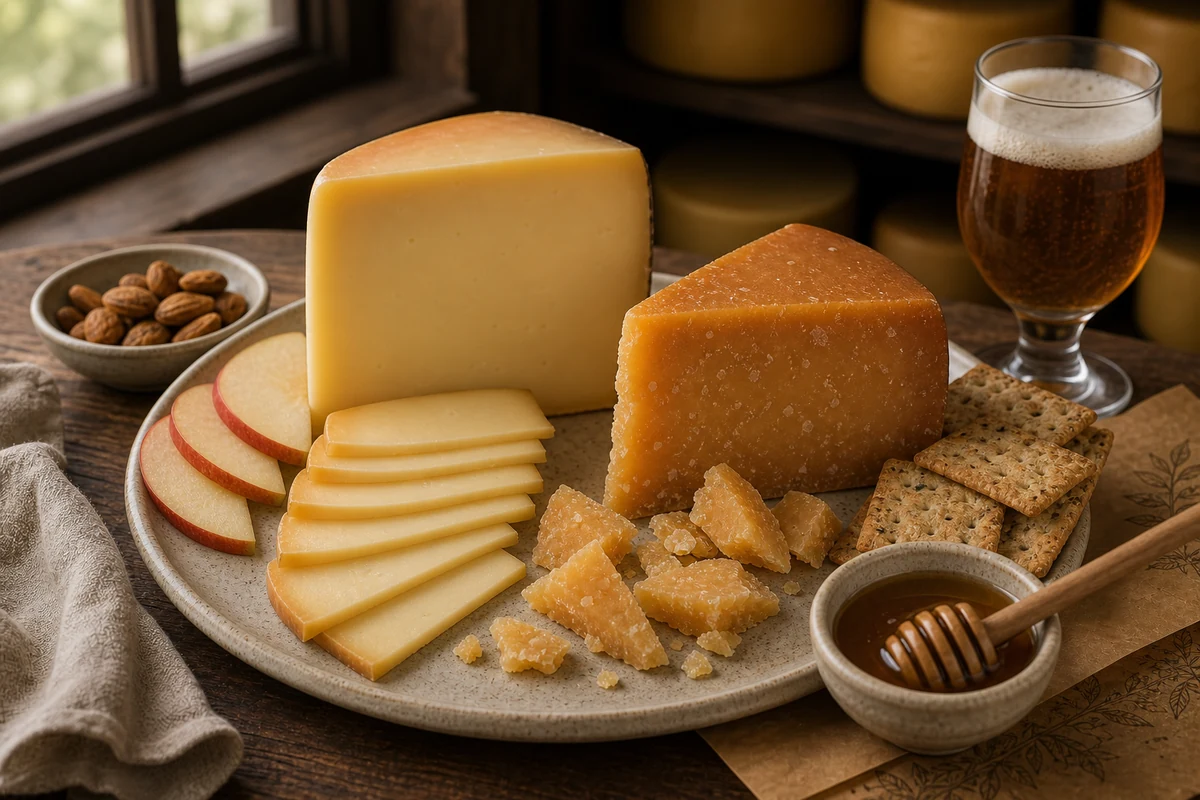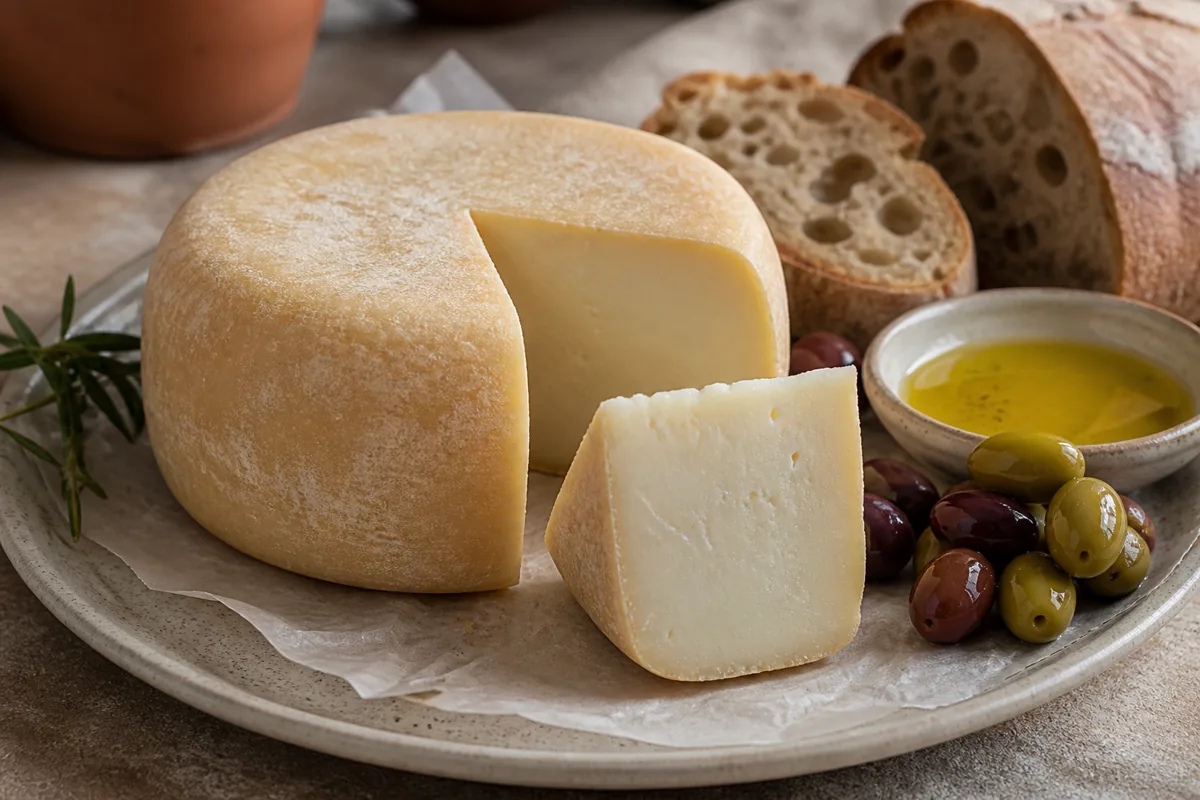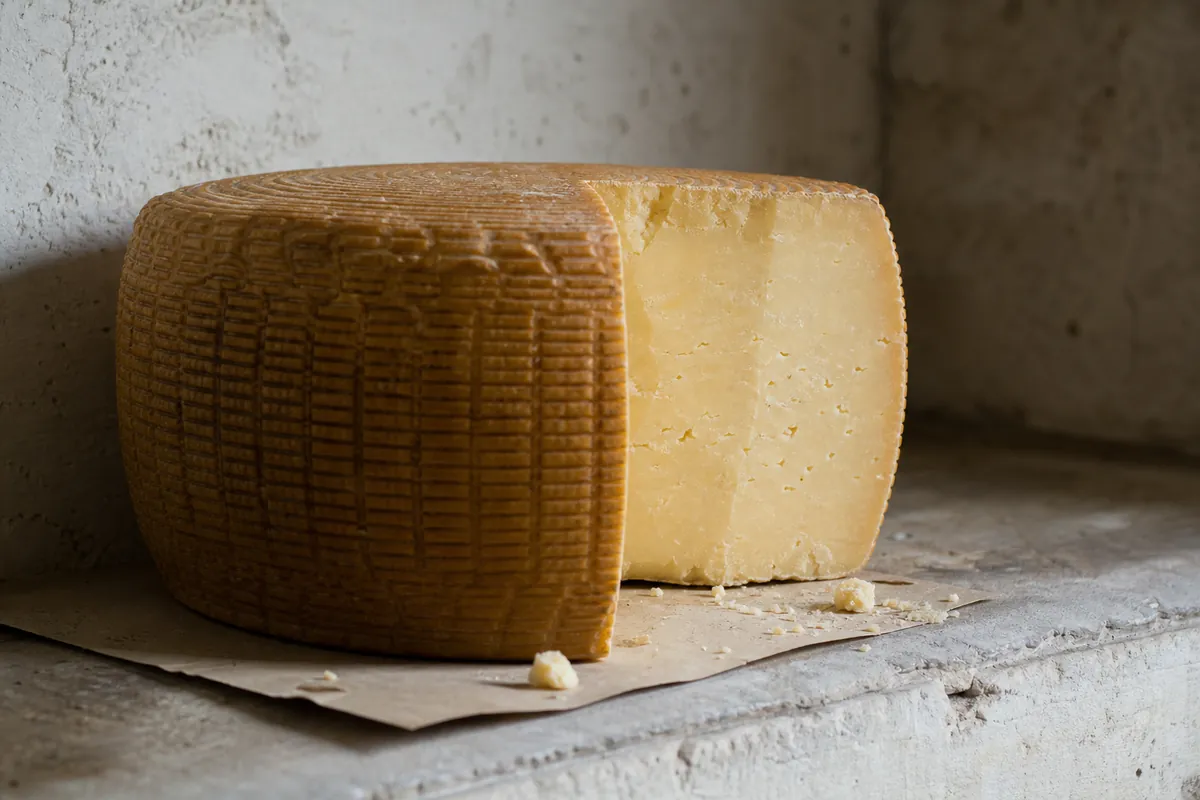
Canestrato is a family of hard southern Italian cheeses pressed in baskets rather than one recipe. Two of them have protected names, Canestrato Pugliese PDO and Canestrato di Moliterno PGI, and they differ in milk, size, age, and place of production.
A label that says only Canestrato names the basket and leaves the milk, the age, and the protected zone open.
In This Article
What Does Canestrato Mean?
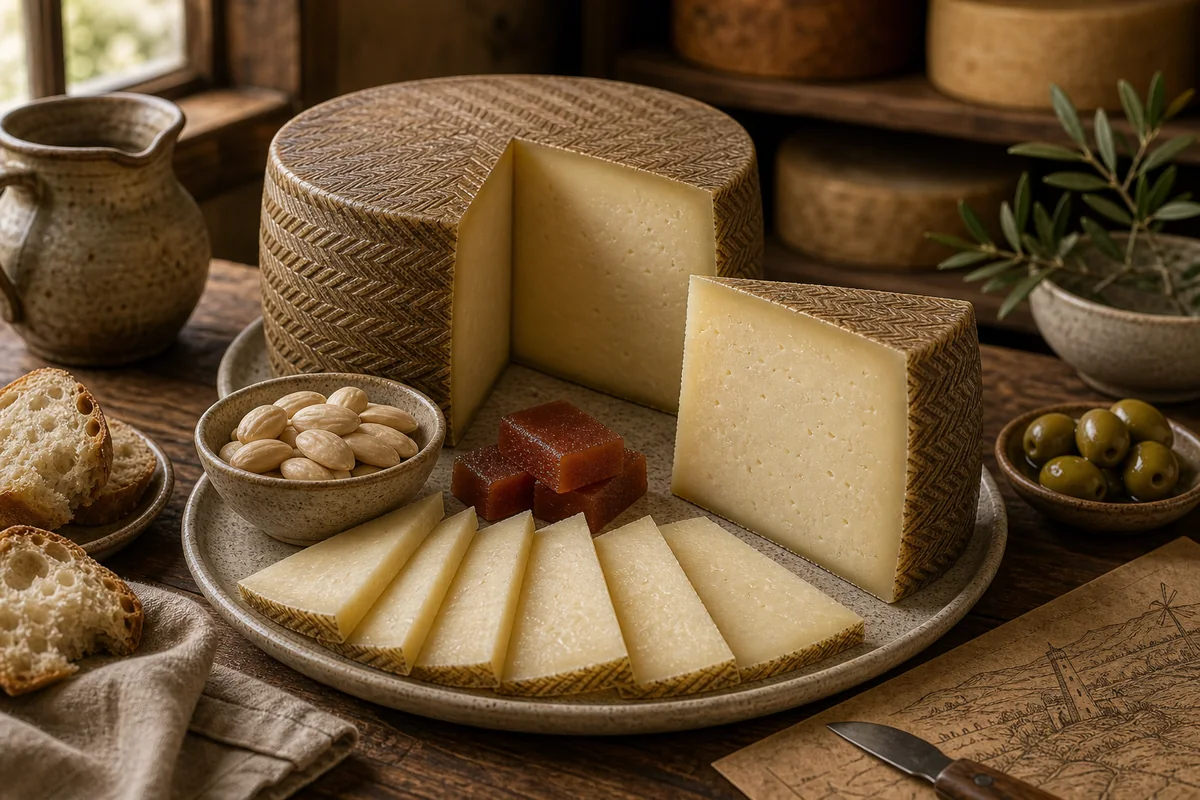
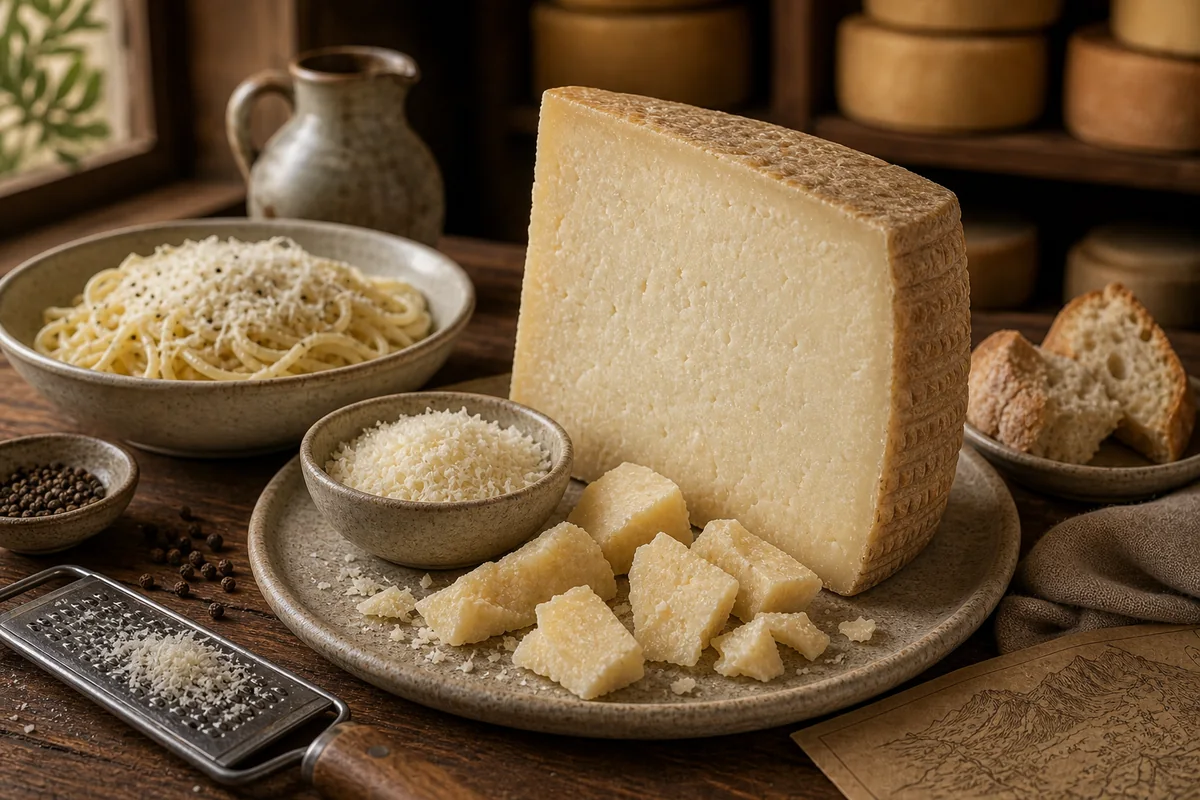
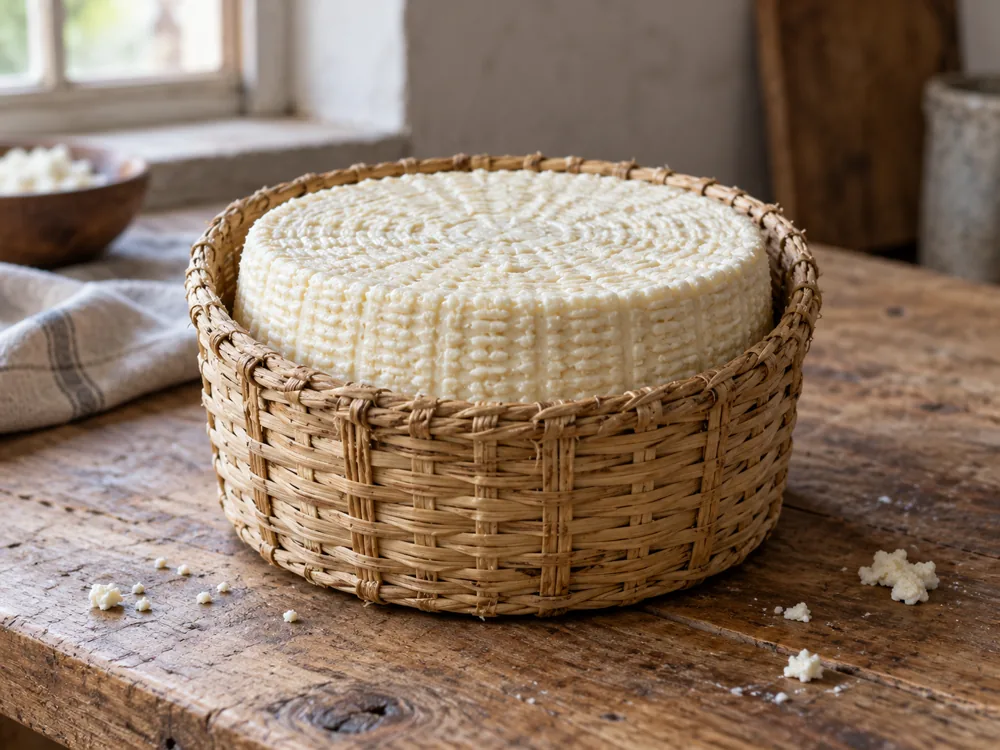
The name Canestrato comes from the woven baskets, canestri, that shape the cheese during production and leave a ridged pattern on the rind.
Alimenti News says the Pugliese cheese is traditionally put in rush baskets. The Moliterno specification allows rush or another food-safe material, provided the rind still gets the typical canestrato striping.
Alimenti News explains why rush suits the job: rush is flexible and easy to shape, and baskets woven closely enough let excess whey drain out while leaving the marks that typify the cheese.
Wikipedia lists production in Basilicata, Apulia, Sicily, and Abruzzo, which puts it in several Italian regions rather than one.
The name describes a mold, so a ridged rind alone does not tell you which recipe is inside.
Which Canestrato Are You Buying?
Canestrato Pugliese PDO is a hard cheese with an uncooked paste, made only from whole sheep's milk in Foggia province and sixteen named municipalities of Bari province.
Its specification dates to a decree of 10 September 1985, and Alimenti News and Consumatori.it both say the name became a protected designation of origin in 1996.
Canestrato di Moliterno PGI is a separate cheese from Basilicata, made from 70 to 90 percent whole sheep's milk and 10 to 30 percent whole goat's milk.
The milk comes from farms in named towns of Potenza and Matera provinces. Maturation must happen in the traditional cellars, called fondaci, of Moliterno.
| Point | Canestrato Pugliese PDO | Canestrato di Moliterno PGI |
|---|---|---|
| Milk | Whole sheep's milk only | 70 to 90 percent whole sheep's milk, 10 to 30 percent whole goat's milk |
| Milk treatment | Not stated in the specification | Raw or thermised |
| Rennet | Animal rennet only, with coagulation at 38 to 45 C | Lamb or kid rennet paste, with coagulation at 36 to 40 C |
| Wheel | Cylinder with flat faces 25 to 34 cm across, 10 to 14 cm high, 7 to 14 kg | Cylinder with flat faces 15 to 25 cm across, 10 to 15 cm high, 2 to 5.5 kg |
| Age | 2 to 10 months | At least 60 days before sale |
| Paste | Straw-yellow, compact, somewhat crumbly, slightly elastic, barely visible fat eyes | Compact with unevenly spread eyes; white or slightly straw-colored when young, straw-yellow when older |
| Fat in dry matter | At least 38 percent | At least 30 percent |
Wheel weight alone separates them, since Moliterno tops out at 5.5 kg and Pugliese starts at 7 kg.
A cut labelled only Canestrato may be either cheese or an unprotected local one. The PDO or PGI wording and the milk statement on the wrapper do the identifying.
Wikipedia names other varieties outside these two, Canestrato of Castel del Monte in Abruzzo and Canestrato trentino, and shows a peppered canestrato from the Nebrodi near Messina in Sicily. The rules in the table belong to the two protected names, so they do not describe those cheeses.
Paste is a weak cue between the protected two. The Pugliese specification describes barely visible fat eyes and the Moliterno one eyes that are unevenly spread, while Alimenti News, listing the Pugliese characteristics, writes small eyes spread evenly, so the wording on the wrapper is a surer guide than the holes.
Beyond the fat minimum in the table, Alimenti News gives Canestrato Pugliese an energy value of 350 to 375 kcal per 100 g.
How Does the Basket Shape the Rind?
The Pugliese specification says the pressings and the canestri molds give the rind its characteristic roughness. The cheese stays in its basket through the whole salting, which starts 2 to 4 days after making and is repeated in several rounds.
That working period lasts about 30 to 60 days depending on the size and weight of the wheel, so a Pugliese wheel spends one to two months against its basket before the 2 to 10 months of ageing. Alimenti News says the pressings are there to push out the excess moisture.
The specification allows salting dry or in brine, and Consumatori.it says Pugliese is salted dry, with coarse salt from the Margherita di Savoia salt pans spread around the form.
The finished rind is brown tending toward yellow, more or less wrinkled, hard and thick. It is treated with olive oil, sometimes mixed with wine vinegar.
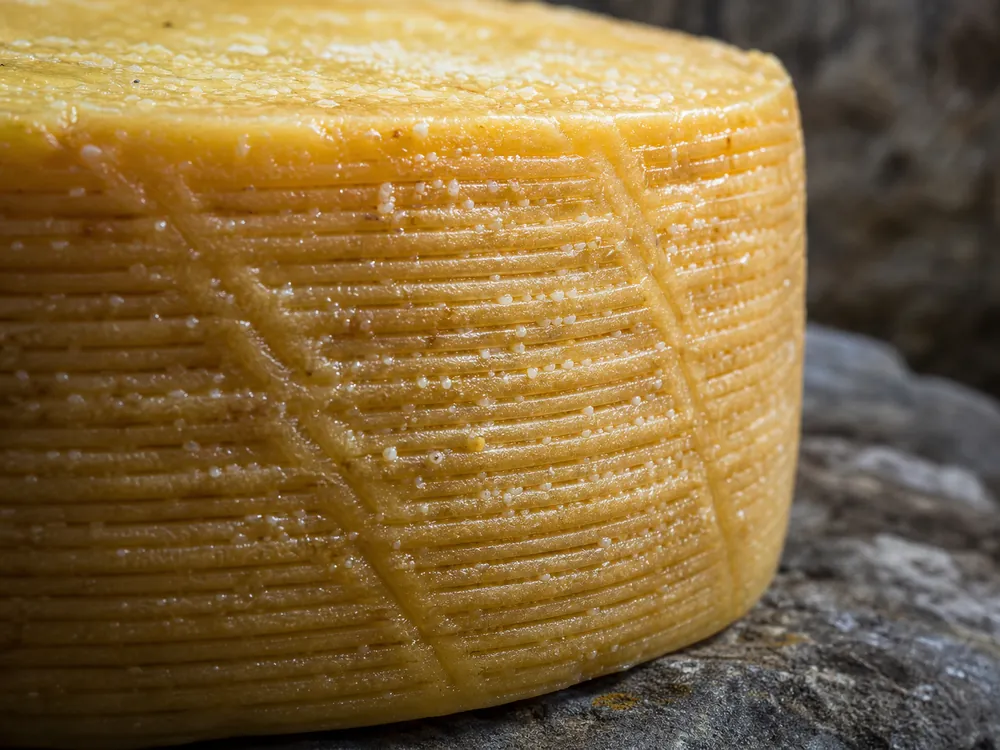
Moliterno's rind runs from yellow in the primitivo type to brown in the stagionato type. Its specification allows olive oil, olive oil emulsified with wine vinegar, or water boiled for 25 to 30 minutes with soot scraped from wood-burning chimneys, which can turn the rind slate black.
The same specification has the curd cut to rice-grain size, pressed in the baskets and worked by hand to push out whey. It lets the shaped wheels dip for up to 3 minutes in whey no hotter than 90°C to help the whey drain and the rind form.
Moliterno salting runs dry for up to 10 days or in saturated brine for 10 to 12 hours per kilogram of cheese, and drying at the producing dairy lasts 30 to 40 days from molding.
The Moliterno specification states that its rind is not edible, and the Pugliese specification is silent on the point, which leaves the question with the producer.
What Do the Specifications Require of the Flock and the Rennet?
Both protected specifications tie the milk to pasture. The Pugliese one sets green or hay forage from the natural pastures of the zone as the base feed, with hay and, exceptionally, simple concentrates added.
Moliterno's specification asks for mainly pasture, fresh forage and hay grown in its own zone, and it allows only cereal grains and legumes as supplements: oats, barley, wheat and maize, or fava, favino and chickpea. It forbids silage and feed made from animal-derived products.
The same specification names the breeds and their crosses: Gentile di Puglia, Gentile di Lucania, Leccese, Sarda and Comisana sheep, and Garganica, Grigia Lucana, Maltese, Jonica, Camosciata and Rossa Mediterranea goats. For the Pugliese, Consumatori.it says the milk comes from Gentile di Puglia sheep, a breed it traces back to the merino.
Moliterno's specification says the habit of keeping sheep and goats together came from using the mountain pasture.
It describes the local Gentile di Lucania as a hardy merino cross, begun in the 15th century with Spanish Merino rams, that gives little milk but milk high in fat and protein. It adds that the goat breeds of the area give good milk in quantity.
Both specifications require animal rennet, so neither protected name covers a vegetarian cheese: Pugliese allows only animal rennet, and Moliterno uses lamb or kid rennet paste.
Moliterno's specification describes how that paste is made: the lambs or kids drink only their mother's milk and are slaughtered at 25 to 45 days.
Their stomachs are dried for 10 to 15 days, ground, mixed with 100 to 200 grams of salt per kilogram and kept in closed glass jars in a cool, shaded place.
How Do Milk and Age Change the Flavor?
The Pugliese specification gives a single flavor, piquant, characteristic and rather marked, and lets the cheese mature from 2 to 10 months.
Consumatori.it says a young Pugliese, aged about 90 days on average, tastes more delicate than a mature one.
It credits the flavor mainly to dried lamb rennet kept with dried orange and lemon peel and nettle leaves, alongside the pasture and the milk.
Moliterno's specification calls the cheese tending toward sweet and delicate early in ageing, then more pronounced and piquant as maturation continues. It also sorts the cheese into three age types that a label may carry.
| Age type | What the specification says |
|---|---|
| Primitivo, up to 6 months | Yellow rind, white or slightly straw-colored paste, table cheese only. |
| Stagionato, over 6 and up to 12 months | Brown rind, straw-yellow paste, table or grating cheese. |
| Extra, over 12 months | Straw-yellow paste, table or grating cheese. |
Only Moliterno's specification reaches past a year, because the Pugliese one stops at 10 months, so an extra label points to a longer-aged cheese than any Pugliese the specification allows.
Why Must Moliterno Age in Its Own Cellars?
A fondaco has to meet four minimums in Moliterno's specification: it sits above 700 m, its walls are at least 40 cm thick, it has at least two openings for air, and at least two sides of the room are underground.
The specification calls a fondaco very cool and well ventilated and credits the cold, dry local climate for the success of the ageing. The Pugliese specification describes only cool, lightly ventilated rooms and sets no building rules.
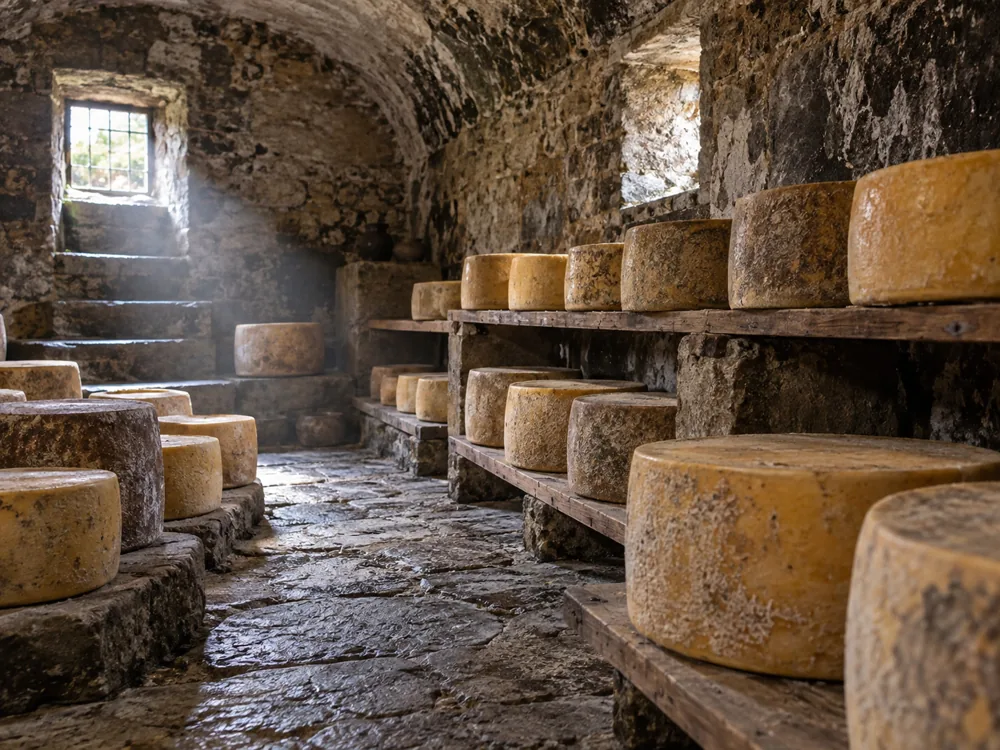
Ageing in the fondaco starts on day 31 to 41 after molding, and the rind treatments described above belong to that phase.
The specification backs the cellar rule with local history, dating the town's pecorino work to the 1700s.
It quotes Bianculli, a Moliterno figure who taught at the Royal University of Naples, crediting the air rather than the cheesemakers. The women who tended the cheese in Moliterno, he noted, did not match its quality once they worked on the Ionian coast.
That is an observation the specification repeats, not a measurement. It still shows what the rule protects: a wedge sold as Moliterno was aged in the town's cellars, while an unprotected canestrato from elsewhere is under no such rule.
Is Canestrato Pugliese Only a Winter Cheese?
Consumatori.it says the true Canestrato Pugliese is made from December to May, the months when flocks moved from Abruzzo to the Tavoliere plain of Puglia. The specification sets no season and says the cheese is made all year, and Alimenti News says the same of production today, at altitudes from 250 to 700 m.
Alimenti News dates the seasonal pattern to the 15th century, when the flocks stayed on the Tavoliere from December to May and the cheese was anciently made then. The winter season describes the old practice, not a condition a wheel has to meet today.
Alimenti News also says Pugliese, like other canestrati of the south, stayed confined to its production area for a long time and became known across Italy only after unification. It cites an 1861 exhibition in Florence that described canestrati as highly prized locally, almost unknown to the rest of Italy and not easily accepted for their taste, which fits the piquant, rather marked flavor in the specification.
Should You Slice or Grate Canestrato?
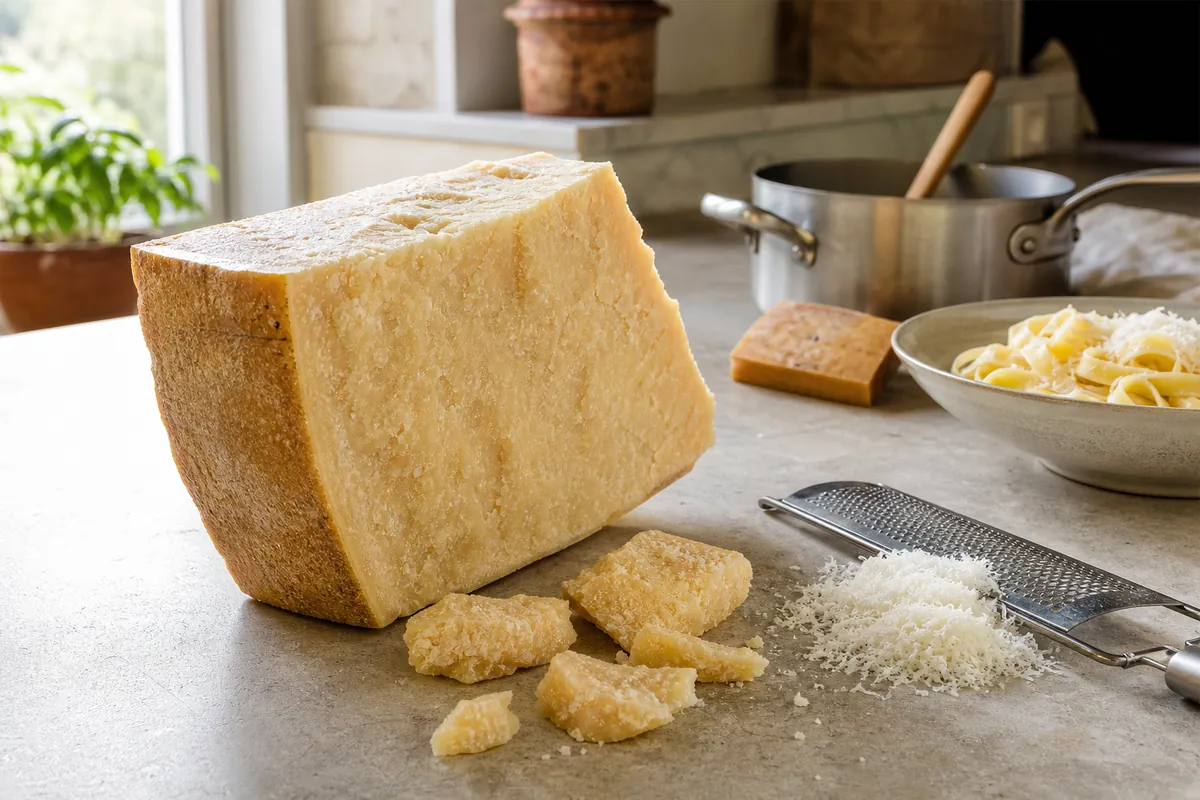
Alimenti News describes a young Pugliese eaten as it is. Both it and Consumatori.it describe a mature one grated over pasta dishes with a meat ragù.
Consumatori.it adds that mature cheese is grated straight onto the plate, and names orecchiette and chitarra as the shapes Puglian tradition uses most, with ziti, mezzi ziti or lumache as alternatives.
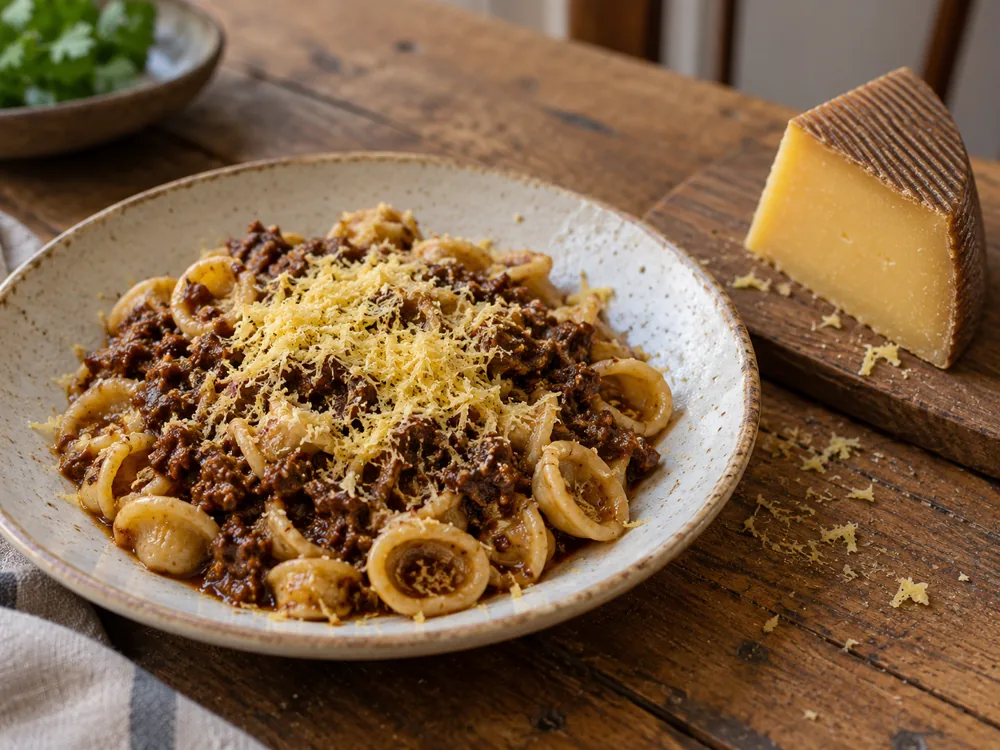
The Pugliese specification calls the cheese a table or grating cheese once it has matured at least six months, and the Moliterno age types above draw the same line: only stagionato and extra, which are over six months, are named for grating.
A grating wedge is a Pugliese aged six months or more or a Moliterno labeled stagionato or extra. A Moliterno primitivo is described only as a table cheese.
Alimenti News and Consumatori.it both say tradition cuts the wheel into wedges with a knife called a petto di piccione, which means pigeon breast.
The Pugliese specification describes the paste as discretamente fondente, an Italian texture term for the paste.
What Pairs With Canestrato?
The pairings below come from Consumatori.it and Alimenti News for Canestrato Pugliese.
| Pairing | Type | Why It Works |
|---|---|---|
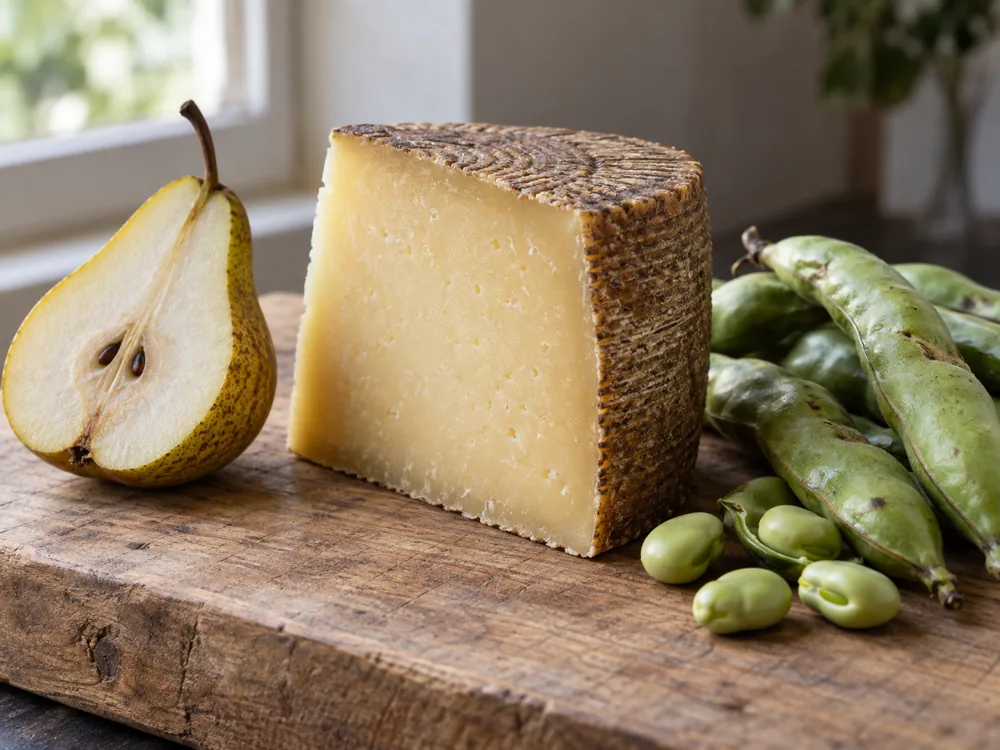
| Pears | Food | Alimenti News and Consumatori.it both pair them with young Pugliese. |
| Fava beans | Food | Both sources pair them with young Pugliese. |
| Raw vegetables in pinzimonio | Food | Both sources name them for young Pugliese. |
| Celery, chicory, black olives and radishes | Food | Consumatori.it serves mature Pugliese in chips from the wheel with them. |
| Locorotondo, San Severo bianco or Fiano di Avellino | Wine | Consumatori.it matches dry, still whites like these with young Pugliese. |
| Cabernet, Chianti or Salice Salentino | Wine | Consumatori.it matches structured, aged reds with mature Pugliese, but never very tannic wines. |
Consumatori.it also allows dry, still rosé with young Pugliese, naming Rosa del Golfo and Rosatello Antinori.
What Can Replace Canestrato?
The Pecorino Romano DOP consortium describes sheep's-milk Pecorino Romano as aromatic and spicy, with a minimum of 5 months for table use and 8 months for grating. The grating version fills the same role as a mature Canestrato.
The consortium gives wheel weights of 20 to 35 kg, against the Pugliese specification's 7 to 14 kg, so a swap changes the scale of the cheese on the label.
Cheese.com calls mild Pecorino Toscano a pale yellow, pasteurized sheep's-milk cheese that is sweeter and less salty than Pecorino Romano and suits slicing or grating. It lists the texture as creamy and smooth, which sets it further from the compact, somewhat crumbly Pugliese paste than Romano is.
Each is a neighbor in milk and use rather than a match for Canestrato.
Is Canestrato Safe During Pregnancy?
The NHS lists pasteurised or unpasteurised hard cheeses, such as cheddar, gruyère and parmesan, as safe to eat during pregnancy.
For a hard cheese like Canestrato, the CDC's safer choice is one made with pasteurized milk. It lists soft cheese made from unpasteurized milk as riskier, and it says pregnant women are 10 times more likely to get a Listeria infection.
Neither agency names Canestrato. Moliterno's specification allows raw or thermised milk and the Pugliese one is silent, so the producer's milk statement is the first thing to check, because the NHS and the CDC treat raw-milk hard cheese differently.
How Do You Read the Label and Store a Wedge?
Alimenti News says cut portions should be kept in a damp cotton cloth. Consumatori.it describes cut wedges wrapped in a cotton cloth only lightly dampened with white wine.
Moliterno's specification allows only primitivo, stagionato or extra as added wording and bars any other qualifier, including the adjectives fine, chosen and selected.
A Moliterno wheel is also sold with a fire-branded mark, two concentric circles that hold the name and a castle with three towers, the town's emblem, 15 cm across and applied by the protection consortium. The specification requires the cheese to be portioned and packed inside the production area, so a wedge sold under the name was cut there.
- The full name, Canestrato Pugliese or Canestrato di Moliterno, and the producer.
- The PDO or PGI wording.
- The milk statement, including raw or thermised for Moliterno.
- The age: months for Pugliese, or primitivo, stagionato or extra for Moliterno.
- For a whole Moliterno wheel, the fire-branded mark with the castle.
Follow the use-by date and handling advice on the producer's label for how long a wedge keeps and how cold to hold it.
SOURCES & REFERENCES
No. Canestrato is a family of basket-molded cheeses. Canestrato Pugliese PDO and Canestrato di Moliterno PGI are separate protected cheeses with their own specifications.
It depends on the named cheese. Canestrato Pugliese uses whole sheep's milk only, while Canestrato di Moliterno uses 70 to 90 percent whole sheep's milk and 10 to 30 percent whole goat's milk.
The curd is pressed in woven baskets, the canestri, and they leave ridges that stay on the rind as the cheese matures.
The Canestrato di Moliterno specification says its rind is not edible. The Canestrato Pugliese specification says its rind is treated with olive oil and sometimes wine vinegar, but it does not say whether the rind is meant to be eaten.
Canestrato Pugliese matures for 2 to 10 months, and it is a table or grating cheese from six months. Canestrato di Moliterno must age at least 60 days before sale, and its labels may say primitivo, stagionato, or extra by age.
It depends on the milk treatment. The NHS lists pasteurised or unpasteurised hard cheese as safe, while the CDC lists hard cheese as safer only when made with pasteurized milk. Moliterno's specification allows raw milk and the Pugliese specification does not state milk treatment, so confirm it with the producer.
No protected Canestrato is. The Canestrato Pugliese specification allows only animal rennet, and the Canestrato di Moliterno specification uses lamb or kid rennet paste.