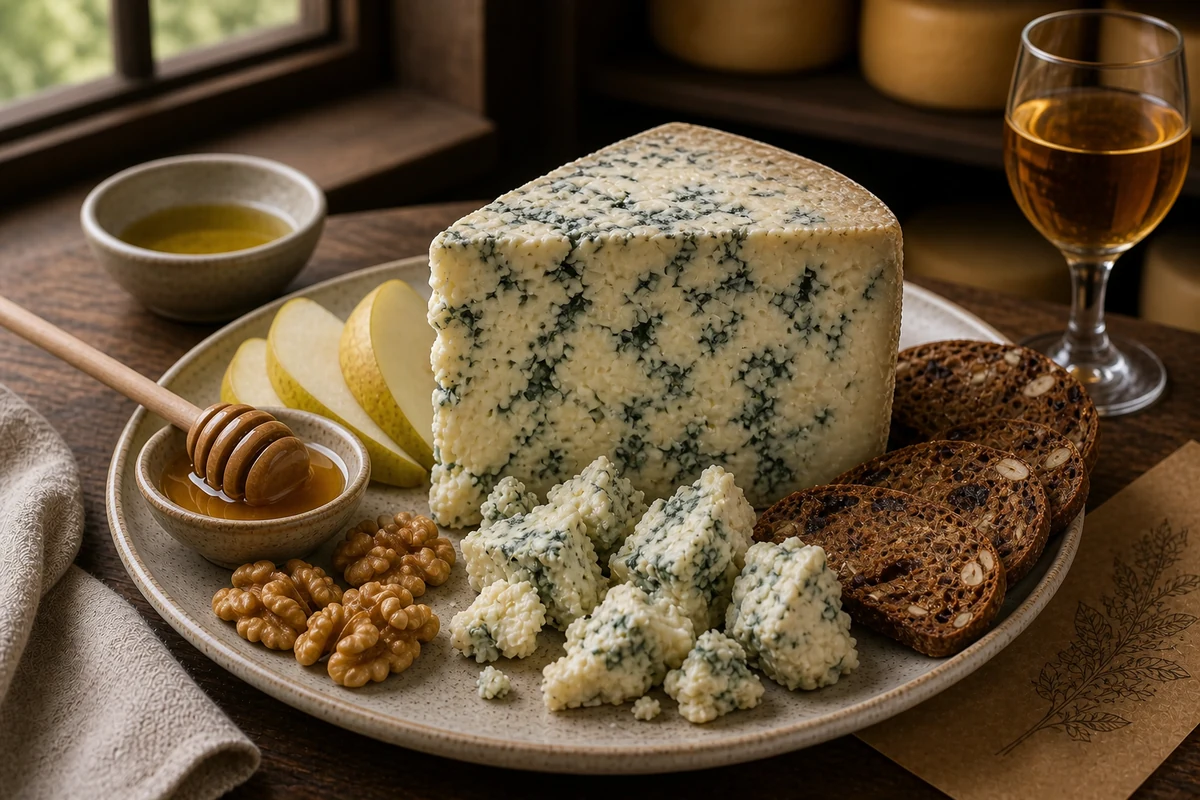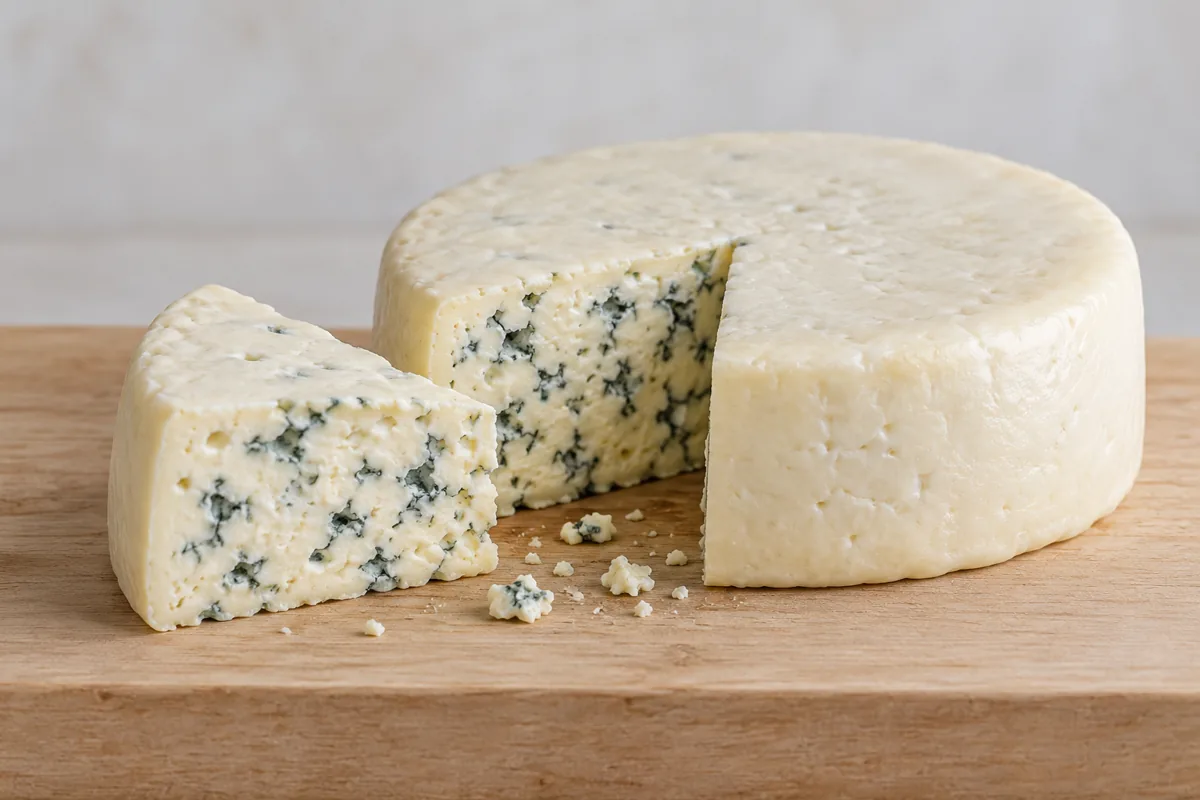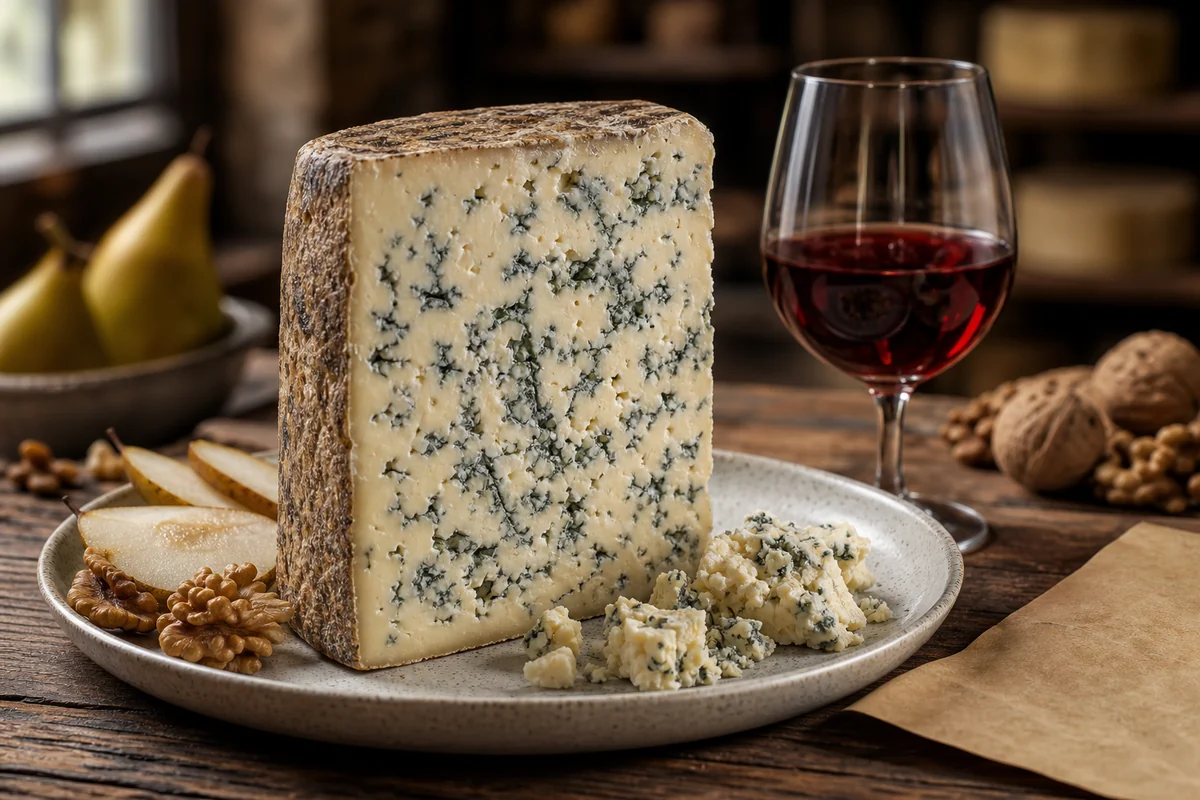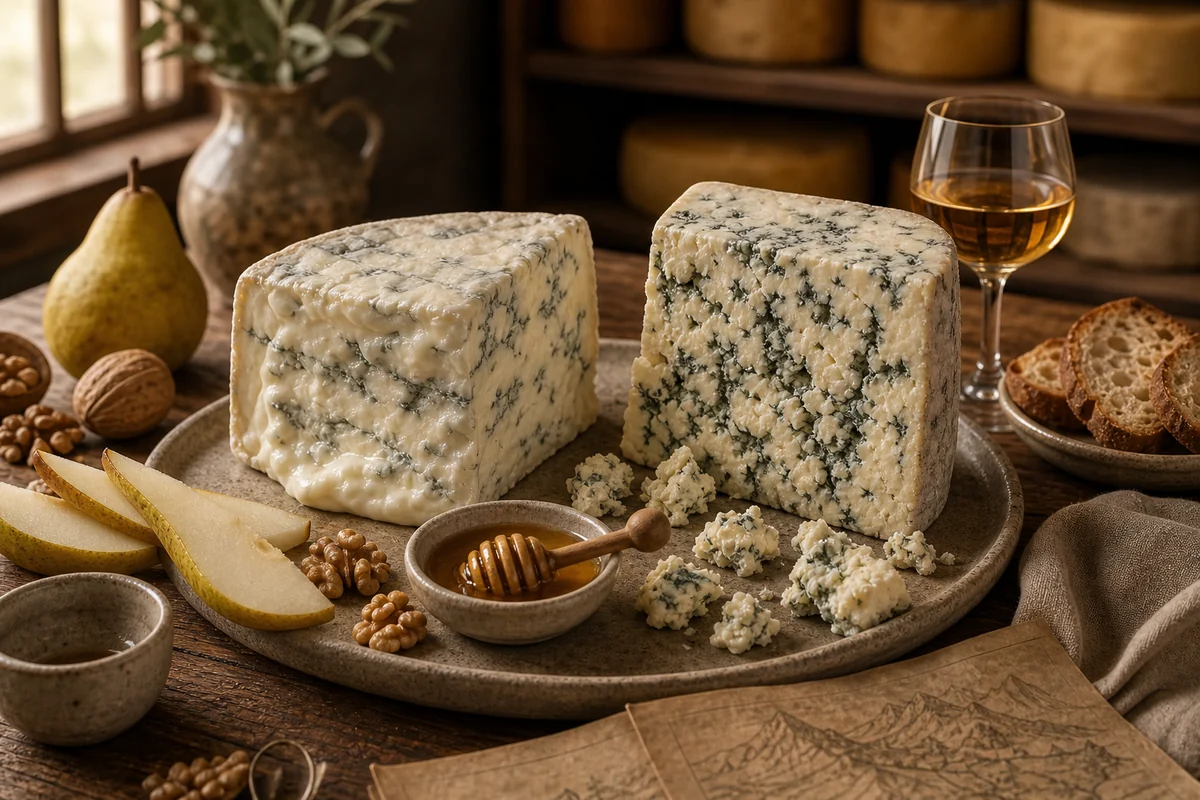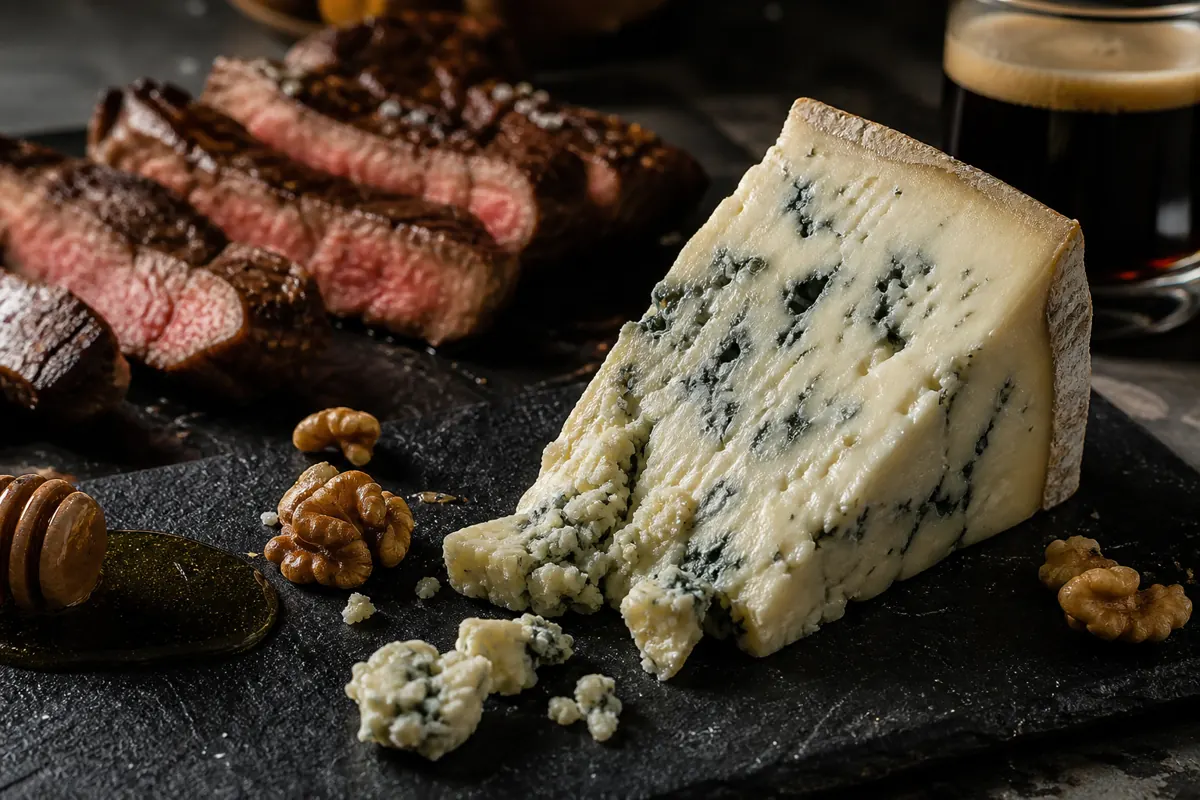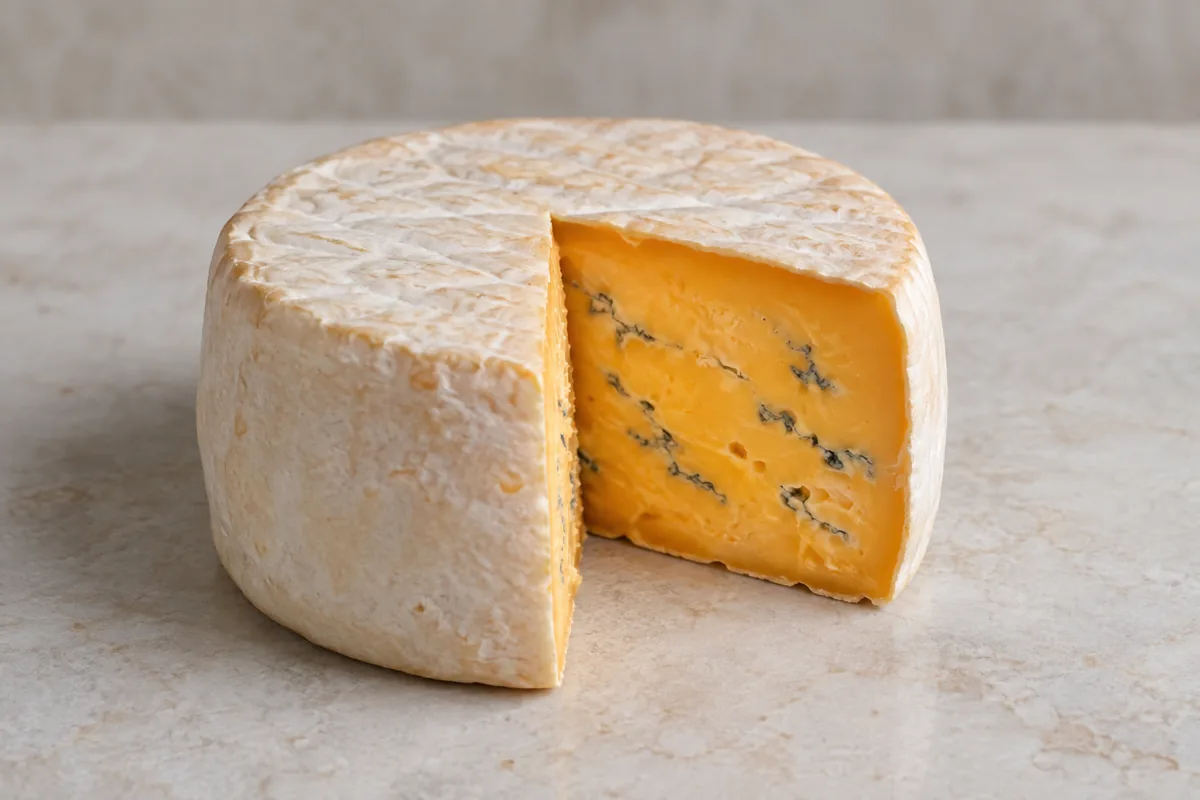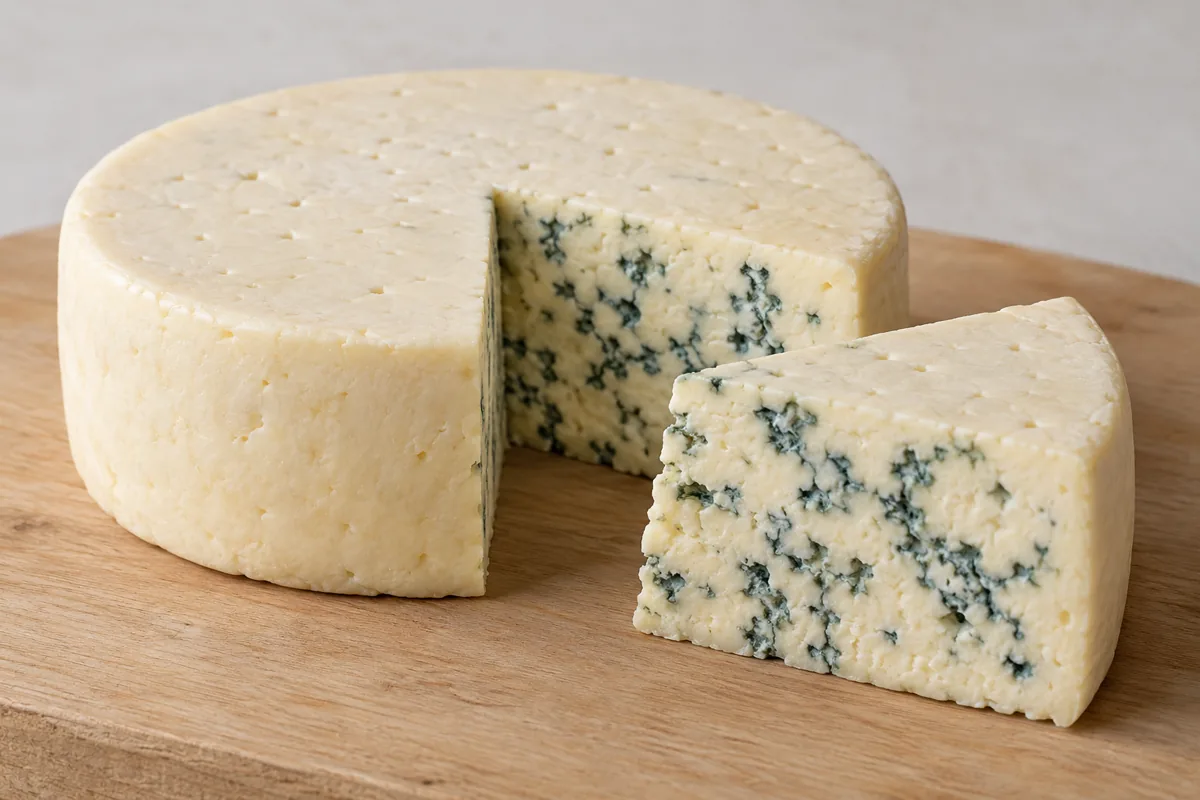
Danish Blue is the English name for Danablu, a blue-veined cheese made in Denmark from Danish cow's milk and protected in the EU as a PGI.
Its rules set two fat levels, two shapes and a ripening floor of five weeks, and the milk is homogenised before the cheese is made. That step goes back to Marius Boel, the dairyman the specification credits with developing the cheese around 1920.
In This Article
What Is Danish Blue Cheese?
Under the Danish product specification, Danablu is a full-fat or extra full-fat blue-mould cheese, semi-firm to soft, made from Danish cow's milk, while Cheese.com and English Wikipedia both file it as a semi-soft blue.
The name Danablu was fixed in 1952 by a Danish Ministry of Agriculture notice on names for Danish cheese, and in North America the cheese is often marketed under the trademark Danish Blue Cheese.
Danablu is one of four Danish cheeses with PGI status, alongside Esrom, Danbo and Havarti. All four may only be made in Denmark from Danish milk at approved dairies.
What Do the Danablu Rules Require?
The specification the Danish Veterinary and Food Administration publishes, in its September 2025 version, fixes the cheese's composition, shape and look.
| Point | What the specification says |
|---|---|
| Fat levels | At least 50% fat in dry matter with at least 52% dry matter, or at least 60% fat in dry matter with at least 56% dry matter |
| Shapes | Flat cylinder about 20 cm across and about 3 kg, or rectangular block about 30 by 12 cm and about 4 kg |
| Surface | White to slightly yellowish or faintly brownish; piercing holes may show; no paraffin or plastic coating |
| Rind | No true rind, but a dense, fairly firm outer layer |
| Paste | White to slightly yellowish, not greyish, with fairly even blue-green marbling that may thin toward the outside |
| Openings | Scattered openings, cracks and piercing channels; no gas holes |
| Ripening | At least 5 weeks |
| Area | Denmark |
Multiplying each pair of minimums gives at least about 26 g of fat in every 100 g of the 50% type and about 34 g in the 60% type. The same minimums cap the water, at 48 g per 100 g for the 50% type and 44 g for the 60% type, so the richer cheese also has the lower ceiling on moisture.
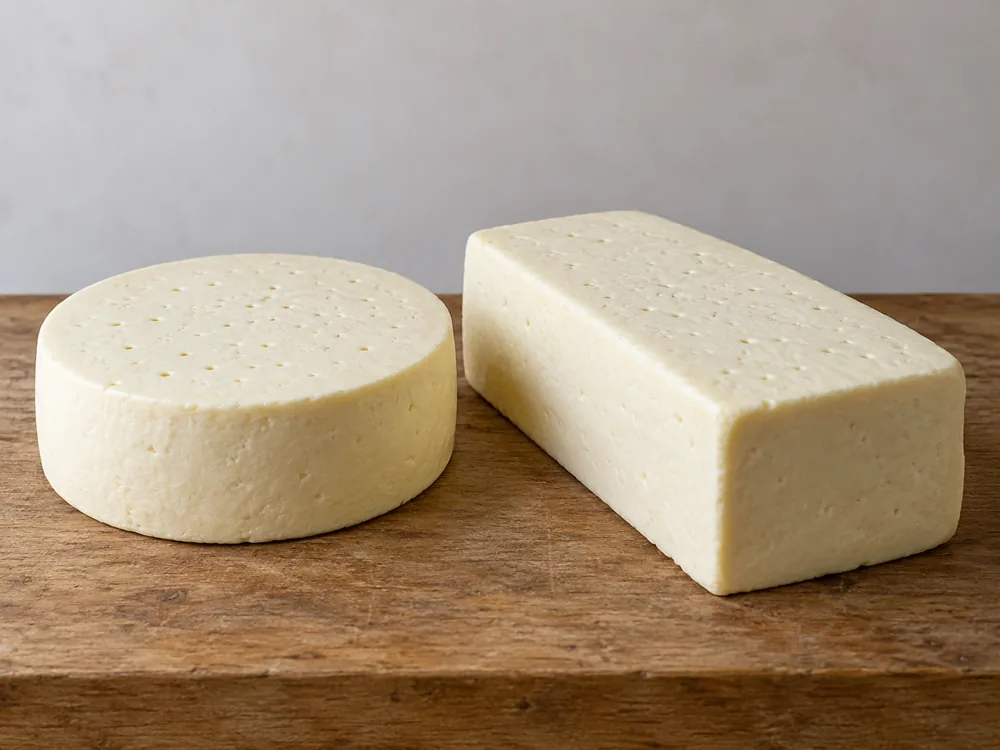
The specification also sets tolerances. A top that is only slightly sunken in the middle is allowed, the faces and sides must be whole, even and regular, and the paste may be denser toward the outside.
So if your cut wedge shows a sparser, firmer band of paste near the outside, it is within the description. The specification excludes an over-moulded paste and any foreign mould in the piercing channels.
How Is Danablu Made?
The specification's method starts with raw Danish cow's milk that is fat-standardised, homogenised, then pasteurised or thermised.
- Cultures: starter culture and blue mould culture go into the milk, and rennet follows after a first souring.
- Curd: it is cut once firm enough, sometimes with light stirring.
- Moulding: the curd fills the moulds and drains.
- Salting and piercing: the cheese is salted, then pierced.
- Ripening: it then goes into store for at least 5 weeks.
Copper wires or rods pierce the formed curds before ageing to distribute the Penicillium roqueforti mould evenly, and the holes can still be seen when the finished wheel is cut open.
The specification places the blue-green marbling in the piercing channels and in the physical holes and cracks of the curd, so the veins trace where the cheese was pierced or left open.
Danablu ripens for at least 5 weeks under the specification, which sets only that floor, and for eight to twelve weeks in English Wikipedia's account. Because the specification's number is a minimum, a pack can be older than that.
Castello adds that the surface of its Danablu gets extra salt, so it stays white while the blue mould grows.
The specification ties homogenising to the cheese's character. It says Boel's 1927 trials with homogenised milk made the cheese fattier, more piquant and whiter, and helped it hold water better.
Castello points the same way for its own cheese: its homogenised cow's milk develops a pronounced bite, which the cream in the milk tempers.
Who Invented Danish Blue Cheese?
Credit goes to Marius Boel, on the authority of The World Atlas of Cheese, which the specification cites, though blue-mould cheese was already made in Denmark from about 1875.
Mammen dates the first trials by Hanne Nielsen of Havartigården to 1874 and says she was inspired by the French Roquefort she met on study trips abroad. English Wikipedia says Boel, too, set out to emulate a Roquefort-style cheese.
Boel's story begins on his family farm in Salling, where cheeses sometimes turned mouldy and he tasted them out of curiosity. By his own account the taste was both peculiar and piquant, so he grew the mould on bread, dried and ground the bread and added the powder to fresh curd.
Boel bought Marslev dairy in 1914 and began making blue cheese there in 1915, and by the 1920s it turned out about 1,000 cheeses a day.
Boel's cheese dates to around 1920 in the specification, with his homogenising trials in 1927, while Mammen has him adding mouldy bread powder to curd from 1914 and working out homogenising in the 1920s, and English Wikipedia says only early in the 20th century.
Read together, the bread-mould cheese and the homogenised cheese are two stages. Mammen treats the homogenised version as the cheese we know today, and the specification calls the 1927 trials a great improvement in quality, so the Danablu in the rules is the second stage.
The 1927 trial used homogenised milk from a dairy in Odense, an idea Boel took from 9% coffee cream that stayed creamy despite its low fat. Homogenising soon became usual at dairies making this type of cheese.
Boel's priority was tested during the Second World War, when an American university patented homogenised cheese milk and tried to charge a fee on Danish cheese made with it. The attempt failed once it was shown that Boel had used the method 20 years earlier.
How Is Danablu Checked for Quality?
Quality checks began as an export matter. Other dairies took up production around 1930 and the number of producers grew, and talks began with Chief Inspector Lohse, head of the State Control, on regular checks of cheeses meant for export.
Those talks led to a producers' association, founded on 23 June 1934, and the first trial judging of cheeses took place in Odense on 16 July 1934. After three trial rounds, criteria were adopted for rind, structure, colour, smell and taste, plus an overall grade for the cheese's suitability as an export product.
A Ministry of Agriculture regulation for judging Roquefort-type cheese at the State's cheese assessments took effect on 1 January 1936. A 1958 law on making and selling cheese set rules for production and control, and notices in 1963 and 1969 gave characteristics for the cheeses.
The specification's description still runs under much the same headings as the 1934 criteria: rind, structure, colour, smell and taste, with surface and consistency added. Today the approved dairies are inspected regularly to check that they follow the production guidelines.
What Does Danish Blue Taste Like?
Danish Blue is salty, sharp or piquant in the descriptions below, though how strong it is varies from one to the next.
- Danablu specification: a clean, piquant taste strongly marked by blue mould, which can be sharp, somewhat salty and acidic with a slight bitter edge.
- Mammen: round, piquant and full of nuances.
- Cheese.com: tangy and salty.
- English Wikipedia: a milder flavour with a sharp, salty taste.
- Castello: a sharp, nutty blue-mould aroma with hints of marzipan and sourdough.
Castello explains its flavour as ripening chemistry. As the cheese matures the mould breaks down fat and protein: the fat gives a nutty, almond-like aroma, the creamy milk lets sweeter notes come forward, and the protein adds savoury, lightly bitter notes like those of sourdough.
Texture is described differently too. The specification asks for a paste that is loose but not crumbly, soft, cuttable and spreadable, and a little firmer and shorter toward the outside.
Cheese.com calls it creamy and crumbly, and Castello describes a light, crumbly texture that turns smooth and creamy in the mouth. Castello puts the smoothness down to the richness of the milk and the crumble to curds placed loosely in the moulds, which knit together only lightly, and says ripening softens the cheese from within.
Danablu is therefore described as both spreadable and crumbly, and the name alone does not tell you which one a given pack is.
How Does Danish Blue Differ From Gorgonzola?
Both are cow's milk blues, but they are built differently, starting with how long they age.
| Point | Danablu | Gorgonzola |
|---|---|---|
| Milk | Danish cow's milk, homogenised, then pasteurised or thermised | Unskimmed cow's milk, pasteurised |
| Ripening | At least 5 weeks; eight to twelve weeks per English Wikipedia | Typically three to four months |
| Piercing | Copper wires or rods before ageing | Metal rods inserted and removed during ageing |
| Paste | Soft, cuttable, spreadable, not crumbly | Buttery or firm, crumbly |
Mammen says the length of ageing decides Gorgonzola's consistency, which firms as it ripens, so a Gorgonzola buyer is in effect choosing an age between its two varieties, Dolce and Piccante.
If you are buying Danablu, you choose on other axes: a fat level, 50+ or 60+, and a format, since the specification's variants differ in fat and shape and its five-week minimum sits well under Gorgonzola's three to four months.
How Do You Serve Danish Blue?
You can use Danish Blue crumbled cold, melted into a dish, or as it is on bread.
| Use | How It Works |
|---|---|
| Salads | Cheese.com, English Wikipedia and Castello all name it crumbled over salad. |
| Pizza and soup | Castello suggests crumbling it over both. |
| Sauces | Cheese.com says it is melted into sauces. |
| Dips | Castello uses it as a base for dips. |
| Bread and crackers | Cheese.com and Castello serve it on bread or crackers; English Wikipedia says Danes often eat it on bread or savoury biscuits. |
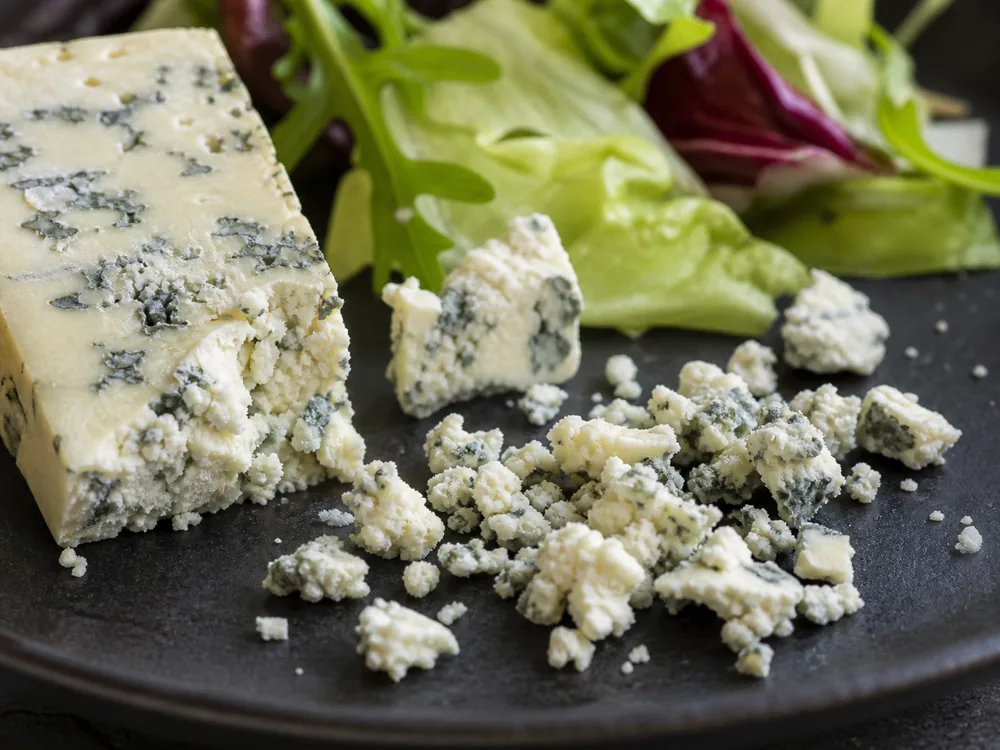
Castello's reasoning for its vegetable and salad uses is contrast. On grilled carrots with caramelised, charred edges the crumbles add a salty bite that sets off the sweetness, and in a radicchio and pear salad a few crumbles bring savoury richness against the bitter leaves and the juicy pear.
Danish Blue also goes into pasta sauces, soups, pizzas, salads and burgers, and Castello says a small crumble adds a rich, savoury note to roasted vegetables or baked potatoes.
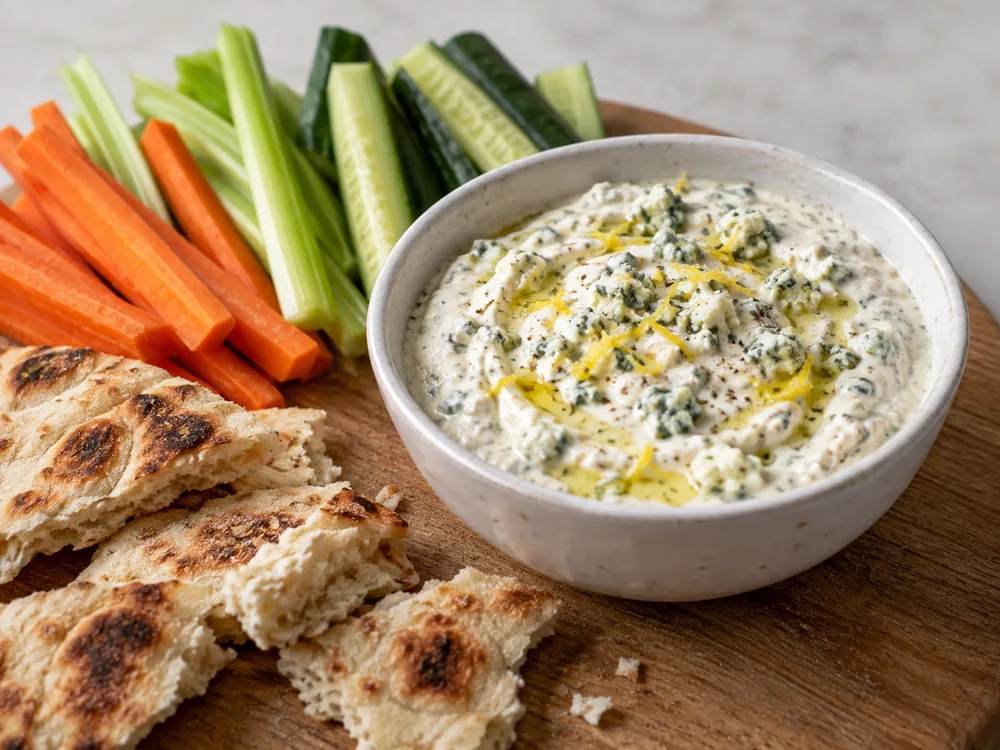
For a dip, stir the cheese into crème fraîche with a little olive oil, honey, lemon zest and a pinch of cayenne pepper, as Castello does, and serve it with bread, crisp vegetables or warm flatbread.
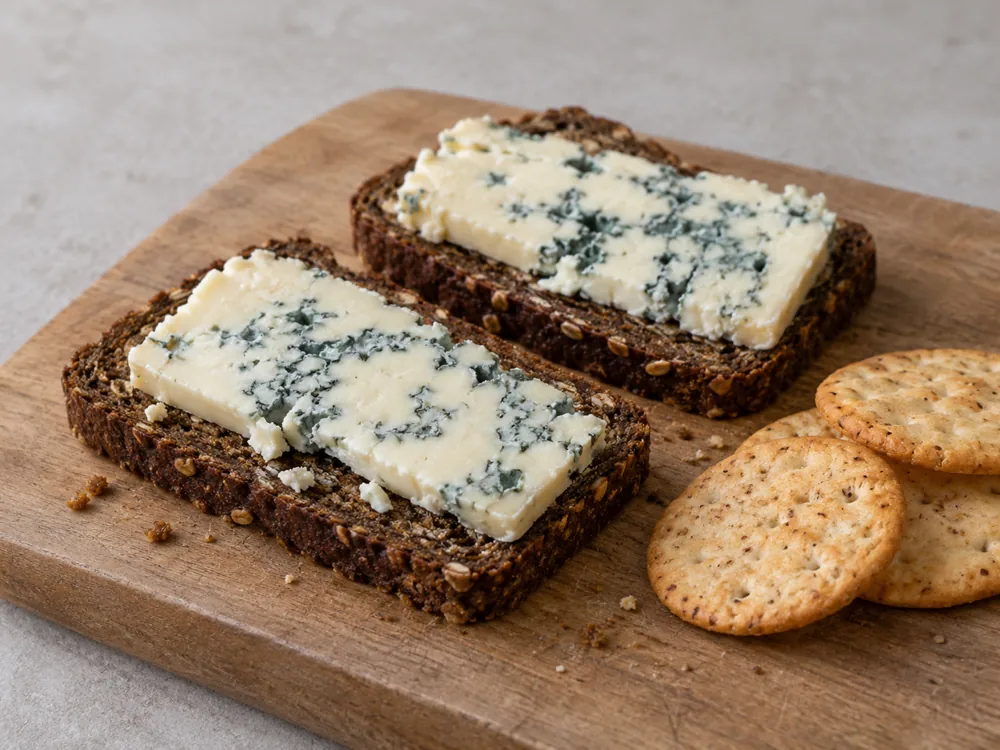
The plainest use is on bread. Danes often eat it on bread or savoury biscuits, and Castello suggests slicing it onto rye bread, crackers or crusty bread.
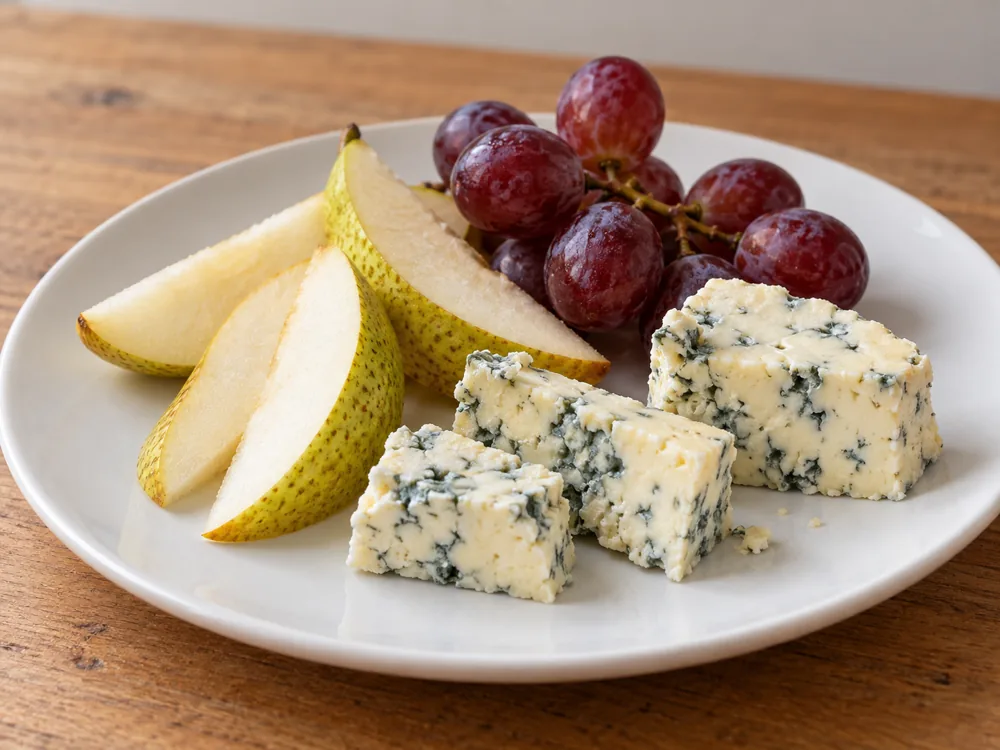
It is also a dessert cheese served with fruit, and Castello puts it on a cheese board with fruit and nuts.
What Goes With Danish Blue?
Fruit and nuts are the partners Cheese.com and Castello agree on: Cheese.com names pears and grapes, and Castello adds honey and figs.
| Pairing | Type | Why It Works |
|---|---|---|
| Pears and grapes | Food | Cheese.com names both fruits. |
| Nuts | Food | Named by both Cheese.com and Castello. |
| Honey and figs | Food | Castello's suggestions for its Danablu. |
| Late-harvest wine | Wine | Castello's wine match. |
| Stout | Drink | Castello's beer match. |
For a drink, Castello picks late-harvest wine or stout.
Read against the taste notes, most of the named partners are sweet ones set against a salty, sharp cheese, and Castello describes its own cheese as balancing sweet and bitter elements.
How Much Fat and Salt Does Danish Blue Contain?
Labels from three Danablu brands give close figures, with 3 to 3.5 g of salt in every 100 g.
| Brand | Energy | Fat | Saturated fat | Protein | Salt | Source |
|---|---|---|---|---|---|---|
| Castello Danish Blue | 341 kcal | 29 g | 18 g | 20 g | 3.3 g | Castello product page |
| St. Clemens Danablu 50+ | 353 kcal | 30 g | 19 g | 20 g | 3.5 g | Open Food Facts label record |
| Milbona Danablu | 349 kcal | 29.5 g | 19.1 g | 20.2 g | 3.0 g | Open Food Facts label record |
English Wikipedia's range of 25 to 30% fat, or 50 to 60% in dry matter, brackets all three labels. Carbohydrate stays under 1 g per 100 g on each of them.
The fat figures on these three labels also show which fat level each pack is: by the arithmetic in the rules section, a 60% type holds at least about 34 g of fat per 100 g, so at 29 to 30 g none of the three labels can be the 60% type, and St. Clemens names its cheese 50+ outright.
For a 30 g piece, the three labels' figures work out to 0.9 to 1.05 g of salt.
How Should You Buy and Store Danish Blue?
On the pack, look for the word Danablu, because only cheese made in Denmark to the specification may carry that name.
Mammen's own range shows why the name matters: its Combi Blue is described as a blue cheese analogue with some milk fat replaced by vegetable fat, a different product from its Danablu.
Castello says to keep Danablu in its original packaging in the fridge, or wrapped loosely in wax or baking paper so the cheese can breathe and does not dry out. Once you open it, it goes into an airtight container so it does not pick up other flavours.
Castello puts the best-enjoyed window at about 5 to 7 days after opening, and says it can often last longer if it is well wrapped and kept in the fridge.
It can go in the freezer, Castello adds, wrapped tightly in an airtight container or freezer bag, though the texture turns slightly crumblier afterwards. Frozen Danish Blue is often best used in cooked dishes such as sauces, soups and casseroles, and Castello says to thaw it slowly in the fridge.
Is Danish Blue Safe During Pregnancy?
The NHS names Danish blue directly: pasteurised or unpasteurised soft blue-veined cheeses, such as Danish blue, gorgonzola and roquefort, must be thoroughly cooked in pregnancy.
Its list of cheeses safe in pregnancy includes any cheese cooked until steaming hot, including soft or blue cheese. Under NHS advice, then, you can eat Danish Blue in a dish cooked until steaming hot, but not as cold crumbles on a salad.
The CDC lists soft cheese made from unpasteurized (raw) milk, including blue-veined cheese, as a riskier choice, and pasteurized soft cheeses heated to an internal temperature of 165°F or until steaming hot as safer. It adds that pregnant women are 10 times more likely to get a Listeria infection.
Served cold, Danish Blue is described as a pasteurized semi-firm to soft blue-veined cheese, a type the CDC list does not cover, so ask a midwife or doctor.
Pasteurisation cannot be taken for granted with Danablu. The specification allows thermised milk as well as pasteurised, and the Milbona Danablu label on Open Food Facts lists unpasteurised milk.
Under NHS advice, the milk treatment does not change the answer for cold Danish Blue.
SOURCES & REFERENCES
What Else Do People Ask About Danish Blue?
No: Danablu is made from Danish cow's milk, and Castello says its Danish Blue differs from Roquefort, the cheese that inspired it, by being made with homogenised cow's milk. Mammen says Roquefort is made from sheep's milk.
English Wikipedia describes a yellowish, slightly moist, edible rind. The Danablu specification says there is no true rind, only a dense, fairly firm outer layer with no coating.
The specification and the St. Clemens label both list rennet and the Milbona label a cheese enzyme, so if you avoid animal rennet, ask the maker whether it is animal or microbial.