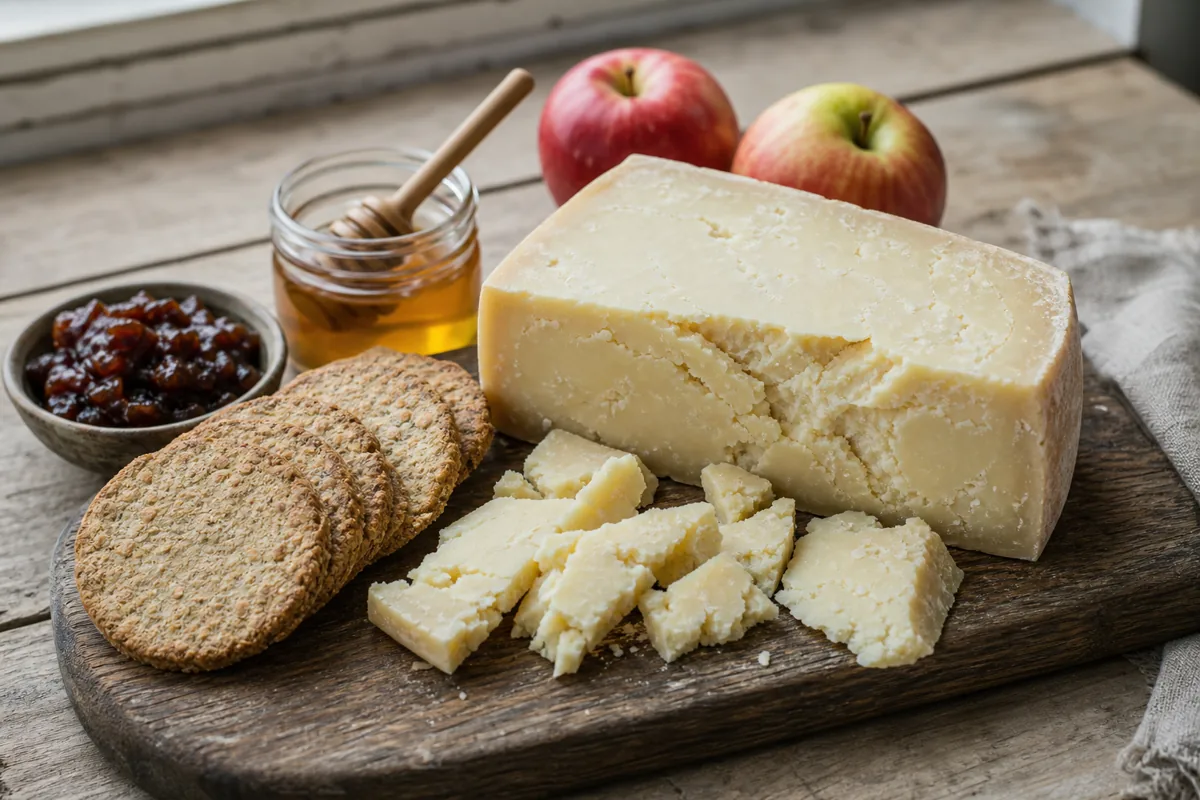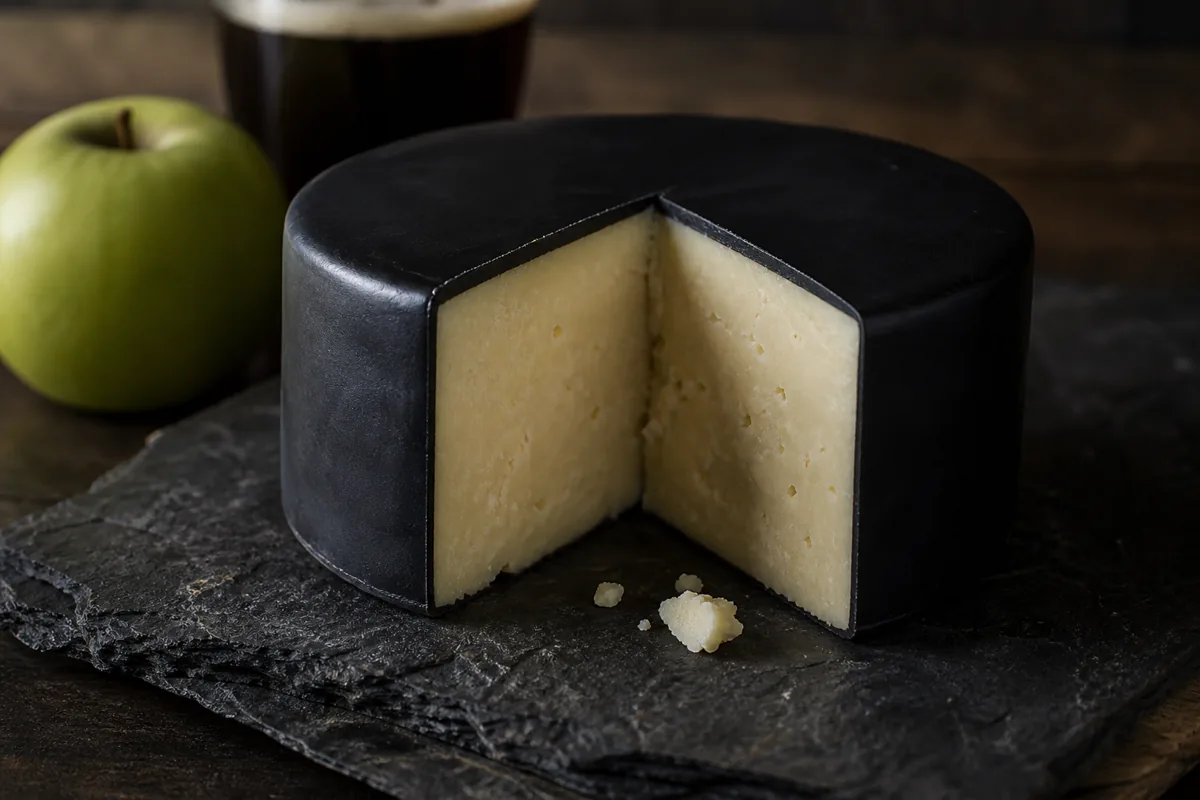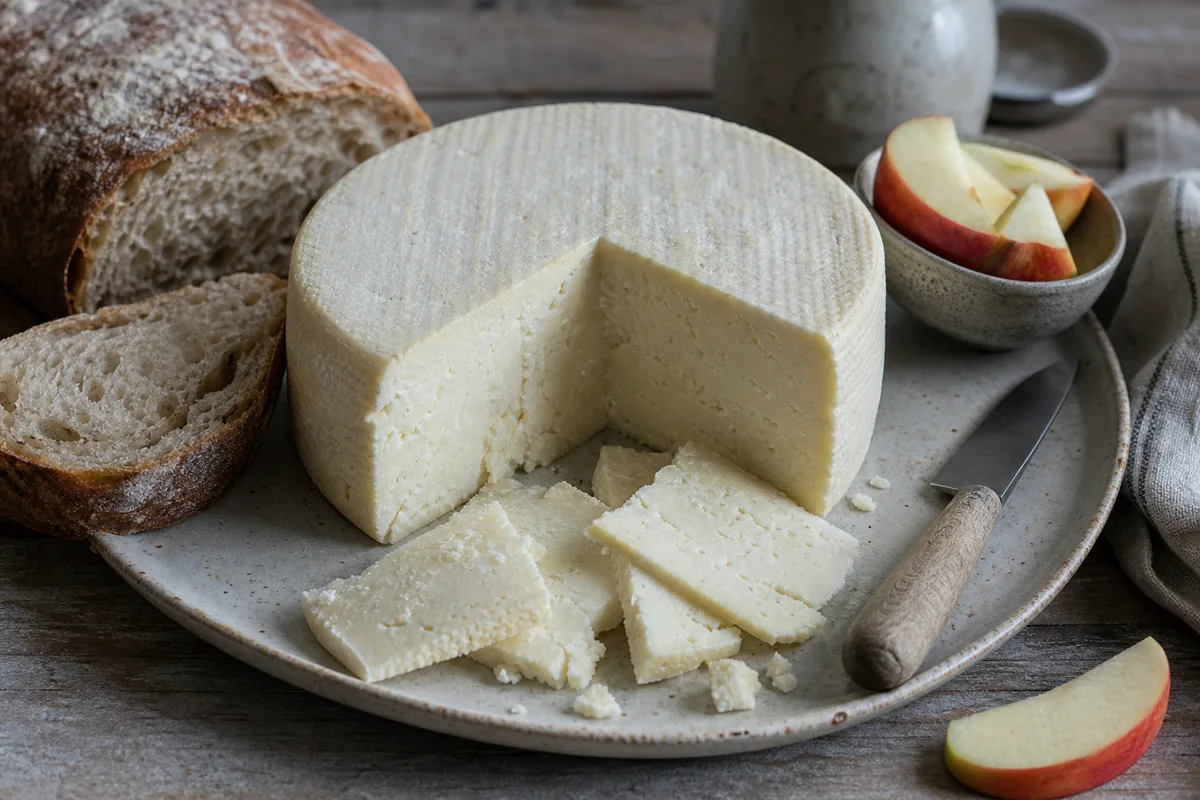
Caerphilly is a crumbly cheese made from cow's milk, and its protected form, Traditional Welsh Caerphilly or Traditional Welsh Caerffili, is described in its PGI specification as the only native cheese of Wales. Much of the Caerphilly sold today comes from England, including Gorwydd, a riper farmhouse wheel made in Somerset.
The Welsh and English wheels differ in age, milk, and label rules, so if you see conflicting figures, check which cheese and which maker each one describes.
In This Article
What Is Caerphilly Cheese?
The PGI specification defines Traditional Welsh Caerphilly as a Caerphilly-styled hard cheese made in Wales from milk produced on Welsh farms. The milk can be pasteurised or raw, and organic or not.
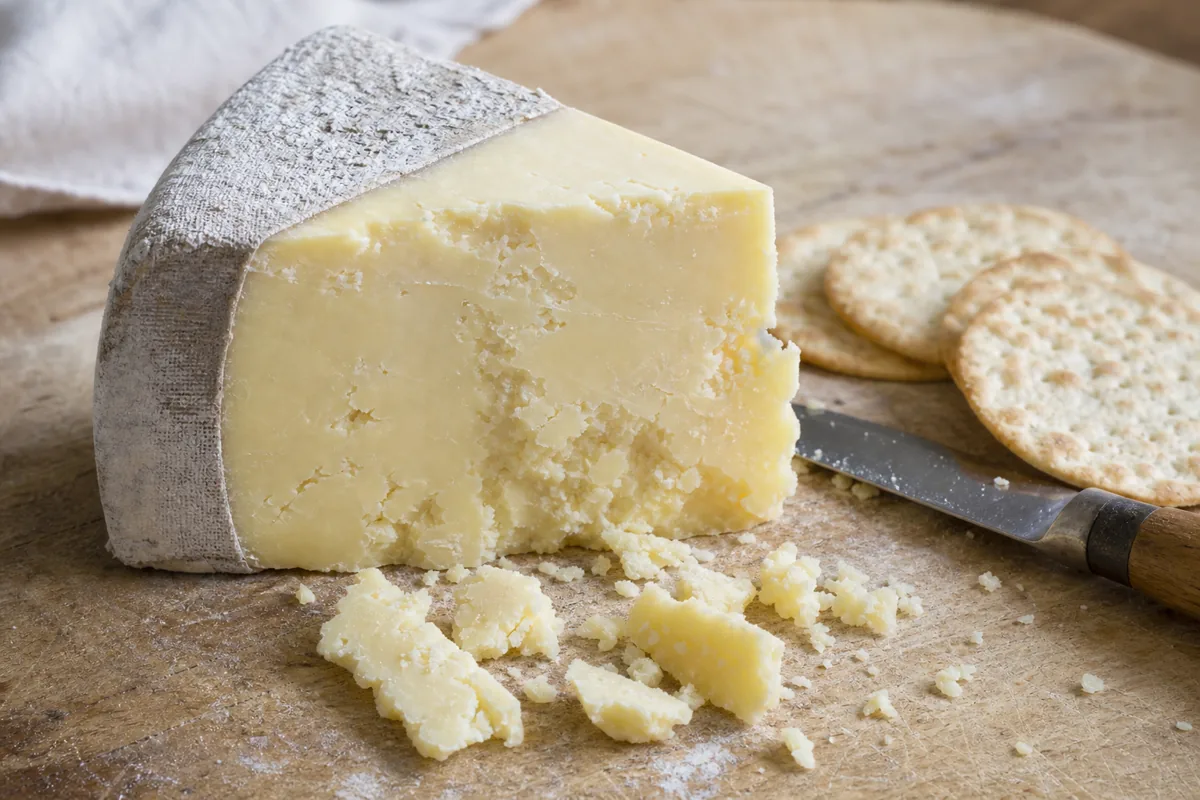
It is a flat round cheese of 2 to 4 kg, 20 to 25 cm across and 6 to 12 cm deep, shaped by hand in moulds and sold naked rather than cloth-bound.
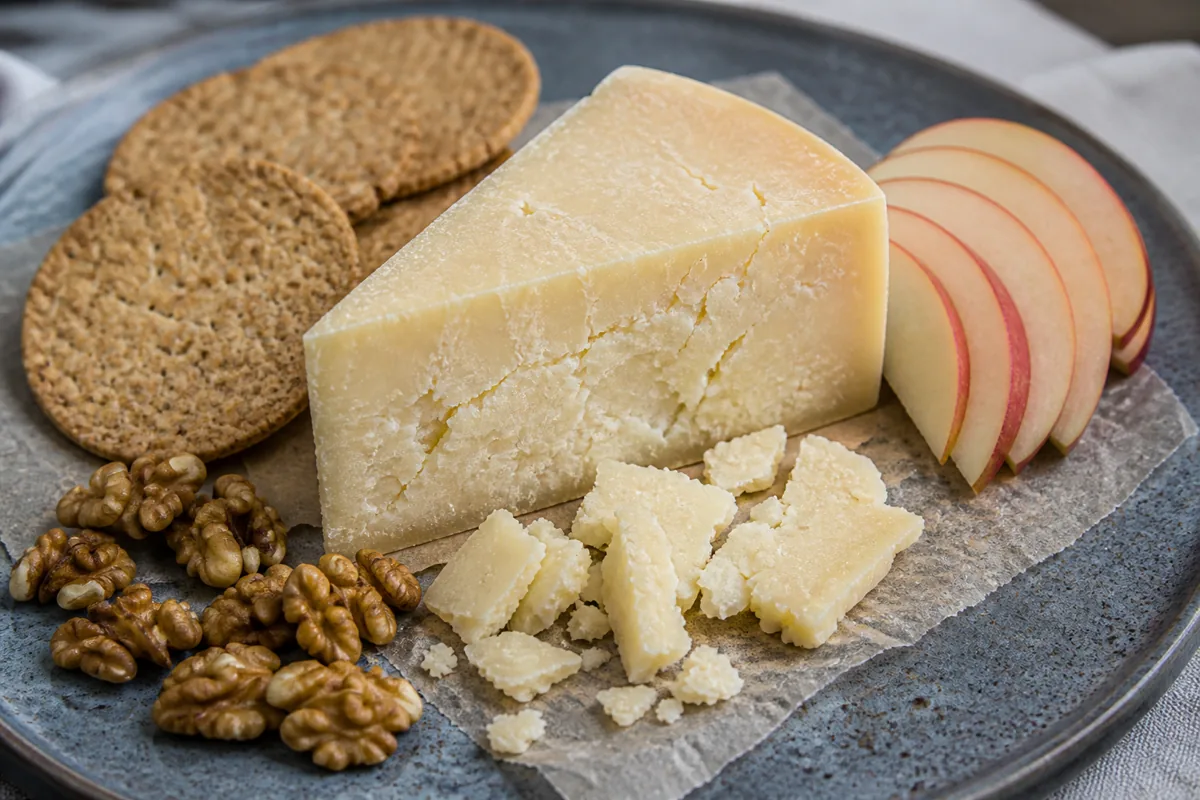
The body is creamy white with a smooth, close and flaky texture, and the outside is smooth and intact, sometimes with a slight mould coat. Historically the cheese was sold dusted with fine oatmeal or flour.
The specification describes a mild, slightly lemony taste with a fresh lingering aftertaste, which grows fuller with maturity while staying mild.
The specification records older names for the cheese: Caws Cymru, meaning Welsh cheese, and Glamorgan cheese, and also the golden cheese of Breconshire, a version that mixed ewe's milk with cow's milk. The protected cheese is made from cow's milk only.
How Is Traditional Welsh Caerphilly Made?
The make is built to keep moisture in the curd, and the PGI specification gives a figure for almost every step.
| Step | What the specification says |
|---|---|
| Ripening | Starter cultures work in the milk for 30 to 60 minutes at 28 to 32 °C |
| Cutting | The curd is cut by knife into large cubes of 10 to 14 mm, at an acidity of 0.12 to 0.16% |
| Scalding | The curd is heated gradually to 32 to 35 °C over 30 to 40 minutes |
| Draining | The whey is drained gently at an acidity of 0.15 to 0.23%, and the curd is piled along the sides of the vat |
| Texturing | The curd is cut and turned every 10 to 15 minutes until acidity reaches 0.23 to 0.30% |
| Milling and moulding | The curd is broken into walnut-sized pieces and packed by hand into cloth-lined moulds, with the smaller pieces on the outside |
| Pressing | About 1.5 bar for 1 to 2 hours, then turned and pressed again at 2 bar |
| Salting | 1% dry salt at milling; a little more may be rubbed on after pressing, or the cheese may be brined |
| Maturing | Stored at 10 to 12 °C, ready from 10 days old or kept up to 6 months |
The cube size is the clearest break from cheddar making, where the specification says the curd would be cut to the size of rice grains. The specification says the large cubes keep fat and moisture in the finished cheese, and the scald, lower than for other hard cheeses, keeps in moisture.
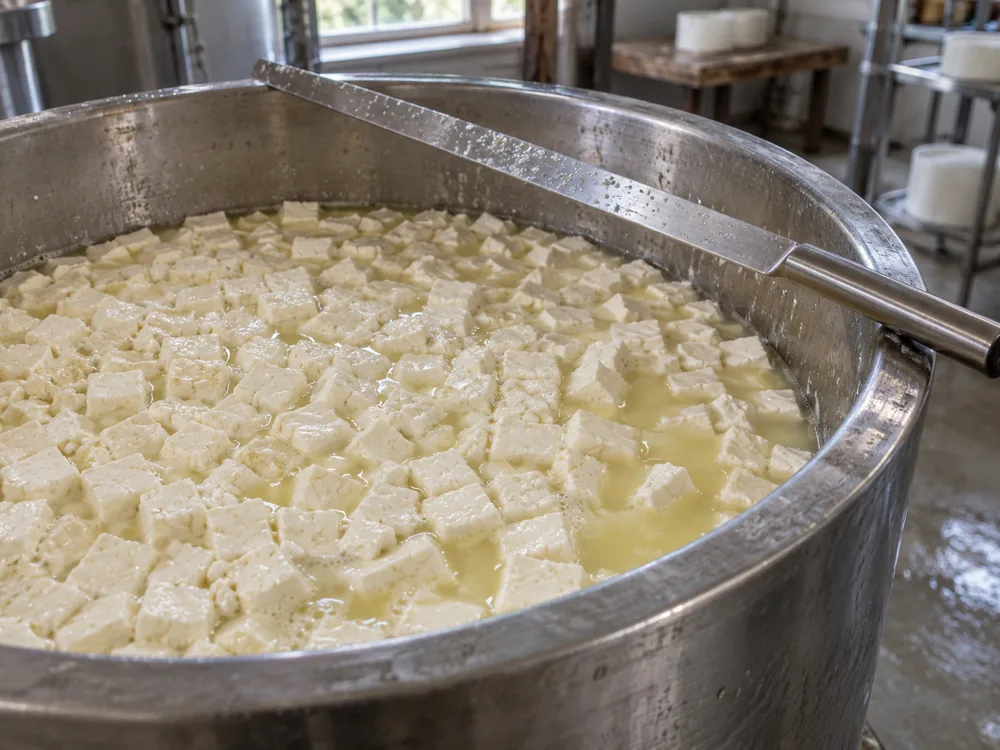
Before the cut, the maker tests the set curd by hand: the specification says the curd is firm enough to cut when it splits cleanly as the hand is pushed into it. The setting time is not fixed, because the wait depends on season, milk quality and the temperature of the curd.
Acidity readings then steer the later steps, and the specification says the curd must not be allowed to chill at any stage. It leaves the acidity at the cut to the cheesemaker's judgement, because season and the source of the milk move the reading.
Acidity figures came into the recipe late: the specification says Annie Evans's notebook of 1907 gave temperatures but no acidities and judged the curd by feel, while a 1964 instruction sheet for students at Aberystwyth supplied more of the science.
The texture the make aims for looks contradictory. Wikipedia, citing a cheesemaking textbook, says acid builds slowly at first and, with the low make temperature, dries the curd into a crumble, while the specification calls the curd at milling soft and velvety and the finished cheese smooth, close and flaky.
Read together, the two accounts put the crumble in the maturing cheese, not in the curd at milling.
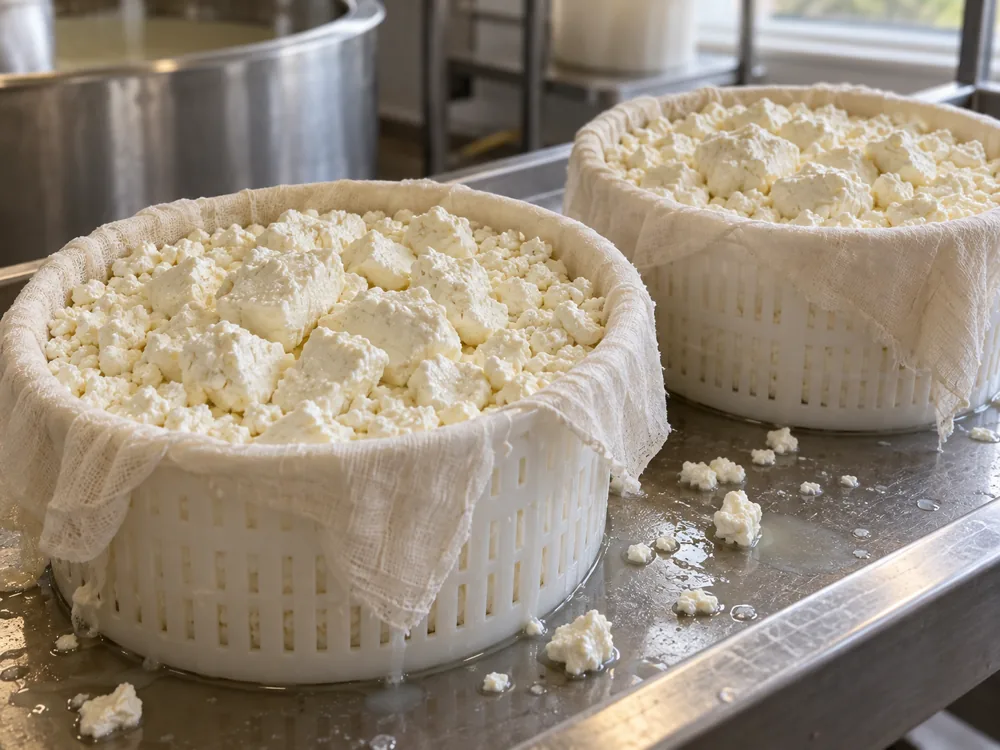
Pressing is light for the same reason: the specification says 1.5 bar holds the shape without pushing cream out of the curd, and the heavier 2 bar comes only after the cheese is turned.
Brine time is how a maker sets the salt level. When a cheese is brined, the specification has it leave the mould the day after pressing and sit in brine for 12 to 24 hours, with the time set by how much salt it needs within the 1 to 2% range.
Young Welsh Wheel or Riper Farmhouse Wheel?
The PGI allows a wide window, from 10 days old up to 6 months for a matured cheese. Caws Cenarth ages its Thelma's Original Caerffili for up to 6 weeks in 3 kg rounds and lets natural moulds grow on the rind.
Its maker describes that cheese as loose and slightly crumbly, with a flavour that is delicate on the palate.
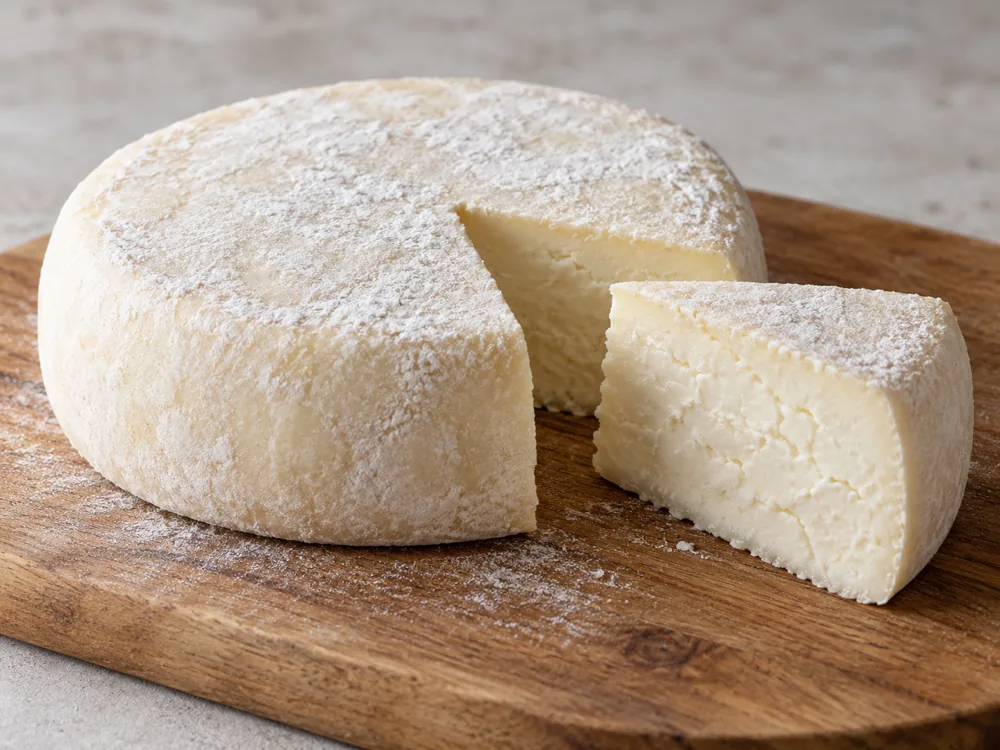
The specification gives the two ages different jobs: it says the cheese is made to be eaten young, while the matured cheese was an important item of the diet in the lean winter months before modern storage existed.
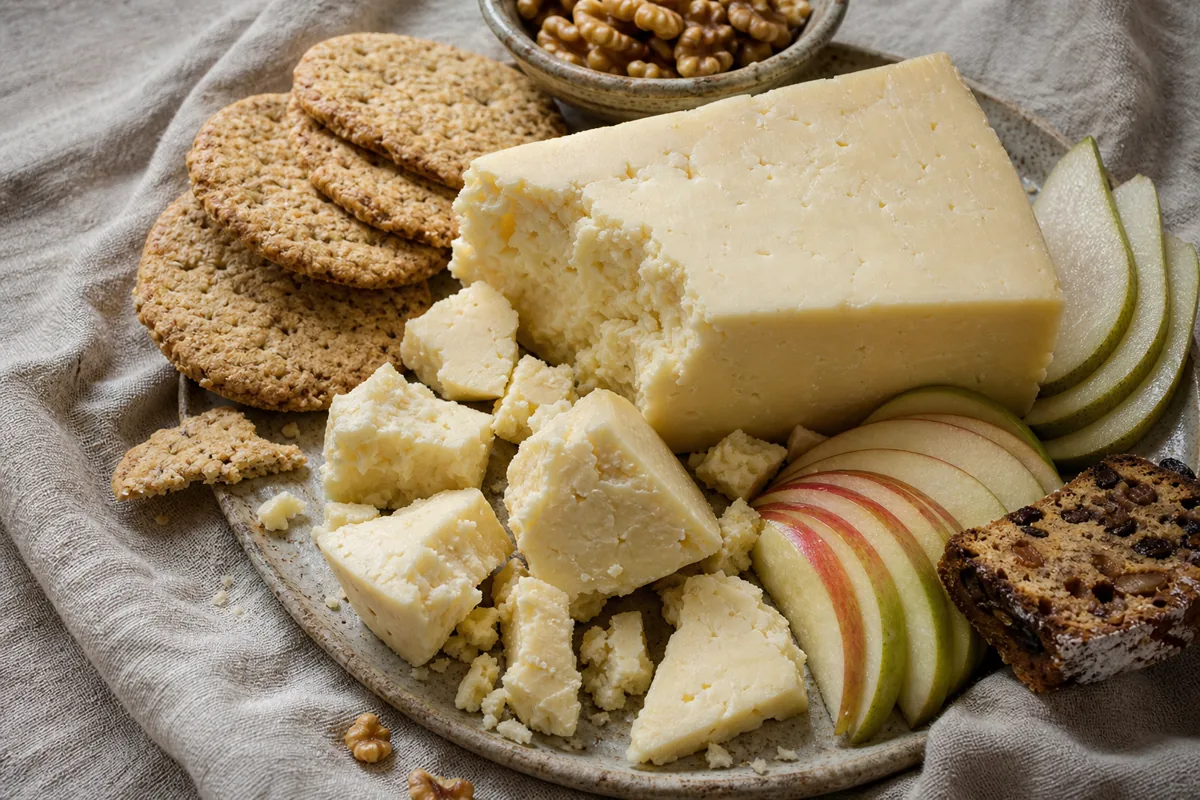
Gorwydd sits at the riper end. Neal's Yard Dairy gives an average age of 2 to 4 months and describes a densely crumbly, lemony centre that gives way to a creamier, more mushroomy layer beneath the edible rind.

The Courtyard Dairy ties the two textures to the rind: Gorwydd has been matured so that the rind breaks down the paste beneath it into a buttery, mushroomy layer around a lemony, lactic core.
That seller puts Gorwydd at three to four months, and the Cheese Society calls three to four months a minimum that is longer than most Caerphillys, a remark that fits Wikipedia's ceiling of ten weeks for Caerphilly in general.
| Source | Cheese described | Age given |
|---|---|---|
| PGI specification | Traditional Welsh Caerphilly | From 10 days, up to 6 months |
| Caws Cenarth | Thelma's Original Caerffili | Up to 6 weeks |
| Neal's Yard Dairy | Gorwydd | Average 2 to 4 months |
| The Courtyard Dairy | Gorwydd | Three to four months |
| The Cheese Society | Gorwydd | 12 weeks and over |
| Wikipedia | Caerphilly in general | Up to ten weeks; ripe in as little as two weeks |
Why Is So Much Caerphilly Made in England?
The cheese took its name from a market town. The PGI specification says the weekly market in Caerphilly became known for quality cheese in the mid-19th century, when market caretaker Edward Lewis stamped good cheeses until his death in 1909.
Wikipedia says the cheese is thought to have been created as food for local coal miners. The Welsh Cheese Company adds that its salt was said to replace minerals lost in hard physical work, its thick rind made it easy to carry and it did not dry out below ground.
Wikipedia puts the move of production to England at the start of the 20th century, when other buyers competed for local milk. The specification instead dates the decline of farmhouse making to October 1933, when the Milk Marketing Board began and farmers could sell milk more profitably to liquid milk depots.
The war then removed what was left: the specification says Caerphilly was prohibited from 1939 to 1945, when rationing allowed only long-keeping cheese such as cheddar, and the restrictions were lifted in 1953.
Somerset kept the style alive. The Courtyard Dairy says Somerset's cheddar makers took it up because it could be sold at 8 weeks or more, against a year for cheddar.
The Courtyard Dairy names Chris Duckett, a farmhouse cheddar maker, as the Somerset maker from whom Todd Trethowan learnt, and Neal's Yard Dairy says Gorwydd started on the Trethowan family farm in West Wales before moving to Puxton Farm in Somerset in 2014.
The Courtyard Dairy and the Cheese Society both give milk as the reason for that move. Wikipedia says the majority of Caerphilly is now made in Somerset and Wiltshire.
Back in Wales, Wikipedia credits Cenarth Cheese with the 1980s revival of farmhouse Caerphilly, after milk quotas left surplus milk that Thelma Adams decided to turn into cheese. The Welsh Cheese Company says the Adams family later campaigned for the PGI, which was granted in 2018.
The Courtyard Dairy instead dates the return of farmhouse Caerphilly to Wales to the Trethowan family's start at Gorwydd Farm in 1996, which is later than the Cenarth revival that Wikipedia and the Welsh Cheese Company describe.
The specification argues that grass ties the cheese to Wales: it cites over 96% of Welsh agricultural land under grass in the 1995 census and says lowland dairy farms can graze cows outside for up to 10 months a year. It names that forage-based milk, with maker skill handed down since the early 19th century, as the link between the place and the cheese.
The PGI names the country of Wales as its area and requires milk from Welsh farms, so a Somerset cheese such as Gorwydd is sold as Caerphilly under its own name, not as Traditional Welsh Caerphilly.
How Does Farmhouse Caerphilly Differ from the Factory Version?
The Welsh Cheese Company describes two very different ways of making Caerphilly: the industrial way gives a young, bland, dry and crumbly cheese, and the traditional handmade way gives a moister cheese with more character. Wikipedia describes the same split, saying the original moist curd was replaced by a much drier version made on an industrial scale.
The Courtyard Dairy puts the cause in the dairy equipment: it says modern Caerphilly evolved toward a sharper, drier cheese because of the large industrial equipment in cheddar dairies, while Gorwydd follows an older recipe that leaves it moister. The specification points the same way, noting that modern commercial creameries often use vacuum rather than traditional pressing.
Wikipedia says the factories that took up Caerphilly after the war made a version that matured very quickly and needed less financing, and that over time the public forgot the difference between the old and new cheeses.
Bee Wilson, writing in the Daily Telegraph in 2011 as Wikipedia reports it, called the old style buttery and the post-war mass-manufactured type young and flavourless, with the texture of chalk.
The PGI gives a dry matter minimum of 55% for younger cheeses. If you want to tell farmhouse from factory, the cues are the maker, the age, and for a Welsh wheel the protected name, whose specification describes curd packed and wheels shaped by hand.
Sources describe farmhouse Caerphilly as moister, handmade and matured longer, and factory Caerphilly as young, dry and crumbly. A named maker, an age of several weeks or more and a Welsh PGI name are the cues they point to.
How Does Caerphilly Differ from Cheddar?
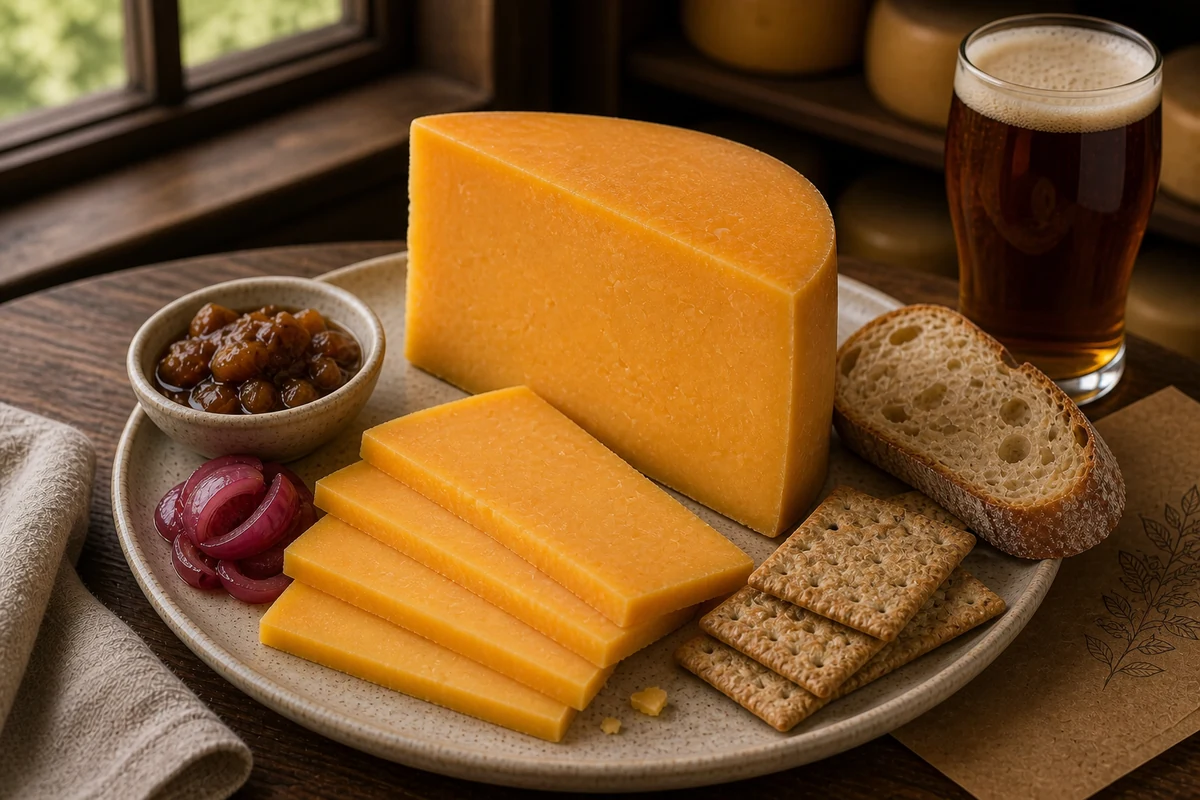
The Welsh Cheese Company separates the two by colour first: Caerphilly is typically very light, almost white, while cheddar is often a warmer golden yellow. It calls the Caerphilly flavour lactic, fresh and lemony with a slightly crumbly texture, and describes cheddar as a rich, creamy hard cheese that takes longer to mature and can taste sharp or tangy.
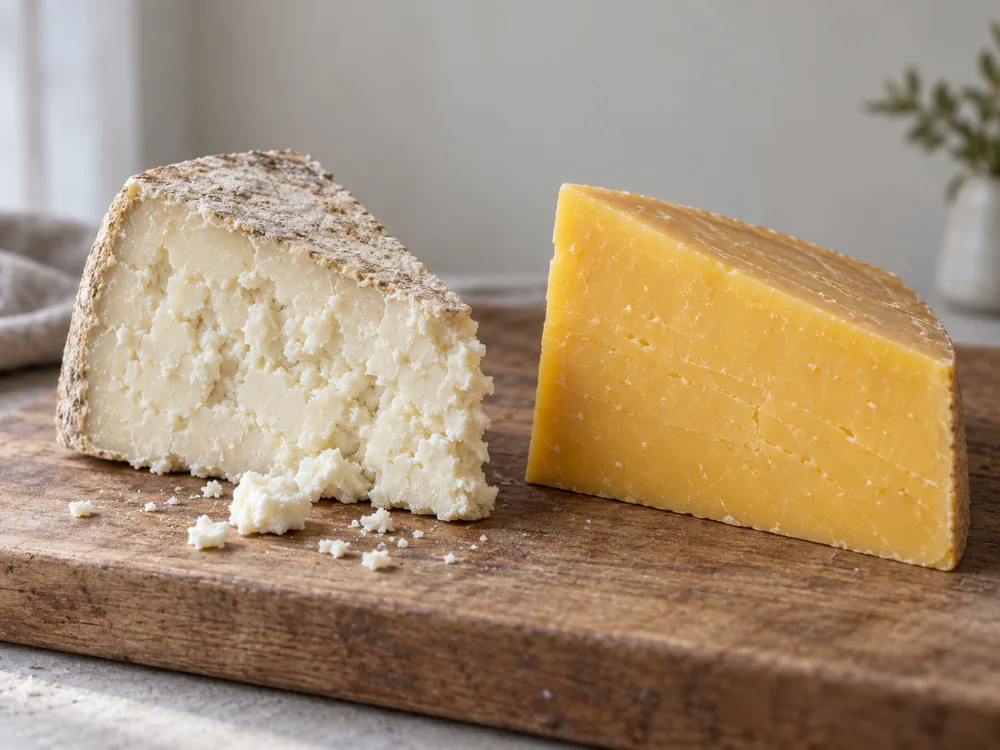
Size separates them as well: the specification sets Caerphilly at 2 to 4 kg and calls it relatively small beside a 20 kg cheddar.
The Welsh Cheese Company adds that both are brilliant for melting and grating into cheesy dishes. A 1987 Chicago Sun-Times article, as Wikipedia reports it, put Caerphilly halfway between ricotta and cheddar, with a mild, salty, buttermilk flavour.
Wikipedia also lists Cornish Yarg, from Cornwall, as a similar style of cheese.
What Should You Check on the Label?
Milk treatment and rennet change from maker to maker, so check the label on the piece you buy. Retailers describing the same cheese do not always agree.
| Product and source | Milk | Rennet |
|---|---|---|
| Thelma's Original Caerffili, Caws Cenarth | Pasteurised organic cow's milk | Vegetarian |
| Gorwydd, Neal's Yard Dairy | Pasteurised cow's milk | Animal |
| Gorwydd, The Cheese Society | Unpasteurised cow's milk | Listed as vegetarian |
| Gorwydd raw batch, The Courtyard Dairy | Raw milk, one batch made on 26 July 2026 | Not stated |
The Courtyard Dairy explains the Gorwydd split: the cheese used to be made with raw milk, and the makers switched to pasteurising in recent years. The label on the piece in front of you is therefore a better guide than an older description.
The specification lists what every Traditional Welsh Caerphilly is ticketed with: a production date that traces back to the Welsh farm milk, a best before date, the weight, the ingredients, the maker's address and the PGI name beside the producer logo.
Thelma's label lists 363 kcal, 29.8 g of fat (18.98 g saturated), 20.9 g of protein and 2 g of salt per 100 g. Those figures describe that one pasteurised organic cheese.
The specification's fat range is a share of dry matter, so it does not line up with the label's 29.8 g per 100 g of whole cheese. The label's 2 g of salt per 100 g is 2%, the top of the 1 to 2% range the specification gives.
Wheel size is the other thing a listing settles: Gorwydd's whole wheel runs about 3.5 to 4 kg, the heavy end of the 2 to 4 kg the PGI gives for the Welsh cheese. Cuts are made by hand, so Neal's Yard Dairy gives a weight range for every fraction and the Cheese Society calls its listed weights approximate.
| Seller and cheese | Whole wheel | Cuts or weights listed |
|---|---|---|
| PGI specification, Traditional Welsh Caerphilly | 2 to 4 kg, 20 to 25 cm across | Miniature cheeses can also be made |
| Caws Cenarth, Thelma's Original Caerffili | Full wheel, 3 kg | Half wheel, 1.5 kg |
| Neal's Yard Dairy, Gorwydd | 3510 to 4058 g | Sixteenth 215 to 254 g, eighth 435 to 507 g, quarter 875 to 1015 g, half 1755 to 2029 g |
| The Cheese Society, Gorwydd | About 4 kg | 250 g to 2000 g, hand cut, weights approximate |
| The Courtyard Dairy, Gorwydd raw batch | Not stated | 250 g, 500 g and 1 kg |
Caws Cenarth's storage line says only to keep the cheese refrigerated, while Neal's Yard Dairy holds Gorwydd wrapped in a humid environment.
The Cheese Society wraps its cuts in breathable waxed paper and says to keep the cheese in the fridge in that paper, avoiding plastic wrap because cheese needs to breathe. The Courtyard Dairy gives its raw batch two weeks of shelf life from delivery.
Is Caerphilly Safe During Pregnancy?
The NHS advice on cheese in pregnancy lists pasteurised or unpasteurised hard cheeses, such as cheddar, gruyère and parmesan, as safe to eat, and the PGI specification calls Traditional Welsh Caerphilly a hard cheese.
The CDC is stricter about milk. It lists hard cheese made with pasteurized milk as safer, and it lists dairy products made from raw milk, along with soft cheese from unpasteurized milk, as riskier.
A raw-milk Caerphilly therefore counts as riskier under the CDC, even though it is a hard cheese. The CDC also says pregnant women are 10 times more likely to get a Listeria infection.
How Do You Serve Caerphilly?
Judges at the True Taste of Wales awards, quoted in the PGI specification, called Traditional Welsh Caerffili a great palate cleanser and particularly good for cooking Glamorgan sausages.
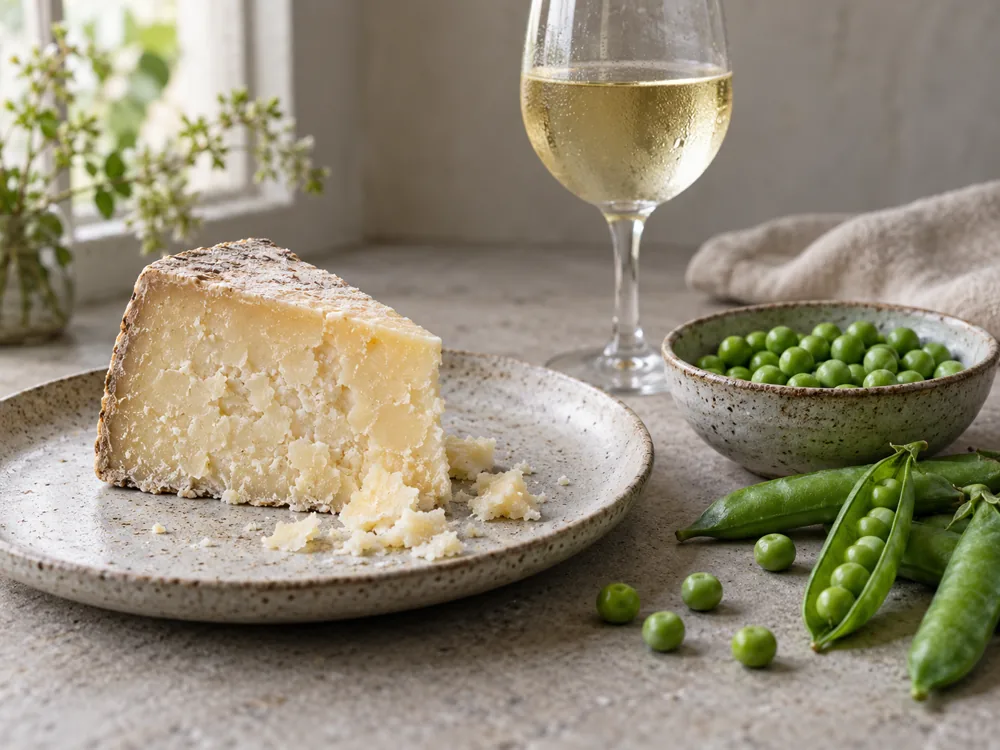
The wine pairings for Gorwydd lean on dry whites. Fiona Beckett of Matching Food and Wine calls basic white burgundy the one outstanding match, and names Mâcon-Villages, Chablis and other cool-climate Chardonnays as wines that work fine.
Her other choices are Chenin Blanc, with Jasnières the one she has had great success with, smooth dry whites such as Soave and Gavi from Italy, and crisp English whites, especially Bacchus, which she serves with fresh peas.
| Pairing | Type | Why It Works |
|---|---|---|
| White burgundy | Wine | Fiona Beckett calls basic white burgundy the outstanding match for Gorwydd and names Mâcon-Villages and Chablis. |
| English Bacchus | Wine | Fiona Beckett suggests it especially when the cheese is served with fresh peas. |
| Jasnières | Wine | Fiona Beckett names this Chenin Blanc as one she has had great success with. |
| Soave or Gavi | Wine | Fiona Beckett lists these smooth dry Italian whites among her matches. |
| Pickles and a pint | Food | The Cheese Society suggests both with Gorwydd. |
The Cheese Society also suggests eating a Gorwydd wedge from the outside in, because the lemony centre and the mushroomy rind do different things.
SOURCES & REFERENCES
The PGI specification describes a mild, slightly lemony taste with a fresh aftertaste. Neal's Yard Dairy describes matured Gorwydd as lemony in the centre and more mushroomy under the rind.
It began in Wales, and only cheese made in Wales from Welsh farm milk can carry the Traditional Welsh Caerphilly PGI. Wikipedia says most Caerphilly is now made in Somerset and Wiltshire.
Some is and some is not. The PGI allows raw or pasteurised milk, Caws Cenarth uses pasteurised organic milk, and The Courtyard Dairy says Gorwydd switched from raw to pasteurised milk in recent years.
The Welsh PGI allows 10 days to 6 months. Caws Cenarth ages its cheese up to 6 weeks, while Neal's Yard Dairy gives an average of 2 to 4 months for Gorwydd.
Yes. Judges quoted in the PGI specification call it particularly good for Glamorgan sausages, and the Welsh Cheese Company says it is brilliant for melting and grating into cheesy dishes.