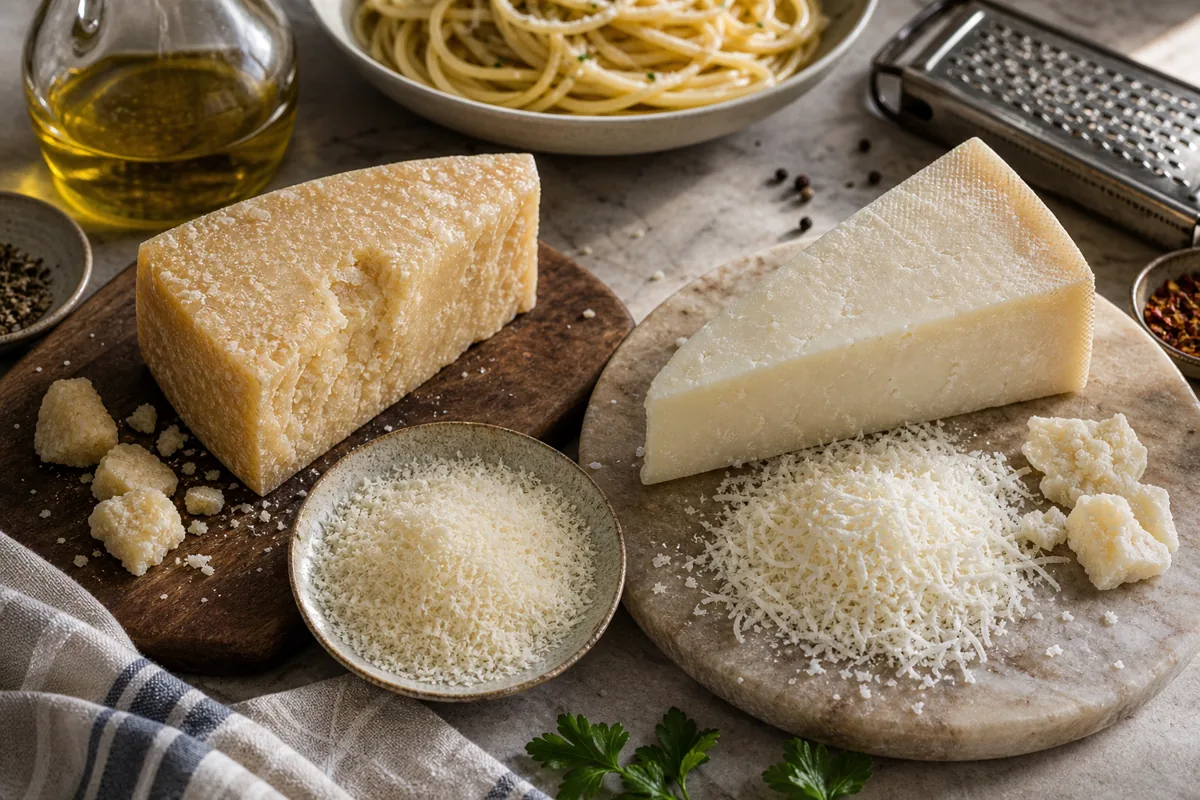
Parmigiano-Reggiano is one protected cheese made to one Italian rulebook. Parmesan outside the EU is a wider label that, in the United States, follows a separate federal standard.
Parmigiano-Reggiano is a protected Italian cheese made from raw cow's milk and aged at least 12 months. Parmesan sold in the United States meets a federal standard that allows pasteurized milk and a 10-month minimum.
Which one to buy depends on where the cheese ends up: eaten on its own, melted into a sauce, simmered as a rind, or served to someone who is pregnant.
In This Article
What Is the Difference Between Parmigiano-Reggiano and Parmesan?
Inside the European Union there is none: in 2008 an EU court decided that the name Parmesan refers only to Parmigiano-Reggiano, and the Consortium's FAQ says the word may be used only for the true cheese.
Outside the EU, Wikipedia says Parmesan can name a locally made imitation. These cheeses come chiefly from the US and Argentina, often under names such as Parmesana or Parmezano.
In the United States the word still has a legal meaning. Federal rule 21 CFR 133.165 sets a standard for "Parmesan and reggiano cheese" that departs from the Italian specification on several points.
| Attribute | Parmigiano-Reggiano (PDO) | US Parmesan (21 CFR 133.165) |
|---|---|---|
| Where made | Five provinces of northern Italy | No place set |
| Milk | Raw, partially skimmed cow's milk, no heat treatment | Cow's milk that may be pasteurized or clarified |
| Ingredients | Milk, salt and rennet; no additives | Also calcium chloride up to 0.02%, enzymes up to 0.1% of the milk weight and harmless artificial colouring |
| Minimum age | 12 months | 10 months |
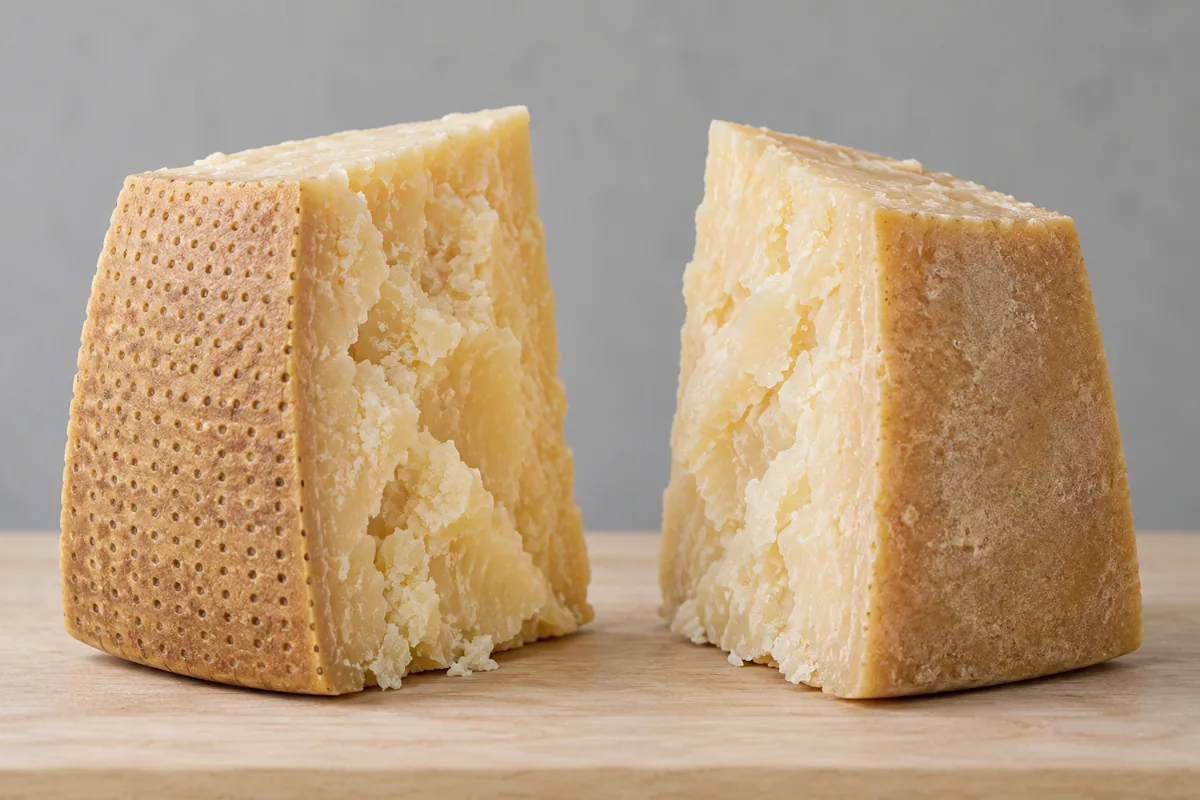
| Rind | Pin-dot marks of origin and a casein plate | May be coated or coloured; no origin marks set |
| Inspection | Every wheel, per the specification | None set in the standard |
The US standard does fix the cheese's make-up: no more than 32 percent moisture, at least 32 percent milkfat in the solids, which matches the 32 percent minimum fat on dry matter in the Italian specification, and a granular texture with a hard, brittle rind that grates readily.
It is looser about the milk. The standard defines milk as cow's milk that may have fat separated from it or have cream, skim milk, concentrated skim milk or nonfat dry milk added, with water to rebuild the concentrated forms.
The milk may also be bleached with benzoyl peroxide, in which case vitamin A is added to the curd and artificial colouring is not used.
Its recipe is not binding either: the rule accepts any other procedure that gives a finished cheese with the same physical and chemical properties, so the fixed points are moisture, milkfat and a cure of at least 10 months.
What it leaves open is the place, the herd and the feed. Those are the rules the Italian specification is built on.
Where and How Must Parmigiano-Reggiano Be Made?
The specification limits production to five provinces of northern Italy: Parma, Reggio Emilia and Modena, the part of Bologna to the left of the River Reno and the part of Mantua to the right of the River Po.
The Consortium's FAQ says every step happens inside that area, from cow breeding to cheesemaking and packaging.
The milk is raw and partially skimmed, from cows fed mainly on forage from the area. Article 1 of the specification bans any heat treatment, centrifugation, bactofugation or microfiltration of that milk.
The Consortium's FAQ lists three ingredients, milk, salt and rennet, with no additives and no preservatives.
The raw milk comes from two milkings. The evening milk is partially skimmed by letting the cream rise naturally in open steel tanks, and the morning milk is mixed with it on delivery, according to Article 3 of the specification.
The starter is a natural whey culture: sweet whey left over from the previous cheesemaking ferments on its own under controlled temperature, and no bought lactic cultures may be added to it. Only calf rennet sets the milk, in bell-shaped copper vats that make up to two wheels each.
Taste of Home, citing the Consortium, puts the milk at about 550 liters for each wheel. The finished wheel weighs at least 30 kg, measures 35 to 43 cm across and 20 to 26 cm high on the side, and has a rind about 6 mm thick.
After a few days in the mould the wheels go into brine, and Wikipedia gives 20 to 25 days in the bath. The specification counts the 12-month minimum from moulding and sets a floor of 16°C for the maturation room in summer.
The feed rules reach the farm. At least half of the forage dry matter must be hay, at least 75 percent of it must be grown in the area of origin, and farms may not use or keep silage of any kind, wrapped bales and trenches included.
The rules give two reasons: silage kept near the cattle housing can contaminate the environment, and the cows' rumens need to adapt to a silage-free diet.
Does Parmigiano-Reggiano Taste Better Than Parmesan?
Taste of Home says it does. At a cheesemonger's side-by-side tasting, it says, Parmesan will taste saltier and more acidic next to the deeply rich, nutty flavour of Parmigiano-Reggiano.
Age is part of the gap: the Consortium's FAQ says most Parmigiano-Reggiano on the market is 24 to 36 months old, well past the US floor of 10 months. Taste of Home ties the longer ageing to a richer, more complex flavour, with even a bit of funk.
The Consortium's tasting guide says graininess, crumbliness and solubility all increase with age, saltiness rises while sweetness fades, and the straw-yellow colour grows more intense.
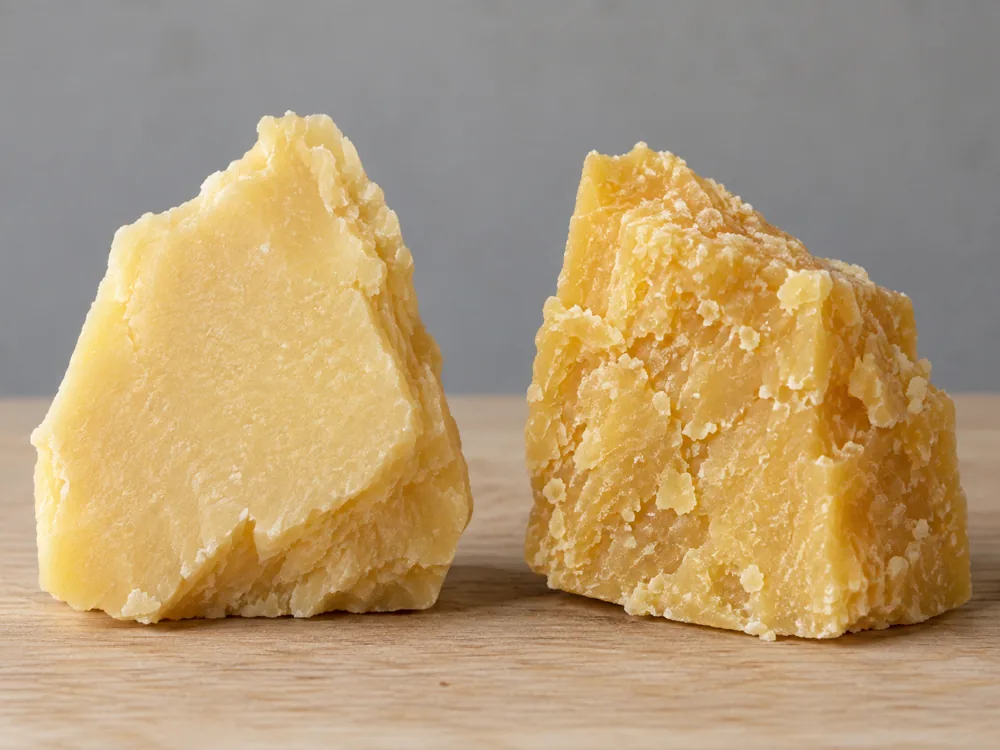
The mechanism is proteolysis: enzymes released by lactic bacteria break the milk proteins into smaller pieces, free peptides and amino acids, and the guide says this breakdown shapes the cheese's structure, sensory properties and digestibility.
The specification turns that into a measurable limit, requiring free amino acids of more than 15 percent of the total proteins, checked by chromatography.
The small white crystals that crunch in older cheese are tyrosine, an amino acid that the Consortium says crystallises when it is free and present in high concentrations. The FAQ calls them good evidence of maturation, because they increase in number and size with longer ageing.
Wikipedia adds that Parmigiano-Reggiano is high in glutamate, with as much as 1.2 g per 100 g, and says that concentration explains its strong umami taste.
The Consortium also lists the aromas each age should show:
- 12 to 18 months: milk, yoghurt and fresh fruit
- 22 to 24 months: fresh fruit, nuts and meat stock
- 30 to 36 months: spices, nuts and meat stock
- 40 months and more: pleasant scents of spices
Crunch alone does not settle which cheese you are eating, since the US standard also describes Parmesan as granular.
How Can You Tell Real Parmigiano-Reggiano?
The dairy marks each wheel with origin information when it is made, and the Consortium adds a selection mark after inspection; its FAQ and the specification's marking rules explain each one.
| Mark | Where | What it tells you |
|---|---|---|
| Pin-dot lettering | Repeated around the side | The name, the dairy number, the month and year of production, and the PDO and Consortium wording |
| Casein plate | Surface of the wheel | A unique code of letters and numbers for that one wheel, plus a data-matrix code |
| Oval fire-brand | Applied to wheels at 12 months | A wheel that passed the quality inspection; the oval carries the year of production |
| Parallel grooves | Along the side that carries the pin dots | Medium-grade cheese |
| Rind scraped bare | Whole wheel | Downgraded cheese with its origin marks removed, which may not refer to the PDO |
| Piece-and-wheel logo and minimum age | Pre-packed pieces | The logo and the minimum maturation; pieces are cut, grated and packed inside the area |
A wedge without dots is not proof of a fake. The Consortium's FAQ says the stencilling band has a set length and hand-made wheels vary in size, so part of a large wheel's side can be left blank, and pieces cut from the top or bottom face carry no lettering either.
A US Parmesan label works differently, because 21 CFR 133.165 requires every ingredient to be declared, so any calcium chloride, colouring or enzymes appear in the ingredient list.
What Do the Grade Marks on Parmigiano-Reggiano Mean?
Every wheel is inspected by Consortium experts, who judge its outside, tap it with a percussion hammer, probe it with a screw-needle and cut at least one wheel from each production batch to examine the paste.
A hollow sound under the hammer marks a wheel the specification calls loose, and the needle lets the inspector smell inside a hole for off-odours before deciding whether it counts against the wheel.
The first category covers first-grade wheels with no defects, plus the zero and one classes, which allow surface splits, small erosions or a few holes up to 3 to 4 cm as long as probing finds no off-odour.
The medium-grade category allows holes wider than 3 to 4 cm, hornet's nests (patches of spongy paste), many small holes or horizontal slits, again without off-odours. The FAQ says these flaws leave the typical aroma and taste unaltered, so on the Consortium's account the grade separates structure from flavour.
Wheels that are swollen, spongy, hollow at the centre or smelling wrong are downgraded: Consortium staff scrape off the rind so the origin marks disappear, and the cheese may no longer refer to the PDO. The FAQ says this de-rinded cheese is used for grated cheese mixtures or for melting.
What Does the Age on a Parmigiano-Reggiano Label Tell You?
Twelve months is the longest minimum maturation of any PDO cheese, according to the Consortium's sensory guide, and there is no ceiling: the FAQ says wheels are sold at 40 months and even beyond 100.
On a pack, the age is a labelling duty: the specification requires the label of pre-packed pieces over 15 grams to state the minimum maturation. Producers may add a descriptive word beside the months: delicato for 12 to 19 months, armonico for about 20 to 26, aromatico for about 27 to 34 and intenso for about 35 to 45.
Wikipedia's infobox lists older trade terms on another scale, vecchio at 18 to 24 months and stravecchio at 24 to 36, so a word from one scale does not map onto the other and the month count is the figure to compare.
Dairies can also ask for an Export mark from 18 months, or a Premium mark from 24 months for wheels whose sensory rating beats the Parmigiano-Reggiano average, and both go only on first-grade cheese.
Compare labels by the month count, since the descriptive words and the older trade terms use different scales. Pre-packed pieces over 15 grams must state the minimum age.
What Is in Pre-Grated Parmesan?
The US rule for grated cheese, 21 CFR 133.146, allows anticaking agents, antimycotics, spices and flavourings, as long as the flavourings do not imitate cheese. The label must say grated cheese and name the cheese varieties used.
The rule also sets a floor of 2 percent of the finished weight for each cheese used, and it allows moisture to be removed from the cheese but not added.
The name says something about the blend. A grated cheese named for one variety holds only that variety, a name pairing parmesan and romano means only those two at 25 percent or more each, and a name ending in with other grated cheese means the extra varieties together make up no more than 10 percent.
Wikipedia cites 21 CFR 133.146 for a 4 percent cellulose limit, but the rule's text puts no percentage cap on the anticaking agent.
The fraud case behind the 2016 headlines was about missing cheese. Wikipedia reports FDA findings that no Parmesan went into a Pennsylvania maker's grated cheese labelled Parmesan, which was apparently a mixture of other cheeses and cellulose, and a sentence of three years' probation and a $5,000 fine.
Grated Parmigiano-Reggiano is defined separately, by Article 5 of the specification.
| Point | US grated cheese (21 CFR 133.146) | Grated Parmigiano-Reggiano (specification) |
|---|---|---|
| Cheese used | One or more varieties that have a US standard, each at 2 percent of the weight or more | Whole Parmigiano-Reggiano PDO cheese, plus trimmings from its own processing |
| Added substances | Anticaking agents, antimycotics, spices and flavourings that do not imitate cheese | None; grated and packed straight away without any treatment |
| Moisture | May be removed from the cheese, not added | 25 to 35 percent |
| Texture | No requirement in the rule | Non-powdery, with no more than 35 percent of particles under 0.5 mm |
| Rind | No requirement in the rule | No more than 18 percent by weight |
| Where made | No place set | Grated and packed inside the production area |
Should You Cook With Parmigiano-Reggiano or Parmesan?
For a sauce, the format matters as much as the name. Food Republic quotes recipe creator Joanne Gallagher saying the anticaking agents on pre-shredded cheese stop it melting smoothly and leave the sauce gritty or grainy.
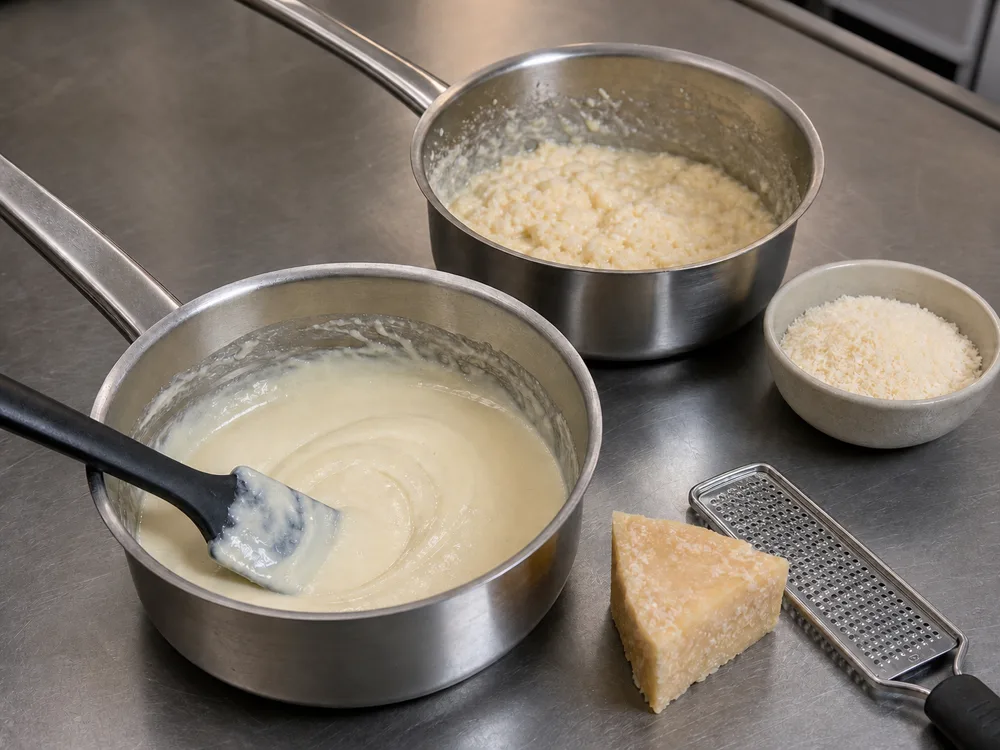
Her fix is to grate the cheese from a block, which she says melts evenly into a smooth, glossy sauce.
Neither cheese is a strong melter, though. The same Food Republic piece says hard, aged, low-moisture cheeses such as Parmigiano-Reggiano do not melt smoothly, and it points to cheeses with more fat and moisture such as Gruyère for a cheese sauce.
Taste of Home takes a more favourable line on the Italian cheese, naming the creamy sauce for cacio e pepe as one of its uses. Both accounts have the cook grating the cheese fresh, one with a rasp grater and the other from a block.
The rind is where the two part ways in the kitchen. The Consortium says Parmigiano-Reggiano rind can be eaten because the cheese has no additives or preservatives, and it advises cleaning the rind well before use.
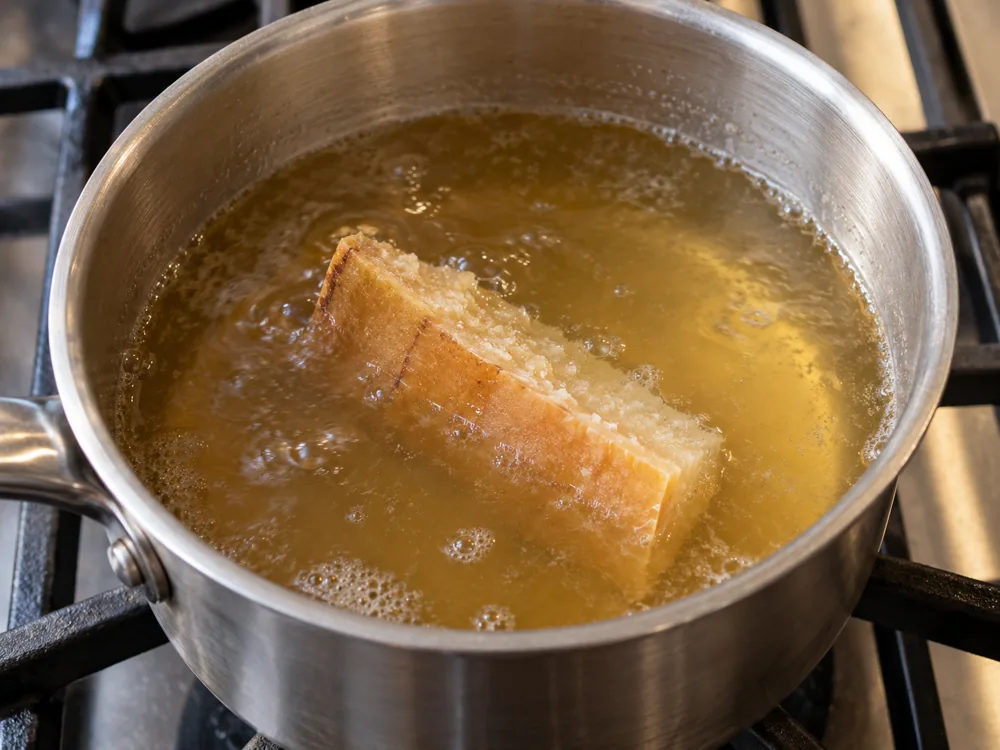
Wikipedia describes pieces of the hardest crust simmered in soups, broths and sauces for flavour, and grilled as a snack when they have no wax on them.
The US standard lets a Parmesan rind be coated or coloured, so a domestic rind is worth checking before it goes into the pot.
For everyday cooking with the Italian cheese, Wikipedia lists grating over pasta dishes, stirring into soups and risottos, and shaving over salads. The Consortium also matches each age to a job.
| Use | How It Works |
|---|---|
| 12 to 18 months | Aperitifs and salads, per the Consortium. |
| 22 to 24 months | The dishes of the Italian tradition. |
| 30 to 36 months | Filled and baked pastas, or served with fruit. |
How Do You Serve and Store Parmigiano-Reggiano?
The Consortium puts the ideal tasting temperature at 16 to 17°C, so cheese from the refrigerator needs at least 1 hour out before tasting, and a vacuum pack is opened at least 30 minutes ahead.
The cheese is not sliced. The traditional almond-shaped knife is pressed tip-first into the paste and used as a lever to break off small pieces, a way of cutting that matches a paste the specification calls fine-grained and flaky.
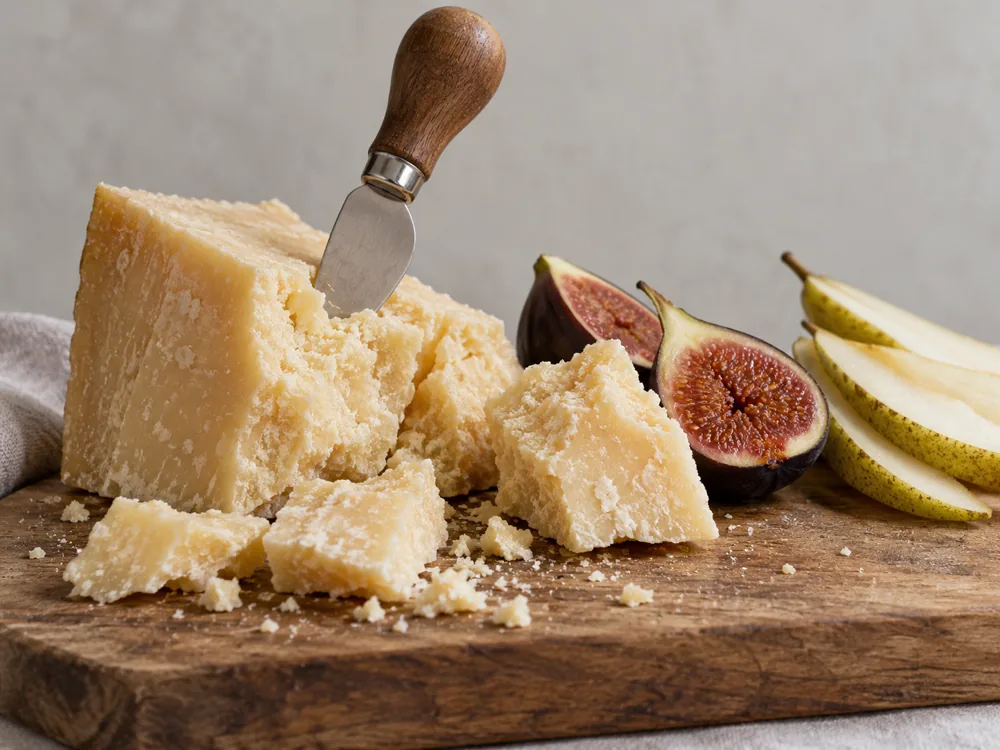
For grating, Taste of Home recommends a rasp grater such as a Microplane, whose fine teeth make a light, fluffy shred, so less cheese is needed, and which is easier to clean than a box grater.
On a board, Taste of Home pairs fresh and dried figs or thin, sweet-tart slices of pear and apple with the cheese, and it suggests a crisp pinot grigio to go with it.
The Consortium's guide matches wine to age instead: sparkling white wines with 12 to 18 months, medium-bodied wines at 22 to 24 months, and structured wines for cheese of 40 months and more.
Storage depends on keeping the paste intact. The Consortium's FAQ says freezing pieces is not a good idea, because the structure of the paste changes and it loses its characteristic crumbliness.
Once a wedge is open, contact with air makes its outer part dry and hard, so the FAQ recommends a glass or plastic container or food-grade plastic film.
Is Parmigiano-Reggiano or Parmesan Safer in Pregnancy?
The NHS lists pasteurised or unpasteurised hard cheeses, parmesan among them, as safe to eat in pregnancy.
The CDC draws its line at the milk. Its safer list names hard cheese made with pasteurized milk, such as Parmesan, while its riskier list includes unpasteurized (raw) milk and dairy products made from raw milk.
Under the CDC lists, raw-milk Parmigiano-Reggiano falls on the riskier side and a US Parmesan made with pasteurized milk falls on the safer side. The CDC's reason is that pregnant women are 10 times more likely to get a Listeria infection.
How Do Grana Padano and Other Grating Cheeses Compare?
Grana Padano is the nearest protected relative, and Taste of Home sets the two side by side: Grana Padano comes from 33 provinces in the north against five for Parmigiano-Reggiano, and it often contains lysozyme, an egg-white protein that helps control fermentation.
Ageing differs too. Taste of Home says Grana Padano is typically aged about 15 months, against a 12-month minimum and a usual 24 or more for Parmigiano-Reggiano, and Wikipedia gives Grana Padano a minimum of nine months.
Wikipedia adds that Grana Padano's cows may be fed silage as well as grass and milk from several different days may be used.
The Parmigiano-Reggiano specification bars silage and keeps the milk to the two milkings of the day, with up to 15 percent of the morning milk held back for the next day's cheesemaking.
Wikipedia describes Reggianito as an Argentine cheese similar to Parmigiano-Reggiano, developed by Italian-Argentine cheesemakers and made in smaller wheels aged for less time.
Parmigiano-Reggiano or Parmesan: Which Should You Buy?
Buy Parmigiano-Reggiano when the cheese is eaten on its own, shaved or grated at the table, since Taste of Home's side-by-side tasting favours it. It is also the one whose rind, once cleaned, can go into the soup pot.
Choose a US Parmesan made with pasteurized milk when a pregnant eater follows CDC guidance, and grate either cheese from a wedge when it has to melt into a sauce.
SOURCES & REFERENCES
Parmigiano-Reggiano vs Parmesan FAQ
Inside the EU, yes: a 2008 court ruling reserves the word Parmesan for the protected cheese. Outside the EU the name can cover local cheeses, and US Parmesan follows a federal standard with a 10-month minimum age and pasteurized milk allowed.
The US rule for grated cheese allows anticaking agents, and Wikipedia names cellulose as the one used. The FDA case behind the headlines, in Wikipedia's account, involved a maker whose grated Parmesan contained no Parmesan at all.
Yes. The Consortium says the rind is edible because the cheese contains no additives or preservatives, and it advises cleaning the rind before use.
For pre-packed pieces over 15 grams, yes: the specification requires the minimum maturation on the label, and a pack may add a word such as delicato or intenso.
The NHS lists both as safe because they are hard cheeses. The CDC's safer list asks for hard cheese made with pasteurized milk, which rules in a pasteurized US Parmesan and leaves raw-milk Parmigiano-Reggiano on its riskier list.