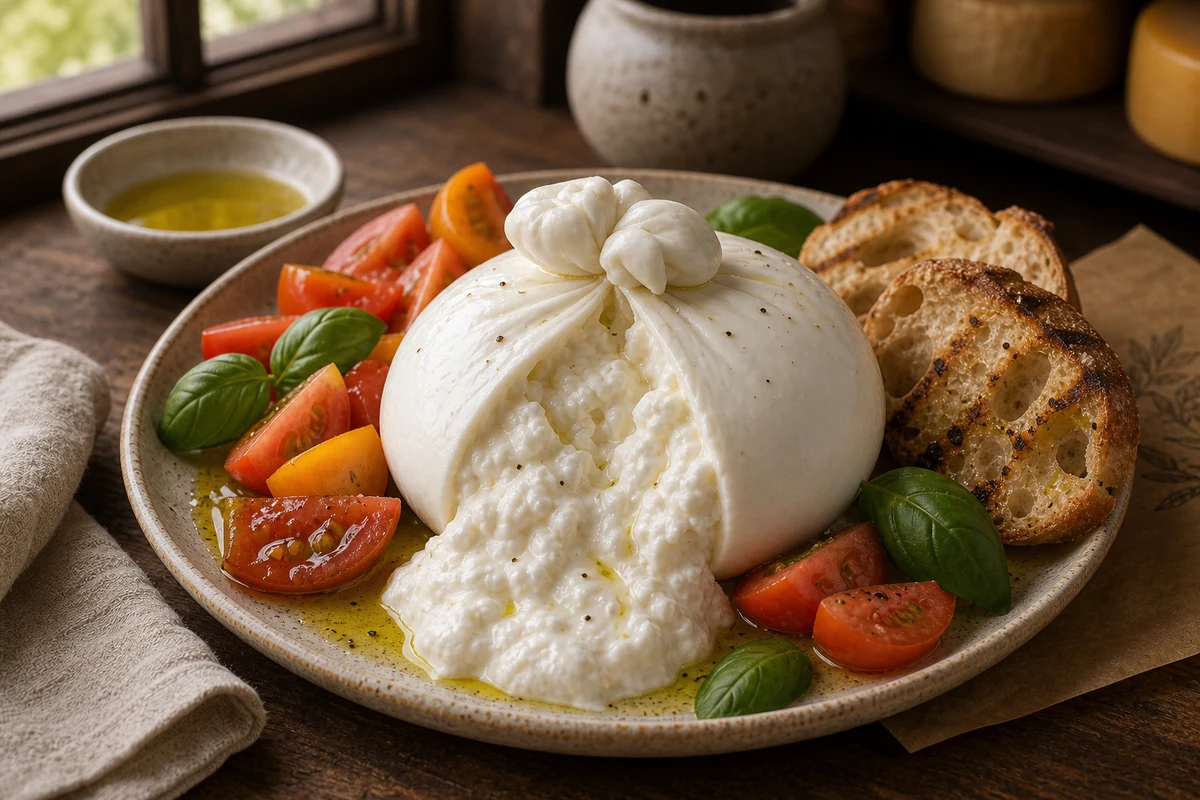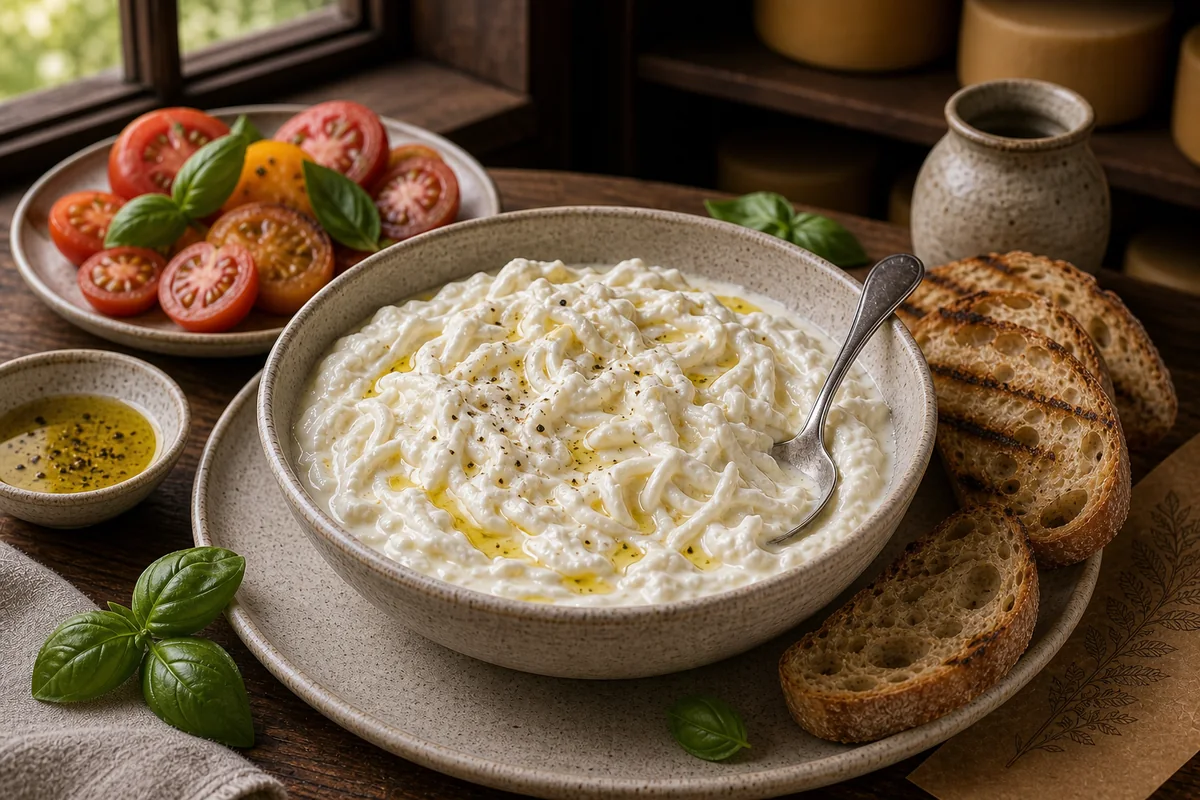
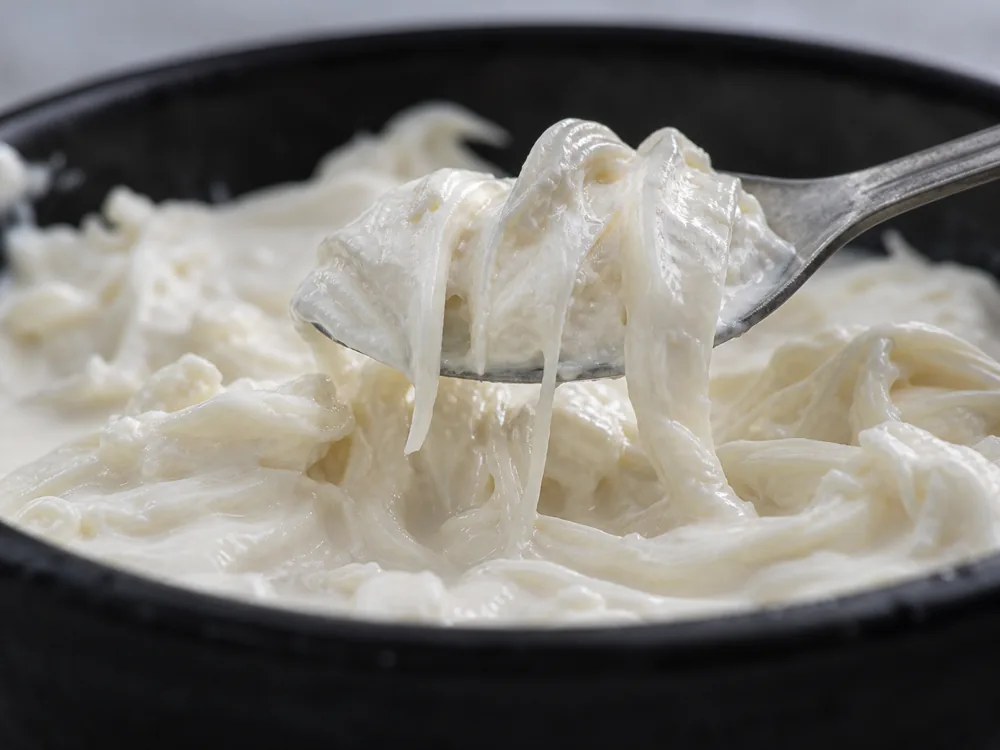
Stracciatella is a fresh cheese made of stretched curd torn into strips and mixed with cream. It is the filling inside fresh burrata, and some dairies also sell it on its own in tubs.
Makers and dairy boards suggest you spoon it onto pizza, pasta, vegetables and bread.
When you buy a tub, read the label rather than trusting the name: milk treatment, ingredients and use-by dates differ from one maker to the next.
In This Article
What Is Stracciatella Cheese?
Stracciatella comes from Puglia in southern Italy. Wisconsin Cheese says the name comes from the Italian word straccia, meaning rags or shreds.
The Burrata di Andria specification gives a more exact reason: the name comes from how the filling is made, because the stretched curd is torn by hand into irregular strips.
Every account of how stracciatella and burrata began starts from surplus stretched curd and cream. The accounts differ on whether the pouch arrived with the filling or after it.
The specification records an oral tradition that Lorenzo Bianchino invented burrata in the early decades of the 20th century. After heavy snow stopped him taking milk to town, he mixed leftover stretched curd with cream and wrapped it in a pouch of stretched curd.
The specification adds that Bianchino applied the principle of the mantèca, an aged stretched-curd casing that keeps butter, to a fresh product. One of the earliest mentions it cites is a Touring Club guide of 1931.
Wisconsin Cheese, like the specification, has the filling and the pouch arriving together. Fine Dining Lovers instead tells it with unsold mozzarella knots that had gone firm, peeled into strands and soaked in cream, with the pouch added later.
The protected name Burrata di Andria covers burrata made and packed anywhere in the region of Puglia, not only in the town of Andria. Its specification describes the whole burrata and uses stracciatella for the filling.
Italian assessors named three cues for that filling: cream that flows out when the cheese is cut, internal strips of varying size, and aromas of fresh or cooked milk, butter and cream.
Those cues describe the filling inside burrata, not every tub, and standalone tubs each print their own recipe, so the milk, cream and salt in the one you buy are whatever its own label lists.
Wisconsin Cheese describes stracciatella as shreds of fresh mozzarella bathed in cream.
Wisconsin Cheese says the curd can be set from the milk of cows or buffalo, so the base of your tub may be cow's milk mozzarella or mozzarella di bufala. The De' Magi, Abbasciano and BelGioioso tubs all name cow's milk.
Stracciatella is also the name of a gelato and a soup.
How Is Stracciatella Made from Stretched Curd and Cream?
The filling starts before the stretch: rennet sets the milk in a few minutes, and the Burrata di Andria PGI specification allows natural calf rennet or a microbial coagulant.
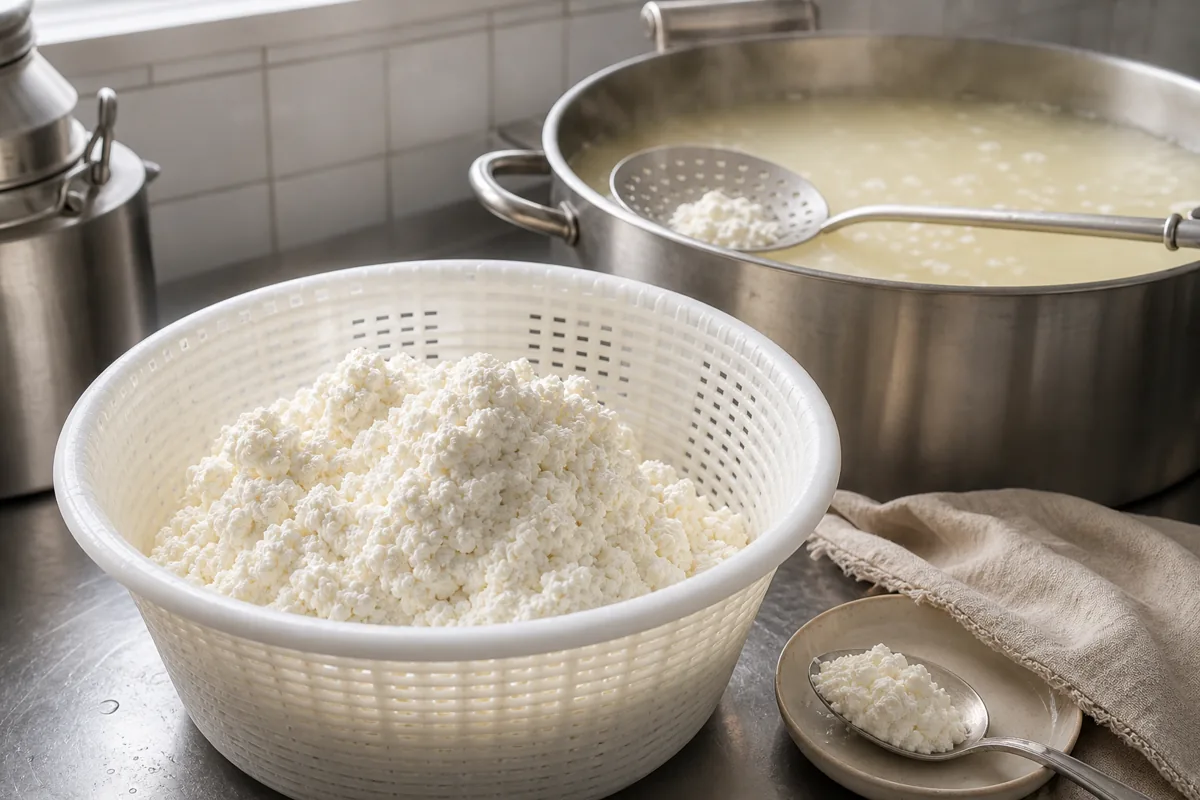
The curd is then cut into grains the size of a hazelnut, which rest while the whey drains and the curd acidifies. That readies it for stretching in boiling water, the first of the stages below.
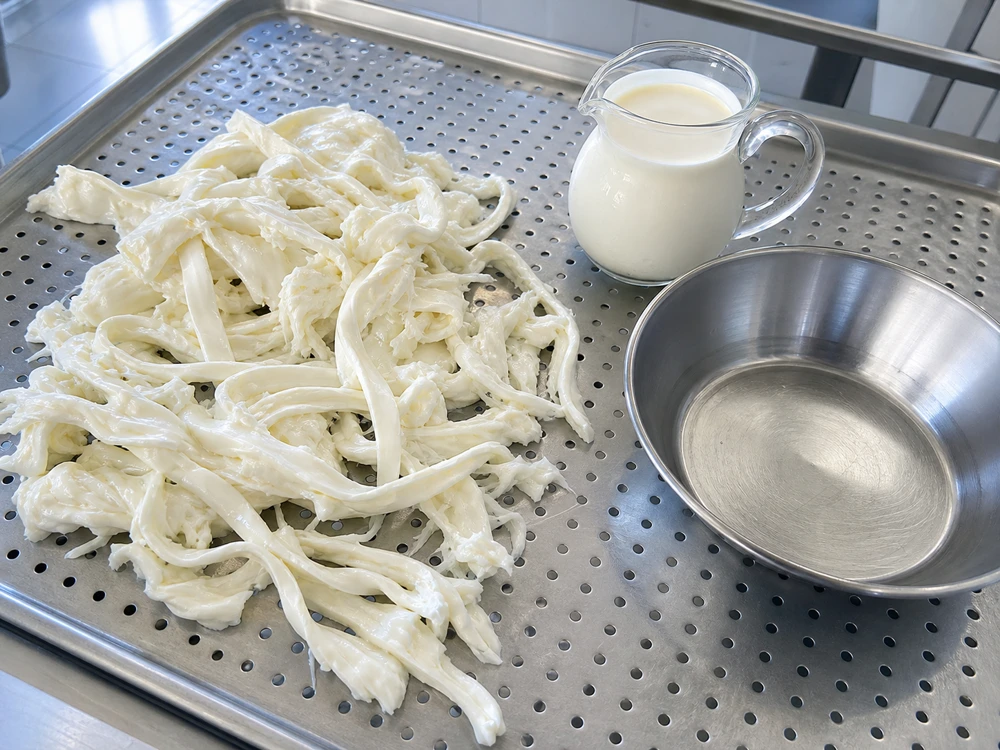
The specification adds a rule for the tearing: it must be done by hand, and the strips must not be cut or broken into a minced mass. It says hand tearing also lets the cream blend better into the curd.
Makers may add salt at three points: in the curd during stretching, in a brine bath, or in the cream.
Fine Dining Lovers says the strands thicken the cream as they soak it and that, after resting, part of the cream is absorbed. Coley Cooks reports the same for its home version, which is why it adds cream until the mixture looks spoonable.
Does the Label Show Whether the Curd Is Cultured or Acid-Set?
Fine Dining Lovers calls authentic stracciatella a cultured product: it says living microorganisms digest the lactose in the cream, thicken it and develop subtle umami notes. It describes the quick acid-set version as fine but simpler, closer to fresh milk and cream.
The specification permits either route, so a PGI burrata can use cultures, acid or both.
The specification lets a dairy acidify the milk with food acids, citric or lactic, or with selected cultures, a starter milk or a whey starter. Where acid is used, the milk is acidified and then warmed to 35 to 37 C in the vat; with cultures, the milk is warmed first and inoculated at 36 to 39 C.
You can read a tub's ingredient line against the two routes. Abbasciano's names citric acid (E330) as an acidity corrector and BelGioioso's lists vinegar, both of which fit the acid route, while De' Magi's lists milk enzymes and no acid, which leaves its method open.
How Does Stracciatella Differ from Burrata?
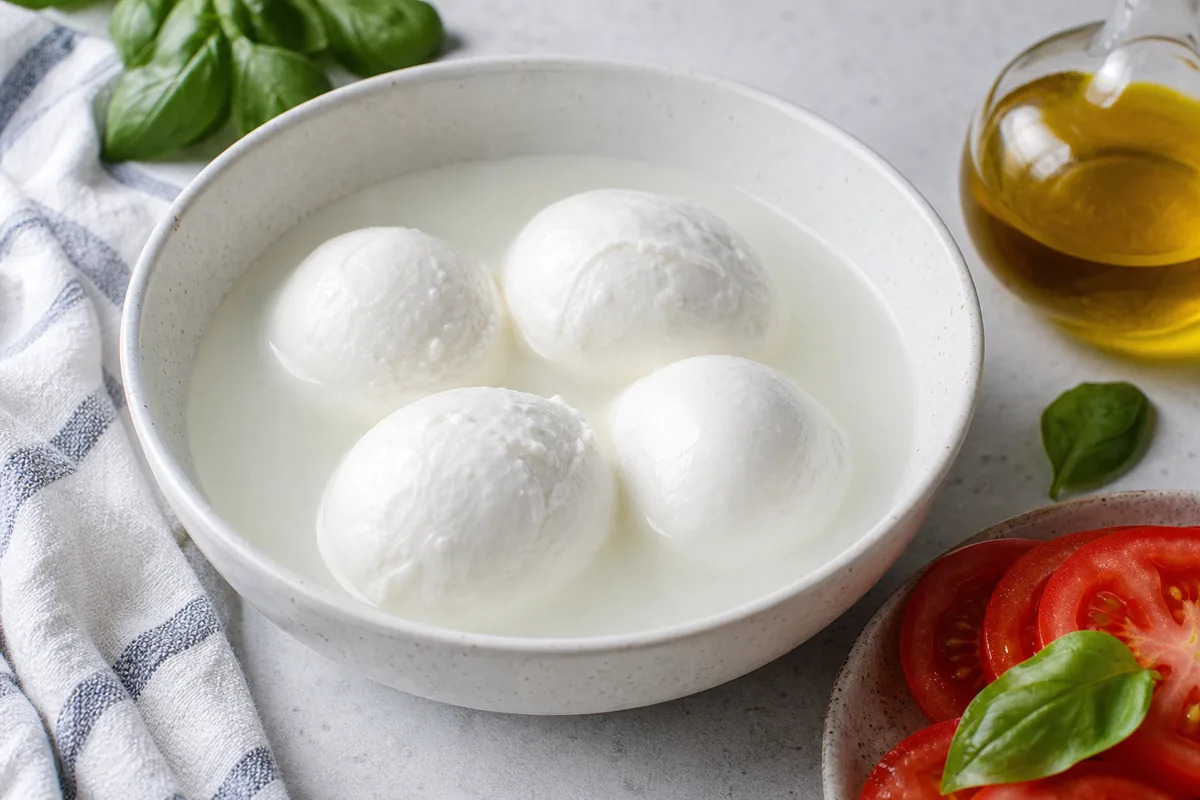
Stracciatella is the filling, and burrata is the whole pouch. The Burrata di Andria specification describes a shell made only of stretched curd, at least about 2 mm thick, that encloses the cream-and-strips mixture.
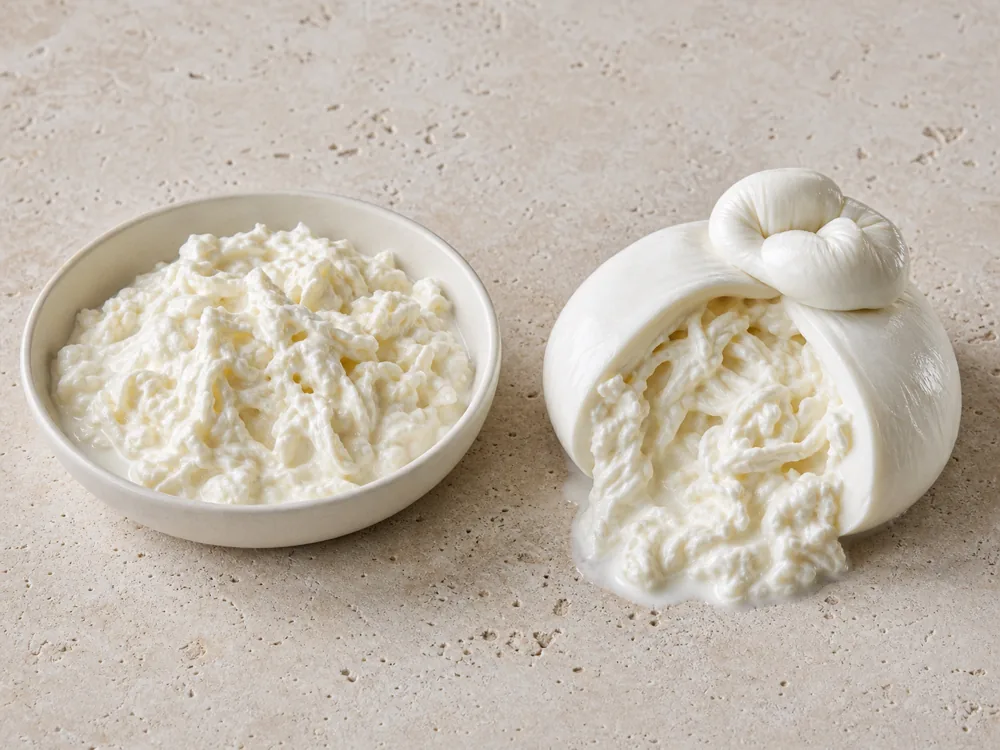
| Stracciatella | Burrata |
|---|---|
| Strips of stretched curd mixed with cream | A stretched-curd pouch holding that mixture |
| No shell | Shell of stretched curd, at least about 2 mm thick (Burrata di Andria PGI) |
| Sold in tubs; De' Magi lists 250 g and 1 kg | Whole burrata weighs 100 g to 1 kg (Burrata di Andria PGI) |
| Spooned from the tub (Wisconsin Cheese) | Cut open, and the cream flows out (Burrata di Andria PGI cue) |
Wisconsin Cheese says stracciatella is too soft to slice and suggests you use a spoon or a cheese spreader instead.
Makers describe their tubs as the burrata filling: BelGioioso names its product Burrata Filling, Abbasciano calls its tub stracciatella di burrata, and De' Magi says its cheese is what goes inside burrata. Wisconsin Cheese adds that BelGioioso sells the stracciatella from its own burrata as a standalone product.
Coley Cooks calls the two almost identical but says burrata filling tends to have smaller mozzarella bits, while stracciatella has longer, thinner strands soaked in cream. Inside burrata, the specification describes strips that vary in size, so strand length gives you no fixed line between the names.
Fine Dining Lovers says the only thing burrata adds is the thin outer layer, with the flavor and richness coming from the filling. If your dish is built on the creamy center, a tub gives you that part alone.
Can You Use Stracciatella in Place of Ricotta?
Wisconsin Cheese says stracciatella can stand in for ricotta in your lasagna or stuffed shells, with extra richness from the cream.
Coley Cooks says the texture depends on full-fat cream and full-fat mozzarella, which is where that richness comes from.
What Are the Best Ways to Use Stracciatella?
Fine Dining Lovers says the best way to serve stracciatella is to spoon it straight from the container, and Coley Cooks spoons it over grilled bread, tomatoes and grilled vegetables. BelGioioso suggests topping pasta dishes and pizza, and Wisconsin Cheese lists crostini, tomato and basil salads, and pizza toppings.
| Use | How It Works |
|---|---|
| Crostini and Bread | Wisconsin Cheese suggests crostini and fresh bread. Fine Dining Lovers adds bruschetta with olive oil and sea salt. |
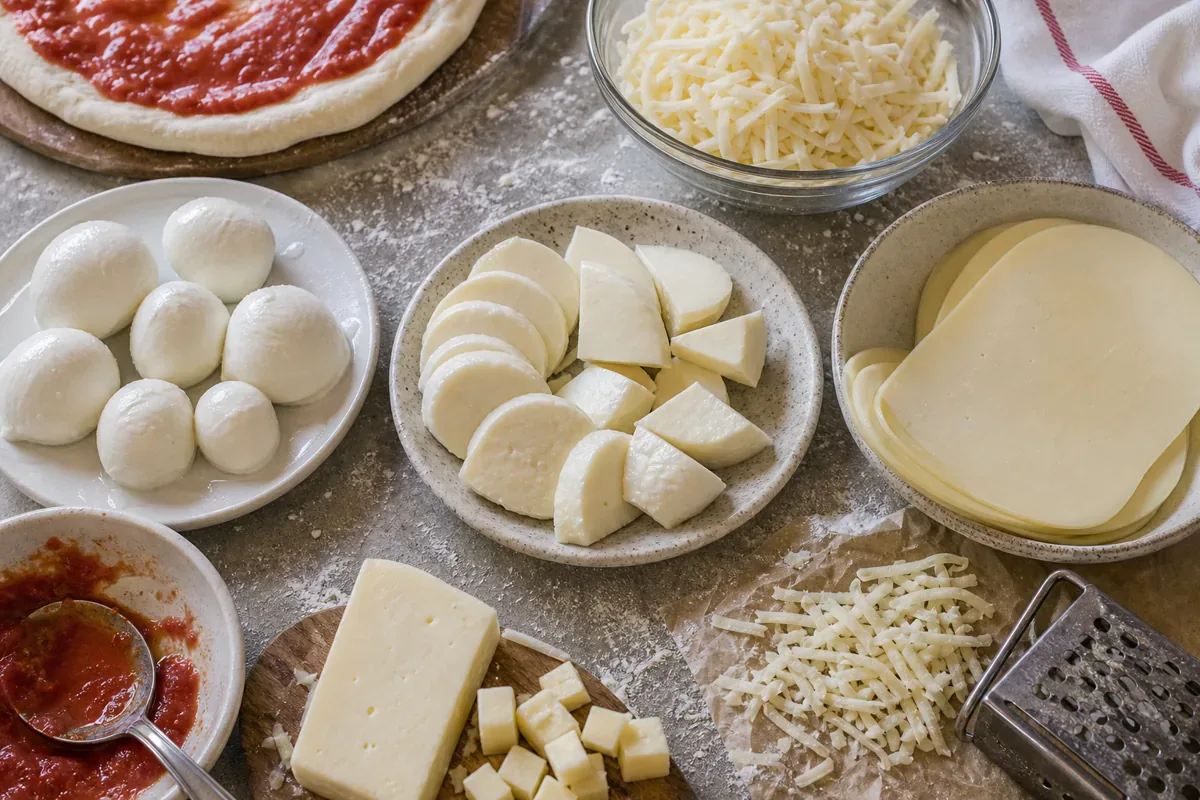
| Pizza | BelGioioso, Wisconsin Cheese and Fine Dining Lovers all list it as a pizza topping. |
| Pasta | BelGioioso suggests topping pastas. De' Magi says it can also be cooked for warm first courses. |
| Vegetables | BelGioioso suggests grilled vegetables. Abbasciano names turnip tops, zucchini, eggplant and bell peppers. |
| Tomato Salad | Wisconsin Cheese lists salads with tomatoes and basil. Fine Dining Lovers lists Caprese. |
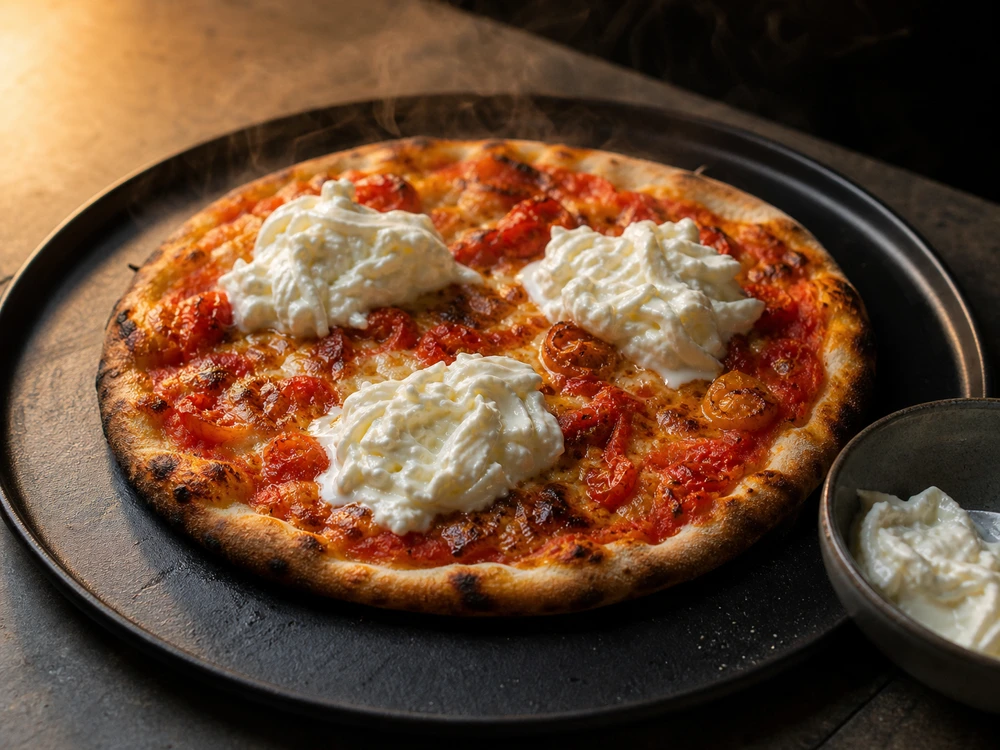
For warm food, the suggestions go two ways. De' Magi says its stracciatella works as it is or cooked for warm first courses, while Wisconsin Cheese and Fine Dining Lovers add it to hot food at the end.
Both put it on a pizza straight from the oven, where Wisconsin Cheese says it melts into a creamy sauce, and Fine Dining Lovers also adds a dollop to hot spaghetti Bolognese or gnocchi in tomato sauce.
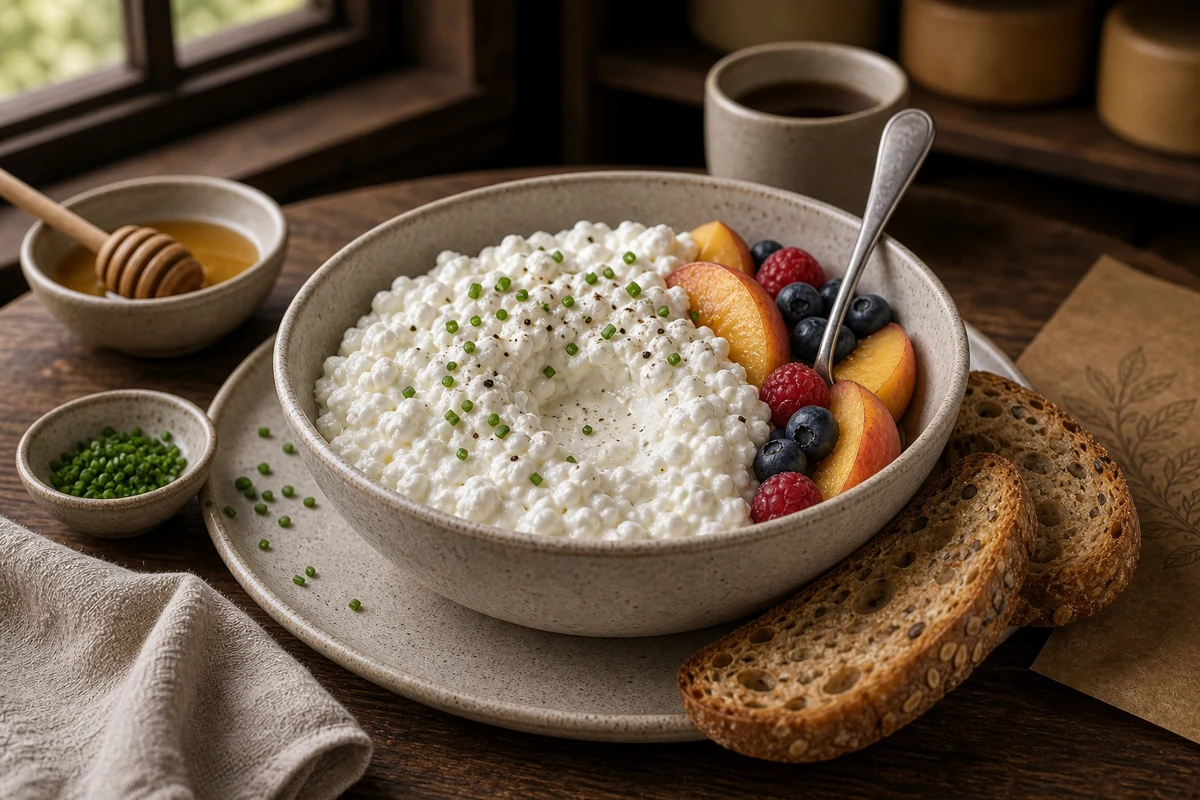
To dress it, Wisconsin Cheese, Fine Dining Lovers, De' Magi, BelGioioso and Coley Cooks use olive oil. Fine Dining Lovers, BelGioioso and Coley Cooks add salt and pepper, De' Magi adds black pepper, and Wisconsin Cheese adds sea salt and is the only one to add a drizzle of honey on bread.
| Pairing | Type | Why It Works |
|---|---|---|
| Prosciutto and Cold Cuts | Food | De' Magi names prosciutto and other cold cuts, and BelGioioso names cured meats. |
| Peaches, Figs and Melon | Food | Wisconsin Cheese names peaches, figs and melons. BelGioioso adds melon and grapes. |
| Roasted Peppers | Food | BelGioioso names roasted peppers. |
| Aged Parmesan and Sharp Cheddar | Food | Wisconsin Cheese suggests a cheese board with these stronger cheeses. |
| Prosecco and Crisp White Wine | Wine | Wisconsin Cheese names sauvignon blanc, chardonnay and prosecco. |
| Light Pilsner | Drink | Wisconsin Cheese also names light pilsners and fruity wheat beers. |
Wisconsin Cheese explains its drink picks by contrast: the bubbles in prosecco set off the richness and subtle tang, while a light pilsner or fruity wheat beer leaves the delicate flavor intact. It also names a gin and tonic with citrus as a refreshing contrast, and a smooth, slightly smoky whiskey or bourbon if you want something bolder.
De' Magi adds fresh truffles and avocado to its list, and the Fine Dining Lovers recipe roundup includes a citrus salad with pistachios and olives, fusilli with lemon-infused stracciatella and a risotto with 'nduja and smoked stracciatella.
How Do You Buy Stracciatella?
Buy by the label: ingredients and nutrition differ from one tub to the next, as three makers' labels show.
| Maker | Ingredients | Energy | Fat | Carbohydrate | Protein | Salt |
|---|---|---|---|---|---|---|
| De' Magi | Pasteurised cow's milk, pasteurised cream, rennet, salt, milk enzymes | 238 kcal | 20.2 g (14.25 g saturated) | 1.0 g (1.0 g sugars) | 11.8 g | 0.33 g |
| Abbasciano | Pasteurized cow's milk, cream, salt, rennet, citric acid (E330) | 271 kcal | 24 g (17 g saturated) | 4.5 g (2.6 g sugars) | 10 g | 0.2 g |
| BelGioioso | Pasteurized milk and cream, vinegar, enzymes, salt | Not stated | Not stated | Not stated | Not stated | Not stated |
Fat runs from 20.2 g at De' Magi to 24 g at Abbasciano, and carbohydrate and protein differ as well. Use the nutrition panel on your own tub instead of a general estimate.
Pack sizes depend on who is buying: De' Magi lists 250 g and 1 kg trays sold by the box, and Abbasciano offers a 250 g tub to individual customers with a 500 g size for food service only. BelGioioso sells its filling in cups and says it makes it to order from milk gathered daily from local farmers.
A smoked version exists too: Abbasciano lists one, and the Fine Dining Lovers recipe roundup includes a risotto made with smoked stracciatella.
How Long Does Stracciatella Stay Fresh?
For your home refrigerator, the FDA's general advice is 40 F or below. De' Magi's 0 to 4 C range, which tops out near 39 F, and the 36 to 40 F that Fine Dining Lovers gives stay at or under that limit.
The Burrata di Andria specification stores burrata at 4 C plus or minus 2 C and tolerates 6 C plus or minus 2 C during logistics. In Fahrenheit, that storage range runs from about 36 to 43 F and the logistics ceiling is about 46 F, so the top of both sits above the FDA's home limit.
| Source | What it says |
|---|---|
| De' Magi | 9 days in the sealed package for its 1 kg tray, refrigerated at 0 to 4 C; the page also says it is usually eaten within a few days of production |
| Fine Dining Lovers | Two to four days after opening, best within the first 24 to 48 hours, ideally kept at 36 to 40 F (2 to 4 C) |
| Wisconsin Cheese | Up to three days in the fridge in an airtight container; freezing makes it grainy |
| Coley Cooks | 5 to 7 days for a homemade batch in an airtight container; freezing is not recommended |
The figures answer different questions: the 9 days is a sealed-package date for one maker's 1 kg tray, and the two to four days starts once a tub is open. The three days is Wisconsin Cheese's general advice and the 5 to 7 days belongs to a home batch, so for the tub you buy, the printed date and the maker's directions decide.
Fine Dining Lovers says stracciatella is usually packed with cream or whey, and that you should keep it submerged so it does not dry out. The specification likewise allows burrata packed in cups or jars in its governing liquid.
The specification gives burrata a moisture of 50 to 70 percent and requires packing at the dairy inside Puglia because the fresh product deteriorates easily. It adds that the short shelf life holds the cheese to a niche market.
The FDA says perishable food left out for 2 hours or more lets bacteria multiply rapidly, and the limit drops to one hour when the air is above 90 F.
That clock applies to a portion on the plate as much as to the tub. Coley Cooks says its homemade version tastes better at room temperature than ice cold, and if you set a portion out to warm, the minutes it spends tempering run on the same clock.
What Can You Substitute for Stracciatella?
Without a tub, your closest match is a cut-open fresh burrata, since Fine Dining Lovers says the creamy center that spills out is stracciatella, though you get the shell with it.
To make it at home, the recipe site Coley Cooks gives a version it says is not the traditional method. It uses one 8-ounce ball of fresh mozzarella, shredded by hand, with half a cup plus 2 tablespoons of heavy cream, and rests the mixture for at least an hour.
Coley Cooks specifies fresh mozzarella from its brine, made from cow's or buffalo milk, never dried or grated processed, and pressed dry because moisture waters down the cream. The cream has to be real heavy cream, and light cream, half and half or milk cannot replace it.
It also names smoked mozzarella, caciocavallo and scamorza as other cheeses you can shred this way.
Is Stracciatella Safe During Pregnancy?
The Burrata di Andria specification allows the curd to be made from raw milk or from milk pasteurized at 72 C for 15 seconds. A PGI burrata can therefore be made either way.
The cream is heat treated: above 75 C for 15 seconds at 10 to 20 percent fat, or above 80 C for 15 seconds above 20 percent, or an equivalent combination. Packaged pasteurized or UHT cream is also allowed, so a note about the cream on your label does not prove the curd was pasteurized.
Pregnant women are 10 times more likely to get a Listeria infection than other people, according to the CDC, which lists soft cheese made from unpasteurized milk as riskier. Go by the pasteurisation statement on the label of your tub.
Stracciatella contains milk: De' Magi lists milk and milk derivatives as allergens, and Abbasciano lists milk, lactose and milk proteins. The Burrata di Andria specification mentions a lactose-free line with under 0.1 g of lactose per 100 g.
Buy stracciatella when you want strips of stretched curd in cream without a burrata shell. Read the label for pasteurized milk and cream, the use-by date and the maker's storage directions.
SOURCES & REFERENCES
What Else Do People Ask About Stracciatella?
Stracciatella is stretched curd torn into strips and mixed with cream. Wisconsin Cheese says the milk can come from cows or buffalo, so read the label.
No. Stracciatella is the filling, and burrata is that filling inside a pouch of stretched curd.
De' Magi says it can be eaten as it is or cooked for warm first courses.
De' Magi gives 9 days in the sealed package for its 1 kg tray at 0 to 4 C, and Wisconsin Cheese says up to three days in the fridge. The date printed on your tub decides.
The De' Magi, Abbasciano and BelGioioso tubs list pasteurized milk. The Burrata di Andria specification allows raw milk for the curd, so check each label.
The NHS lists pasteurised mozzarella and burrata as safe and says to avoid unpasteurised milk and cream. Check that the curd and the cream are both pasteurized.
The filling of a fresh burrata is the closest match. At home, Coley Cooks combines hand-shredded fresh mozzarella with heavy cream.