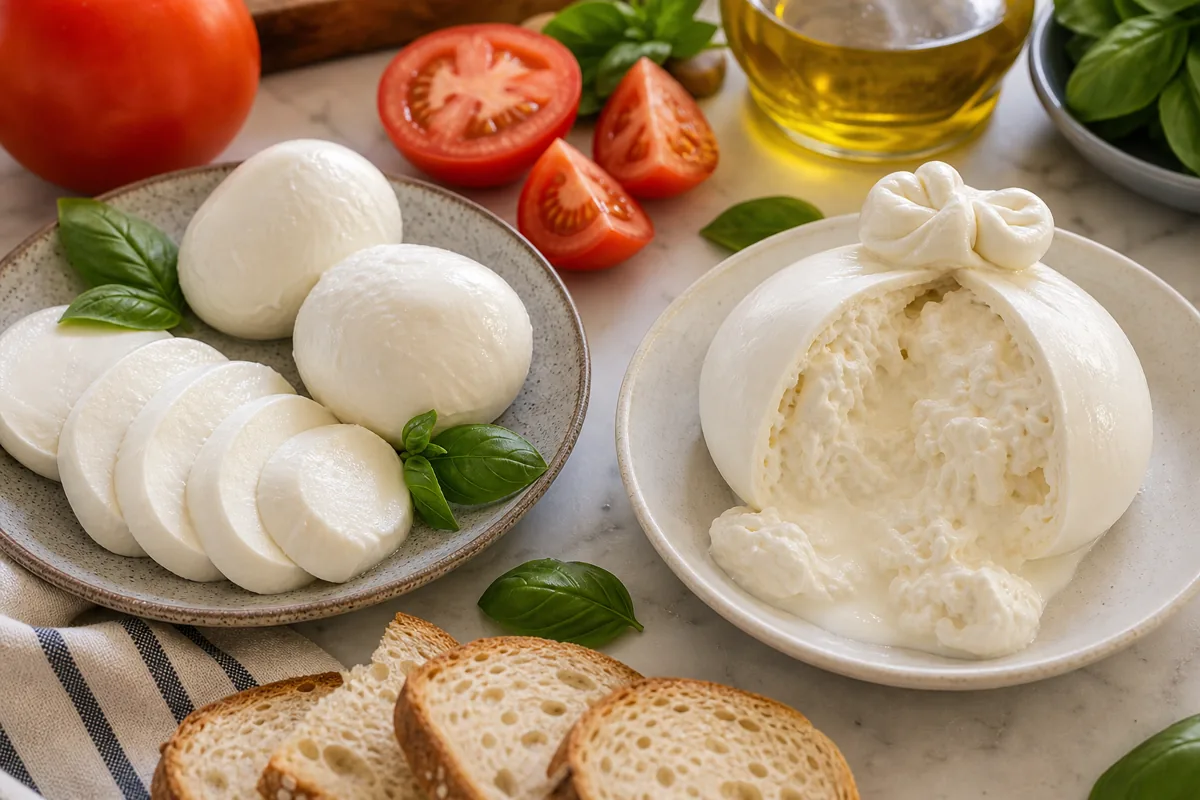
A burrata pouch is built from mozzarella: the Burrata di Andria PGI specification makes its casing only of stretched curd and fills it with cream and curd torn into strands.
That filling is what you pay for, and it is also what limits the cheese. Fresh mozzarella is one solid piece of stretched curd, so it slices, melts and keeps in ways a cream-filled pouch cannot.
In This Article
What Is the Difference Between Mozzarella and Burrata?
Both start as pasta filata, curd stretched in hot water until it turns elastic. The burrata specification stretches the curd with boiling water, and the buffalo mozzarella trade association, quoted by Wikipedia, describes the maker kneading it into a smooth, shiny paste.
The two split after stretching. Mozzarella is shaped into a finished ball or braid, while the burrata maker tears part of the curd into strands, mixes them with cream, and seals them inside a pouch formed from the rest.
Mozzarella itself comes in two main milks, and Wikipedia names the version made from the milk of the Italian buffalo mozzarella di bufala.
| Point | Mozzarella Tradizionale STG | Mozzarella di Bufala Campana DOP | Burrata di Andria PGI |
|---|---|---|---|
| Milk | Whole cow's milk | Fresh whole milk from Italian Mediterranean buffalo | Cow's milk |
| Milk treatment | Pasteurized at 71.7 °C for 15 seconds | Raw, thermized or pasteurized | Raw, or pasteurized at 72 °C for 15 seconds |
| Shape and weight | Spheres of 20 to 250 g; braids of 125 to 250 g | Rounds, bites, braids, pearls, cherries and knots of 10 to 800 g; braids up to 3 kg | Rounded pouch with a closure at the top, 100 to 1,000 g |
| Moisture | 58 to 66% for spheres; 56 to 62% for braids | Up to 65% | 50 to 70% |
| Fat in dry matter | 44% minimum | 52% minimum | Not set |
Burrata's moisture row is the widest in the table, and GIFT gives part of the reason: the consistency of the filling varies with the quantity and quality of the cream. Two burratas sold under the same protected name can therefore differ in how fluid the center is.
The milk-treatment row is where the three rules differ most, and the pregnancy section explains what that means for the label.
Which Mozzarella Are You Comparing With Burrata?
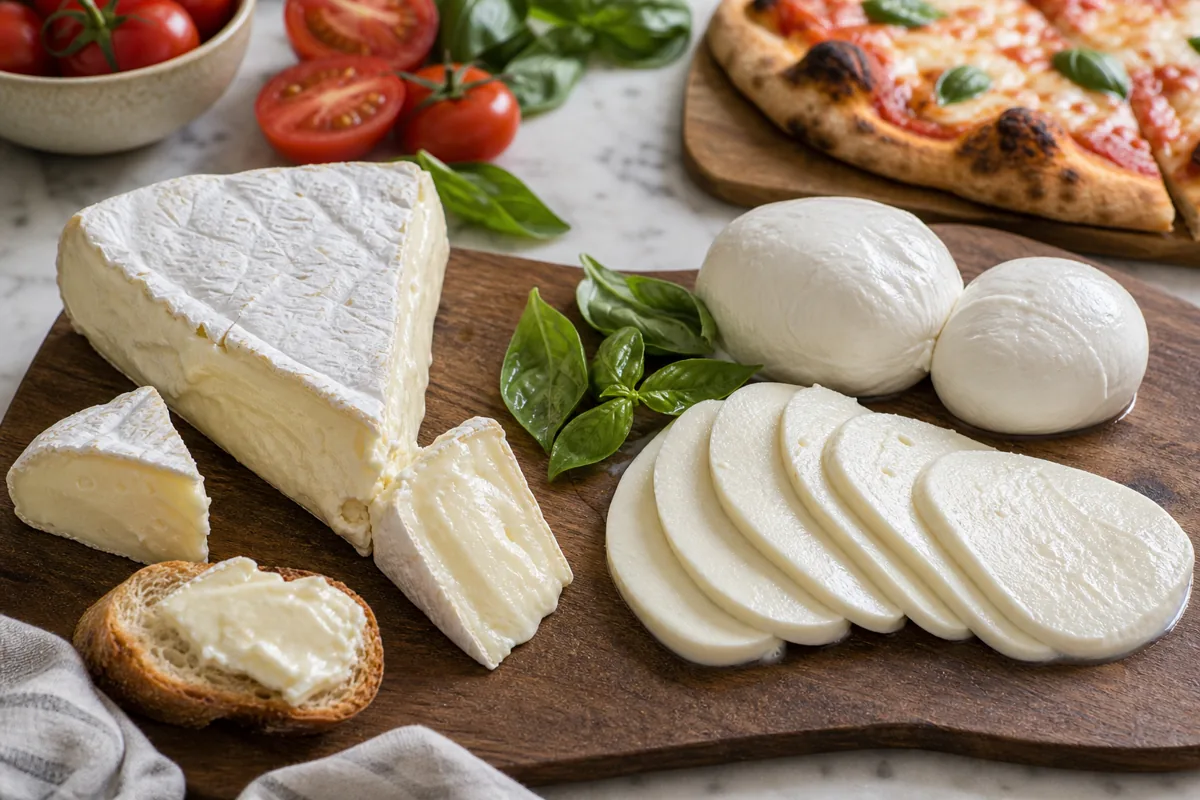
In a shop, mozzarella usually means fresh or low-moisture mozzarella, and burrata's counterpart is the fresh kind. Fresh mozzarella is the ball stored in brine or whey, usually about 90 g and 6 cm across, and Wikipedia says it can reach 1 kg and about 12 cm.
Wikipedia names the small fresh balls by size: ovolini are about the size of a hen's egg, ciliegine are cherry-sized, perlene are the smallest, and bocconcini are about bite-sized. Perlene go into salads or hot soups and pasta dishes just before serving, while ovolini go whole into a composed salad or sliced onto a small sandwich.
A label that says only mozzarella carries none of the STG figures in the table. GIFT explains that the EU protects only the full name Mozzarella Tradizionale, and that other products may keep the word mozzarella as long as they carry neither the Union symbol nor the words "traditional speciality guaranteed".
GIFT also lists Mozzarella di Gioia del Colle, a cow's-milk DOP whose area takes in towns in the Bari and Taranto provinces of Puglia, where burrata also comes from, plus part of Matera. Its 2024 single document sets moisture at 58 to 65%.
The cow's-milk and buffalo versions also differ in composition. GIFT, quoting the 2019 CREA food tables, gives cow's-milk mozzarella 58.8% water and 19.5 g of fat per 100 g, against 55.5% water and 24.4 g of fat for buffalo mozzarella, so the buffalo ball is the drier and richer of the two.
How Is Burrata Made Compared With Mozzarella?
The burrata specification leaves the maker a choice of how to acidify the milk: citric or lactic acid, selected cultures, or a milk or whey starter. GIFT reports that none of the three protected mozzarella names acidifies chemically, since the buffalo and Gioia del Colle DOPs use a whey starter from the previous batch and the STG uses a natural milk starter.
Whatever the acid, the curd has to reach the right acidity before it will stretch. Wikipedia puts mozzarella curd at a pH of about 5.2 to 5.5 at that point, and the burrata specification has the cut curd rest while the whey drains so that it settles and acidifies for stretching.
Salt can go in at three points under the specification: into the curd as it is stretched, into the cream, or afterwards in a brine bath once the pouch has cooled.
The pouch is closed on itself and sealed at once with boiling water, or tied at the neck, then cooled in water for a time that depends on its size.
The specification gives the finished casing a thickness of about 2 mm, and GIFT describes it as milky white, smooth and shiny, without a crust, built of overlapping elastic fibrous layers.
GIFT adds an average surface pH of 6.1 to 6.2 and a water activity of 0.95 to 0.97 from a 2013 study of Puglia burrata in the Journal of Food Protection, against the pH of 5.1 to 5.6 that it says the STG requires of mozzarella. The figures come from different kinds of measurement, so they show direction rather than an exact gap.
What Is Stracciatella, and Why Is It Inside Burrata?
The Burrata di Andria specification defines the stracciatella filling as stretched curd torn by hand into strands and soaked in cream.
The rule keeps the tearing manual so the cream blends into the curd, and it bars any cutting that would turn the irregular strands into a minced mass.
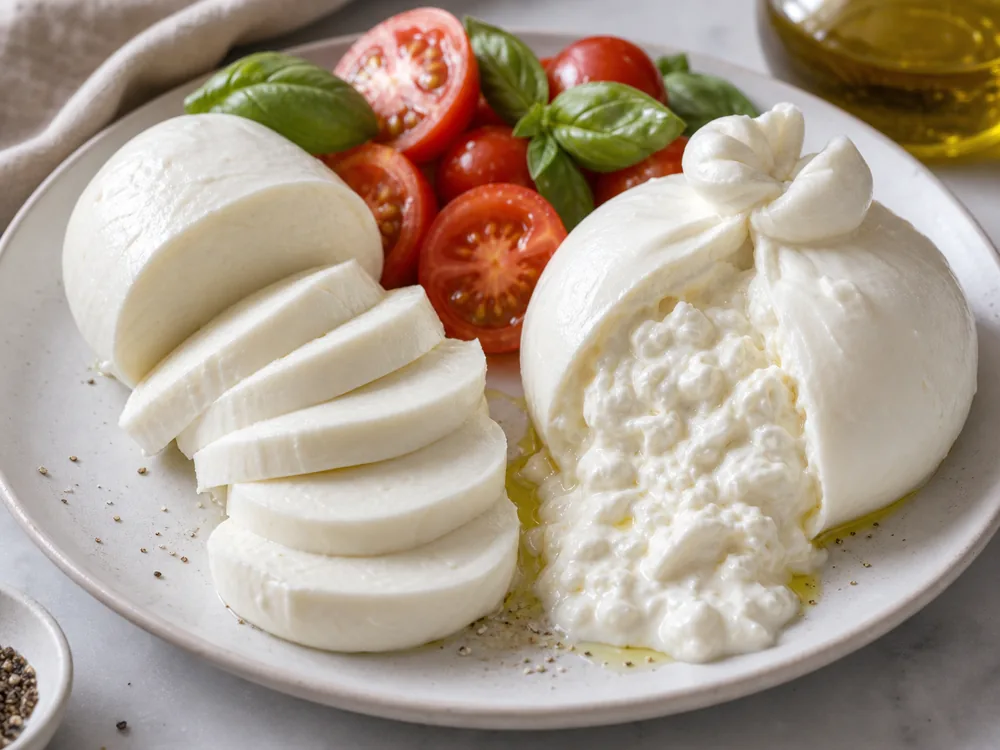
The name comes from that tearing. The specification ties it to curd that is "stracciata" by hand into irregular strands.
Stracciatella is also sold on its own: Great Italian Food Trade (GIFT) describes burrata stracciatella as burrata without its outer casing.
Burrata began in Andria, in the Apulia region of southern Italy, and the specification and Wikipedia date its first making differently.
- Burrata di Andria specification: oral tradition credits Lorenzo Bianchino, on an old farm in the first decades of the 20th century, when heavy snow stopped the milk reaching town; one of the first written mentions is in the 1931 Touring Club guide.
- Wikipedia: records say Bianchino first made the cheese in 1956, though an origin around 1900 has also been suggested, and its lead places the birth of burrata in the 1920s, as a way to cut food waste.
If the specification's 1931 mention is accurate, the 1956 record cannot be the first batch, since it falls 25 years later. For a buyer the date changes little, because the specification, not the first batch, sets what the protected name guarantees.
In the specification's account, Bianchino mixed the scraps left from stretching curd with cream and wrapped them in a casing of the same curd. The idea borrowed from mantéche, casings of aged stretched curd that held butter.
GIFT points out that burrata and stracciatella are not technically cheeses under Codex Alimentarius standards, because the cream added to the curd is not coagulated with acid or rennet. The EU still protects Burrata di Andria as a PGI, under Regulation (EU) 2016/2103.
Which One Is Better for Pizza?
Mozzarella is the cheese to bake on a pizza, and Wikipedia notes that some versions, such as low-moisture mozzarella, are made specifically for pizza.
Fresh mozzarella brings more water with it. Arla Pro explains that fresh-style mozzarella generally contains more water, and that the moisture inside the cheese is released onto the pizza as it heats.
That is why Arla Pro says fresh mozzarella may need draining, tearing or careful portioning before it goes on.
How much water reaches the base depends on the cheese's moisture, the amount used and the intensity of the bake, Arla Pro says, so a generous layer of higher-moisture cheese may need more heat or a longer bake.
Low-moisture mozzarella works the other way, since Arla Pro says the water removed in production gives it a more controlled moisture release. Wikipedia describes a denser mozzarella made by adding citric acid and partly drying it, often used for baked dishes such as lasagna and pizza.
Arla Pro adds that neither format is automatically right: the choice depends on the pizza style, the oven, the finish wanted and whether the pizza is eaten at once or has to travel.
Cheese is not the only source of water. Arla Pro also lists a heavy or watery sauce, wet toppings such as mushrooms and fresh tomatoes, an overloaded pizza and an oven that is too cool.
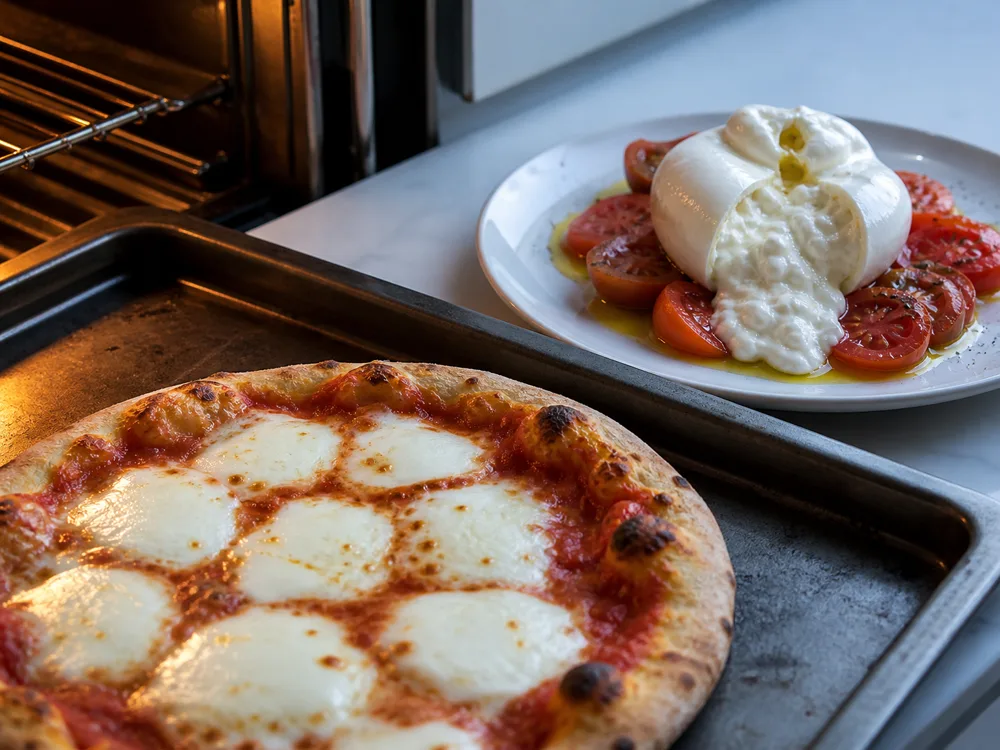
Burrata goes on last. Indi Hampton's burrata pizza at With Spice adds it after the pizza has cooked, which she says keeps the cheese creamy and stops the pizza turning soggy.
She drains the ball and leaves it at room temperature for at least 20 minutes, lets the pizza cool slightly, then tears the burrata over it by hand, since slicing with a knife is messier.
Her sauce is a raw tomato puree squeezed of seeds and watery centers and shaken through a sieve to remove excess liquid, so the recipe manages moisture on the sauce side as well.
The With Spice recipe never bakes the burrata at all. Mozzarella remains the cheese that goes on before the oven.
Which One Belongs on a Cold Plate or Salad?
On a cold plate, choose by whether you want even slices or one center that spills. Wikipedia's Caprese salad, at its simplest, is tomato and mozzarella sliced with basil, salt, pepper and extra virgin olive oil.
The same entry says cow's-milk fior di latte is the favorite on Capri and the Sorrento Peninsula, while buffalo mozzarella is more common elsewhere in Campania.
Burrata brings cream to the plate instead. Among the tasting markers in the Burrata di Andria specification, set by the Italian cheese tasters' body ONAF, are cream flowing out when the cheese is cut and aromas of fresh or cooked milk, butter and cream.
GIFT calls the filling not spreadable, with a fresh-dairy flavor that leans acidic and an aroma dominated by cream with a hint of slightly acidic milk, citing a 2020 study of Burrata di Andria PGI in the journal Foods.
| Pairing | Why It Works |
|---|---|
| Tomatoes and basil | Wikipedia's Caprese pairs them with sliced mozzarella; With Spice's burrata pizza sits on a raw tomato sauce. |
| Arugula and Parmesan | With Spice tops its burrata pizza with arugula dressed in olive oil, vinegar and Dijon, plus shaved Parmesan. |
| Pizza and pasta | Wikipedia says mozzarella is used for most types of pizza and several pasta dishes. |
Vinegar is where the two sources part. Wikipedia says Italians leave it out of Caprese in the belief that it would spoil the delicate flavor of fresh mozzarella, while the With Spice burrata pizza is topped with arugula tossed in olive oil, vinegar and Dijon.
Can You Substitute Mozzarella for Burrata?
Mozzarella can replace burrata's shell but not its filling. The specification makes the casing entirely of stretched curd, so a ball of mozzarella gives you that texture without the cream and torn strands inside.
Stracciatella covers the other half, because GIFT's definition makes it the burrata filling without the casing.
For a pizza, stracciatella spooned on after baking follows the same timing as the With Spice recipe while skipping the pouch.
Burrata is the weaker stand-in for mozzarella on a hot dish, because the With Spice burrata pizza keeps it out of the oven entirely.
Wikipedia describes a relative made in the provinces of Naples, Caserta and Salerno, bocconcini alla panna di bufala, in which fresh buffalo mozzarella is mixed with fresh cream. It joins mozzarella and cream as burrata does, but not in a pouch.
How Long Do Mozzarella and Burrata Keep?
Mozzarella gives you more time. Wikipedia says it is traditionally served the day after it is made, but it can be kept in brine for up to a week.
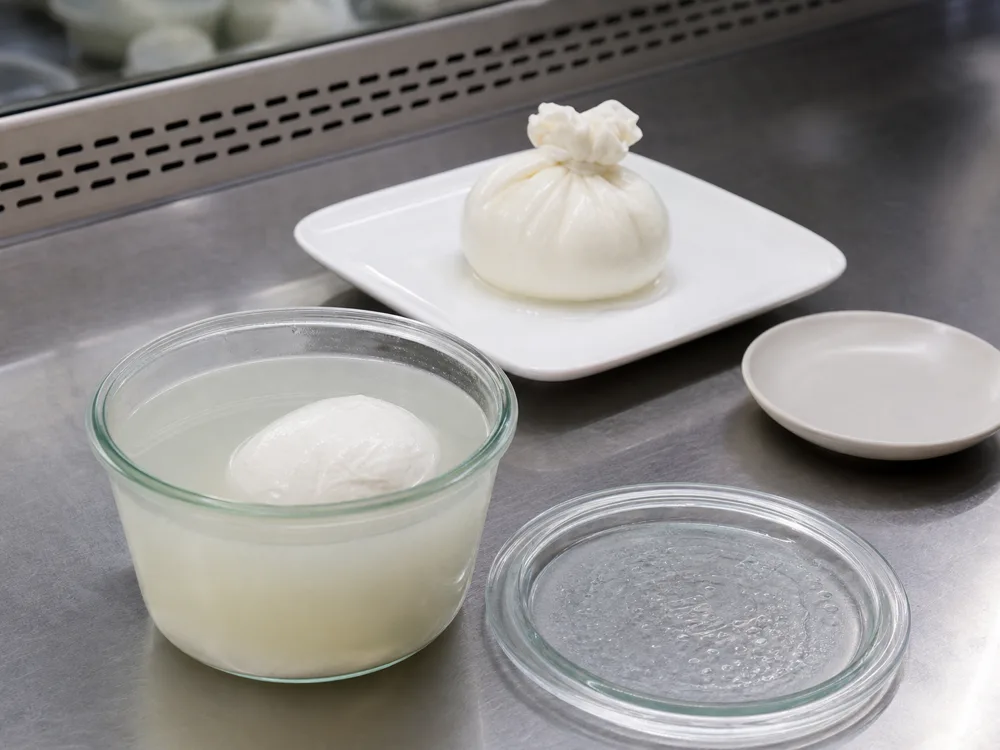
Wikipedia's own storage section puts the tradition a day earlier, the day it is made, and relays food writer Arthur Schwartz's report that a Neapolitan will not eat day-old mozzarella unless it is fried or baked, even though manufacturers market a week-long shelf life.
Kept mozzarella also changes: Wikipedia says it develops a sour flavor and softens, more slowly in larger cheeses. Some Naples residents like it "relaxed", softened in the hours after it is made, while Schwartz reports that Campanians near the dairies buy it still firm.
The low-moisture kind sold for pizza keeps far longer: Wikipedia says it can stay refrigerated for up to a month, and some shredded packs carry up to six months.
Burrata has no such margin. Wikipedia's burrata entry says it does not keep well even when refrigerated and advises using it promptly while still fresh.
The PGI specification writes that into its rules. Burrata di Andria must be packed at the dairy inside Puglia because it is a fresh product that spoils easily, and it must be kept at 4 °C, give or take 2 °C.
The same document says the short shelf life holds back its sale, and calls it a product to eat fresh.
The specification also tolerates 6 °C, give or take 2 °C, during logistics, so a pouch can reach the shop a few degrees warmer than its storage temperature and still meet the rules.
Buy burrata for a meal you are about to serve rather than for later in the week.
Are Mozzarella and Burrata Safe During Pregnancy?
Among the cheeses that are safe in pregnancy, the NHS lists pasteurized soft cheeses, including mozzarella and burrata.
The CDC puts mozzarella made with pasteurized milk among safer choices and soft cheese made from unpasteurized milk among riskier ones. It also notes that pregnant women are 10 times more likely to get a Listeria infection.
The label decides it, because both protected specifications allow raw milk. Burrata di Andria may be made with raw or pasteurized milk, and GIFT's summary of the buffalo mozzarella rules allows raw, thermized or pasteurized milk.
The NHS also counts any cheese cooked until steaming hot as safe. Burrata added after baking, as in the With Spice recipe, has not been cooked that far, so the pasteurization check still applies.
Mozzarella or Burrata: Which Should You Buy?
At the counter, the label and pack tell you what the name alone does not.
Only the full name Burrata di Andria is protected. GIFT notes that Italy's list of traditional products, which has no legal value, also records plain burrata in Puglia and a buffalo burrata in Campania and Lazio, so the Puglia packing and 4 °C storage rules above bind only the IGP pouch.
Buy by the job and the day you will eat it.
Buy mozzarella when the cheese has to melt, slice or keep better than burrata. Buy burrata when the cream-filled center is the point of the plate and you will eat it soon.
SOURCES & REFERENCES
Mozzarella vs Burrata FAQ
Short answers to the questions that come up once both are in the basket.
Close, but not quite. Burrata is a pouch of stretched curd, the same kind of curd as mozzarella, filled with stracciatella: hand-torn curd strands soaked in cream, according to the Burrata di Andria PGI specification.
The With Spice burrata pizza does not bake it at all. Its author adds the burrata after the pizza has cooked, which she says keeps the cheese creamy.
Mozzarella. Wikipedia says it keeps in brine for up to a week, while burrata does not keep well even refrigerated and should be eaten promptly.
The NHS lists pasteurized burrata as safe. Burrata di Andria may be made from raw milk, so check the label for pasteurized milk.