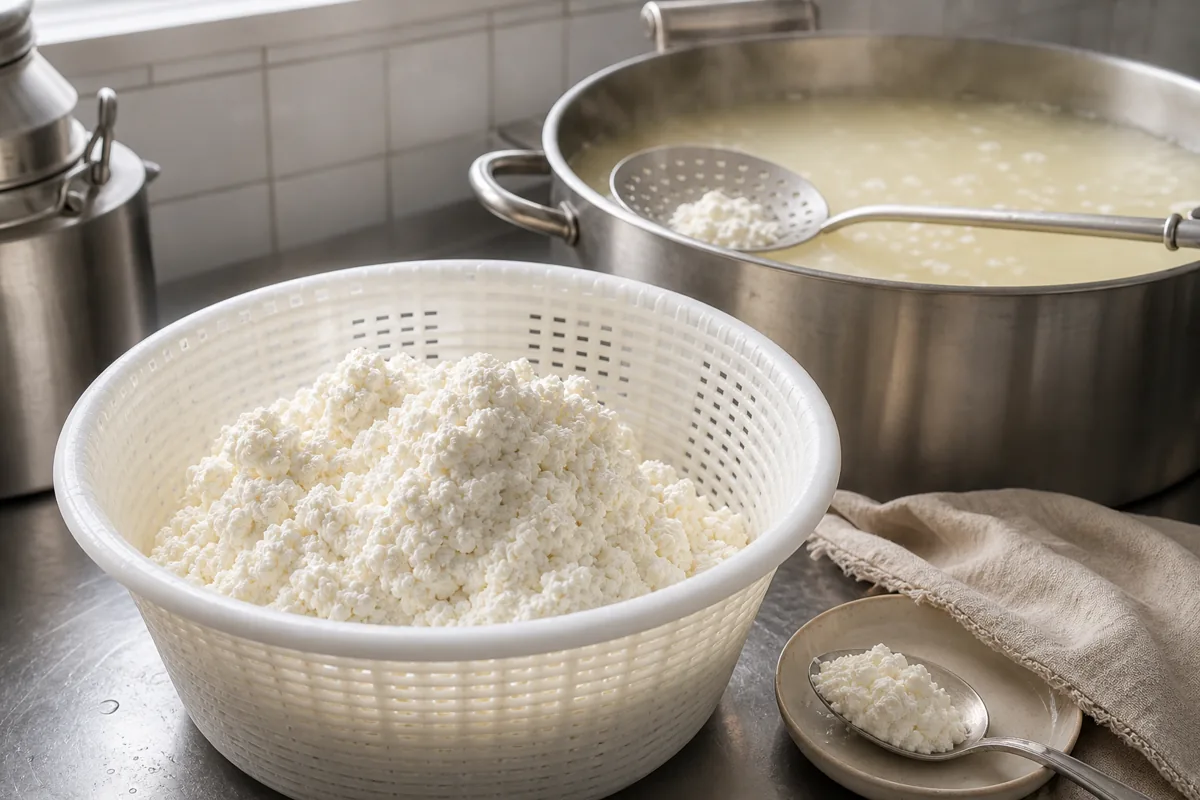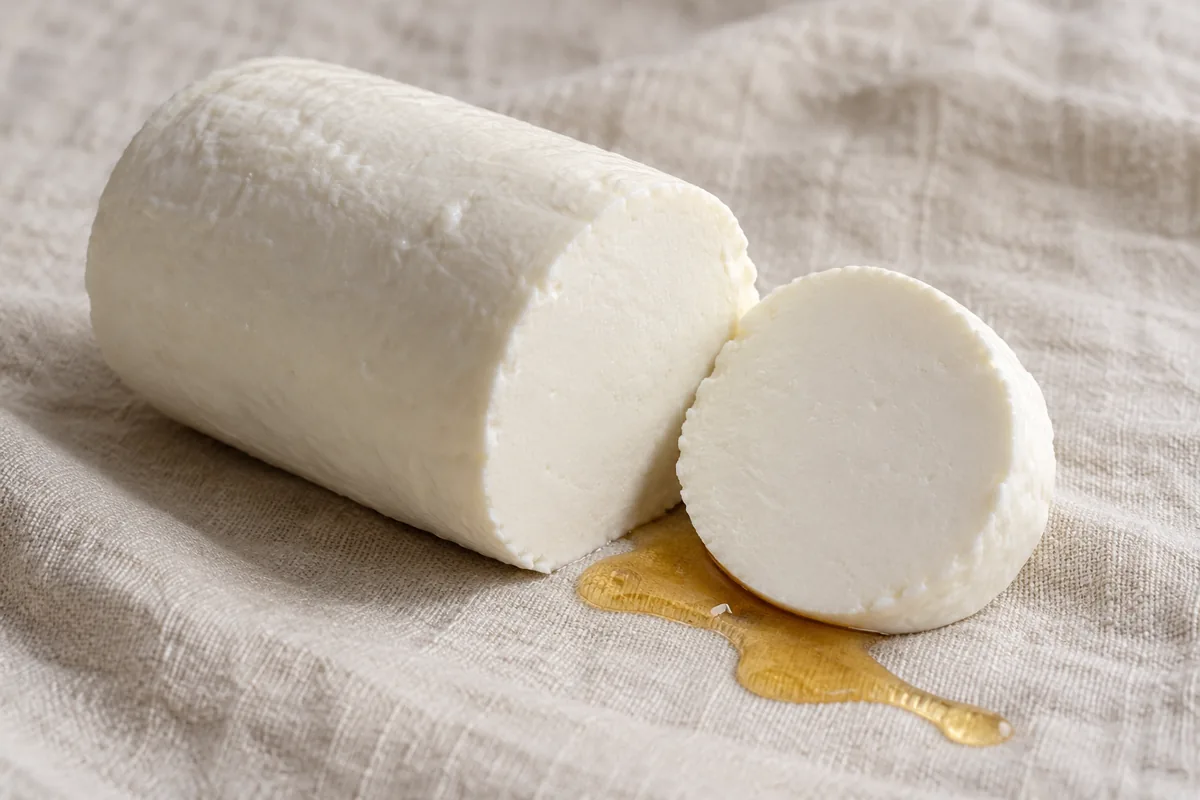
Manouri is a soft Greek cheese with PDO status, made by adding milk or cream to the whey left over from sheep's or goat's milk cheese.
The added cream is what sets Manouri apart: English Wikipedia says it gives the cheese a creamier texture than feta.
In This Article
What Is Manouri?
Cheese Connoisseur names feta and Batzos as the cheeses whose whey goes into Manouri.
Cheese.com says PDO Manouri is made only in the protected areas of Central Macedonia, Western Macedonia and Thessaly.
Greek Wikipedia adds Crete to the places where Manouri is made, outside the three PDO regions. The name comes from the Greek word manós, meaning sparse, and the Lytras dairy gives the same origin.
Cheese.com and Cheese Connoisseur also write the name as Manoypi, which Cheese Connoisseur's R. M. Peluso says is pronounced man-o-yohr-ey in Greek.
Cheese Connoisseur adds that Manouri made outside the PDO areas is not the genuine article, and Mevgal describes its own as made in Central and Northern Greece.
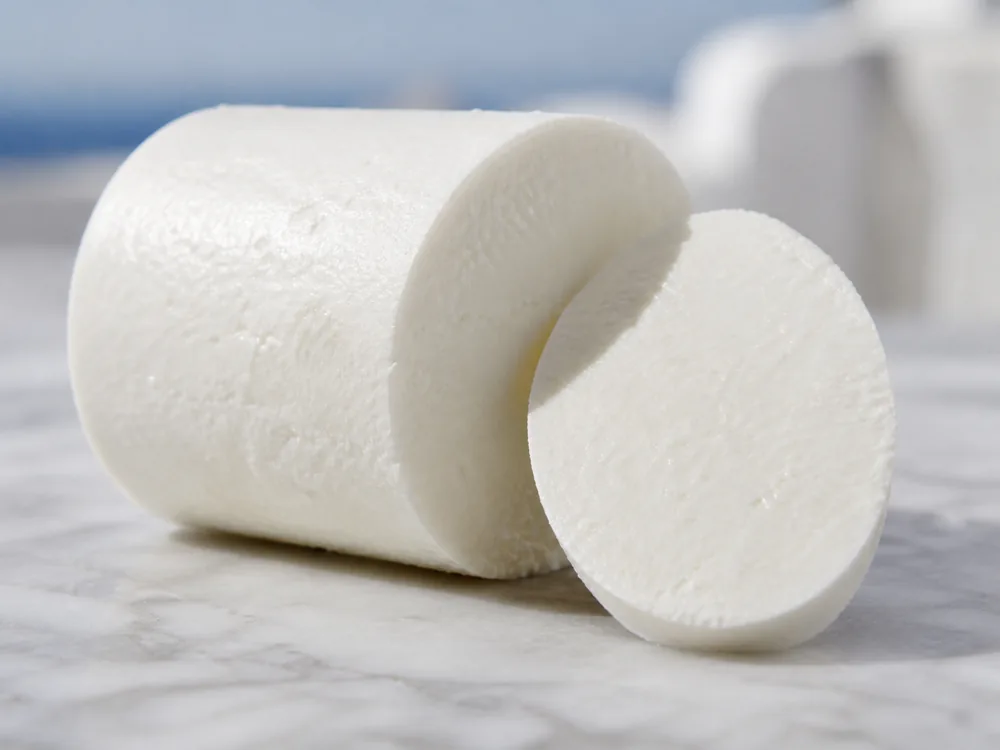
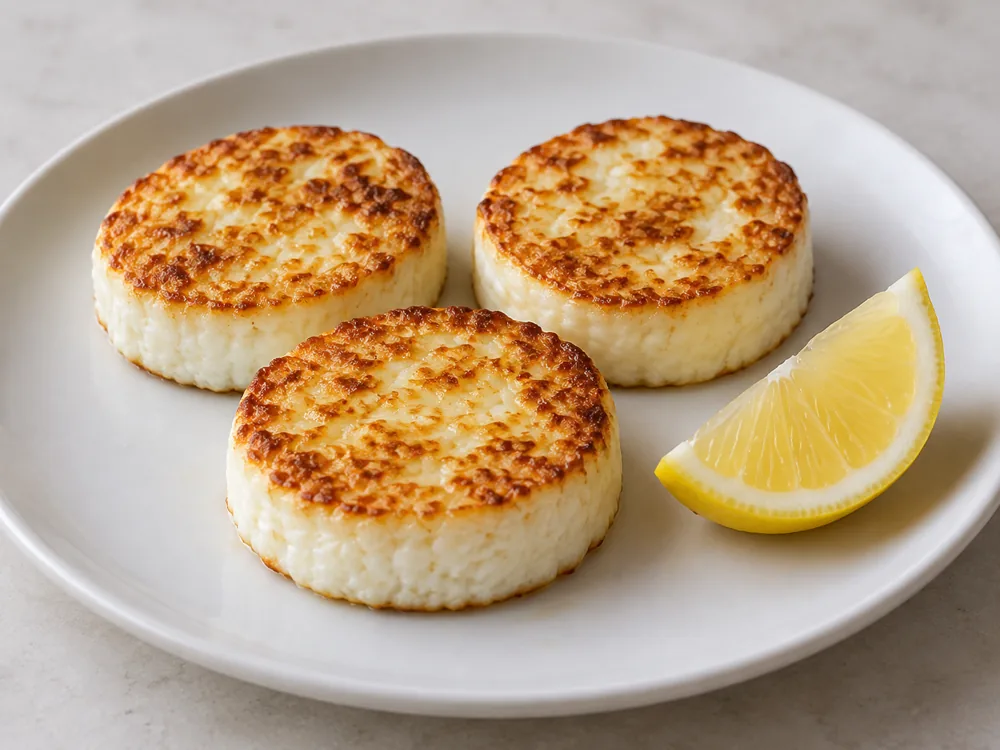
Greek Wikipedia describes the finished cheese as a white cylinder with no rind and no holes, sold in several sizes and weights.
Its paste is compact and soft, with a creamy texture that lets you cut it without crumbling. The same entry records that Greece's National Milk Committee called Manouri the most excellent traditional Greek whey cheese.
Manouri is semi-soft to Cheese.com and English Wikipedia, soft to Greek Wikipedia and a fresh cheese to Cheese Connoisseur. The paste they describe is the same in each case, so the soft or semi-soft label comes from where each of them draws that line.
The two limits in that list come from Greek Wikipedia's average composition.
How Is Manouri Made?
Greek Wikipedia lists three starting bases, which vary from place to place: a mixed sheep-and-goat base, sheep whey, or fresh sheep-and-goat cream alone, with fresh whole milk or cream added to the first two. It adds that the best qualities need whey from hard cheeses made for the purpose, a description that matches Batzos more closely than feta.
The whey is first filtered or centrifuged to remove leftover curd, then enriched with sheep or goat cream until its fat reaches at least 2.5 percent.
Over 40 to 45 minutes, the dairy stirs the mixture and heats it to 88 to 90 °C.
When the mixture passes 70 to 75 °C, the dairy adds about 1 percent salt and up to 25 percent sheep or goat milk or cream. The first flakes of whey protein appear at around 80 °C, so stirring slows and then stops while the heat keeps rising to 88 to 90 °C.
The curd is collected in cylindrical cloth bags and drained for 4 to 5 hours, which gives Manouri its log shape.
After draining, the cheese goes into cold rooms at 4 to 5 °C and stays there until it is sold, in Greek Wikipedia's account, while English Wikipedia gives Manouri an ageing time of 60 days and Cheese Connoisseur's Manouri profile says the logs are aged up to about 60 days.
The two need not conflict: if the cheese waits in the cold rooms until it is sold, as Greek Wikipedia describes, up to about 60 days could simply be the longest that wait runs. Cheese Connoisseur and Cheese.com both call Manouri fresh, so a buyer should expect a white, rindless fresh cheese rather than an aged one.
What Does Manouri Taste Like?
Manouri is mild in Cheese.com's and Greek Wikipedia's words, with a mild aroma in Lytras's and a clean flavor in Cheese Connoisseur's and the Washington Post's. The descriptions differ only in the small notes, from citrus to a hint of sheep's milk.
| Source | Flavor notes |
|---|---|
| Cheese.com | Subtle, clean and nutty; sometimes milky and slightly citrusy |
| The Washington Post, quoted on English Wikipedia | Light, slightly sour aroma like fresh yogurt without its acidity; clean, subtle nutty flavor with a bit of sheepiness and the barest hint of tang |
| Cheese Connoisseur | Fresh and clean, tending to be slightly sweet, with lemony, nutty or fresh grassy notes |
| Lytras dairy | Sweet taste, mild aroma, low salt |
| Greek Wikipedia | Sweet, mild taste and aroma |
For texture, Cheese.com compares Manouri to a light cheesecake. In Cheese Connoisseur, writer Peluso says the Hotos brand feels like tiny pearls of cream when pressed against the palate.
He adds that the Hotos paste is well integrated, with no oily separation, and calls its mouthfeel luxurious.
Lytras calls its Manouri compact but smooth and easy to slice.
Manouri vs Feta and Ricotta
Feta is made from milk and matured in brine, while Manouri and ricotta are both made from whey. That split explains most of the differences in the table.
| Point | Manouri | Feta | Ricotta |
|---|---|---|---|
| Made from | Sheep or goat whey with added milk or cream (Cheese.com) | Sheep's milk, or sheep's milk with up to 30% goat's milk (Wikipedia) | Whey from sheep, cow, goat or buffalo milk (Wikipedia) |
| Salt | Much less salty than feta (Wikipedia); close to feta on Hotos labels (Cheese Connoisseur) | Matured in brine (Wikipedia) | Low in sodium (Wikipedia) |
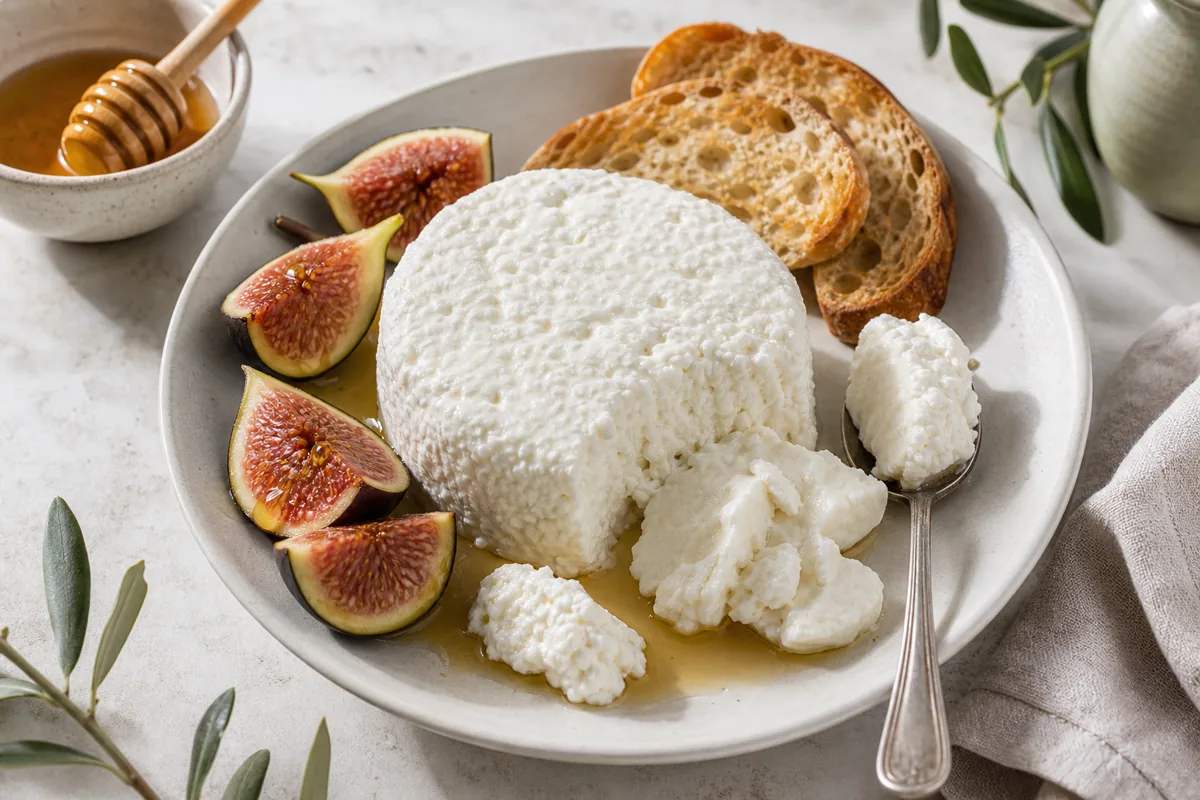
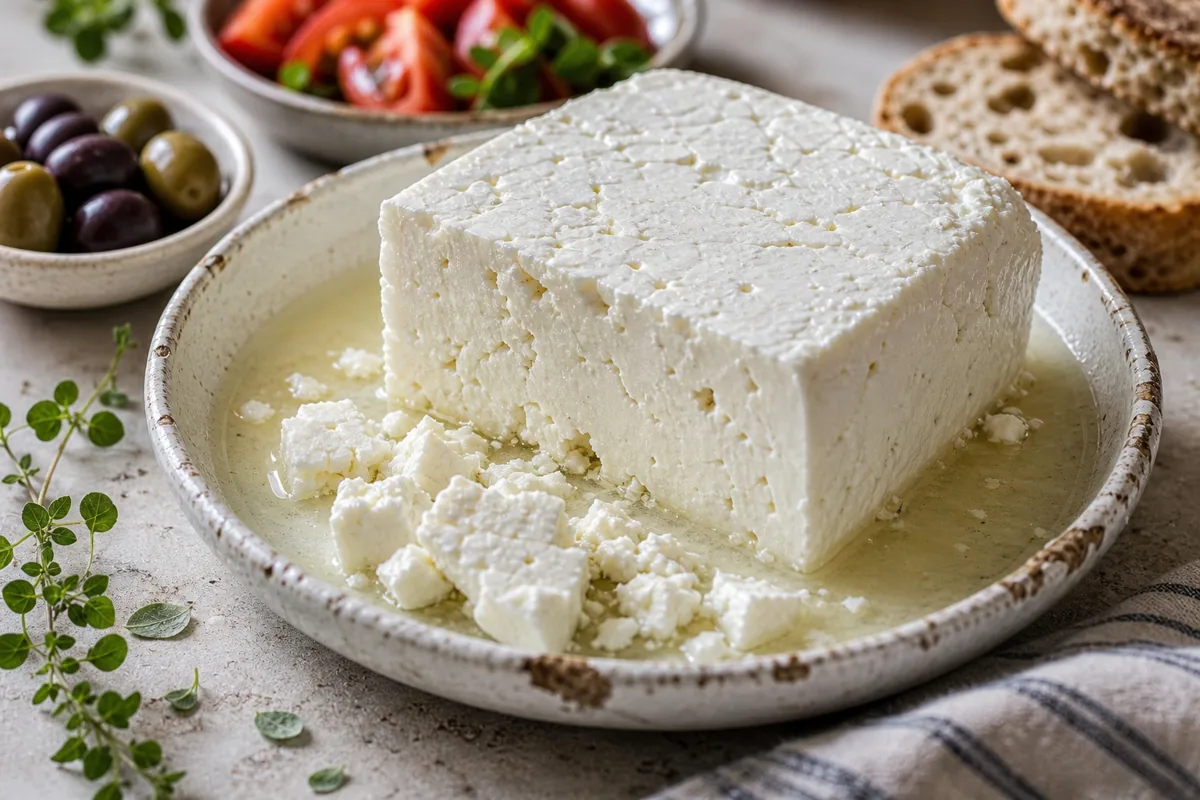
| Texture | Compact, soft and creamy (Greek Wikipedia) | Soft, crumbly and slightly grainy (Wikipedia) | Fine curd, considerably lighter than some fresh cheeses (Wikipedia) |
| Flavor | Mild and milky (Cheese.com) | Tangy and salty, from mild to sharp (Wikipedia) | Slightly sweet (Wikipedia) |
| Ageing | Chilled until sale, or up to about 60 days by other accounts | At least 2 months in brine (European Commission Feta PDO) | Fresh ricotta is highly perishable (Wikipedia) |
| Fat in dry matter | At least 70% (Greek Wikipedia) | At least 43% under the EU PDO (Wikipedia) | Varies with the milk used (Wikipedia) |
| Acidity (pH) | 5.9 on average (Greek Wikipedia) | Usually 4.4 to 4.6 (Wikipedia) | Not stated |
The fat row fits Cheese Connoisseur's finding that, crumbled, Manouri is more delicate and creamier than feta because of its higher fat content, while feta can be drier inside and fragment. The acidity row lines up with the Washington Post's description, quoted on English Wikipedia, of an aroma like fresh yogurt without feta's acidity.
How much less salty Manouri is than feta depends on the measure: English Wikipedia calls it much less salty, but Cheese Connoisseur says the sodium gap on labels is usually not that significant. Its example is a 28 g serving, where Hotos feta has 250 mg of sodium and Hotos Manouri has 240 mg.
Peluso adds that Manouri can contain up to a third less sodium than some fetas and that it tastes far less salty than its nutrition label leads a reader to expect, so the gap he reports is in taste more than on the label.
Cheese.com still files Manouri in its feta family.
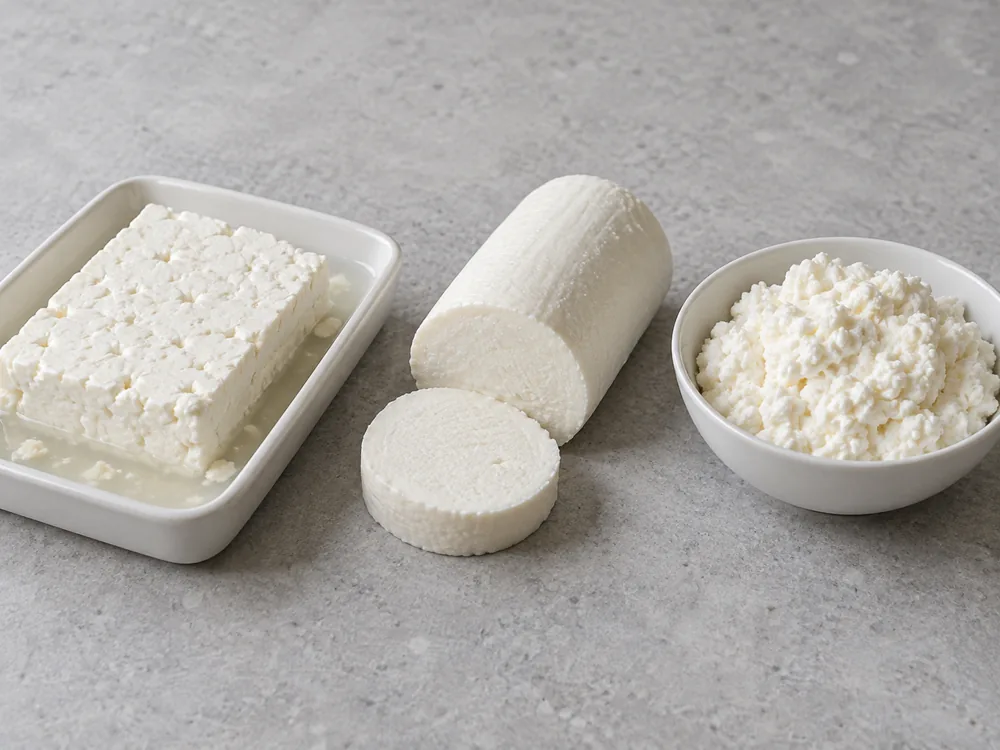
To make ricotta, the whey is left to sour for 12 to 24 hours and then heated close to boiling, which forms a fine curd. Peluso, writing in Cheese Connoisseur, calls Manouri finer in texture, more delicate and less acidic than ricotta.
Manouri belongs to the whey cheeses, alongside Anari and Mizithra.
English Wikipedia's Manouri entry calls Mizithra a Greek sheep cheese with a very similar flavor but a drier texture.
What Is in 100 g of Manouri?
Manouri is a rich cheese: two Greek dairies print 441 and 451 kcal per 100 g on their Manouri PDO, with 45 g of fat on both. Most of that fat is saturated, at 31 to 32 g per 100 g on the same labels.
| Per 100 g | Mevgal | Lytras |
|---|---|---|
| Energy | 441 kcal | 451 kcal |
| Fat | 45 g | 45 g |
| Saturated fat | 32 g | 31 g |
| Carbohydrate | 1.8 g | 1.5 g |
| Sugars | 1.7 g | 1.5 g |
| Protein | 7.2 g | 10 g |
| Salt | 2 g | 1.2 g |
Salt is where the figures part most: Greek Wikipedia gives an average of 0.80 percent salt, and Cheese.com and English Wikipedia both give 0.8 percent, yet the two labels print 1.2 g and 2 g per 100 g. The salt in the pack you buy can therefore be up to two and a half times the reference figure, so the label is the number to use.
Greek Wikipedia's average composition puts moisture at 51.9 percent and protein at 10.9 percent, and its energy figure of 460 kcal per 100 g sits a little above both labels. Lytras also lists 109 mg of calcium per 100 g.
Fat runs above the references too: Cheese.com gives 36 to 38 percent and Greek Wikipedia 36.7 percent, yet both labels print 45 g per 100 g. The 70 percent minimum in the list above is fat in dry matter, so it is measured against the 48.1 percent of the cheese left after the water, and on Greek Wikipedia's averages 36.7 divided by 48.1 gives about 76 percent.
Sugars stay between 1.5 and 1.7 g per 100 g on both labels, so check yours if you need a separate lactose figure.
Greek labels count salt in grams per 100 g, while the US labels Cheese Connoisseur quotes count sodium in milligrams per 28 g serving, so the two sets of figures cannot be set side by side as printed. On those US labels, Krinos Manouri has 14 g of fat and 270 mg of sodium per serving, and Lytras prints a 20 g portion of its own at 90 kcal and 9 g of fat.
Peluso sees a trade-off between fat and sodium from brand to brand, notes that some brands sell lower-fat, lower-sodium versions, and says even a 1 percent difference matters to someone close to a daily limit.
Compare labels in one unit: salt in grams per 100 g on Greek packs, sodium in milligrams per serving on US packs. Peluso sees a fat-versus-sodium trade-off between brands, so the right pack depends on which figure matters more to you.
How Do You Use Manouri?
Cheese Connoisseur's uses run from breakfast to dessert, while Lytras says its Manouri can be sliced as it is or baked, for starters and for a variety of hot or cold, sweet or savory desserts.
| Use | How It Works |
|---|---|
| Grilled or pan-fried slices | Cheese Connoisseur serves them as an appetizer with sun-dried tomatoes, a wedge of lemon or vinaigrette. |
| Greek salad | Cheese Connoisseur suggests Manouri in place of feta. |
| Sweet phyllo pastry | Cheese Connoisseur sweetens the cheese with sugar or honey, wraps it in phyllo and bakes it. |
| Breakfast | Cheese Connoisseur suggests it instead of yogurt, or spread on whole-grain toast instead of butter. |
Pastries such as spanakopita are a use for Manouri, and Peluso says he has eaten it in savory spanakopita-type pies.
Peluso also suggests tossing slices into a favorite pasta dish or a vegetable casserole, and says he has eaten it crumbled over vegetables and pasta dishes or as a companion to fruit.
| Pairing | Why It Works |
|---|---|
| Honey | Cheese.com names Manouri drizzled with honey as a way to serve it. |
| Honey and nuts | Cheese Connoisseur suggests drizzling a plain slice with honey and nuts as a dessert, garnished with grapes or kiwi. |
| Baklava and coffee | Cheese Connoisseur's pairing when Manouri is served as dessert. |
| Apricot jam and nuts | Mevgal's product photo shows grilled Manouri on a plate with apricot jam and nuts. |
Does Manouri Melt When Heated?
For the pasta and casserole uses above, Peluso says to think of Manouri as heating like ricotta, rather than expecting it to melt like mozzarella. In Greece, he writes, grilling is the common way to prepare it, and pan-frying it to a crunchy finish is an option on many menus.
Greek Wikipedia says the first flakes of Manouri form as heat denatures the whey proteins, and English Wikipedia describes ricotta curd forming through heat and acidity.
Can Manouri Replace Feta, Ricotta or Cream Cheese?
Wherever you use ricotta, Manouri can probably take its place, according to Peluso.
Swapping Manouri for feta shows up on the label: Peluso puts the Hotos versions at 74 calories for feta and 130 for Manouri, with 6 g and 13 g of fat per 28 g serving. He calls feta the heartier, everyday cheese and Manouri the more upscale, versatile one.
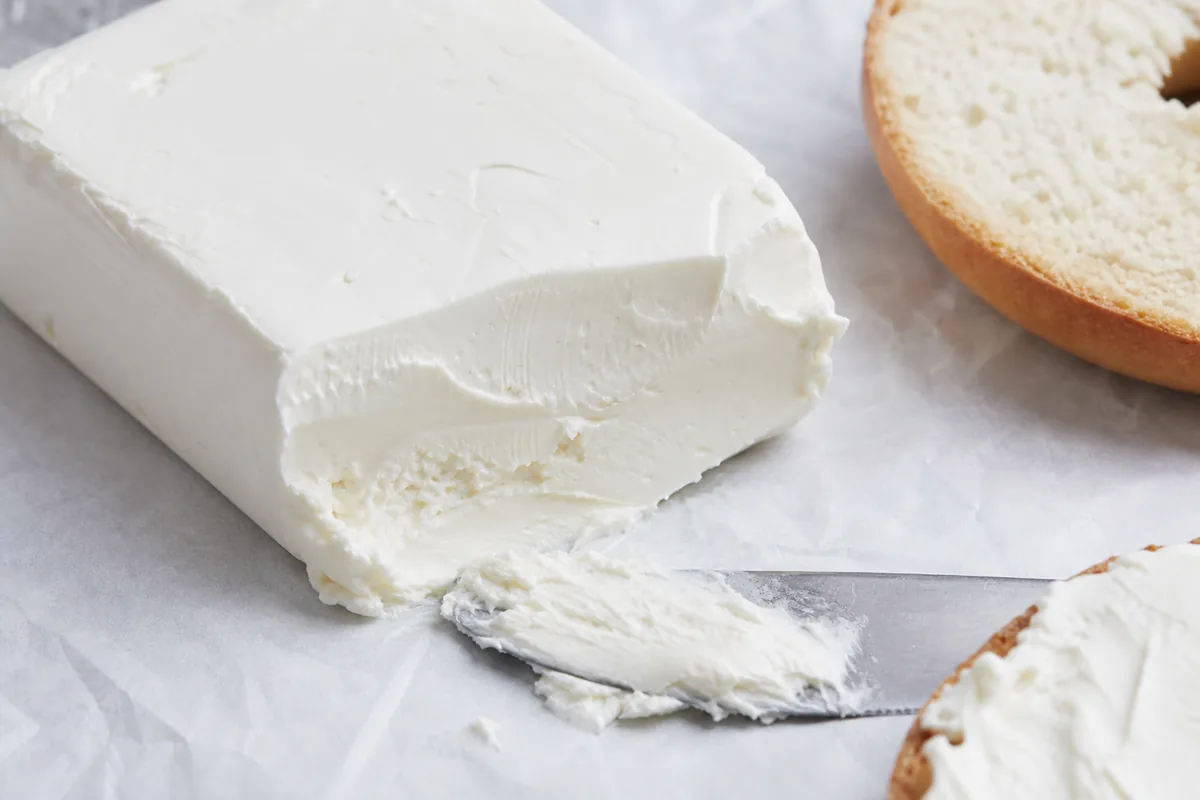
For cream cheese, English Wikipedia and Cheese Connoisseur both name cheesecake as the dish where Manouri can take over.
How Do You Buy and Store Manouri?
Greek dairies sell Manouri PDO in 200 g retail packs and in larger blocks, and Mevgal and Lytras both list 200 g packs and 2 kg blocks.
If you are shopping in the United States, Cheese Connoisseur says only a few of Greece's dozens of Manouri brands are available, through specialty import shops and online, and names Hotos and Krinos.
- Name: Manouri PDO, the protected name for cheese from the three regions above.
- Milk: sheep and goat whey with added milk or cream, as Mevgal describes it.
- Pasteurization: Mevgal states it on its product page; check the label on other brands.
- Salt: 1.2 to 2 g per 100 g on the two labels in the nutrition table.
After opening, keep your Manouri refrigerated and eat it within 7 days, as Lytras advises. The same dairy gives a minimum shelf life of six months from production for the unopened pack.
Against that seven-day limit, a 200 g pack holds ten of Lytras's 20 g portions, while a 2 kg block holds a hundred.
If you want to freeze Manouri, check the label or ask the seller for guidance.
Is Manouri Safe During Pregnancy?
It depends on the milk, on how Manouri is classed and on whether you heat it. Mevgal's product page calls its Manouri PDO pasteurized, and Cheese.com lists Manouri as made from pasteurized goat's or sheep's milk.
The NHS lists pasteurised soft cheeses, such as ricotta and feta, as safe in pregnancy, along with any cheese cooked until steaming hot. Cheese.com and English Wikipedia call Manouri semi-soft and Greek Wikipedia calls it soft, so this line covers pasteurised Manouri, and the NHS says foods made from unpasteurised milk must be thoroughly cooked.
The CDC lists pasteurized soft cheeses heated to an internal temperature of 165°F or until steaming hot as safer and soft cheese made from unpasteurized (raw) milk as riskier, and says pregnant women are 10 times more likely to get a Listeria infection. Served cold, Manouri is described as a pasteurized fresh, soft or semi-soft whey cheese, a type the CDC list does not cover, so ask a midwife or doctor.
SOURCES & REFERENCES
What Else Do People Ask About Manouri?
Mild and creamy. Cheese.com calls the flavor subtle, clean and nutty, and the Washington Post, quoted on English Wikipedia, found only the barest hint of tang.
No. Feta is made from milk and matured in brine for at least 2 months, per the European Commission's Feta PDO specification, while Manouri is a whey cheese enriched with milk or cream, with about 0.8 percent salt according to English Wikipedia.
No. Both are whey cheeses, but Manouri adds milk or cream and forms a compact cylinder. Cheese Connoisseur calls it finer, more delicate and less acidic than ricotta.
Yes. Cheese Connoisseur suggests grilling or pan-frying slices and serving them with sun-dried tomatoes, a lemon wedge or vinaigrette.
Not like mozzarella. Cheese Connoisseur says to think of it as heating like ricotta, and notes that grilling is common in Greece.
Cheese Connoisseur says it can probably replace ricotta wherever ricotta is used and names it in place of feta in a Greek salad, though Hotos Manouri has 130 calories against 74 for Hotos feta.
Lytras says to keep its Manouri refrigerated after opening and eat it within 7 days.
The NHS lists pasteurised soft cheeses as safe to eat and any cheese cooked until steaming hot as safe, and the CDC lists pasteurized soft cheeses heated to an internal temperature of 165°F or until steaming hot as safer. Served cold, Manouri is described as a pasteurized fresh, soft or semi-soft whey cheese, a type the CDC list does not cover, so ask a midwife or doctor.