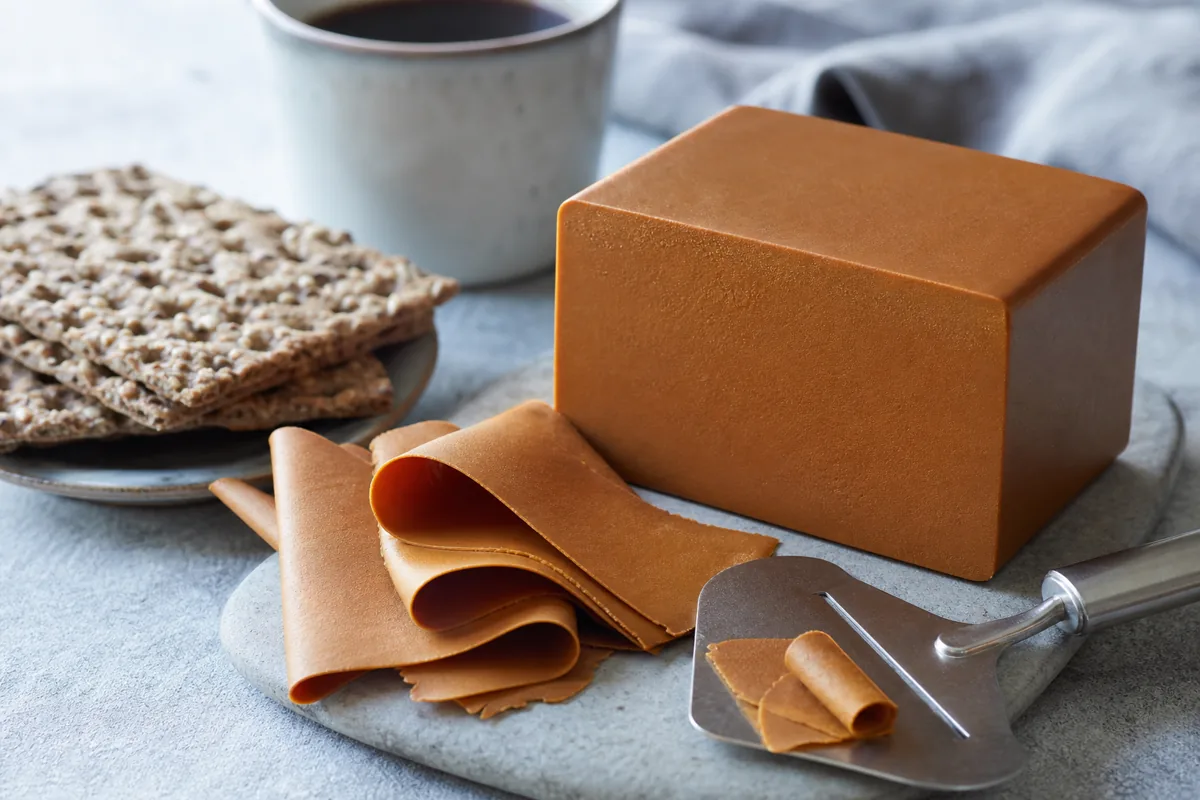
Brunost is Norway's brown whey cheese, made by boiling whey with milk and cream until it turns brown and sweet.
Meny, a Norwegian supermarket chain, puts consumption at about 1.7 kg per person each year. TINE, the Norwegian dairy that makes it, describes the taste as sweet and fudge-like, with a hint of goat's milk.
In This Article
Brunost is cooked whey, not a ripened curd
Ordinary cheese starts with milk curds, and the liquid drained from them is whey. Brunost starts with that whey.
Meny lists the steps: the whey is boiled to drive off excess water, and milk and cream go into the boiling whey. The mixture is stirred constantly until it reaches the right colour and consistency, then cooled in molds.
Norwegian Wikipedia says the whey is cooked down to a dry matter content of about 80 to 82 percent.
Because the base is whey rather than curd, English Wikipedia says brunost is not technically cheese, though cheesemakers produce it and it is sold, handled and eaten like cheese. None of the sources describes an ageing step, so the process ends when the block cools.
The invention of modern brunost is credited to Anne Hov in Gudbrandsdalen, and TINE USA dates it to 1863.
Wikipedia says she was a milkmaid who added cream to the whey, while TINE's English product page calls her a farmer's wife. Wikipedia adds that she received Norway's King's Medal of Merit in 1933.
Why does Brunost taste like caramel?
Science Meets Food describes whey as approximately 94 percent water, with the remaining 6 percent being lactose, protein and minerals.
Meny says the lactose caramelises under high heat like any other sugar, and TINE says the mixture is caramelised and boiled, hence the brown colour. Norwegian Wikipedia credits the Maillard reaction for the browning instead.
How far the browning goes differs by type. Norwegian Wikipedia describes Heidalsost as more intensely browned, with sharp, burnt notes.
The goat note comes from the milk that goes in. TINE's Gudbrandsdalen label lists pasteurized goat's milk at 144 g per 100 g of cheese, alongside cream, pasteurized cow's milk and sweet rennet whey.

Brunost, Gjetost, and Gudbrandsdalsost are not exact synonyms
Brunost is the umbrella name for the family, and the named types differ mainly in the milk they use.
Wikipedia says gjetost and geitost are alternate spellings of one word that means goat cheese in Norwegian, and that gjetost is the usual spelling in the US.
Ekte geitost translates as true goat cheese, a name Wikipedia calls misleading, because Norwegians call goat cheese such as French chèvre hvit geitost, or white goat cheese.
| Type | Milk and character |
|---|---|
| Fløtemysost | Made from cow's milk; Wikipedia calls it the milder type and the second most popular |
| Gudbrandsdalsost | Cow and goat milk with cream and whey; Wikipedia calls it the most popular type |
| Ekte Geitost | Goat whey, goat cream and goat milk on TINE's label; Wikipedia describes an intense taste |
| Prim | Softer and spreadable, made by stopping the cooking earlier |
TINE USA says its brunost is sold under the brand name Ski Queen in the US.
The ingredient list shows which type you are holding: goat's milk appears in Gudbrandsdalsost and Ekte Geitost, while fløtemysost is the cow's-milk version. A mixed-milk Gudbrandsdalsost is the middle choice for a first block, with goat's milk in the mix but not as the only milk.
Norwegians slice Brunost thin and serve it on bread and waffles
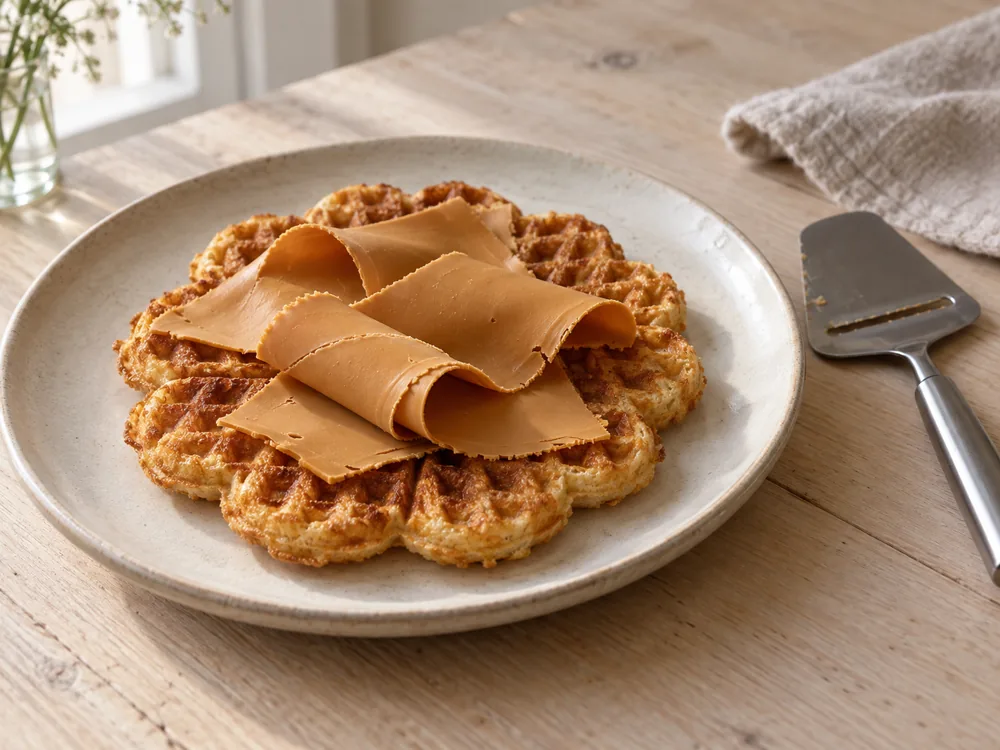
TINE says most Norwegians eat brunost on sandwiches, cut into thin slices with a cheese slicer.
TINE's UK labels for Gudbrandsdalen and Ekte Geitost both add that the cheese is best sliced when cool.
English Wikipedia says it is customarily served thin-sliced in matpakke, the Norwegian packed lunch, and the other serving ideas the sources give are below.
| Use | How It Works |
|---|---|
| Waffles | TINE names waffles as a use. |
| Pancakes | Norwegian Wikipedia lists pancakes next to waffles and bread. |
| Crispbread and biscuits | English Wikipedia names both as customary bases. |
Brunost also goes into sauces and brownies
TINE says brunost can be used as an ingredient in brownies or sauces, and TINE USA adds that you can cook with it or put it on top of a snack or breakfast.
The Norwegian food-waste organisation Matvett recommends game stews and brown sauces for a piece that has dried out.
A recipe that adds brunost also adds sugar and fat, so the nutrition figures further down apply to sauces and brownies as well.
Brunost keeps for months but should not be frozen
Matvett says brunost rarely goes bad, because the long boil kills most bacteria and the high lactose and fat content keeps bacteria and mould from thriving.
- TINE's UK labels for Gudbrandsdalen and Ekte Geitost: store at 0 to 4 °C.
- Matvett: 1 to 4 °C, in its own packaging.
- Meny: roughly four months in the refrigerator, often much longer; room temperature is fine before opening, the refrigerator afterwards.
A dry, hard end is a common sight at the back of the refrigerator, Matvett says, and it stays usable while it is free of mould.
For mould, Matvett says white or green spots can be cut away with a 1 cm margin.
Meny says brunost is not suitable for freezing because it becomes grainy and tough.
High lactose changes the nutrition and who can eat it
English Wikipedia notes that where many cheeses are naturally free of lactose, brunost is high in lactose.
TINE's UK product pages give these label values per 100 g.
| Nutrient | Gudbrandsdalen | Ekte Geitost |
|---|---|---|
| Energy | 1835 kJ (441 kcal) | 1790 kJ (429 kcal) |
| Fat | 28 g | 27 g |
| Carbohydrate | 35 g | 34 g |
| Sugars | 30 g | 30 g |
| Protein | 10 g | 13 g |
| Calcium | 460 mg | 553 mg |
By that arithmetic, a 20 g portion of Gudbrandsdalen supplies about 88 kcal and 6 g of sugars.
TINE's UK pages mark both Gudbrandsdalen and Ekte Geitost as suitable for vegetarians.
Is brunost safe during pregnancy?
Neither the CDC nor the NHS names brunost when it lists which cheeses are safer during pregnancy, so the milk on the label is the fact to check.
The CDC lists soft cheese from unpasteurized milk among its riskier choices, and hard cheese, mozzarella and feta made with pasteurized milk among the safer ones. The NHS says hard cheeses such as cheddar, gruyère and parmesan are safe pasteurised or unpasteurised.
SOURCES & REFERENCES
TINE says brunost is made from whey, cow's and/or goat's milk, and cream, which is caramelised and boiled until it turns brown. The mixture is then cooled in molds, according to Meny.
English Wikipedia says brunost is not technically cheese because it is made from whey rather than curd. Cheesemakers produce it, and it is sold, handled and eaten like cheese.
Wikipedia treats gjetost and geitost as spellings of goat cheese and both as types of brunost. Ekte geitost uses only goat's milk, while Gudbrandsdalsost mixes cow and goat milk.
TINE describes it as sweet and fudge-like with a hint of goat's milk.
TINE says most Norwegians eat it on sandwiches in thin slices cut with a cheese slicer. It also goes on waffles and into brownies or sauces.
Yes. English Wikipedia calls brunost high in lactose, and TINE's Gudbrandsdalen label lists 30 g of sugars per 100 g.