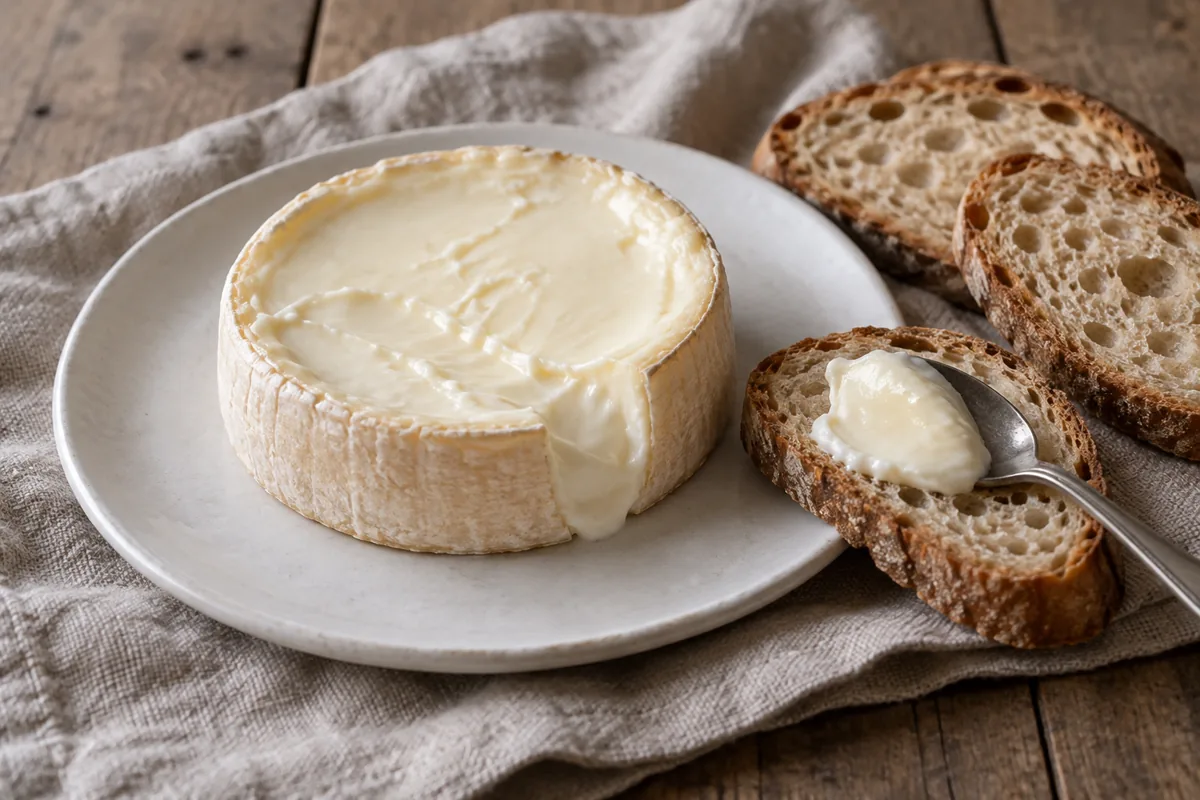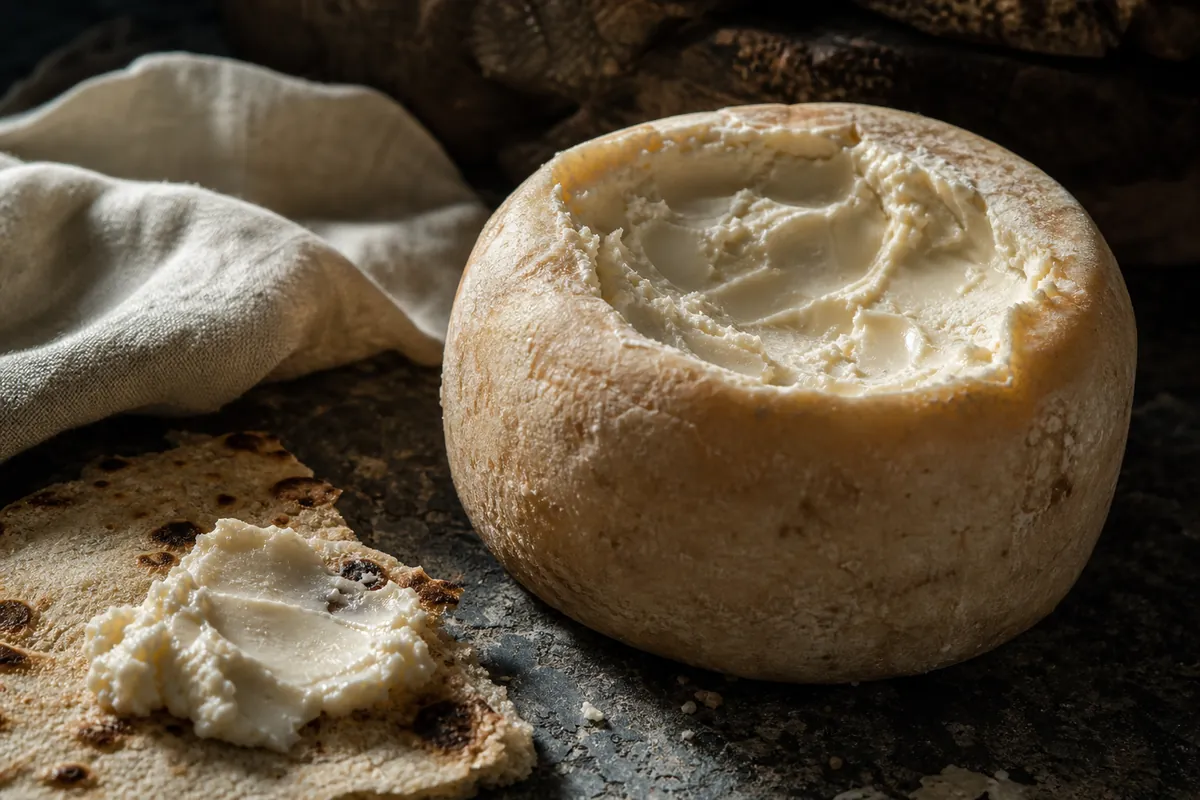
Casu marzu is a Sardinian sheep's milk cheese that cheese-fly larvae soften from the inside, and selling it has been prohibited in Italy since 1962.
Even so, Italy's national database of traditional food products lists it, and Sardinia's official tourism site presents it among the island's cheeses.
In This Article
How Does a Pecorino Become Casu Marzu?
It starts as a whole pecorino with part of the rind removed, so the cheese fly Piophila casei can lay eggs in the exposed paste. The samples in a 2015 study in the Italian Journal of Food Safety were made in Sardinia from whole ewe's milk.
Other steps favour the fly: a shorter salting time, small holes filled with oil to soften the rind and attract the insect, fewer turns of the wheel, and open rooms where the fly can reach it.
Names vary by village. English Wikipedia titles it casu martzu and lists casu modde, casu cundìdu and casu fràzigu, while Italian Wikipedia leads with casu frazigu, calls the spelling casu marzu erroneous, and adds regional names such as casu mùchidu and casu bèiu.
Pecorino Sardo is a separate cheese with its own PDO, granted in 1996. Some sources name Pecorino Sardo as the base for casu marzu and others say only pecorino, and casu marzu itself carries no PDO.
When Is It Made and How Long Does It Take?
Ripening runs from 60 days to six months. The nine samples in the 2015 study had ripened for 60 to 90 days, English Wikipedia puts the whole fermentation at about three months, and Italian Wikipedia gives three to six months.
Production happens in summer in the study's account, when higher temperatures favour the fly's life cycle. Italian Wikipedia gives a longer season, spring and summer and sometimes into late autumn.
Study wheels sit uncovered in the warmer rooms of the plant so flies can reach it. Two local beliefs about quality come up: pecorino from milk collected toward the end of June is most desirable because of how the sheep's reproductive cycle affects lactation, and a warm sirocco wind is thought to soften the cheese and encourage more maggot activity.
How many larvae remain at opening depends on whom you read. In Italian Wikipedia's version the top (su tappu) is cut off once the cheese is mature and the larvae have clearly dwindled, showing a soft, homogeneous, yellowish cream.
Other accounts have larvae still in the wheel. A typical ready wheel still holds thousands of maggots in English Wikipedia's telling, and in Food Republic's report the live maggots usually remain at the bottom when it is served.
Modern preservation techniques have stretched the shelf life to several years, where the cheese was once unobtainable outside late summer and early autumn (English Wikipedia).
What Do the Larvae Do to the Paste?
They make it very soft: acid from their digestive system breaks down the cheese's fats.
The 2015 samples had the highest levels of total free amino acids, the study's index of how far the proteins had broken down. The authors put that down most probably to the larvae's strong proteolytic activity and the warm storage.
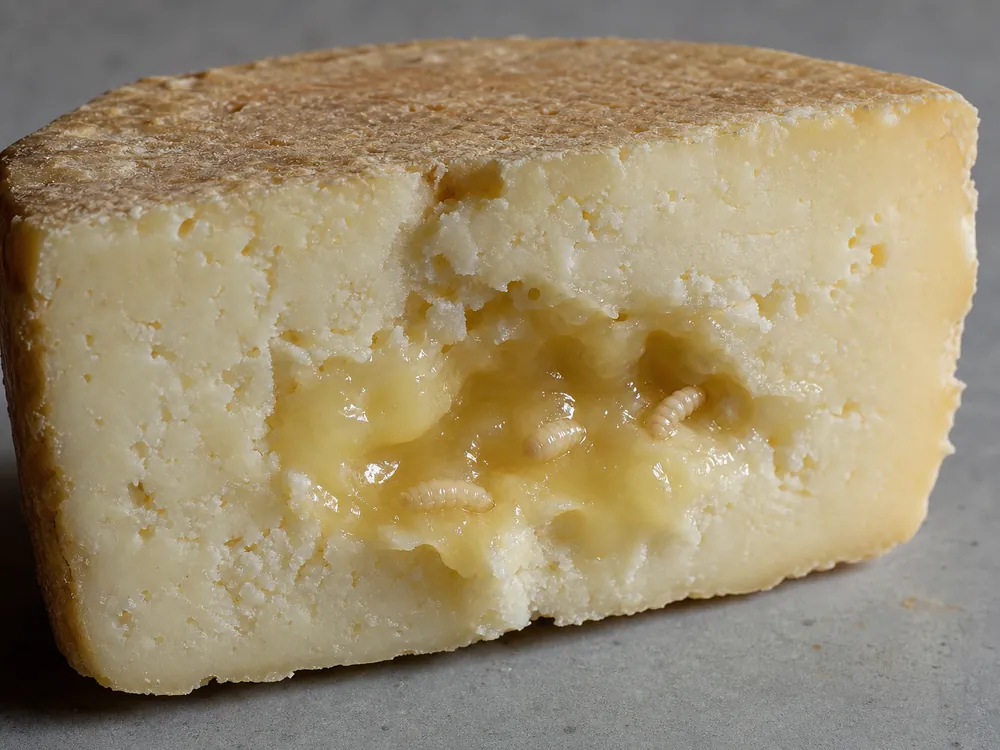
Cheeses with a holed paste were colonised more easily in a 2010 University of Sassari study (Mazzette and colleagues) that exposed three batches of two cheese types to Piophila casei under controlled conditions over 90 days. Those cheeses also showed more proteolysis and lipolysis than firm-paste cheeses, and colonisation differed between batches.
Work on breeding the fly in controlled conditions, so production could meet hygiene rules, began in 2005 with Sardinian breeders and the University of Sassari's agricultural entomology institute (Italian Wikipedia).
On the wheel, the fly passes through four stages: eggs laid on the cheese, larvae that feed on it, pupae, and adults that emerge and must find another cheese before they die.
Late-stage larvae leap by hooking their mouths into their own rear segments and releasing, a movement believed to explain the name "cheese skippers". They also use it when dispersing to the dark, dry places where they pupate, a stage of around 12 days.
| Question | Answer |
|---|---|
| How long is a larva when fully grown? | 9 to 10 mm long and 1 mm wide |
| How far can a larva jump? | Up to 15 cm (English Wikipedia's Casu martzu entry) or 10 to 12 cm (its Cheese fly entry) |
What Does It Taste Like, and How Do Sardinians Eat It?
Expect spice and a long finish. An intense taste with Mediterranean, pastoral and spicy notes and an aftertaste that lasts for hours is how English Wikipedia puts it, and Food Republic writes of flavours from earthy and tangy to spicy and lingering.
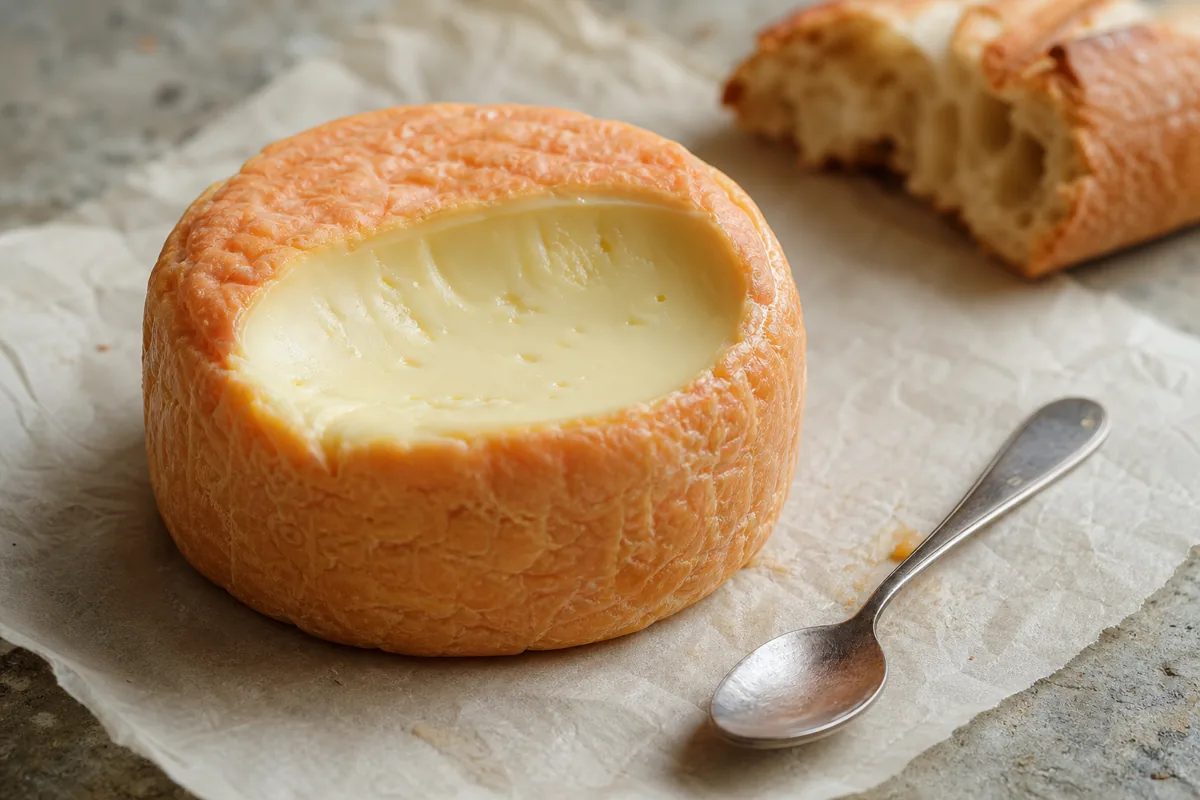
Cheese.com calls it creamy and pungent, with ammonia-like undertones in the aroma, with a texture from smooth and spreadable to semi-liquid and larvae that add a flavour reminiscent of Gorgonzola or other blue cheese. A liquid called làgrima ("teardrop") may seep out.
It is generally reserved for village festivals and family celebrations, served as thin strips are spread on moistened pane carasau, the Sardinian flatbread, with a strong red wine such as Cannonau. Diners hold a hand over the bread because the larvae can launch themselves up to 15 cm when disturbed.
| Pairing | Type | Why It Works |
|---|---|---|
| Pane carasau | Food | English Wikipedia says the strips are spread on moistened Sardinian flatbread. |
| Cannonau | Wine | English Wikipedia names a strong red wine such as Cannonau as the usual match. |
Is Casu Marzu Legal?
No. It cannot be sold in Italy. The ban dates to 1962 in English Wikipedia's account, and Italian Wikipedia cites Article 5 of Law 283/1962 and EU regulations 852, 853, 854 and 882 of 2004.
Potential health risks from Piophila casei are the stated grounds in Italian Wikipedia, and English Wikipedia files the ban under laws against selling infested food. Offenders face heavy fines, though enforcement is patchy.
The same fly is a pest elsewhere in the industry. Its larvae burrow and are hard to detect until they are large enough to disperse, and dairies fear them because they attack every type of cheese, so whole batches can be lost and rooms have to be disinfested.
Being in the Ministry of Agriculture's traditional-products database certifies at least 25 years of production, and the sale ban stands separately. The Sardinia tourism site still lists it among the island's cheeses.
Sardinia has asked the EU for PDO status (Italian Wikipedia), and English Wikipedia's cheese infobox lists its certification as none. Attempts have also been made to get around the ban by declaring it a traditional food.
A 2019 estimate cited by English Wikipedia put illegal production at 100 tonnes a year, worth 2 to 3 million euros, with a black-market price up to double that of an ordinary pecorino. It also appears on English Wikipedia's list of cheeses that are not legal in the United States.
Is Casu Marzu Safe to Eat?
A 2015 study by Manca and colleagues in the Italian Journal of Food Safety concluded that casu marzu can be considered unsafe, especially for people treated with monoamine oxidase inhibitor drugs (MAOIs). It compared three Sardinian ewe's milk cheeses and measured nine casu marzu samples, with the highest value found for each amine is below, in milligrams per 100 grams.
| Compound | Highest value (mg per 100 g) |
|---|---|
| Tyramine | 231.4 |
| Histamine | 126 |
| Putrescine | 165.8 |
| Cadaverine | 470.7 |
| Total biogenic amines | 1,035.7 |
Two samples reached totals of 1,035.7 and 923.0 mg per 100 g, far above the 75 to 90 mg threshold the paper cites.
The 2015 Sardinian study concludes that casu marzu can be considered unsafe, especially for people treated with MAOI drugs.
The larvae themselves may survive stomach acid and reach the intestine, a condition called pseudomyiasis that brings nausea, vomiting and gastrointestinal upset. English Wikipedia also records documented pseudomyiasis cases with P. casei.
Guinness World Records named it the world's most dangerous cheese in 2009. Food Republic quotes the producer Sergio Bituleri saying no one has ever got sick from eating it, a producer's claim rather than a measured rate.
Sardinian aficionados treat the cheese as unsafe once the larvae have died, while some eaters seal it in a paper bag to starve the larvae of oxygen.
Casu Marzu in Pregnancy
The amine study's verdict, that casu marzu can be considered unsafe, applies with extra force if you take MAOI drugs. Pregnancy is a reason to avoid it outright.
Cooking is the usual NHS fix for risky cheese, and the NHS wants food made from unpasteurised milk cooked until steaming hot, yet that fix fails here. Heat leaves biogenic amines in place, and a cheese sold outside the law has no label you can trust, so avoid casu marzu while pregnant.
In the US, the CDC counts raw-milk soft cheese as riskier and wants pasteurized soft cheese heated to 165°F, and no CDC line covers a larva-ripened cheese, so avoid it, and talk to your midwife or a GP if you have already eaten some and feel worried or unwell. Cheese in pregnancy covers the soft cheeses that are easier calls.
How Do Its Amine Levels Compare With Other Sheep's Milk Cheeses?
In the 2015 study, casu marzu reached the highest total biogenic amines of three Sardinian ewe's milk cheeses, up to 1,035.7 mg per 100 g. Pecorino Sardo PDO from cheese factories stayed between 3.1 and 33.5, and farmhouse pecorino ran from 9.4 to 287.8, with four of its 12 samples also over the 75 to 90 mg threshold.
| Cheese | Samples | Ripening in the study | How it was made and ripened | Total amines (mg per 100 g) |
|---|---|---|---|---|
| Pecorino Sardo PDO, cheese factory | 13 | 30 to 360 days | Thermised milk with a starter culture, rooms held at 6 to 12 °C and 80 to 95% humidity | 3.1 to 33.5 |
| Farmhouse pecorino | 12 | 60 to 360 days | Raw milk without a starter culture, rooms with no control over temperature or humidity | 9.4 to 287.8 |
| Farmhouse casu marzu | 9 | 60 to 90 days | Pecorino left uncovered in warm rooms so flies can lay eggs | 62.9 to 1,035.7 |
The authors link the gap to conditions. Amine-forming bacteria need free amino acids from protein breakdown plus a suitable pH and temperature, which ripening can supply.
Insects and raw milk combined with a high storage temperature seem to favour amine formation, while the PDO cheese, made from thermised milk in controlled rooms, kept its totals low. High amine totals also point to poor hygiene in the raw material or the manufacture, because the bacteria behind them are often contaminants.
Casu marzu itself varied widely. Besides the two highest samples, the other seven totals ran from 62.9 to 282.1 mg per 100 g, in line with artisanal Italian cheeses such as Formaggio di Fossa and Pecorino di Farindola.
Blue cheese, among the richest in biogenic amines, peaks at 158.5 mg per 100 g for tyramine, 210.4 for cadaverine and 25.7 for putrescine in the figures the paper cites. The highest casu marzu values above exceed all three, and some samples held the highest contents found in cheese up to then.
Are There Other Cheeses Made With Fly Larvae?
Yes. Casgiu merzu comes from southern Corsica, especially around Sartène, and similar Italian cheeses include brös ch'a marcia in Piedmont, cacie' punt in Molise, casu puntu in Salento, casu du quagghiu in Calabria, furmai nis in Emilia-Romagna, marcetto in Abruzzo and salterello in Friuli-Venezia Giulia.
The Basque Country has gazta-ustela, whose name means "rotten cheese". One goat's milk cheese elsewhere in Europe is left in the open air until the fly lays eggs, then aged in white wine with grapes and honey, a step meant to keep the larvae from emerging and give a strong flavour.
Daniel Defoe's 1724 account has Stilton brought to table with mites or maggots round it, and German Milbenkäse and French Mimolette rely on cheese mites.
Larvae, Mould, Brine or Mites: Four Ways to Ripen
Blue, washed-rind and mite-ripened cheeses each hand the breakdown to a different agent, and casu marzu uses insect larvae.
| Cheese | What does the work | Time the source gives |
|---|---|---|
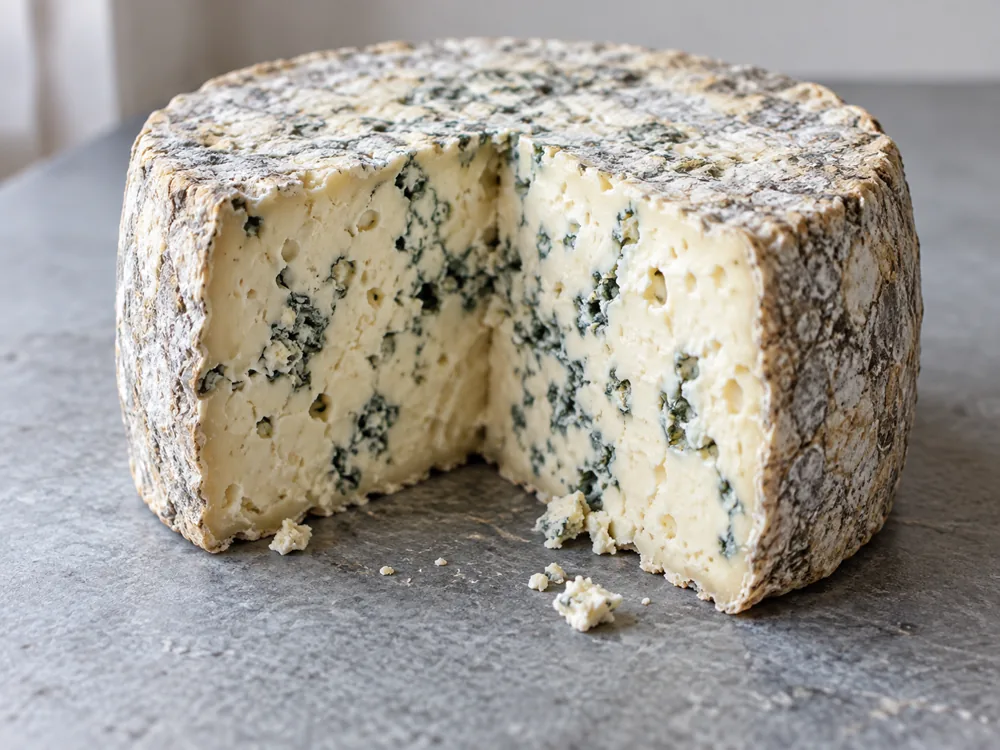
| Blue cheese | Penicillium roqueforti mould along air tunnels made by piercing | 60 to 90 days before the typical flavour develops |
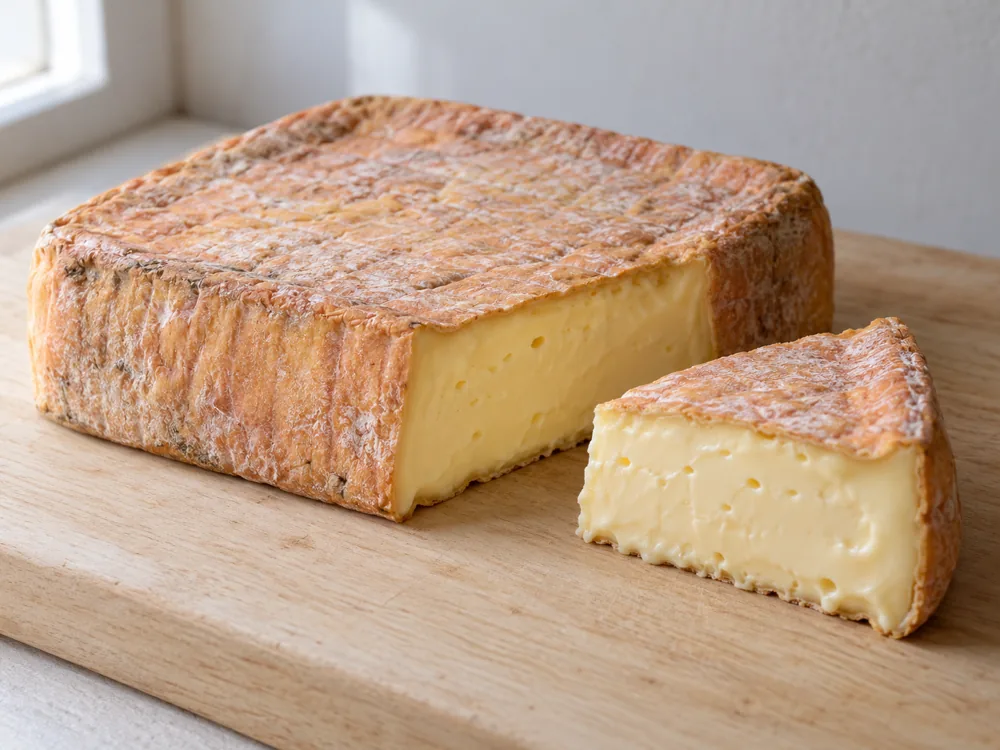
| Taleggio | Surface washed once a week with brine (Taleggio PDO) | At least 35 to 40 days |
| Mimolette | Cheese mites added to the surface | 2 months to 2 years |
| Casu marzu | Cheese-fly larvae feeding in the paste | About 3 months to 6 months, depending on the source |
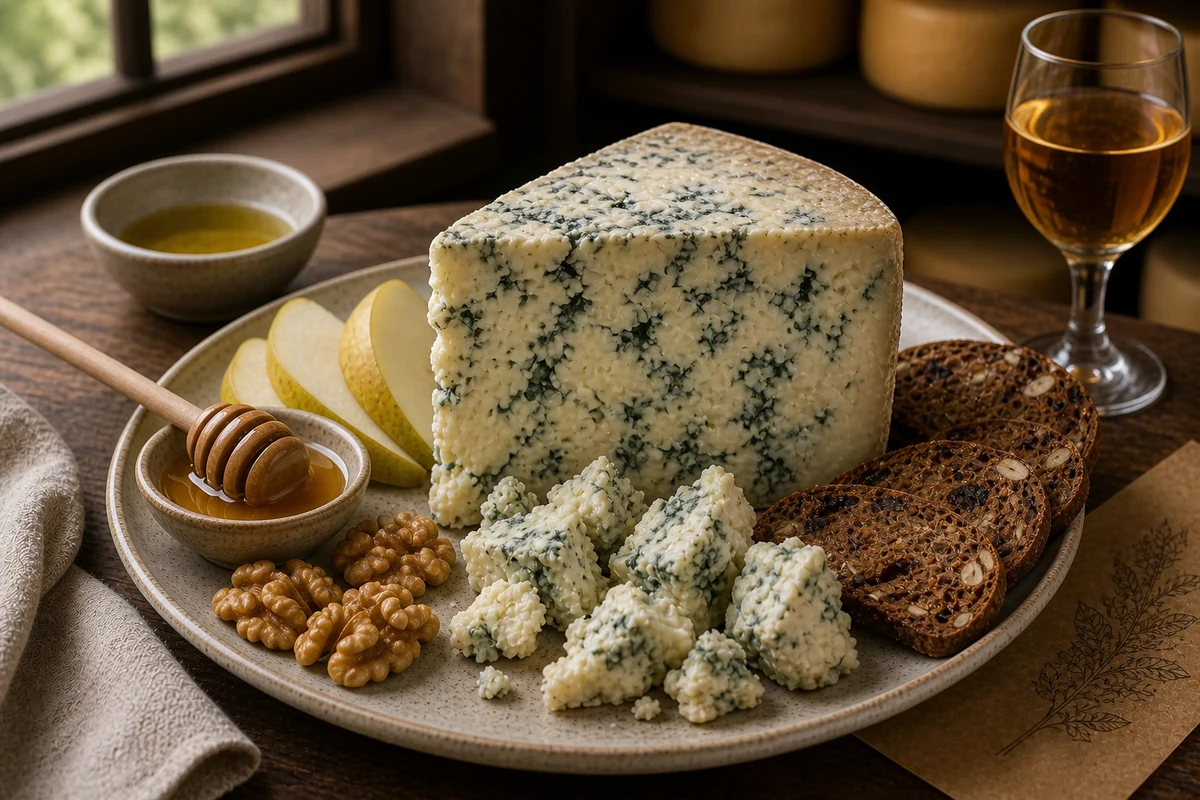
Blue cheese loaves are punctured at the start of ripening so air reaches the Penicillium roqueforti mould. They ripen at around 8 to 10 °C and 85 to 95% relative humidity, while the 2015 study's casu marzu sat in the warmer rooms of the plant.
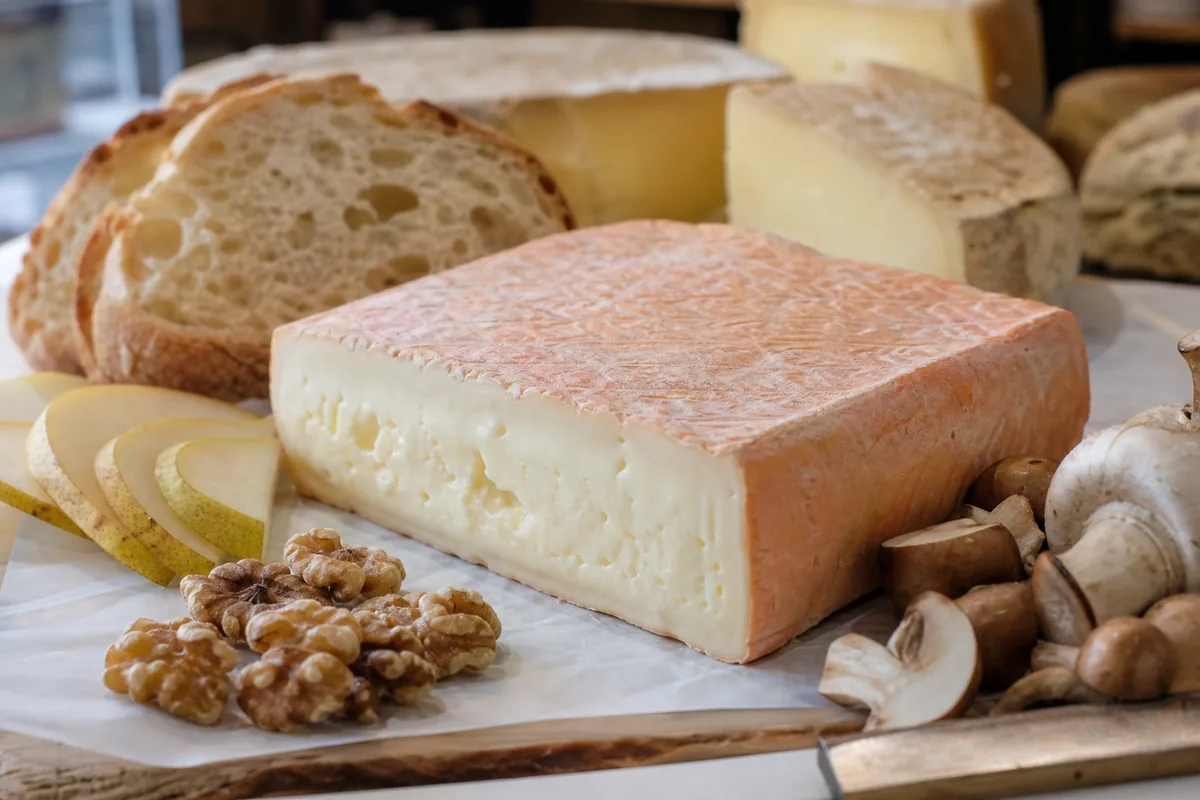
A Taleggio PDO wheel is washed once a week with brine, which promotes the growth of mould on the rind and gives it an orangey-pink colour.
The grey rind of aged Mimolette comes from cheese mites added to the surface to enhance flavour, while its bright orange colour comes from annatto. In 2013 the FDA detained about a ton of it for exceeding a standard of six mites per cubic inch, and the restriction was lifted in 2014.
Mimolette is made from pasteurised cow's milk. Young, it tastes like Parmesan, and extra-old it takes on a hazelnut-like flavour.
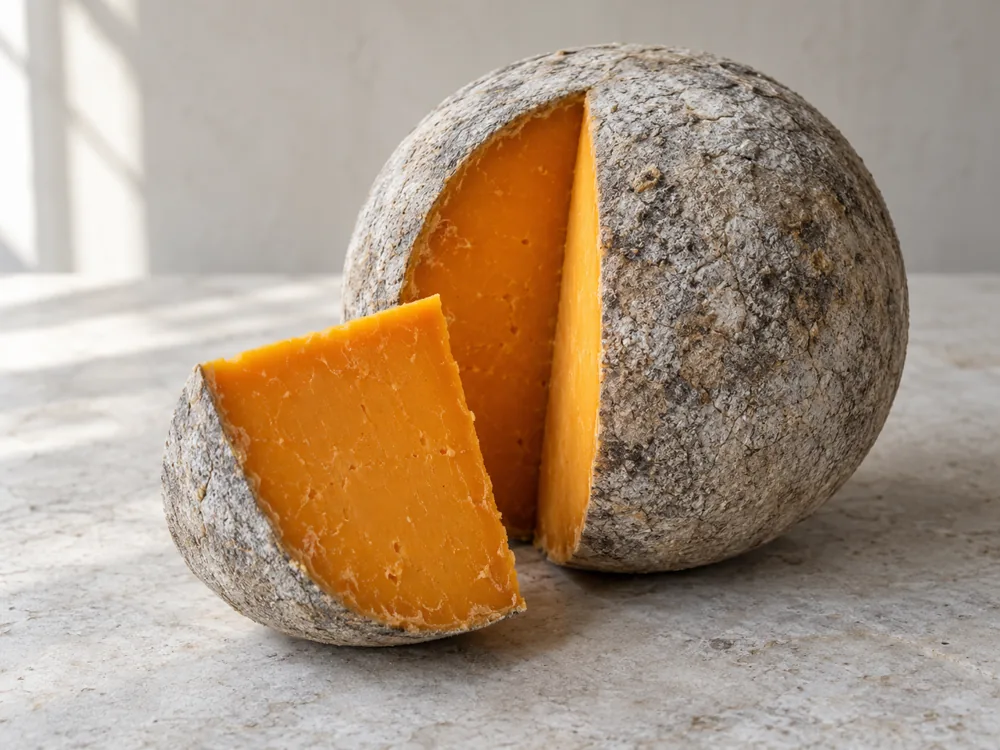
Mimolette's mites work on the rind, while casu marzu's larvae feed through the paste.
What Can You Eat Instead?
Pecorino Sardo is the nearest regulated match for milk and origin. It is made from the milk of the local Sarda sheep, has had PDO protection since 1996, and comes as dolce (20 to 60 days) or maturo (more than two months), growing sharper as it matures.
Its rind is deep yellow to dark brown around a white to straw-yellow paste. The dolce wheel weighs 1.0 to 2.3 kg and the maturo 1.7 to 4.0 kg, and in the 2015 amine comparison Pecorino Sardo PDO had the lowest totals of the three cheeses.
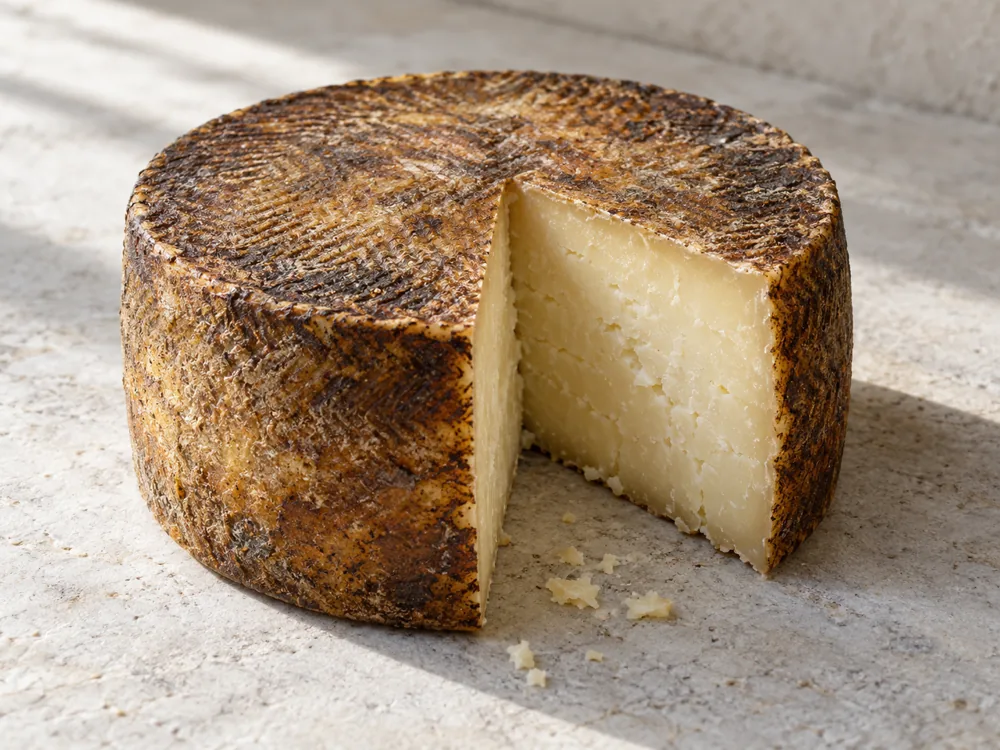
Pinna Formaggi's Pecorino Romano PDO matures from five months, when it is a table cheese, to eight months for grating, with a white, hard and compact paste and an intense, spicy and salty flavour.
Pecorino Romano originated in Lazio, and about 95% of production is now in Sardinia. Both of the closest Italian cheeses are made from sheep's milk.
SOURCES & REFERENCES
Not legally. The Italian sale ban covers the whole country, Sardinia included, so any wheel you are offered is sold outside the law.
No. Sardinia's request to the EU has not produced a PDO, and its listing as a traditional product is a different register with no protected name.