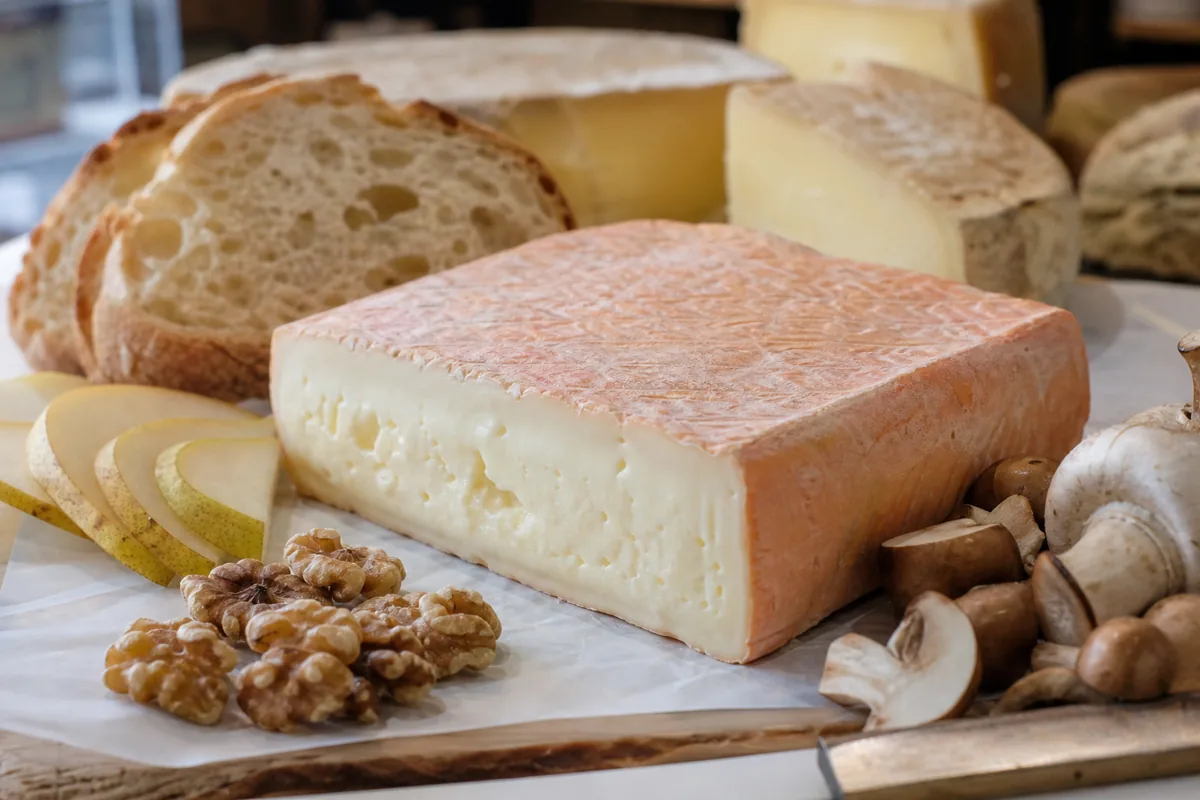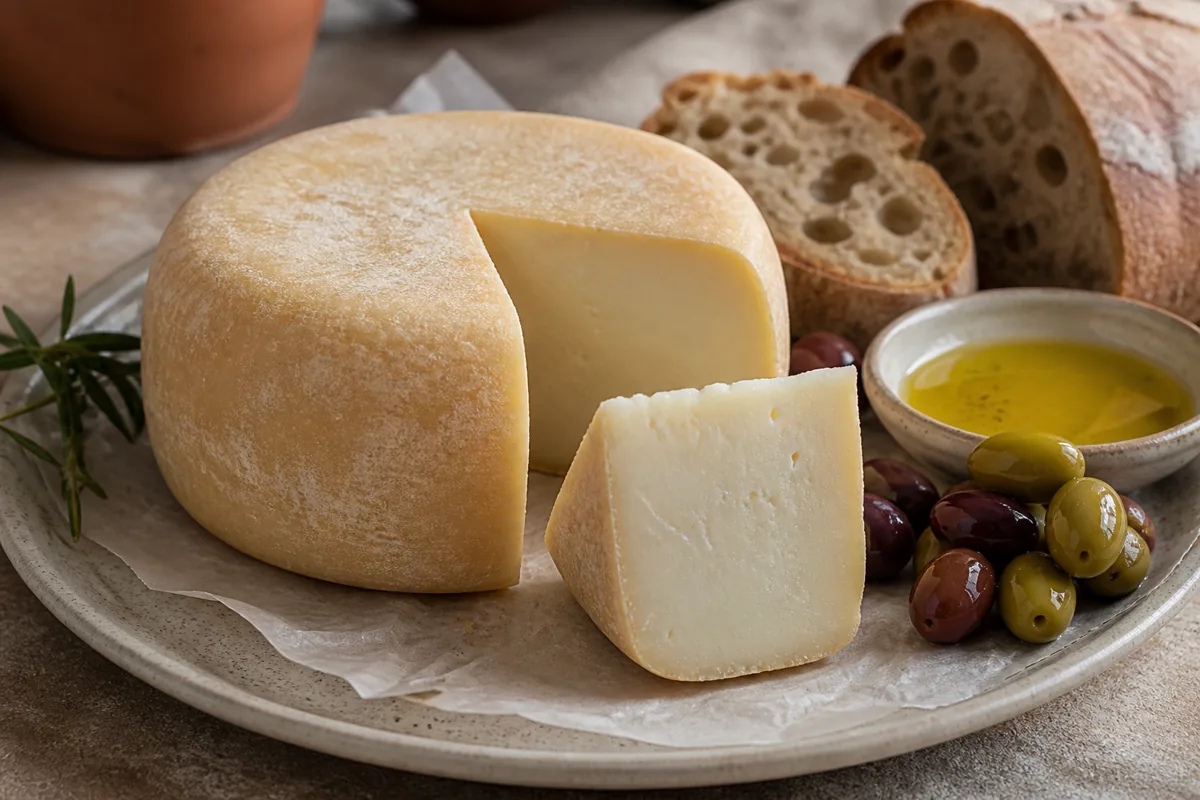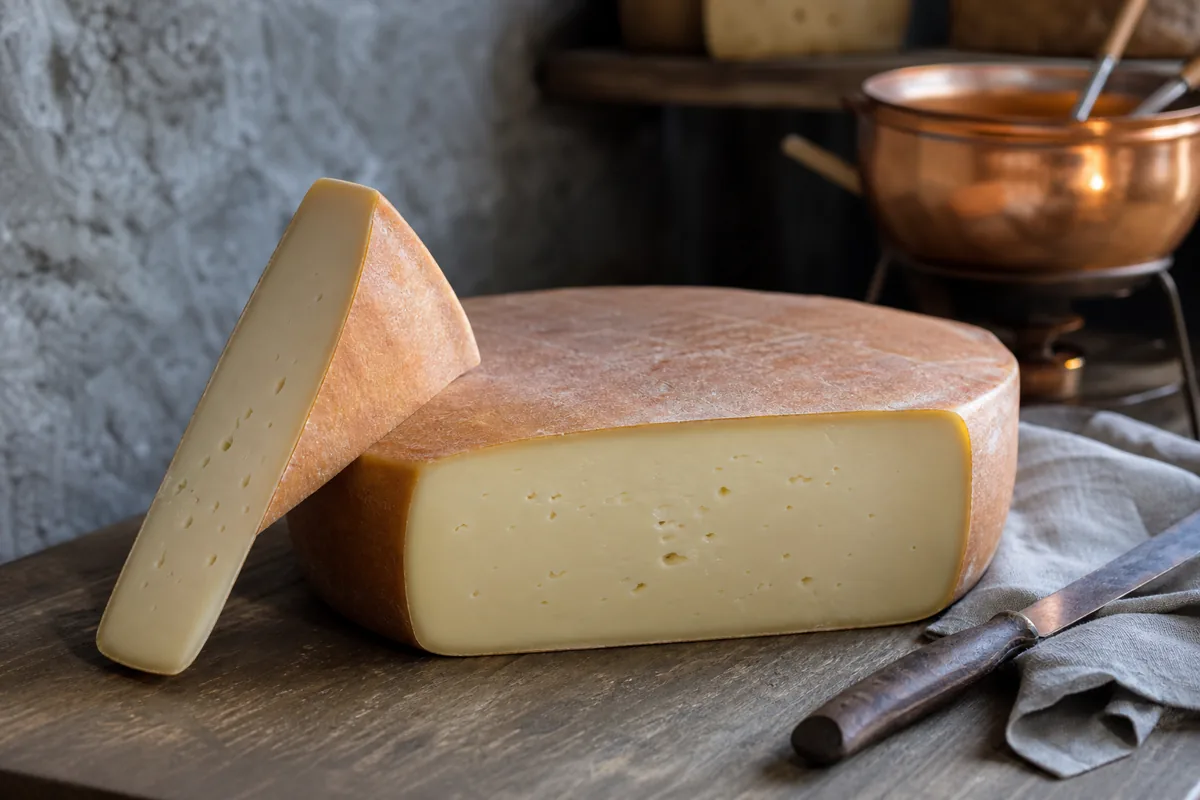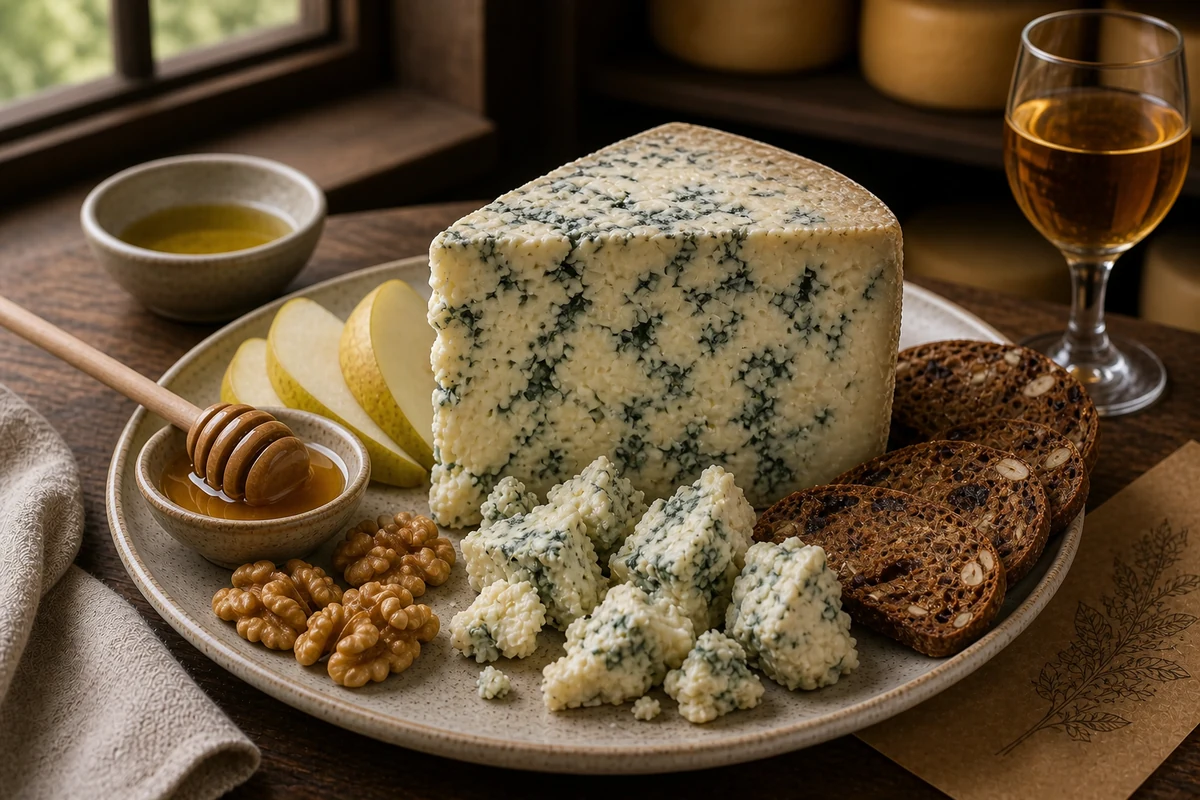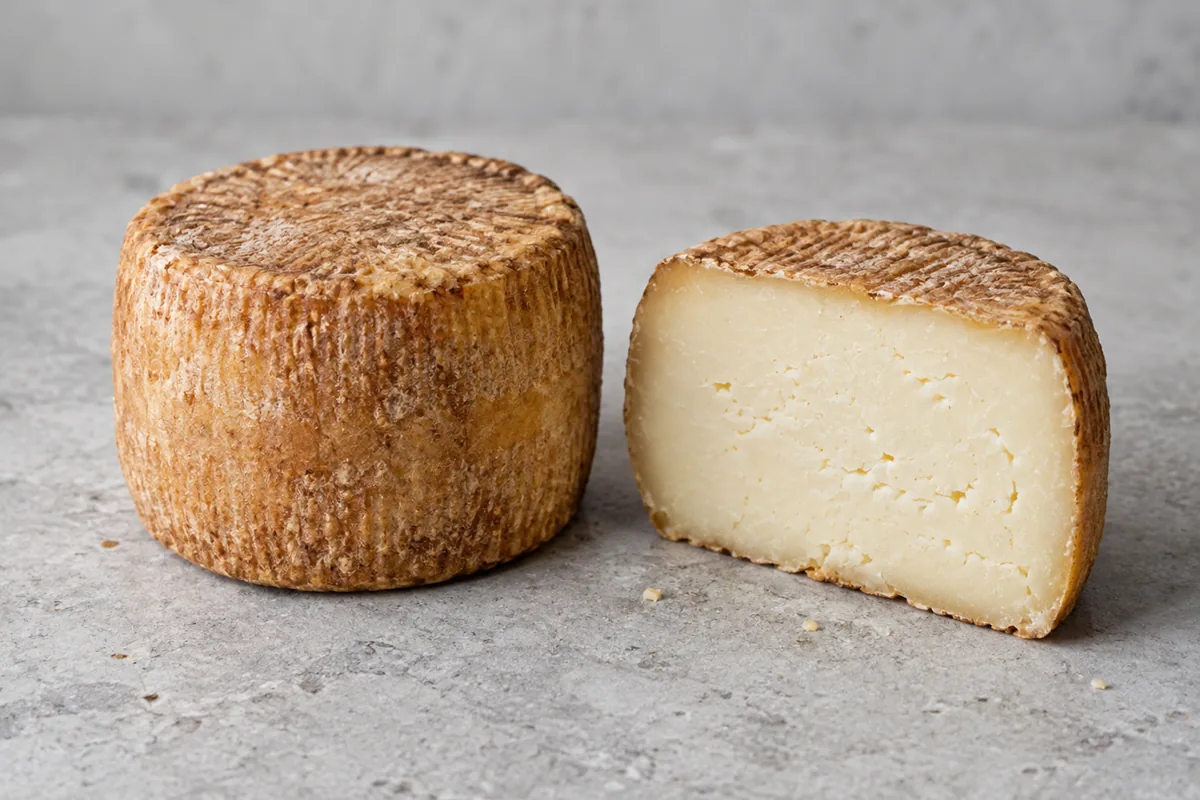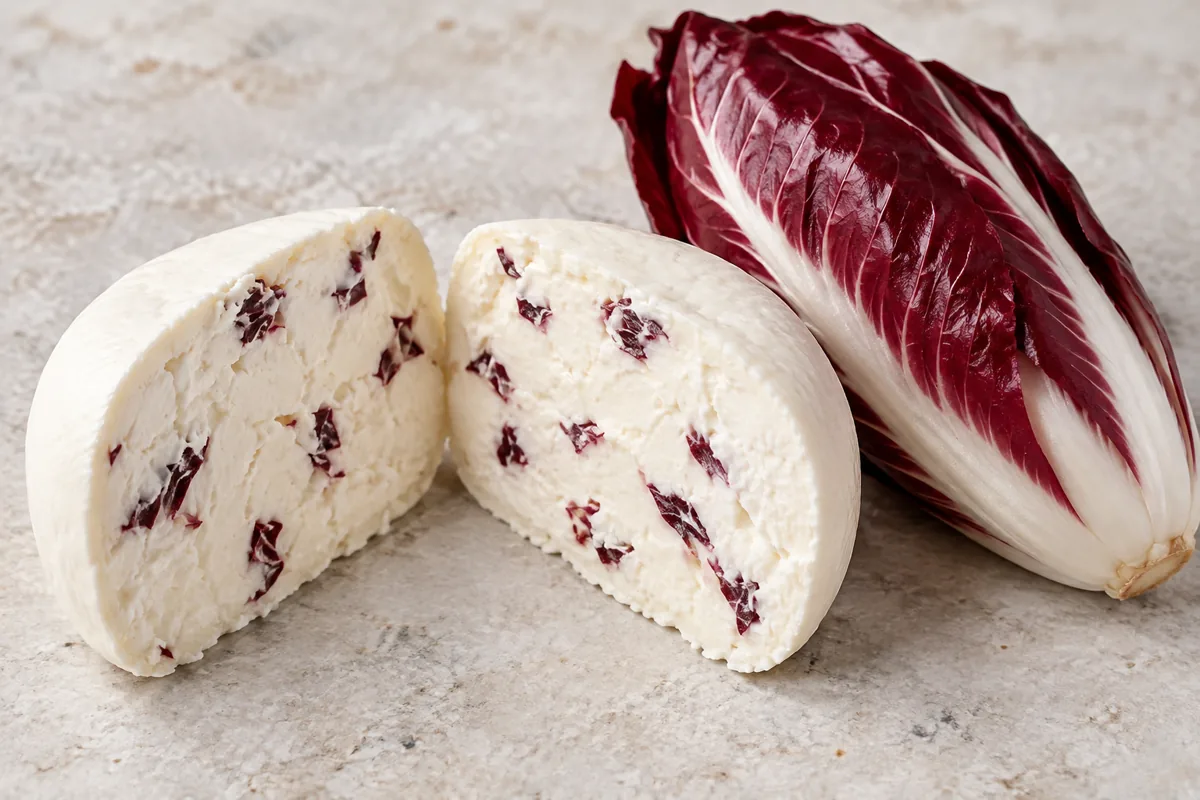
Cacioradicchio is a soft cheese that La Casearia Carpenedo makes in Veneto, Italy, from pasteurized cow's milk and dried red Treviso radicchio. An online retailer selling the 425 g form says it is matured for at least one month and has a soft, elastic texture.
If you are wondering how bitter it is, the retailer calls the bitter note slight, and its ingredient list gives the dried radicchio behind it as a minimum of 0.2%.
In This Article
What Is Cacioradicchio?
La Casearia Carpenedo is based in Camalò di Povegliano, in the province of Treviso. Antonio Carpenedo started in cheese in 1961, when he helped his father in a local cheese shop, and his sons Ernesto and Alessandro now run the company.
He took over a small dairy in Rovarè in the 1960s and turned to cheese ageing in 1976, a turn the company page puts after an award from the city of Thiene for his Casatella Trevigiana DOP.
Today the company describes its work as affinage, the ageing and finishing of cheeses, and it makes flavored cheeses made in Italy with grape skins, hay, walnut leaves, pepper, spices, beer and liqueurs.
The retailer presents Cacioradicchio as Antonio Carpenedo's tribute to the farming tradition of Treviso and calls it an aged cheese on a caciotta base. It lists La Casearia Carpenedo as producer and Agriform as packager, so ask the maker whether Carpenedo makes the curd or finishes a cheese made elsewhere.
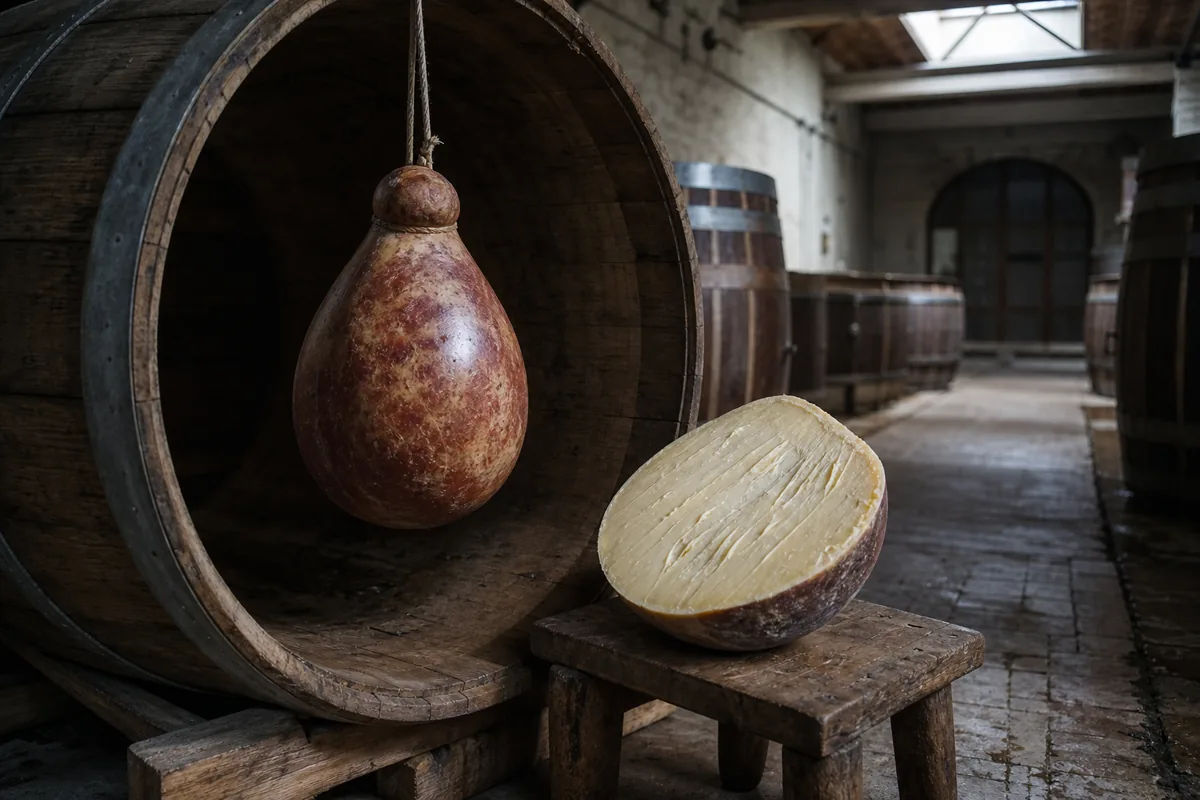
The retailer calls the milk aroma typical of a Venetian caciotta. Wikipedia describes an Italian caciotta as a cylindrical cheese of up to 1 kg with a brief ripening.
That style name does not tell you the milk, since caciotta is made from the milk of cows, sheep, goats or water buffalo. For this cheese, the retailer and Cheese.com both list cow's milk.
Where Does the Bitterness Come From?
The bitter note comes from the dried radicchio. The retailer's ingredient line names red radicchio di Treviso IGP, the late type called tardivo, at a minimum of 0.2%.
Wikipedia says radicchio has a bitter and spicy taste that mellows when it is grilled or roasted.
If that 0.2% applies to the whole form, the 425 g cheese you buy holds at least about 0.85 g of dried leaf.
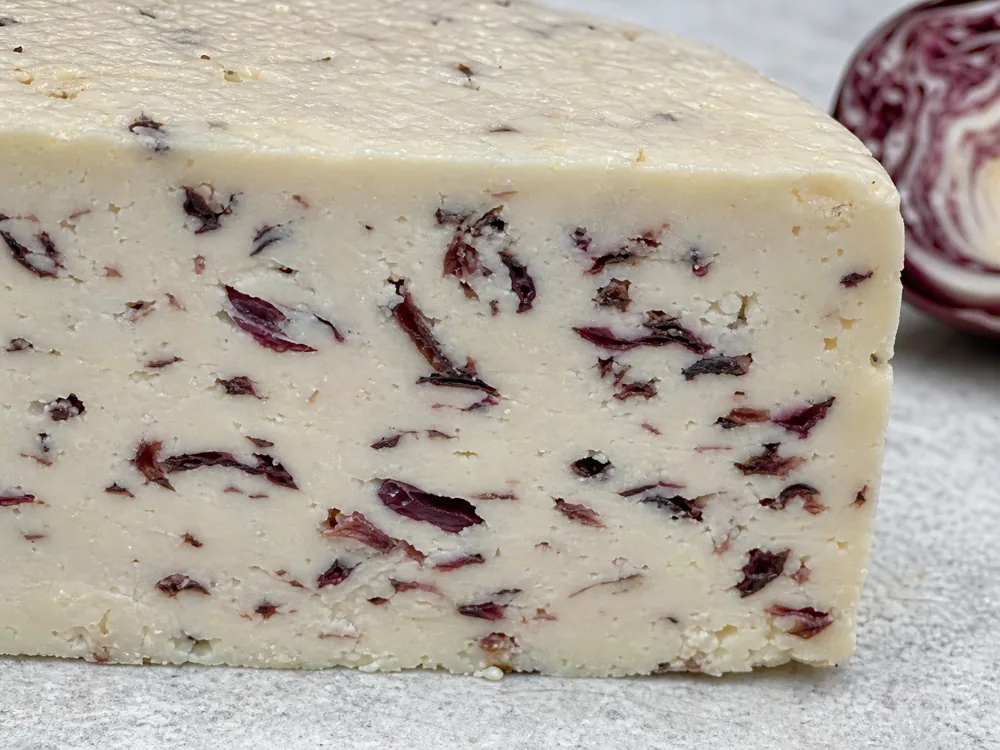
The retailer's own label raises a doubt about how little that is. It prints 2.3 g of fibre per 100 g, which comes to about 9.8 g across a 425 g form, more than eleven times the leaf the minimum guarantees.
Milk, salt and rennet add no fibre, so if the figure is specific to this recipe, the dried radicchio is well above the floor; if it is not, the fibre line says nothing about the radicchio.
What you can see at the counter is colour: the retailer describes a white paste dotted with coloured spots that show the radicchio is there.
The 0.2% figure is a minimum from one retailer's ingredient list.
Does Cacioradicchio Have a Leaf Wrap or Radicchio in the Paste?
Cacioradicchio has a leaf-wrapped rind in Cheese.com's listing, while the retailer's ingredient list and the IGP site's product listing both treat the radicchio as part of the cheese.
| Point | Retailer (Spaghetti & Mandolino) | Cheese.com | IGP radicchio site |
|---|---|---|---|
| Milk | Pasteurized cow's milk | Pasteurized cow's milk | Not stated |
| Radicchio | Dried tardivo in the ingredients, minimum 0.2% | Aged with dried red radicchio leaves; rind listed as leaf wrapped | Listed as a cheese made with Radicchio Rosso di Treviso IGP |
| Rennet | Listed, type not stated | Vegetarian: no | Not stated |
If you are vegetarian, the rennet is the point to settle. Cheese.com marks the cheese as not vegetarian, and the retailer's ingredient line lists rennet, so ask the maker whether it is animal or microbial.
Wikipedia's general description of caciotta adds a third possibility, a soft yellow rind around a white or yellowish body. That describes the style rather than Cacioradicchio, so check the label or ask the maker what the outside of the form you buy is.
What Does Cacioradicchio Taste Like?
The retailer describes a fresh milk aroma and a slight bitter note typical of radicchio. On the palate it names fresh flavors that come mainly from the milk, with the sweetness sitting in harmony with the bitter notes.
Cheese.com lists the flavor as bitter, herbaceous and subtle and the aroma as aromatic and fresh.
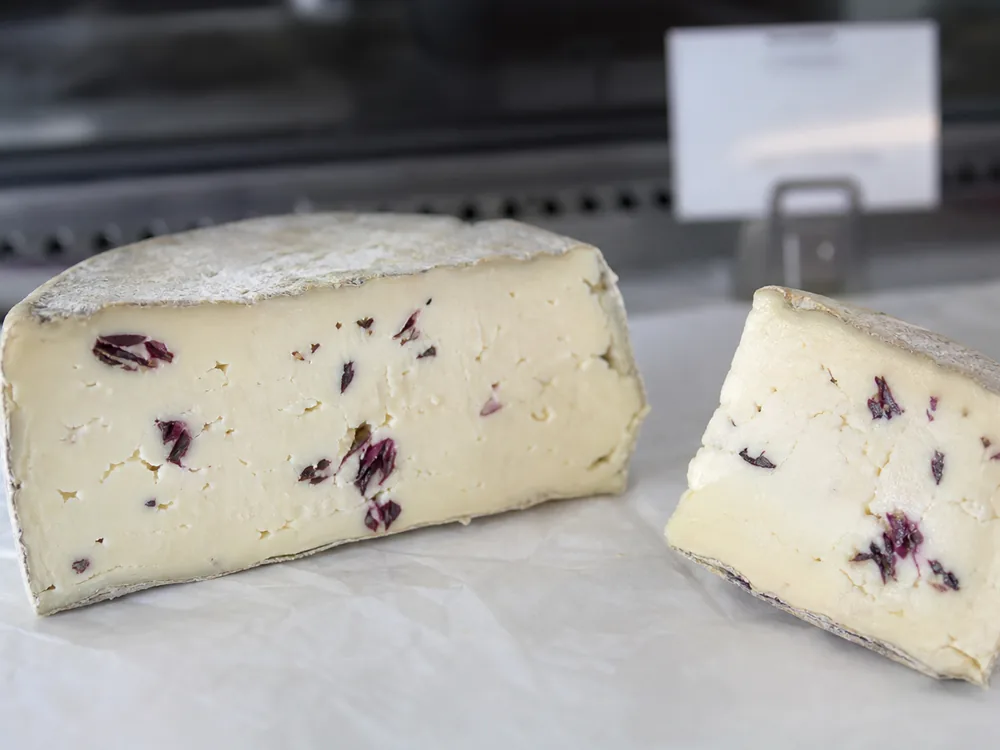
The retailer calls the texture soft and elastic and mentions slight cracks when cut in a paste it calls dry and pleasant to the touch. Cheese.com lists a creamy texture, a compact paste and a white colour.
A paste that is dry to the touch and cracks slightly under the knife holds its shape, which sits oddly beside Cheese.com's creamy, though Cheese.com's compact fits it.
The retailer's account is the one written about a cut piece, so for what a slice will feel like when you cut one, go by that account.
What Is Treviso Tardivo, the Radicchio in Cacioradicchio?
The retailer's ingredient line names the tardivo type of Radicchio Rosso di Treviso IGP, a leaf that is lance-shaped, with a deep wine-red leaf blade and a white main rib.
The tardivo takes two growing stages. Seedlings go into the open field between 20 July and mid-August and grow for about four months, and the first cold weather burns the outer leaves and halts their growth.
After harvest, which starts on 20 October, the plants go with their roots into tanks of running spring water kept at a constant temperature of not less than 10 to 12 °C. In that water and darkness the plant wakes and grows new leaves without chlorophyll, white and red-violet, and after about fifteen days the shoots are trimmed, washed and packed.
The IGP site calls the tardivo rib pleasantly bitterish and crunchy and says the type takes weeks of manual work to reach the table. Wikipedia calls tardivo crunchy and bitter and usually eaten cooked, so a label naming tardivo names a leaf both sources describe as bitter.
Wikipedia describes the earlier precoce type as a longer head than the Chioggia with more pronounced white veins and a distinctive bitter taste, blanched by tying the heads and leaving them without light for two to three weeks after harvest.
The IGP in the ingredient name protects the vegetable, and the tardivo may be grown only in 24 communes: 17 in Treviso province, 5 in Venice province and 2 in Padua province.
Cacioradicchio is one of the processed foods made with the leaf, alongside beers, liqueurs, creams, jams and frozen grilled radicchio.
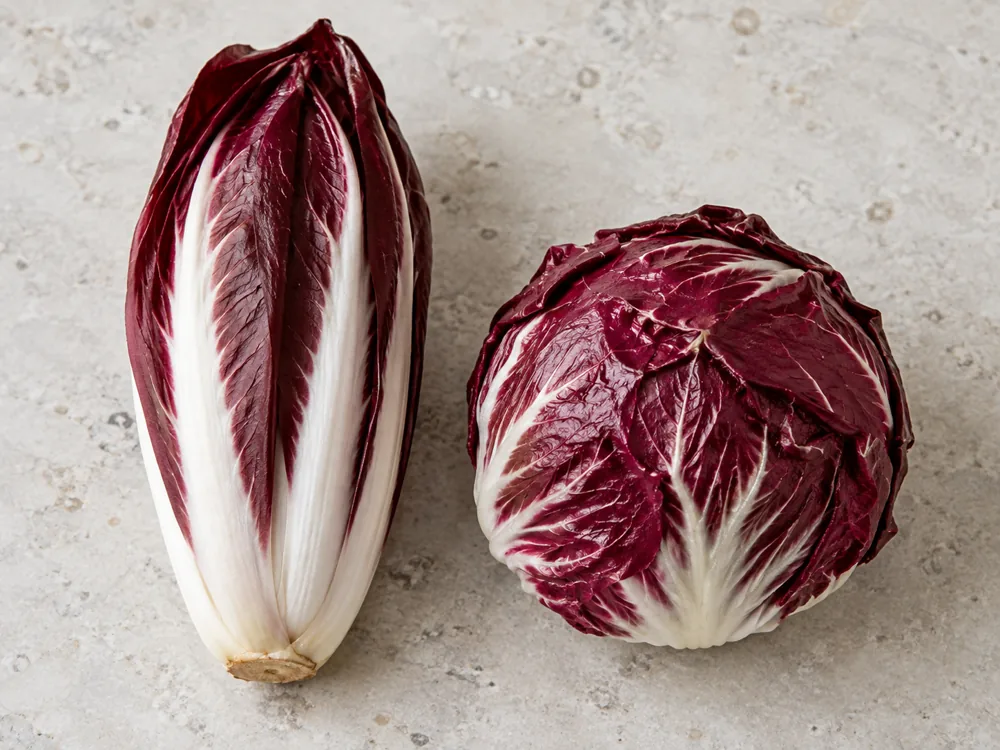
Wikipedia calls the round-headed Chioggia the most popular and widely used variety, so the elongated Treviso shape is not the most widely used one.
Which Other Cheeses Are Made with Treviso Radicchio?
Caseificio Tomasoni in Breda di Piave sells a cow's milk caciotta with the same minimum of 0.2% dried radicchio. It lists a compact paste and a fresh taste with a not-too-marked radicchio aftertaste.
| Cheese | Maker | What the source gives |
|---|---|---|
| Cacioradicchio | La Casearia Carpenedo | Pasteurized cow's milk, soft and elastic, 425 g, at least one month of maturation |
| Caciotta al Radicchio Rosso di Treviso IGP | Caseificio Tomasoni | Cow's milk, compact paste, 300 g or 500 g, 30 days shelf life stored at 0 to 4 °C |
| Fresh soft cheese with radicchio | Latteria Soligo | Listed on the IGP site; details not stated |
The Venturin agricultural company makes a stracchino with Treviso radicchio and a burrata with radicchio, both on the IGP site's list.
Tomasoni's 30 days is a shelf life under refrigeration, not a maturation time, so it cannot be set against the retailer's minimum of one month for Cacioradicchio. Treat them as separate cheeses that share a vegetable.
How Should You Serve Cacioradicchio?
The retailer calls Cacioradicchio excellent for appetizers or for starting a vertical tasting of cheeses, and says its melting point is good. It adds that the cheese pairs well with fresh or lightly grilled radicchio.
If you want the gentler partner for a cheese with only a slight bitter note, choose the lightly grilled leaf, since grilling mellows radicchio's bitter edge. Fresh radicchio is the sharper one.
For hot dishes, Tomasoni describes its own caciotta, a separate cheese, as an ingredient to melt into hot first courses or to stretch over snacks.
| Use | How It Works |
|---|---|
| Appetizer plate | The retailer calls it excellent for appetizers or for starting a vertical tasting of cheeses. |
| With fresh radicchio | The retailer names fresh radicchio as a pairing. |
| With lightly grilled radicchio | The retailer names this too. |
| Hot dishes | Tomasoni says its radicchio caciotta melts into hot first courses and turns stringy on snacks. |
What Does the Nutrition Label Show for Cacioradicchio?
The retailer prints the nutrition values per 100 g and lists milk as the allergen.
| Nutrient | Per 100 g |
|---|---|
| Energy | 387 kcal / 1,602 kJ |
| Fat | 32.0 g |
| Saturated fat | 22.9 g |
| Carbohydrate | 0.72 g |
| Sugars | 0.55 g |
| Protein | 22.8 g |
| Fibre | 2.3 g |
| Salt | 1.22 g |
At 1.22 g of salt per 100 g, a whole 425 g form carries about 5.2 g of salt.
Tomasoni prints different per-100 g values for its radicchio caciotta: 348 kcal, 30 g fat, 18 g protein and 1.5 g of salt, with 514 mg of calcium. Against that, the Cacioradicchio label shows more protein (22.8 g) and less salt (1.22 g), so you cannot use one cheese's numbers for the other.
Fat and protein alone add up to 54.8 g per 100 g for Cacioradicchio and 48 g for Tomasoni's, which points to less water in Cacioradicchio and fits the retailer's dry paste.
The label lists 0.55 g of sugars per 100 g. If you need a lactose figure, ask the maker.
Is Cacioradicchio Safe During Pregnancy?
The retailer and Cheese.com both say the milk is pasteurized, so confirm it on the label. The CDC lists soft cheese made from unpasteurized (raw) milk as riskier and pasteurized soft cheeses heated to an internal temperature of 165°F or until steaming hot as safer.
The CDC also lists any queso fresco-type cheese, meaning queso fresco, requesón or similar fresh, soft cheeses, as riskier whether the milk is pasteurized or not. If you are pregnant, ask a clinician whether Cacioradicchio falls in that group.
Served cold, Cacioradicchio is described as a pasteurized soft, elastic, creamy and compact cheese, a type the CDC list does not cover, so ask a midwife or doctor.
The NHS says pasteurised soft cheeses such as mozzarella, ricotta and burrata are safe, while pasteurised or unpasteurised mould-ripened soft cheeses with a white coating, such as brie, camembert and chèvre, must be thoroughly cooked.
Cheese.com gives the colour as white, so check whether the form you buy carries a white coating on the outside, since the NHS cooking rule covers mould-ripened soft cheeses with a white coating. Take those label details to a clinician with the general rules on eating cheese during pregnancy.
Where Can You Buy Cacioradicchio and What Should You Check?
The retailer lists the whole form at about 425 g and showed it as unavailable. Tomasoni's page also marks its radicchio caciotta unavailable online and lists the weight as variable.
For storage, Tomasoni's 30 days at 0 to 4 °C belongs to its own caciotta, so it does not transfer to a Cacioradicchio you buy.
SOURCES & REFERENCES
It is La Casearia Carpenedo's soft cheese made from pasteurized cow's milk and dried red radicchio di Treviso IGP, per a retailer and Cheese.com.
The retailer calls the bitter note slight, and its ingredient list gives the dried radicchio as a minimum of 0.2%.
The retailer credits it with a good melting point.
Cheese.com says no, and the retailer lists rennet, so ask the maker which kind it is.
A retailer and Cheese.com say the milk is pasteurized, so check the label for it and ask a clinician.