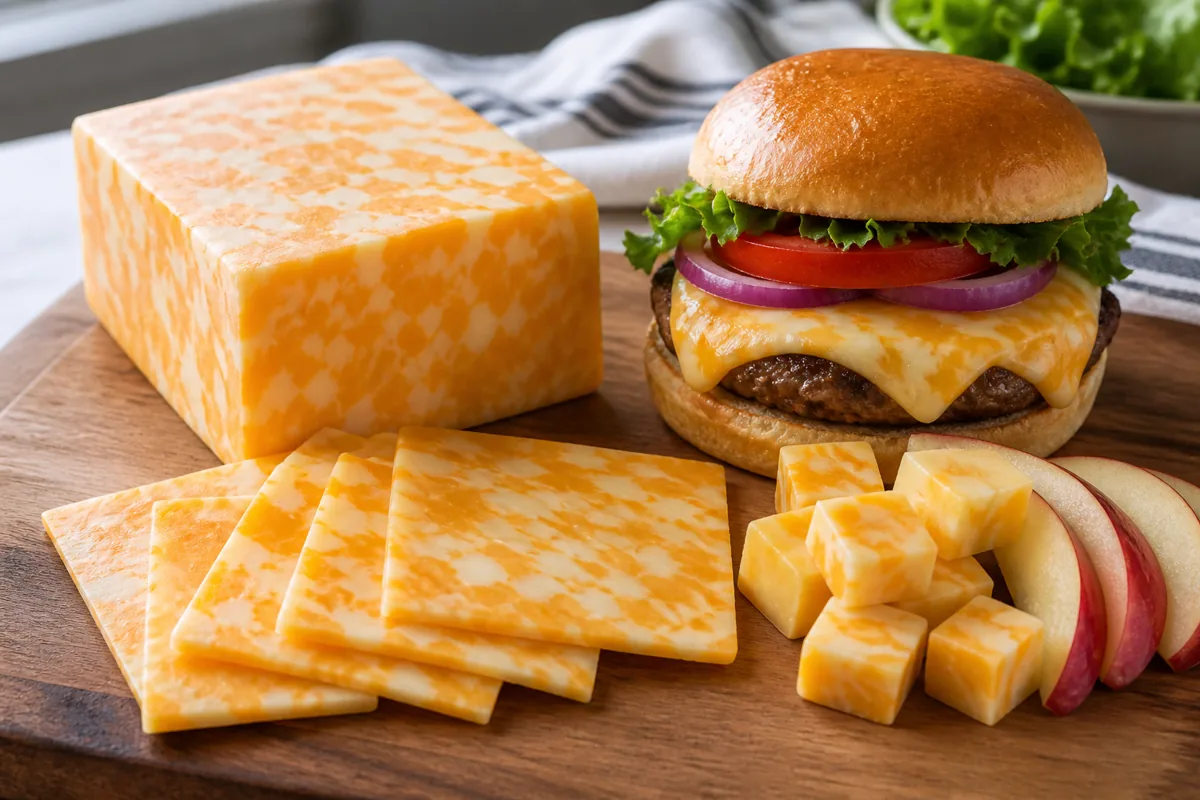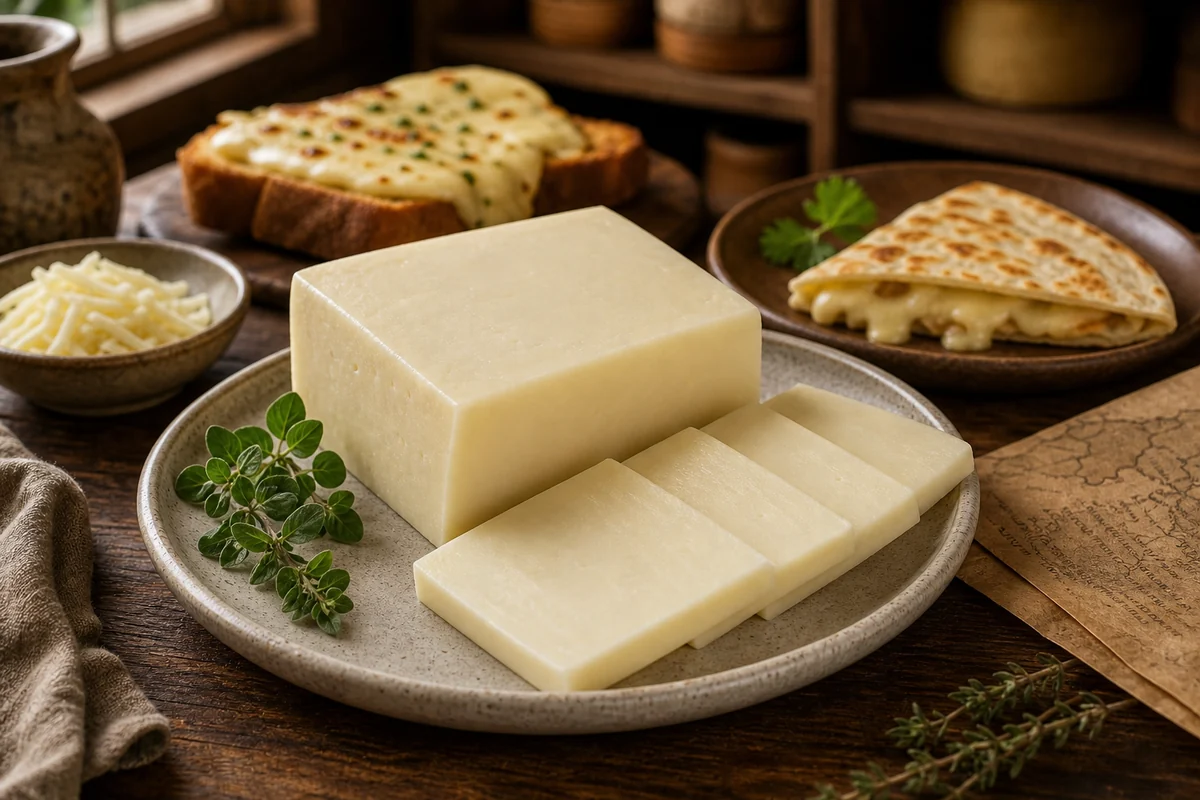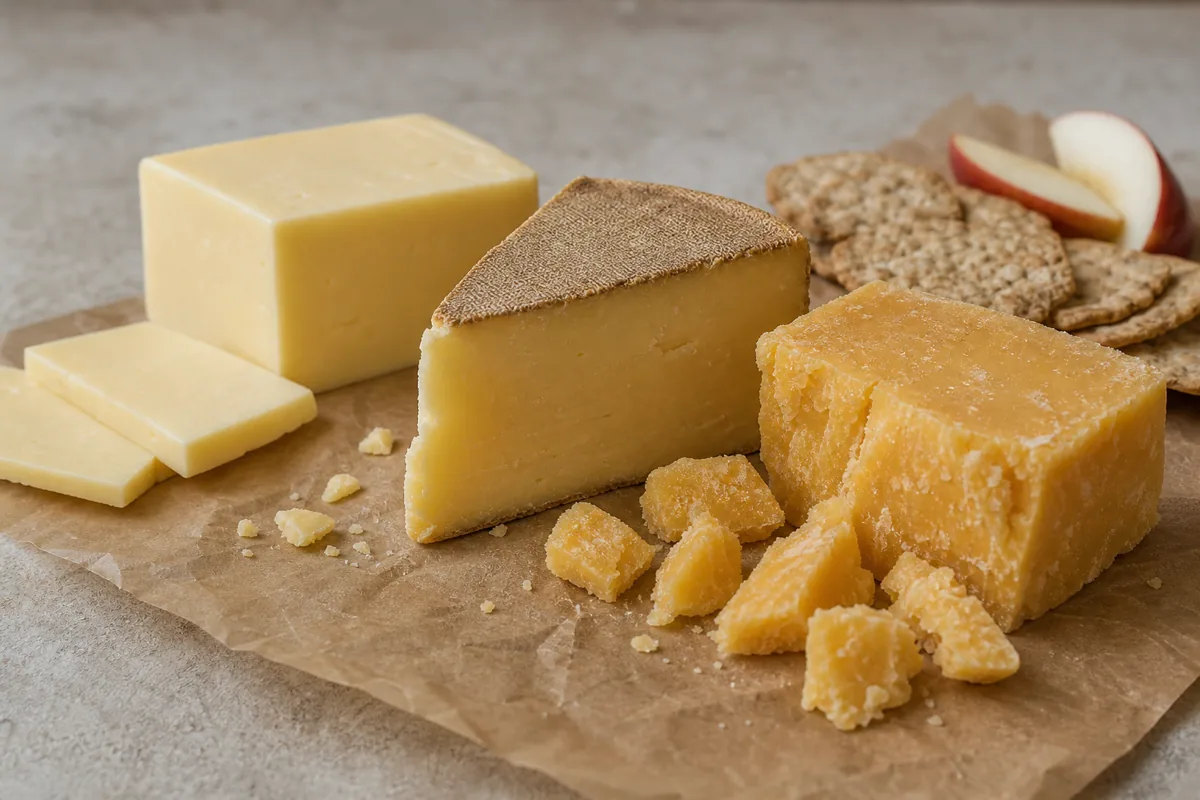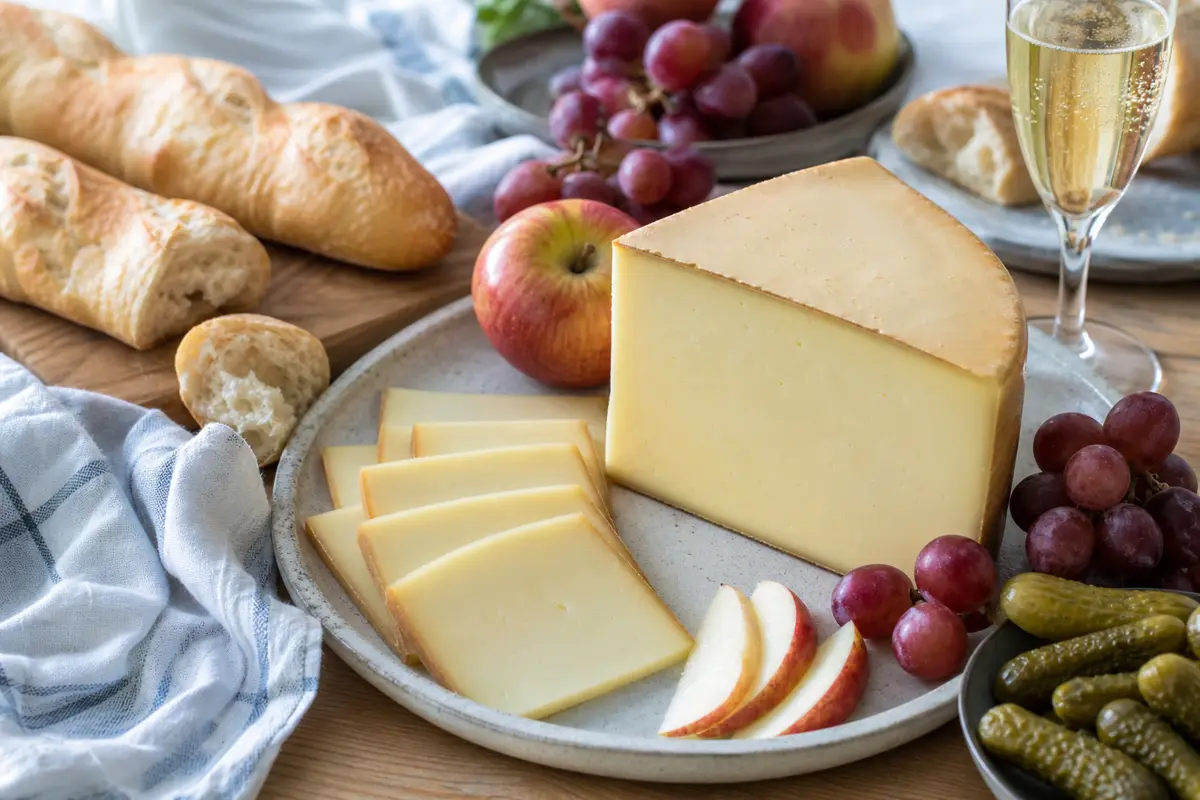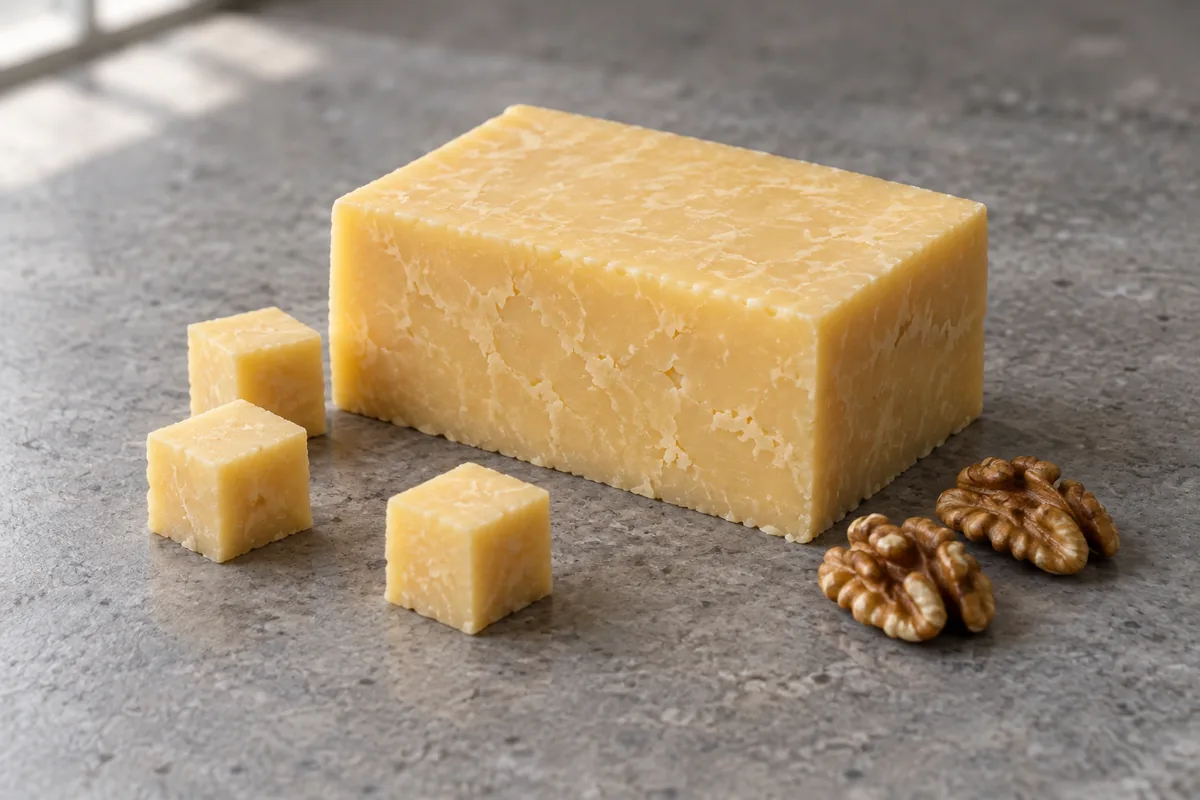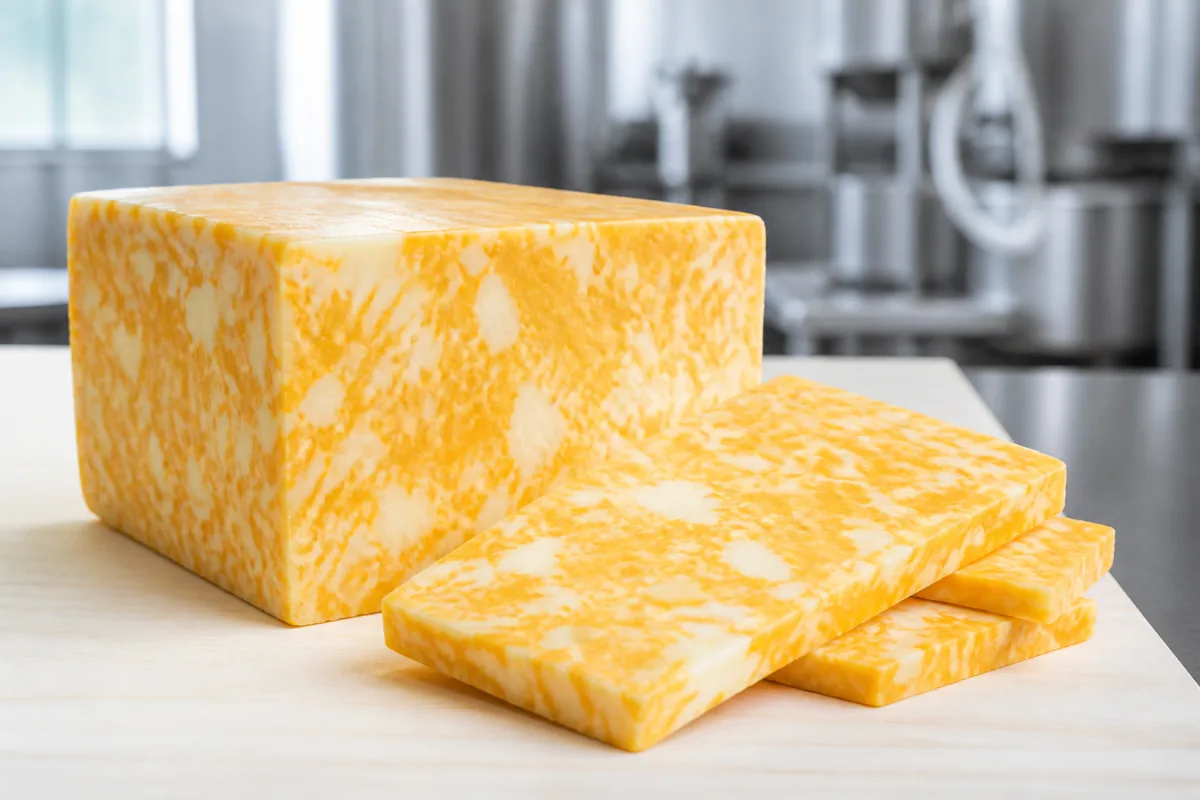
Marble Cheddar is Cheddar in two colors: white Cheddar and orange Cheddar combined into one marbled block.
Colby-Jack is a different marble cheese: it pairs Colby with Monterey Jack instead of two Cheddars.
In This Article
Why Is Part of Marble Cheddar Orange?
The orange comes from an added food coloring: the Bothwell, Balderson and Agropur blocks are colored with annatto, an orange-red coloring made from the seeds of the achiote tree, while the Black Diamond and Cracker Barrel blocks carry an unnamed "colour". Many Cheddars are made in a white and an orange version that differ only by the presence of annatto, and Marble Cheddar puts the two versions in one block.
The seeds are dried and ground into a fine red powder, which goes by annatto, roucou or achiote, and the color sits in carotenoid pigments such as bixin and norbixin.
Cheese color once followed the season: fresh summer grass carries carotene that gives milk, and the cheese made from it, a natural orange tint. Because the pigment travels in the cream, cheese made from skimmed milk came out white.
Makers began coloring cheese mainly to mask the white hues of winter cheese and to imitate the more intense colors of the finer summer cheese. The first colorants were saffron, marigold and carrot juice, and annatto came into use later.
The earliest known record of annatto in cheese is a 1743 Dutch household dictionary, according to Paul Kindstedt of the University of Vermont.
In England, colorants went into Gloucester cheese as early as the 16th century so that inferior cheese could pass as the best Double Gloucester, and annatto was later used for the same purpose in cheeses such as Cheshire, Red Leicester and colored Cheddar made in Scotland.
Coloring with annatto has since extended to many modern processed cheese products, such as American cheese and Velveeta, and annatto also colors Mimolette from France and Leyden from the Netherlands.
Red Leicester was colored partly to make customers believe that a darker orange meant richer milk and tastier cheese. A deeper orange in a Marble Cheddar is a coloring choice, not a sign of richer milk.
The balance of bixin and norbixin sets the shade: a preparation with more bixin gives a more orange hue, and one with more norbixin a more yellow one. Bixin dissolves in fat and can be turned into norbixin, which dissolves in water, a dual solubility that is rare among carotenoids.
Does Each Color Taste Different?
Expect one flavor across both colors, since both parts are Cheddar and the orange one differs by its coloring.
Once the seeds are dried, ground and added to cheese in small amounts, annatto's effect on aroma and flavor is minimal, in Cheese Scientist's account.
How Does the Marble Pattern Get into the Cheese?
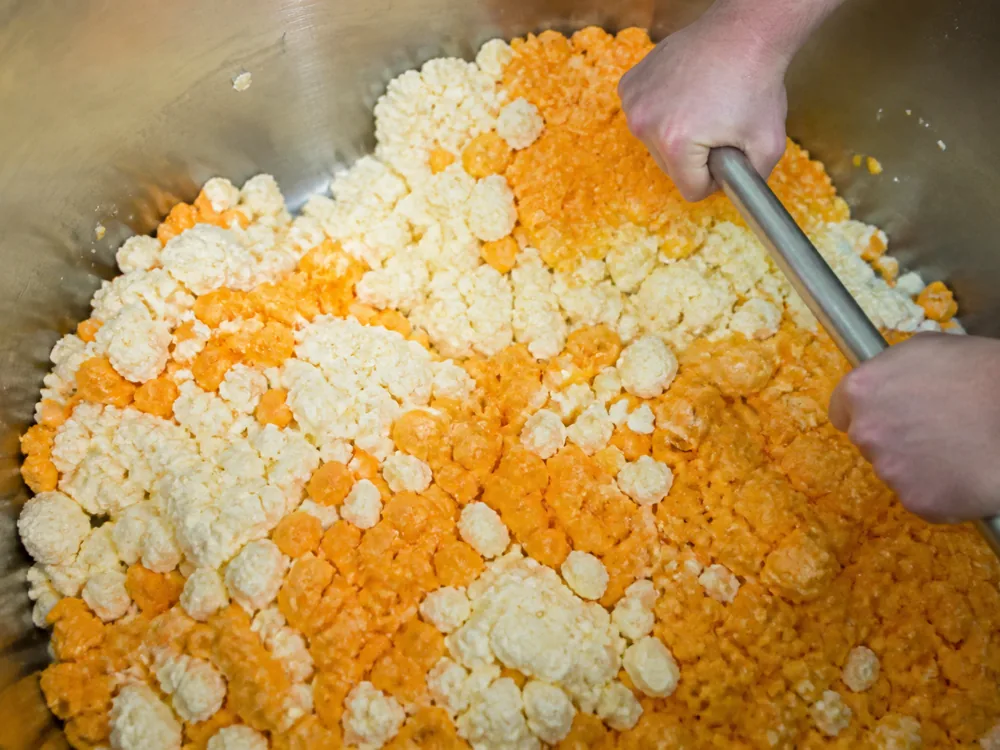
At Balderson the pattern starts at the curd stage: the block is made by mixing its white and colored Cheddar curds together. Bothwell and Black Diamond make theirs by blending white and orange Cheddars.
Is Marble Cheddar the Same as Colby-Jack?
No, and color will not tell you which one is in the package, since both are described as orange and white. The product name is the reliable test: Marble Cheddar names Cheddar or goes simply by Marble, as Cracker Barrel's block does, while Colby-Jack names Colby and Monterey Jack or goes by Marble jack, Co-Jack or Cojack.
| Check | Marble Cheddar | Colby-Jack |
|---|---|---|
| Made from | White Cheddar and orange Cheddar | Colby and Monterey Jack |
| Texture | Usually firm and smooth | Semi-hard in Wikipedia's summary, semi-soft in its text |
| Age stated | Unripened at Agropur; 3 to 6 months at Balderson | Up to 14 days |
| Flavor | Usually mild and creamy, and sharper with age | Described as mild to mellow |
| Aroma | Rich in Cheese.com's entry; mild on Balderson's page | Not stated |
| Names used | Marble Cheddar | Colby-Jack, Marble jack, Co-Jack, Cojack |
In Colby-Jack the two colors are two different cheeses: annatto gives the Colby half its orange, and the white half is Monterey Jack. In Marble Cheddar both colors are Cheddar, and the annatto, where a label names it, is in the orange one.
Colby and Monterey Jack are made separately: each starts as pasteurized milk mixed with bacterial cultures, a coagulant is then added, and annatto goes in while the Colby is being made.
Both are drained of whey, then curds of each are selected and blended into the marbling. The blend is shaped, often into a semicircular or rectangular block, or shredded.
Shape helps only with a round piece: young Colby-Jack is generally sold in a full-moon or half-moon shape, while the Agropur, Black Diamond and Cracker Barrel Marble Cheddars come as blocks or bars. A rectangular block can be either cheese, so go by the name.
Colby-Jack ages for up to 14 days. That short ageing is described as what makes it mild.
Balderson's Marble Cheddar is aged 3 to 6 months and still sold as mild. A mild taste alone will not tell you which of the two cheeses you have.
Where Does Marble Cheddar Come From?
Marble cheeses originated in the United Kingdom, Marble Cheddar included.
Two other marble cheeses show the range of the style. Red Windsor is Cheddar with added red wine, usually Port or Bordeaux, or with a red food coloring, and Sage Derby is a Derby cheese traditionally made with sage, now usually colored with green plants such as spinach, parsley and marigold or with a green vegetable dye.
Bothwell makes its Marble Cheddar, one of more than two dozen cheeses, in New Bothwell, Manitoba, from 100% Canadian milk, and it took 1st Place and Best of Class at the 2020 World Champion Cheese Contest. Black Diamond's is a Product of Canada made with 100% Canadian milk, and Dairy Isle's Marble uses 100% Prince Edward Island milk.
Colby-Jack, by contrast, is American. Colby was created by Joseph F. Steinwand in Colby, Wisconsin, in 1885, Monterey Jack was made by Mexican Franciscan friars in Monterey, California, during the 1700s, and Colby-Jack is mainly produced in Wisconsin and California.
What Does Marble Cheddar Taste Like?
Marble Cheddar is usually mild and creamy, sometimes rich, with a firm, smooth texture.
Age is what usually sharpens it: depending on the age of the cheese, the taste can carry a slightly sharp undertone.
For a sense of how sharp a block will be, check its age or grade: Agropur's foodservice block is a Mild Marble Cheddar, Balderson ages its block 3 to 6 months, and Black Diamond also sells an Extra Old Marble.
For a milder block, choose one graded mild, such as Agropur's Mild Marble Cheddar; for a sharper one, choose an extra-old block, since age usually sharpens the taste.
| Block | Flavor | Texture | Age |
|---|---|---|---|
| Bothwell | Mild yet flavorful | Smooth | Not stated |
| Balderson | Mild, a smooth Cheddar flavor similar to its Medium; mild aroma | Firm, slightly firmer than its Medium | 3 to 6 months |
| Dairy Isle | Mild | Slightly springy | Naturally aged, no length given |
| Agropur (mild, 34% M.F.) | Mild and slightly acidulous | Firm, rather elastic, smooth body without holes | Unripened |
| Black Diamond | Rich | Firm | Not stated |
| Black Diamond Extra Old Marble | Richer and sharper than traditional marble cheese | Not stated | Extra old |
| Cracker Barrel | Creamy | Not stated | Not stated |
What Is Marble Cheddar Used For?
Use it in snacks and sandwich slices, or cut it into cubes, squares, triangles or sticks for a decorative garnish, a cheese tray or a dish.
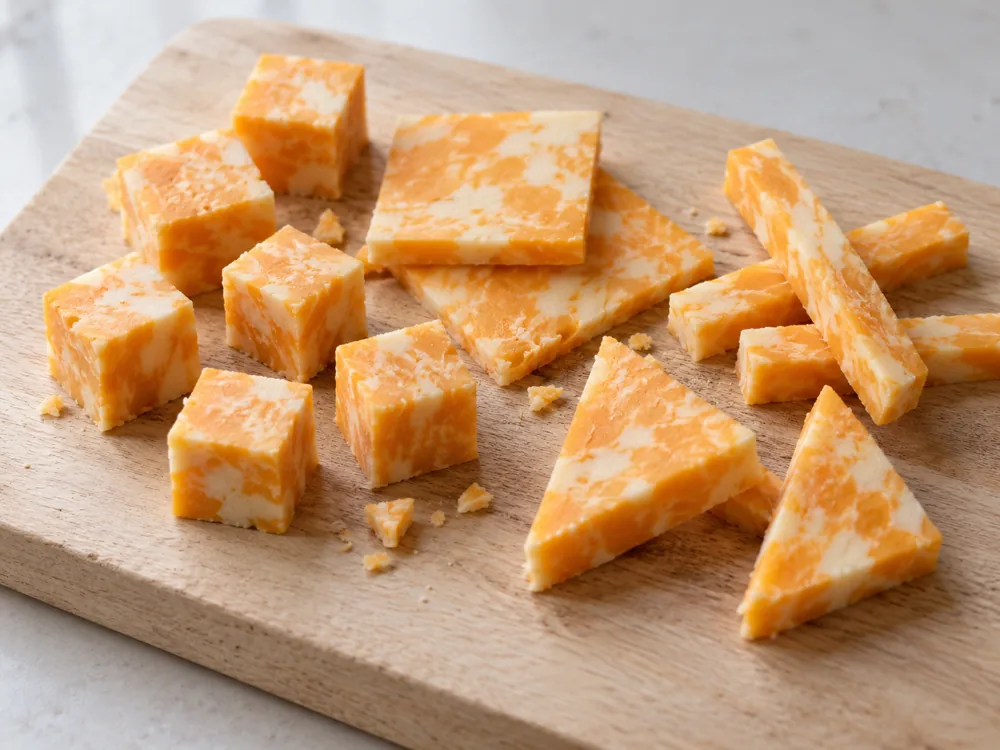
In cooking it goes into nachos and mac 'n cheese, quiches, omelettes and burgers, and it can be melted over baked dishes and vegetables or on tuna crostini.
Try it in stuffed peppers and chili cheese buns as well. Those cooked uses overlap with Colby-Jack's, which include burgers, pasta bakes, macaroni and cheese and casseroles, many of them American or Mexican in origin.
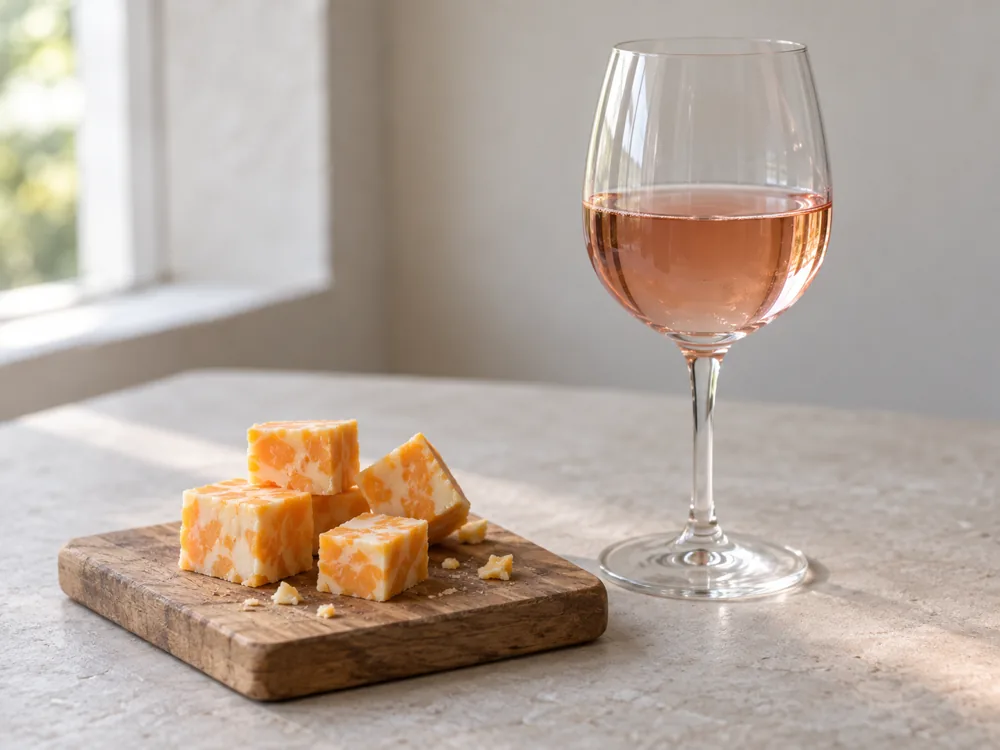
To drink, try a dry rosé, a Chardonnay, Port, any sparkling wine or a fruity red. For beer, try pale ales or a good strong stout.
| Pairing | Type | Why It Works |
|---|---|---|
| Dry rosé | Wine | Try a dry rosé with it. |
| Chardonnay | Wine | Or pour a Chardonnay. |
| Sparkling wine | Wine | Any sparkling wine suits it. |
| Port | Wine | Try a glass of Port with it. |
| Fruity red wine | Wine | A fruity red is another wine to try. |
| Pale ale or strong stout | Drink | For beer, try a pale ale or a good strong stout. |
Is Marble Cheddar Safe During Pregnancy?
If you follow NHS advice, you can eat Marble Cheddar: it is a hard cheese made from Cheddar, and the NHS lists pasteurised or unpasteurised hard cheeses, such as cheddar, as safe to eat.
If you follow US advice, check the label for the milk: Bothwell's Marble Cheddar is made with pasteurized milk, and Cheese.com gives pasteurized cow's milk for Marble Cheddar in general, while the Balderson, Dairy Isle, Agropur, Black Diamond and Cracker Barrel pages do not state the milk treatment.
If the label says pasteurized milk, you can eat Marble Cheddar: the CDC lists hard cheese, when made with pasteurized milk, such as Cheddar, as safer.
If you follow US advice, ask a midwife or doctor before you eat a Marble Cheddar without a label that says pasteurized milk, even cooked: the CDC lists unpasteurized (raw) milk and dairy products made from raw milk as riskier. It says pregnant women are 10 times more likely to get a Listeria infection.
What Ingredients Are in Marble Cheddar?
It depends on the maker: Bothwell's list is the shortest, Balderson's adds cream, whey proteins and calcium chloride, and the Agropur, Black Diamond and Cracker Barrel lists add modified milk ingredients.
Dairy Isle hand-turns and naturally ages its cheeses, its Marble included, with no enhancers, no artificial enzymes and no modified milk ingredients.
| Block | Ingredients as listed | Other stated facts |
|---|---|---|
| Bothwell | Fresh pasteurized milk, bacterial culture, salt, microbial enzyme, annatto coloring | Per 2.5 cm cube (30 g): 120 calories, 10 g fat (6 g saturated), 7 g protein, 190 mg sodium |
| Balderson | Milk, cream, whey proteins, salt, bacterial culture, calcium chloride, microbial enzyme, annatto | Cow's milk; 280 g size listed |
| Agropur | Milk, modified milk ingredients, cream, salt, bacterial culture, annatto, calcium chloride, microbial enzyme | 34% M.F. and 39% moisture on the 2.27 kg block |
| Black Diamond | Milk, modified milk ingredients, cream, salt, bacterial culture, calcium chloride, colour, microbial enzyme | Per 30 g: 120 calories, 10 g fat (6 g saturated), 7 g protein, 220 mg sodium, 200 mg calcium; 400 g and 600 g |
| Cracker Barrel | Milk, modified milk ingredients, bacterial culture, salt, calcium chloride, colour, microbial enzyme | Per 30 g: 120 calories, 10 g fat (7 g saturated), 7 g protein, 210 mg sodium; 270 g, 400 g, 600 g and 740 g |
| Dairy Isle | No full list on the page | 100% Prince Edward Island milk; no enhancers, artificial enzymes or modified milk ingredients |
A microbial enzyme is on every full list here. If you buy Dairy Isle's and the enzyme matters to you, ask the dairy which one it uses.
If annatto disagrees with you, read the list before you buy, since two of the five full lists do not name the coloring. In the amounts used in food, annatto is harmless for most people yet can cause allergic reactions in those who are sensitive to it, in Cheese Scientist's account.
US rules class annatto extract as a color additive exempt from certification, and a food colored with it may show it on the ingredient list as "colored with annatto" or "annatto color". In the European Union it carries the number E160b.
Sodium runs from 190 mg in a 30 g serving of Bothwell's block to 210 mg in Cracker Barrel's and 220 mg in Black Diamond's, or about 630 to 730 mg per 100 g.
That is at or above the 600 mg per 100 g that Colby-Jack was down to by 2014, though the figures come from different years and sources.
A 30 g serving of the Bothwell, Black Diamond or Cracker Barrel block has 120 calories, 10 g fat and 7 g protein. Saturated fat is 6 g in the first two and 7 g in Cracker Barrel's.
Black Diamond's serving also has 200 mg of calcium. Agropur's mild block is 34% milk fat and 39% moisture, the only fat and moisture percentages given for these blocks.
Sizes run from Cracker Barrel's 270 g block up to its 740 g one, with Balderson's at 280 g and Black Diamond's at 400 g and 600 g. Agropur's foodservice block weighs 2.27 kg and comes as 2 × 2.27 kg.
For a lactose-free block, Black Diamond sells a Lactose-Free Marble Cheddar, a blend of white and orange cheddars without lactose, in a 400 g size.
If Agropur's website and the label on your Agropur pack differ, go by the pack, since Agropur's website may lag behind the label.
Is Marble Cheddar a Natural or Processed Cheese?
To know what is inside your block, go by the ingredient list: none of the full lists from Bothwell, Balderson, Agropur, Black Diamond and Cracker Barrel includes an emulsifying salt.
Whether it counts as processed depends on whose label you read: Cheese.com lists Marble Cheddar as hard and processed and Wikipedia calls marble cheeses usually hard, processed cow's milk cheeses, while Bothwell calls its cheeses natural and Black Diamond sells its block among its Natural Cheese Bars.
The definition behind the reference label is broad: a marble cheese can be made by combining two differently colored curds, cheese curds or processed cheeses. Balderson's Marble Cheddar is made the first way, by mixing white and colored Cheddar curds.