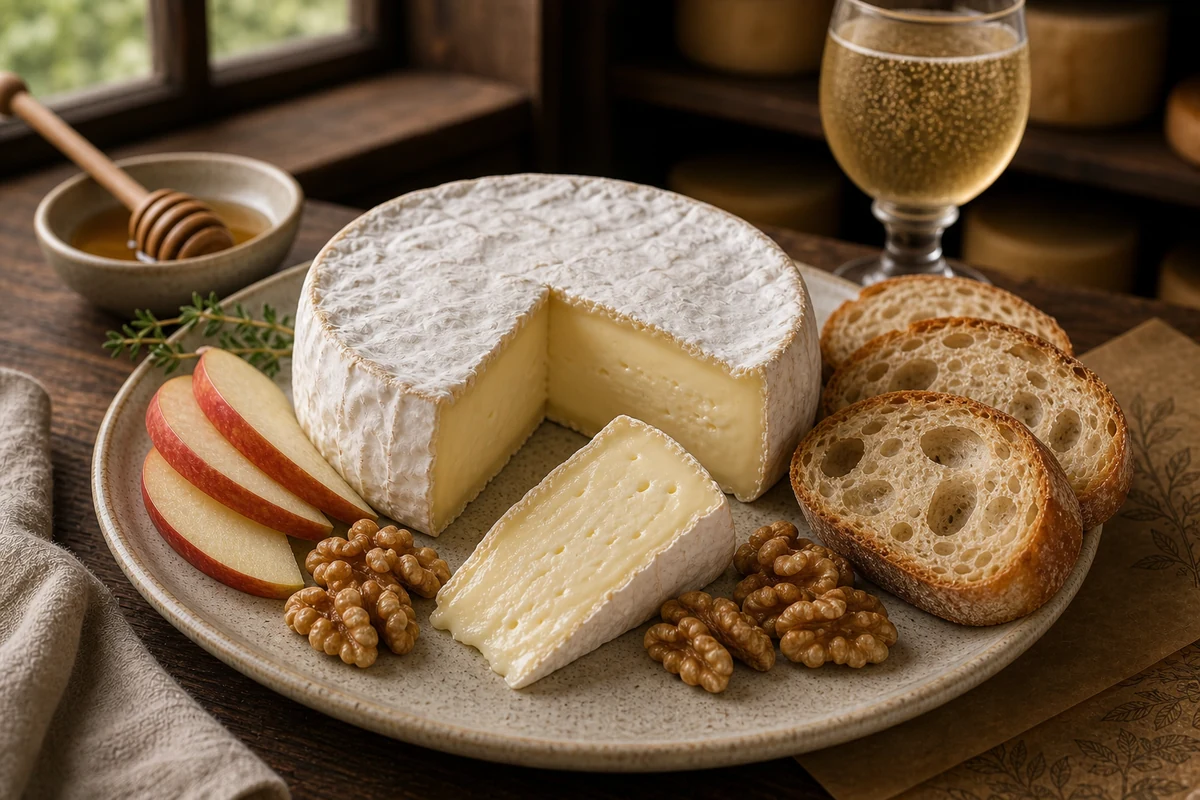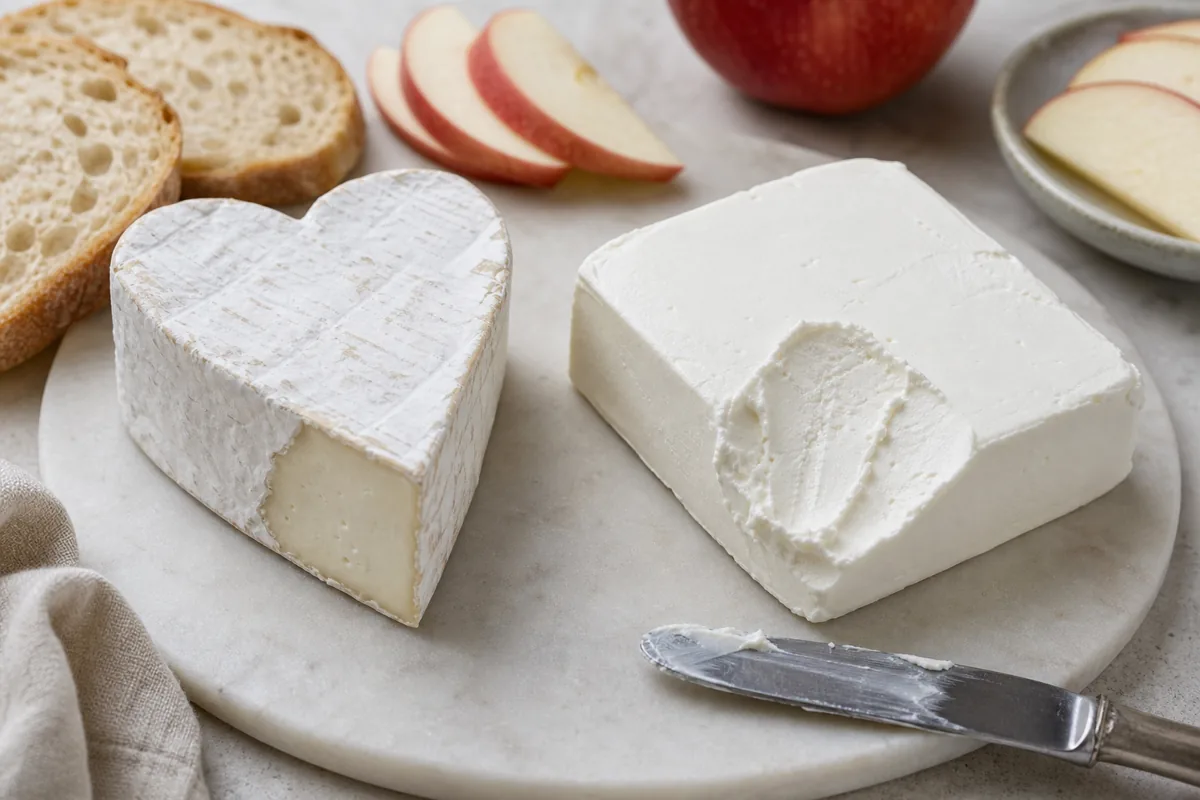
Neufchâtel is the name of two different cheeses. In France it is a soft cheese with a white bloomy rind, made in the Pays de Bray in Normandy under protected rules, and in the United States it is a fresh, unripened cheese with less fat than cream cheese.
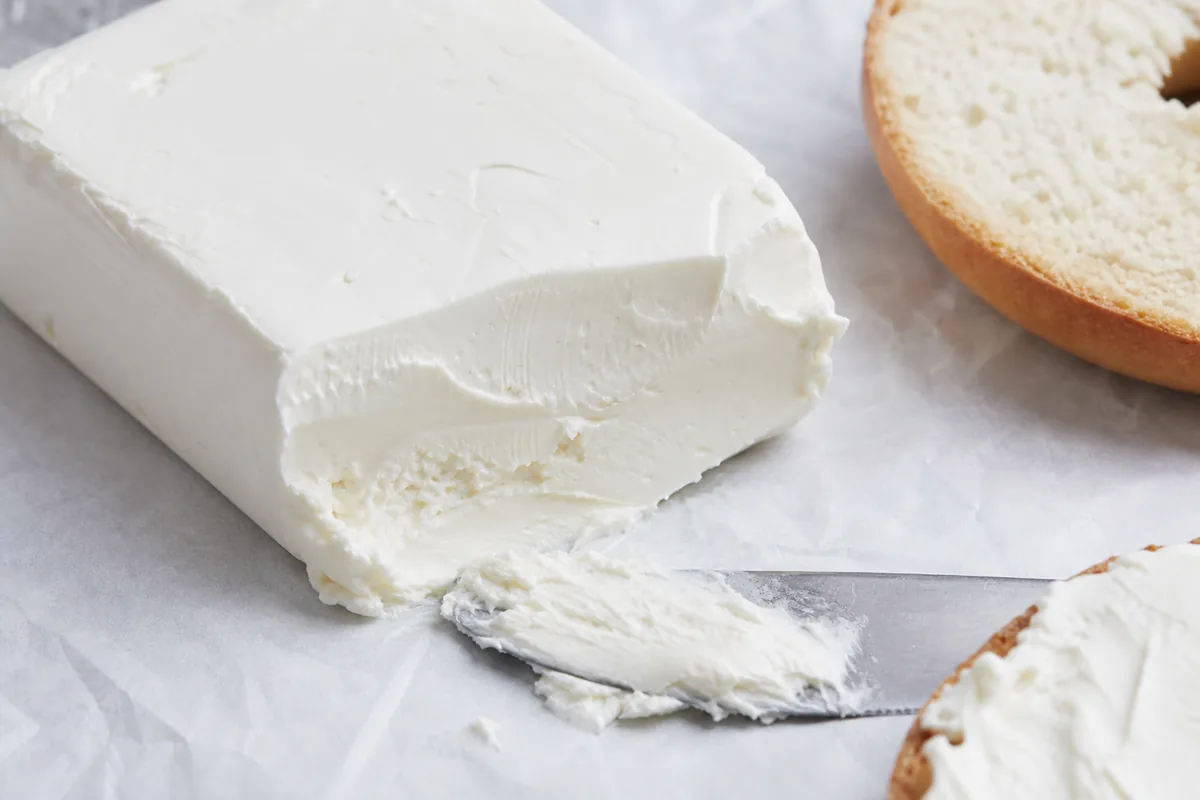
The shape usually tells you which one you have: the French cheese comes in six set shapes, the heart among them, while Kraft Heinz sells its Philadelphia Neufchâtel as an 8 oz block.
In This Article
How Do You Tell French and American Neufchâtel Apart?
Both products are cow's-milk cheeses, and the rules behind them differ on almost every other point. The French cheese follows a specification filed with INAO, France's origin-label authority, and the American one follows an FDA standard of identity.
| Point | French Neufchâtel (AOP) | American Neufchâtel |
|---|---|---|
| Rulebook | INAO specification | FDA standard, 21 CFR 133.162 |
| Milk | Whole cow's milk, raw or heat-treated | Pasteurised milk, nonfat milk or cream |
| Fat | At least 45 g per 100 g of dry matter | At least 20% and under 33% of the cheese |
| Water | At least 40 g of dry matter per 100 g | No more than 65% moisture |
| Rind and ripening | White bloomy rind, ripened at least 10 days | No rind, described by Kraft Heinz as uncured |
| Shape | Six set shapes, including the heart | Block, such as Philadelphia's 8 oz pack |
The two fat figures count against different things: the French specification measures fat as a share of the dry matter, and the FDA measures it as a share of the whole cheese.
Multiplying the French minimums, 45% of at least 40 g of dry matter, gives about 18 g of fat per 100 g of cheese by our arithmetic, a floor just under the American range, with no upper limit in the French rules.
At the counter, three checks separate them.
- French: the name Neufchâtel in letters at least two-thirds the size of the largest on the label, with the AOP mention and the EU logo, both required by the specification.
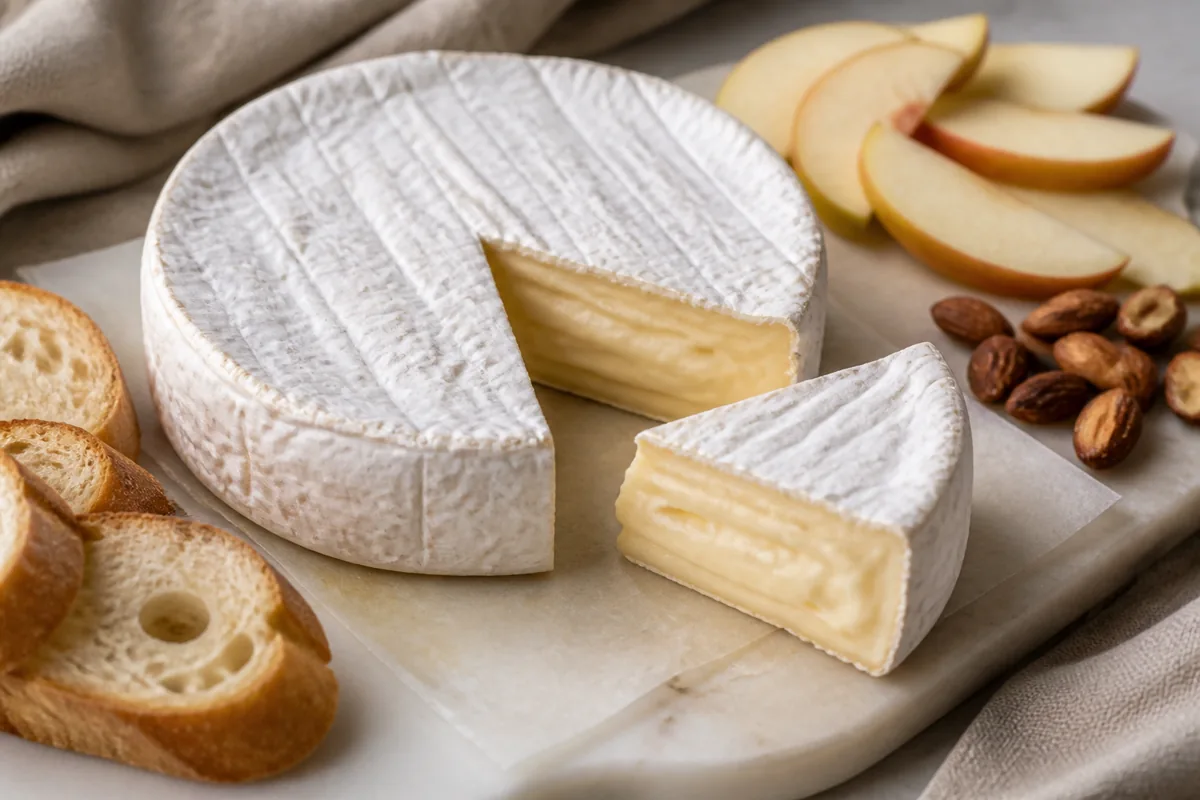
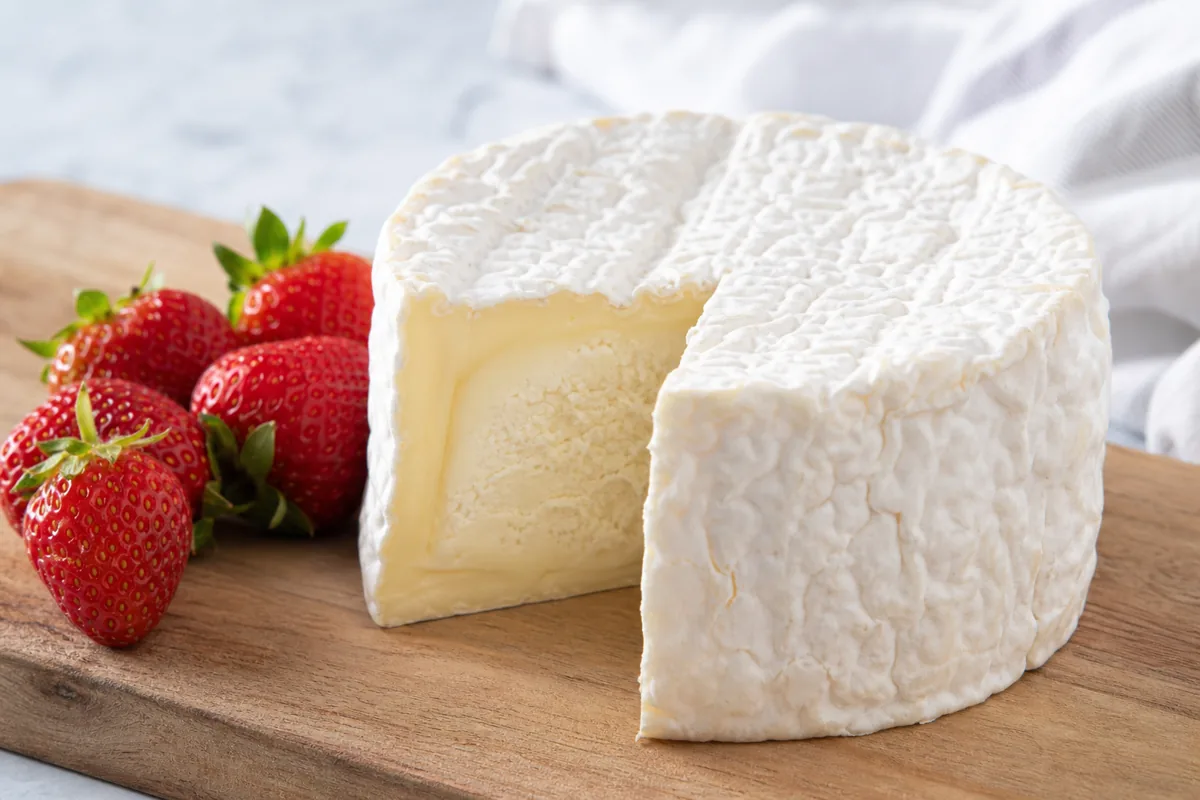
- French: a white bloomy rind on a heart, square, brick or cylinder.
- American: a plain rindless block, such as Philadelphia's, labelled with a third less fat than cream cheese.
How Is French AOP Neufchâtel Made?
French Neufchâtel comes from the Pays de Bray, a zone of 133 communes in Seine-Maritime and one in the Oise, on the northern edge of Normandy in France.
The specification requires that at least 60% of each supplying herd be Normande cows, grazing at least six months a year. Producers set that minimum, it says, because Holsteins had been replacing the breed over the previous quarter century.
It also sets grass rules: during the six or more grazing months, pasture must supply more than half of the base ration, each dairy cow needs at least 0.25 ha of grazeable meadow, and silage maize is capped at 0.25 ha per cow. At least 80% of the base ration must come from the farm itself, and bought-in supplements are limited to 1,800 kg per cow per calendar year.
The specification ties those rules to the land: the Pays de Bray has heavy, wet clay soils that suit grass better than ploughing and about 800 mm of rain a year, and its name comes from a Celtic word for mud.
The same text describes Normande milk as rich in fat and protein, with an excellent aptitude for soft cheese, and says it gives a lactic curd that suits draining and pressing.
The make starts much like a fresh cheese. Rennet sets the milk slowly, over 18 to 36 hours, until it reaches pH 4.2 to 4.6, and the curd then drains in bags before a light pressing.
Draining and pressing the curd before moulding is the step the specification singles out as particular to Neufchâtel among bloomy-rind soft cheeses. A dairy gives the two stages at least 4 hours in all, while a farm gives each stage 6 to 12 hours.
The drained curd is kneaded, moulded and salted with dry salt, and it may be seeded with Penicillium candidum, the white mould behind the bloomy rind.
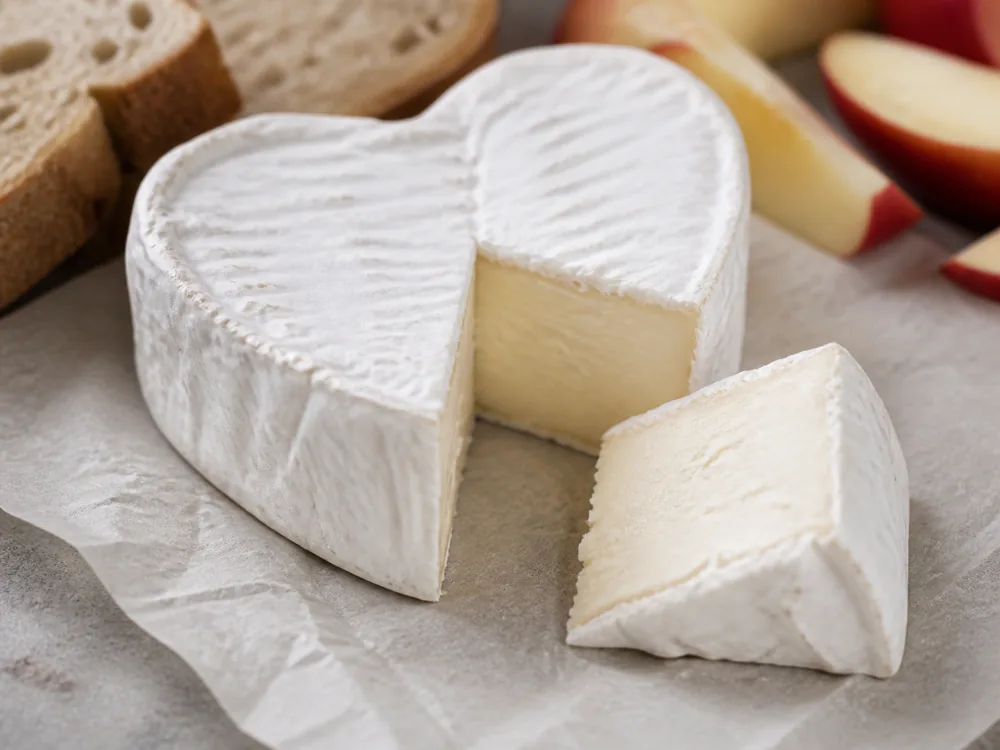
Under the specification, ripening lasts at least 10 days from moulding, at 10 to 14°C and 90 to 100% humidity. The specification calls it a short-ripened cheese, though it notes that some people in the region eat it after more than three months.
The AOP producers' site lists raw, thermised or pasteurised milk, and the specification says farmhouse makers, who produce close to half of the tonnage, keep traditional habits such as renneting the milk very quickly without pre-heating.
The AOP site singles out the farmhouse cheese as the one people appreciate most. If that is the one you want, ask the seller, because the specification's labelling section asks only for the name, the AOP mention and the logo, so the AOP mention does not itself mark a cheese as farmhouse or dairy.
The specification also closes off shortcuts. Homogenising the milk, standardising its protein and concentrating it by removing water before setting are forbidden, though standardising the fat is allowed.
Beyond the milk, the only permitted ingredients are rennet, harmless cultures of bacteria, yeasts and moulds, and salt. Delaying the curd, paste or cheese by chilling it below 2°C is banned, as is modified-atmosphere storage of fresh or ripening cheese.
The control body samples cheeses at the maker, tests them in a laboratory, and has a tasting commission judge them by sight, touch and taste against a scoring grid.
Output is small: 1,576 tonnes were sold in 2020, with 42 milk producers, 16 farmhouse producers and 21 workshops.
Does French Neufchâtel Taste Mild or Sharp?
French Neufchâtel is mild, buttery and slightly salted in the description on the AOP producers' site, with a fine white rind over a creamy, soft, smooth paste and a milky, fresh aroma.
Other references describe a sharper cheese. Wikipedia describes a grainy texture and a taste saltier and sharper than Camembert and Brie, and Cheese.com adds mushroom notes from the rind.
| Source | Texture | Taste | Ripening |
|---|---|---|---|
| INAO specification | Supple, smooth, firm but not hard, not sticky, runny or grainy | Lightly salted | At least 10 days, sometimes eaten after more than three months |
| AOP producers' site | Creamy, soft, smooth and melting | Mild, buttery, balanced and slightly salted | Not stated |
| Wikipedia | Grainy, slightly crumbly | Saltier and sharper than Camembert and Brie | 8 to 10 weeks |
| Cheese.com | Creamy, somewhat crumbly, with a distinct graininess | Rich and tangy, slightly salty, with mushroom notes | 8 to 10 weeks |
For a cheese sold under the AOP name, the specification's 10-day minimum is the rule, because the specification is the legal text. The 8 to 10 weeks given by Wikipedia and Cheese.com describes a longer ripening that the rules do not require.
Texture splits the same way, since the specification describes the paste as smooth and not grainy. Cheese.com also says the milk is pasteurised, which the specification rules out for farmhouse cheese.
Wikipedia and Cheese.com, which give 8 to 10 weeks of ripening, are also the two that describe a sharper cheese, so they may describe a riper cheese than the one behind the producers' mild wording.
The specification has cheeses sampled at the end of the minimum ripening, so its smooth, not-grainy wording is tested on a young cheese, and a riper cheese falls outside what that sampling checks.
Why Is Neufchâtel Cheese Heart-Shaped?
The best-known explanation is a legend. Wikipedia and the AOP producers' site both tell of young women in the Hundred Years' War giving heart-shaped Neufchâtel to English soldiers to show their love.
The documents are less romantic. The specification cites a 1790 tax that the mayor of Neufchâtel set by the cheese's shape, naming the heart, the round and the bonde, and a 1936 decree that listed the heart among the permitted forms.
That decree described a salted, kneaded soft cheese in the shape of a bonde, a square, a heart or a flat round called the Malakoff, and the Malakoff is not among today's six.
Today the heart is one of six shapes the specification allows, each with a set mould size and a minimum weight after ripening.
| Shape | Mould size | Minimum weight |
|---|---|---|
| Cœur (heart) | 8 to 9 cm from centre to point, 9.5 to 10.5 cm across, 3.2 cm high | 200 g |
| Grand cœur (large heart) | 10 to 11 cm from centre to point, 13.5 to 14.5 cm across, 5 cm high | 600 g |
| Bonde (cylinder) | 4.3 to 4.7 cm wide, 6.5 cm high | 100 g |
| Double bonde | 5.6 to 6 cm wide, 8 cm high | 200 g |
| Carré (square) | 6.3 to 6.7 cm a side, 2.4 cm high | 100 g |
| Briquette (brick) | 6.8 to 7.2 cm by 4.8 to 5.2 cm, 3 cm high | 100 g |
The double bonde weighs at least 200 g under the specification, while Wikipedia lists it at 400 g and also calls it twice a 100 g bonde.
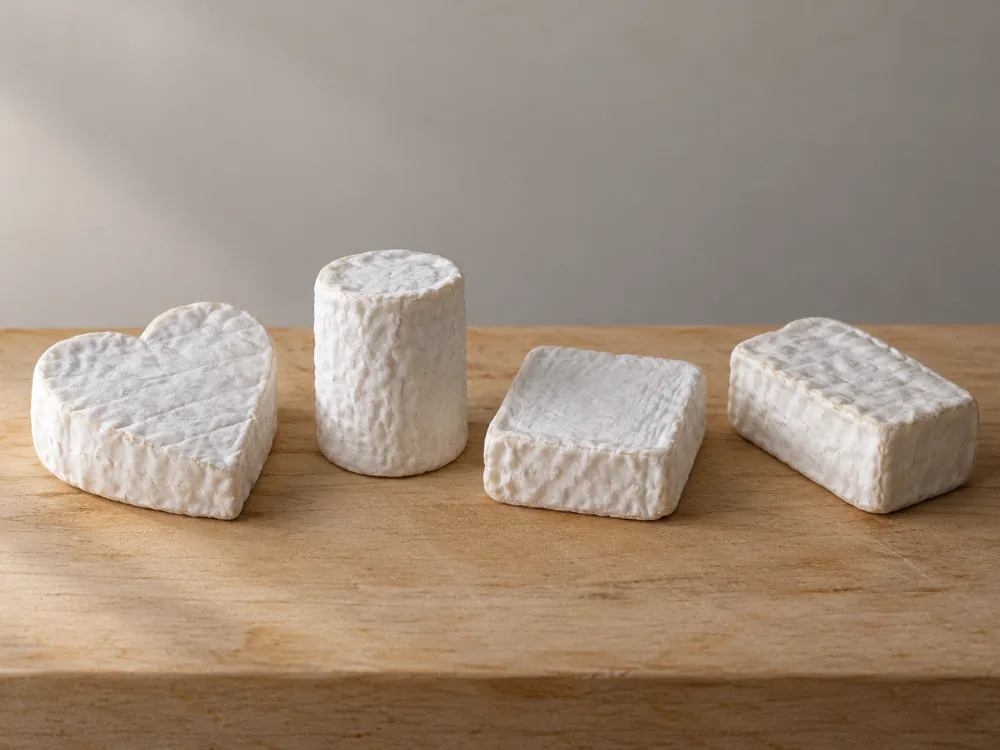
The heart, square, brick and bonde have straight sides, flat parallel faces and clean edges.
How Did a Norman Cheese Name End Up on an American Block?
The name crossed the Atlantic with a recipe: William Lawrence, a New York dairyman, created the first American cream cheese in 1872 by adding cream to a traditional Neufchâtel recipe.
Adding cream was not new in Normandy either. The specification quotes an 1839 account of three Neufchâtel kinds, one with cream added, one from whole milk and one from skimmed milk, with the whole-milk kind the most eaten.
Fresh Neufchâtel was a Norman product as well. The specification quotes an 1856 estimate of nearly three million fresh bondons eaten in Paris each year, and an 1877 report that describes the fresh cheese as a small cylinder about 8 cm high and 5 cm across.
After the Second World War, similar fresh and bloomy-rind cheeses were made industrially outside the Pays de Bray, and many farmhouse makers stopped making cheese and sold their milk to dairies, which the specification describes as the start of a decline.
The French makers then fought for the name. They formed a syndicate in 1957, and after an American delegation to the International Dairy Federation sought approval in 1965 for a cheese it called Neufchâtel, they pressed on until the appellation decree of 3 May 1969.
Neufchâtel's start date is disputed: the specification traces the cheese to the 10th century and to a 1543-1544 account at the abbey of Saint-Amand in Rouen, its first record by name, while Wikipedia and Cheese.com put its origins in the 6th century.
How Is American Neufchâtel Made?
Under the FDA standard, a lactic acid culture acts on milk, nonfat milk or cream, with or without a clotting enzyme, until the mixture coagulates, and the coagulated mass is warmed, stirred and drained.
The curd may then be heated until it turns fluid, homogenised or otherwise mixed, and have its moisture adjusted with cheese whey. None of those steps has a place in the French make described above.
The standard also allows stabilisers up to 0.5% of the finished weight, about 1 g in an 8 oz (227 g) block by our arithmetic. Kraft Heinz's Philadelphia Neufchâtel lists three, xanthan, carob bean and guar gum, alongside salt and cheese culture.
If you see a gum on the ingredient line, it points to the American type, since a French AOP cheese cannot contain one.
Is Neufchâtel Lower in Fat Than Cream Cheese?
Yes, under US law. The FDA standard sets American Neufchâtel at 20% to under 33% milkfat, and standard cream cheese at no less than 33%.
Neufchâtel may also hold more water, up to 65% against 55% for cream cheese.
Both standards allow cream. The FDA lists milk, nonfat milk or cream as Neufchâtel's dairy ingredients, and Kraft Heinz lists pasteurised milk and cream first on its Philadelphia Neufchâtel.
Kraft Heinz sells that product as having a third less fat than cream cheese, and its nutrition panel puts numbers on the claim: a 28 g serving, one-eighth of the 8 oz block, lists 70 calories, 6 g of total fat, 4 g of saturated fat and 120 mg of sodium.
By our arithmetic, 6 g in 28 g is about 21% fat by weight, close to the 20% floor of the legal range, and about a third below the roughly 9 g that the same serving would hold at cream cheese's 33% minimum.
Cheese.com gives almost the same serving figures, 70 calories and 3.5 g of saturated fat, and calls the cheese high in saturated fat and sodium. The Philadelphia panel lists 19% of the daily value for saturated fat and 5% for sodium.
The legal range is why the name alone settles little: a Neufchâtel at 32% milkfat would sit almost level with cream cheese at 33%, and the third-less figure is Kraft Heinz's claim for its own product.
The fat per serving on each label decides the comparison: the legal ranges meet at 33% milkfat, and the third-less-fat figure is Philadelphia's claim, not a legal requirement.
Can I Use Neufchâtel Instead of Cream Cheese in Cheesecake?
Kraft Heinz lists cheesecake among the uses for its Philadelphia Neufchâtel, along with frosting, cookies, queso dip and bagels.
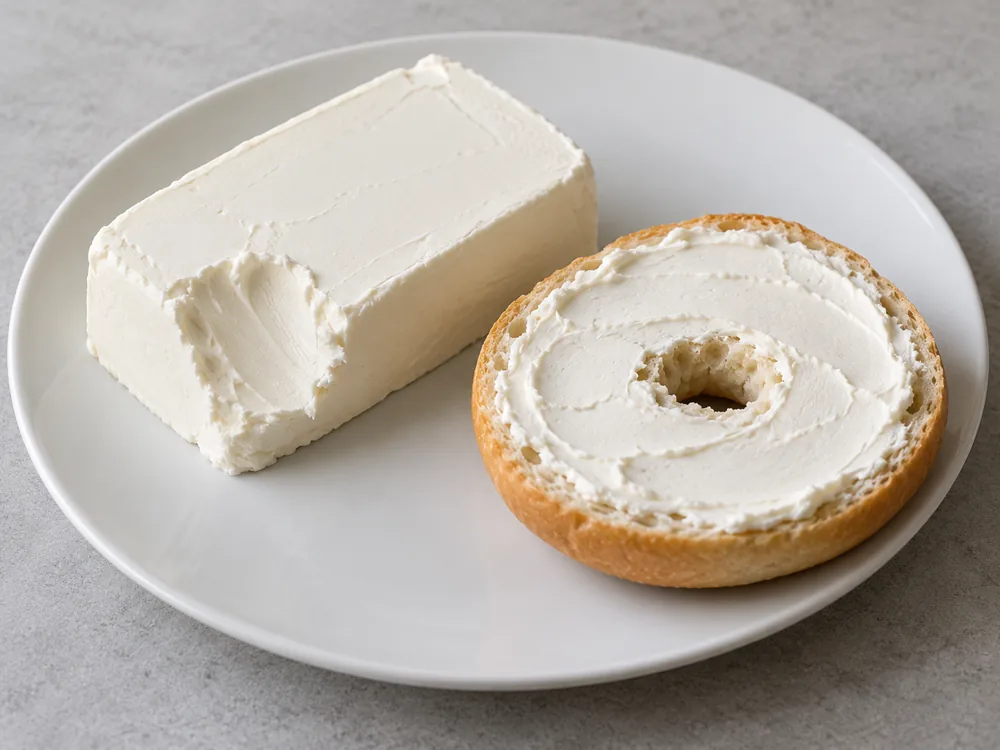
Its FAQ describes Neufchâtel as similar to cream cheese in flavour and texture, with less fat and more moisture.
The Kraft Heinz product page adds potatoes, eggs, pasta, wraps, sauces and a fruit dip to that list. Cheese.com says Neufchâtel melts into sauces, soups and baked dishes and works as a base under smoked salmon, vegetables or jam.
Cheese.com describes the French cheese yet lists cream-cheese uses such as cheesecake and frosting. For a cheesecake, the Philadelphia block is the product whose maker names that use.
The FAQ says a cheesecake made with PHILADELPHIA keeps up to 5 days in the refrigerator and up to 2 months in the freezer, but that guidance covers cream cheese. The one Neufchâtel line in it advises against freezing frosting made with Light Neufchâtel.
Can You Eat the Rind on French Neufchâtel?
Yes: Wikipedia describes the rind as dry, white and edible, and Cheese.com also calls it edible. If you are pregnant, the NHS says pasteurised or unpasteurised mould-ripened soft cheeses with a white coating, such as brie, camembert and chèvre, must be thoroughly cooked.
The AOP producers' site describes the rind as a thin skin with short, dense white mould, slightly downy to look at.
When you cut it, the same site advises cutting wedges from the centre outward, as with a Camembert, so that each person gets an equal share of rind and paste.
What Goes with French Neufchâtel?
The AOP producers' site pairs Neufchâtel with perry from Domfront and ciders, and it suggests red wine for well-ripened cheeses. Its tasting box also lists seven red wines and five beer styles.
| Pairing | Type | Why It Works |
|---|---|---|
| Poiré Domfront | Drink | The perry the AOP producers' site names first. |
| Cider | Drink | Listed by the AOP site as ciders in general. |
| Beaujolais | Wine | One of seven reds in the AOP site's tasting box, which suggests red wine for well-ripened cheeses. |
| Côtes-du-Rhône | Wine | Another red from that list, which also names Graves, Chinon, Anjou and Bourgueil. |
| Saumur | Wine | A third example from the same list of reds. |
| Baguette, dried fruit bread or brioche | Food | The three breads the AOP site suggests. |
| Farmhouse ale or saison | Drink | Two of the five beer styles in the AOP site's tasting box, which also names Berliner weisse, blonde ale and summer ale. |
These cider and red wine matches come from the French producers and are meant for the French cheese.
Can You Eat Neufchâtel Cheese While Pregnant?
It depends on which Neufchâtel it is, and the NHS and CDC rules on cheese in pregnancy treat the two differently.
American Neufchâtel must be made from pasteurised dairy ingredients under the FDA standard, and the NHS lists pasteurised soft cheeses such as cream cheese as safe to eat. The CDC lists cream cheese made with pasteurized milk among the safer cheeses, but served cold, American Neufchâtel is described as a pasteurized fresh, soft and spreadable cheese, a type its list does not cover, so ask a midwife or doctor.
The French cheese is a soft cheese with a white mould rind, which fits the NHS description of pasteurised or unpasteurised mould-ripened soft cheeses with a white coating, such as brie, camembert and chèvre, that must be thoroughly cooked.
The CDC lists soft cheese made from unpasteurized milk as riskier, and the French specification requires farmhouse makers to use their milk raw within 12 hours of milking, while dairies may pasteurise or thermise it. With the French cheese, ask whether it is farmhouse or dairy-made and check the label for the milk treatment.
The CDC also says pregnant women are 10 times more likely to get a Listeria infection, and its safer list also includes pasteurized soft cheeses heated to an internal temperature of 165°F or until steaming hot, along with cream cheese, cottage cheese, feta and mozzarella made with pasteurized milk.
How Long Does Neufchâtel Last After Opening?
Kraft Heinz says its Philadelphia products should be used within 10 days after opening or by the date on the package, whichever comes first, and it labels its Neufchâtel keep refrigerated and do not freeze.
Its FAQ gives quality, not safety, as the reason for the freezing advice, and asks that the pack be re-sealed and returned to a 40°F refrigerator straight after each use.
Cheese.com gives Neufchâtel two weeks after opening and four to six weeks unopened. If you have a Philadelphia block, follow the maker's 10 days, the rule written for that pack.
For the French cheese, an 1839 account that the specification quotes says whole-milk Neufchâtel kept nearly three months, and the specification adds that the heavy salting behind that keeping has declined as transport and refrigeration improved.
The specification credits the cheese's acidity and salt content for that long keeping, and says it was what made the cheese fit to travel by rail to Paris, Belgium, Britain and the colonies in the 19th century.
SOURCES & REFERENCES
What Else Do People Ask About Neufchâtel?
No. American Neufchâtel is a close relative with less milkfat and more moisture, and French Neufchâtel is a separate bloomy-rind cheese ripened for at least 10 days.
The AOP specification allows only présure, the French term for rennet, to set the milk, while Cheese.com says either microbial or animal rennet can be used. The FDA standard for American Neufchâtel permits clotting enzymes, and Kraft Heinz's Philadelphia Neufchâtel has no listed enzyme.
The French AOP producers call it mild, buttery and slightly salted, while Wikipedia and Cheese.com describe a saltier, sharper or tangier cheese with a grainy texture.