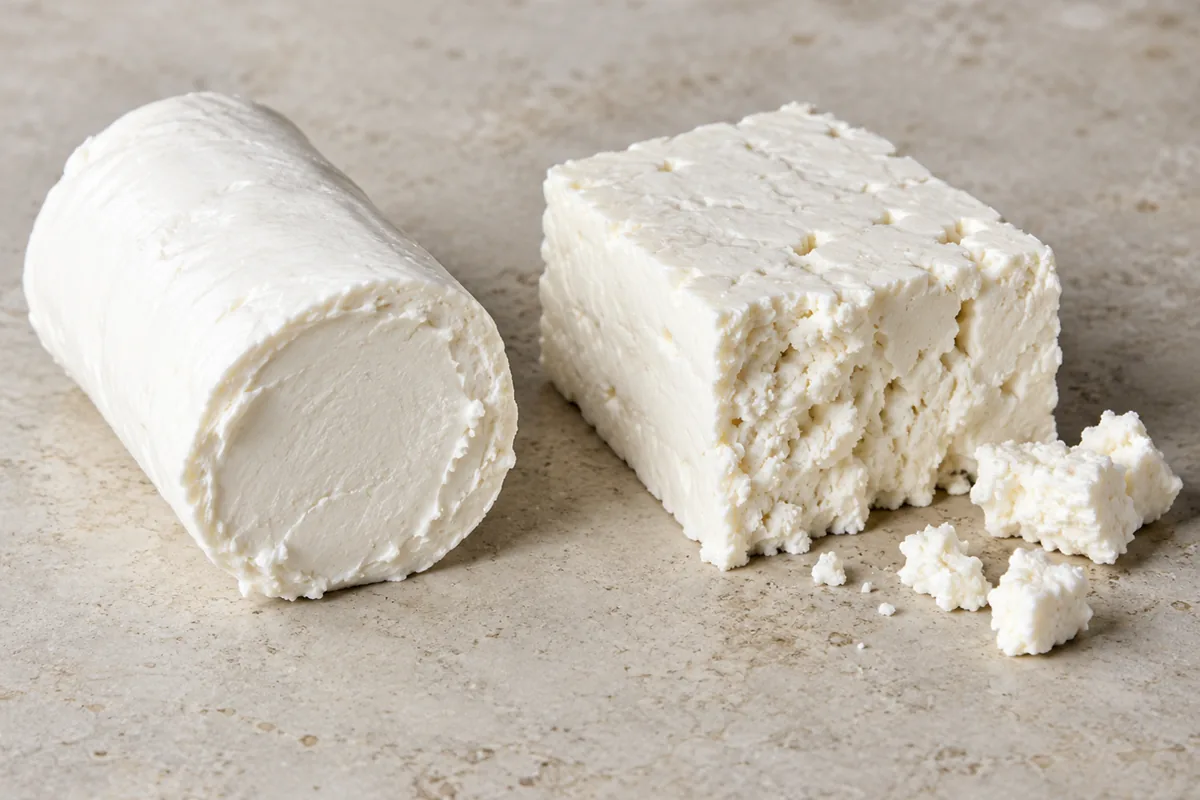
Fresh goat cheese and feta are both white and tangy, but they start from different milk and end in different packs. Feta is matured in brine, which makes it the saltier of the two.
Goat cheese spreads and feta crumbles, and that texture split decides most recipes before flavour does.
In This Article
What Is the Difference Between Goat Cheese and Feta?
The milk comes first. Goat cheese, or chèvre, is cheese made from goat's milk, while Greek feta is a white brined cheese made from sheep's milk or a mix of sheep's and goat's milk, according to Wikipedia.
| Attribute | Goat Cheese | Feta |
|---|---|---|
| Milk | Goat's milk | Sheep's milk, or sheep's milk with up to 30% goat's milk (PDO) |
| Origin | Made worldwide; chèvre is the French name | PDO name limited to mainland Greece and Lesbos |
| How it is made | Fresh, or aged into firmer styles | Dry-salted, then matured in 7% brine |
| Texture | Fresh: soft and spreadable; aged: firmer and crumbly | Crumbly and slightly grainy, small or no holes, no skin |
| Flavour | Fresh: mild and tangy | Tangy and salty, from mild to sharp |
| Milk treatment | Pasteurized or unpasteurized (Cheese.com) | Pasteurized or not; most producers now pasteurize (Wikipedia) |
Feta's protected name also fixes its composition: a maximum moisture of 56% and at least 43% fat in dry matter, per Wikipedia's summary of the EU designation. Goat cheese has no single rulebook, so its styles run from fresh and soft to aged and hard.
Is Feta a Goat Cheese?
No. Under EU rules, feta is made in mainland Greece and Lesbos from sheep's milk, or from sheep's milk with up to 30% goat's milk from the same area.
So a genuine Greek feta can contain some goat's milk without being a goat cheese. The name has been a protected designation of origin in the EU since 2002.
Outside the EU the word is looser. Wikipedia notes that most cheese sold as feta in the United States is American and made from cow's milk.
Feta made in Denmark and elsewhere outside Greece belongs to the same story: production spread to Denmark, France, Germany, Italy, the UK and the US, often with part or all cow's milk. After the EU protected the name, the European Commission gave other nations five years to find a new name for their feta or stop making it.
Wikipedia lists the new names that followed: Arla Foods renamed its white cheese Apetina, Yorkshire Feta became Fine Fettle Yorkshire, and imitation feta goes by labels such as "salad cheese" and "Greek-style cheese".
Canada took a middle route: under a 2013 trade agreement with the EU, existing Canadian makers kept the name feta, while new entrants label their product "feta-style/type cheese".
A Greek address does not guarantee the protected name either. Wikipedia notes that the island of Cephalonia traditionally makes feta but was left out of the PDO area.
How Do Goat Cheese and Feta Taste Different?
Goat cheese gets its tang from the milk. Wikipedia credits goat's milk's higher share of caproic and caprylic acids, fatty acids named after the Latin word for goat, for the tart flavour.
Cheese.com describes fresh chèvre as mild and tangy and soft enough to spread, while aged versions turn firmer and crumbly with a more complex flavour.
Part of that spread starts with the milk: Wikipedia says goat's milk is heavily influenced by what the goats eat, and goats take in many bitter plants that cows and horses will not. Cheese.com places chèvre anywhere from gamey and tangy to mild and creamy.
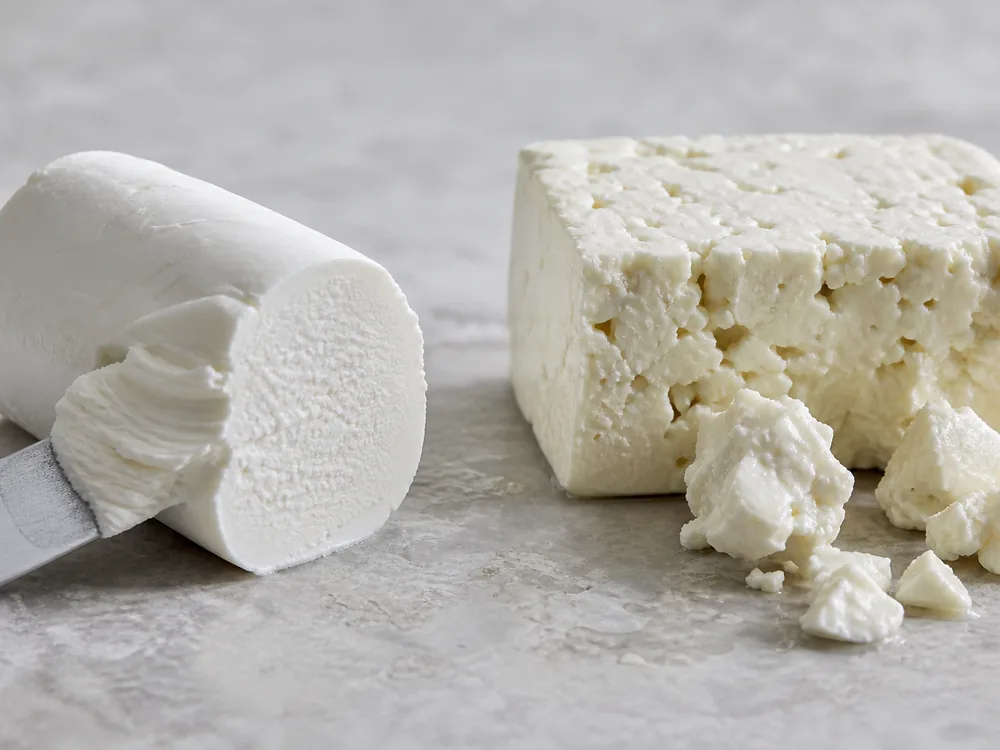
Feta's tang arrives with salt. Wikipedia describes it as tangy and salty, from mild to sharp, and says the firm style is tangier than the soft one.
The salt comes from the make: the curds are dry-salted to about 3% salt, then the cheese matures in a 7% brine for weeks before at least two more months in cold storage.
Why Does Feta Taste Different From Pack to Pack?
The milk sets the base. Cheese.com says the inclusion of sheep's milk is what gives feta its distinct flavour and texture, and it describes sheep's milk as rich and creamy.
Cheese.com adds that feta made with cow's milk tastes more subtle and less tangy than the traditional sheep and goat blend, and Wikipedia reports that most cheese sold as feta in the United States is cow's milk.
Wikipedia describes a well-made traditional feta as creamy when sampled, with aromas of ewe's milk, butter and yoghurt, and in the mouth tangy, slightly salty and mildly sour, with a spicy finish that recalls pepper and ginger and a hint of sweetness.
Most producers now pasteurise the milk, according to Wikipedia, and then add a starter culture to replace the organisms the heat kills, because they are needed for acidity and flavour development. The EU rules describe the result as a pH that usually ranges from 4.4 to 4.6, and Cheese.com credits the lactic acid bacteria with feta's tanginess.
Two more sources of variation sit outside the milk. Barrel ageing, the more traditional method, is said to impart a unique flavour, according to Wikipedia, and the protected specification credits the land's biodiversity and the breeds of sheep and goats for feta's aroma and flavour.
What Makes Feta Crumble and Goat Cheese Spread?
Water is the clearest measured gap: USDA lists 55.2 g per 100 g in feta and 60.8 g in soft goat cheese, and the feta rules cap moisture at 56%. Soft goat cheese's figure sits above that cap, which fits its spreadable body.
In feta's make, Wikipedia says, rennet goes in once the milk has cooled to about 35°C (95°F). The compacted curd is chopped and left in a mould or cloth bag so the whey drains, and after several hours it is firm enough to cut up and salt.
Goat cheese follows no fixed sequence. Wikipedia lists the settings that move it between soft, semihard and hard: the type of starter, the time or pressure of draining, and the temperature and duration of curing.
So spreadable is only one of goat cheese's textures. Cheese.com says chèvre turns firmer and crumbly as it ages, which makes an aged goat cheese a closer match for feta than a fresh log is.
Is Goat Cheese or Feta Healthier?
Neither is lighter. USDA lists both at about 265 calories and 21 g of fat per 100 g, so the contrast lies in the rows below them.
| Nutrient | Feta (FDC 173420) | Soft goat cheese (FDC 173435) |
|---|---|---|
| Energy | 265 kcal | 264 kcal |
| Protein | 14.2 g | 18.5 g |
| Fat | 21.5 g | 21.1 g |
| Calcium | 493 mg | 140 mg |
| Sodium | 1,140 mg | 459 mg |
Soft goat cheese carries more protein, 18.5 g against 14.2 g. Feta carries about 3.5 times the calcium, 493 mg against 140 mg.
Saturated fat is nearly level, 13.3 g in feta against 14.6 g in soft goat cheese. Cholesterol splits more widely, 89 mg against 46 mg, and feta's vitamin B-12 of 1.69 µg is almost nine times the 0.19 µg in goat cheese.
Sodium is the widest gap, and the brine explains it: 100 g of feta holds about 2.5 times the sodium of the same weight of soft goat cheese.
Per 28.35 g (1 oz), the portion both USDA records list, feta carries about 323 mg of sodium and soft goat cheese about 130 mg. Wikipedia's figure for feta, over 400 mg of sodium per 100 calories, agrees with USDA's, which works out to about 430 mg (1,140 mg for 265 kcal).
The PDO's 43% fat counts fat in dry matter, the cheese minus its water, so it cannot be compared with the 21.5 g per 100 g in the table. Dividing that 21.5 g by the 44.8 g that is not water gives about 48% for USDA's feta, and soft goat cheese comes to about 54% (21.1 g in 39.2 g).
These are USDA averages for each type, so a given pack can differ, and its own nutrition label is the figure that applies to it. Cheese.com's feta page lists 364 mg of sodium for a 1 oz (28 g) serving, about 40 mg above USDA's figure, and says the saltiness varies with the brand and type.
Which Dishes Are Built Around Feta?
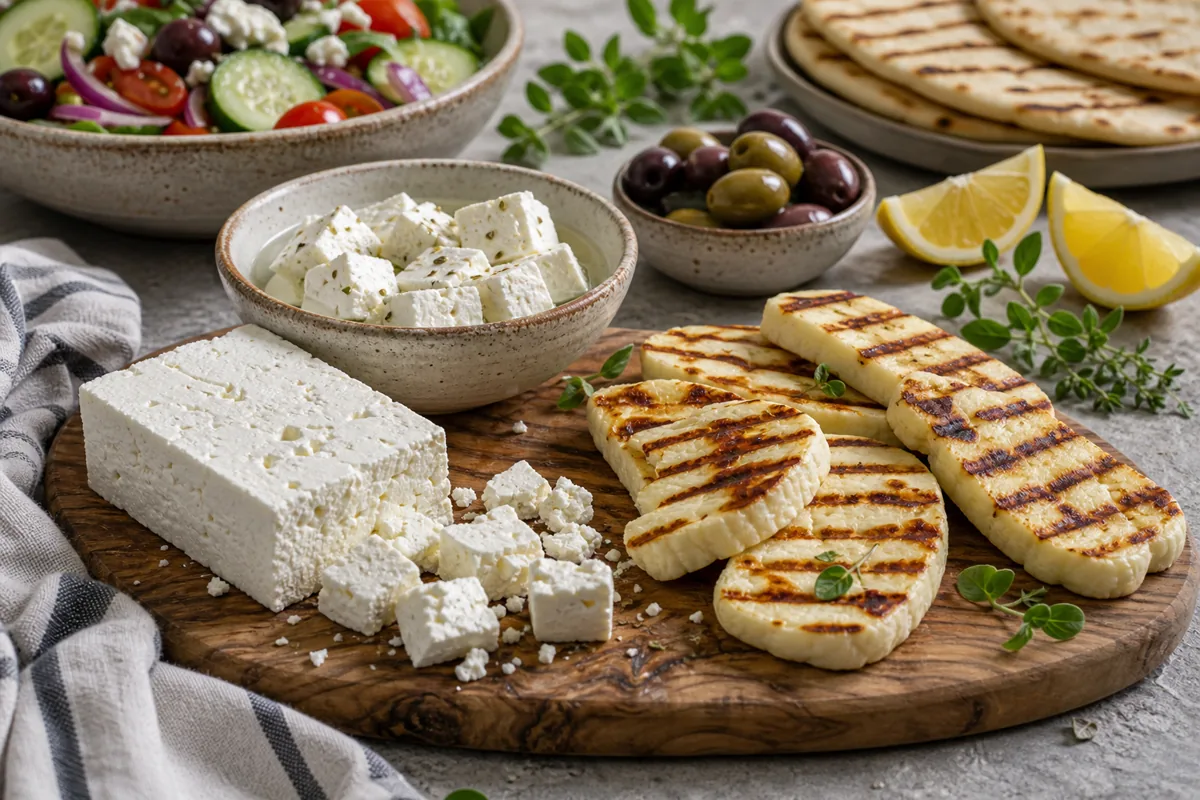
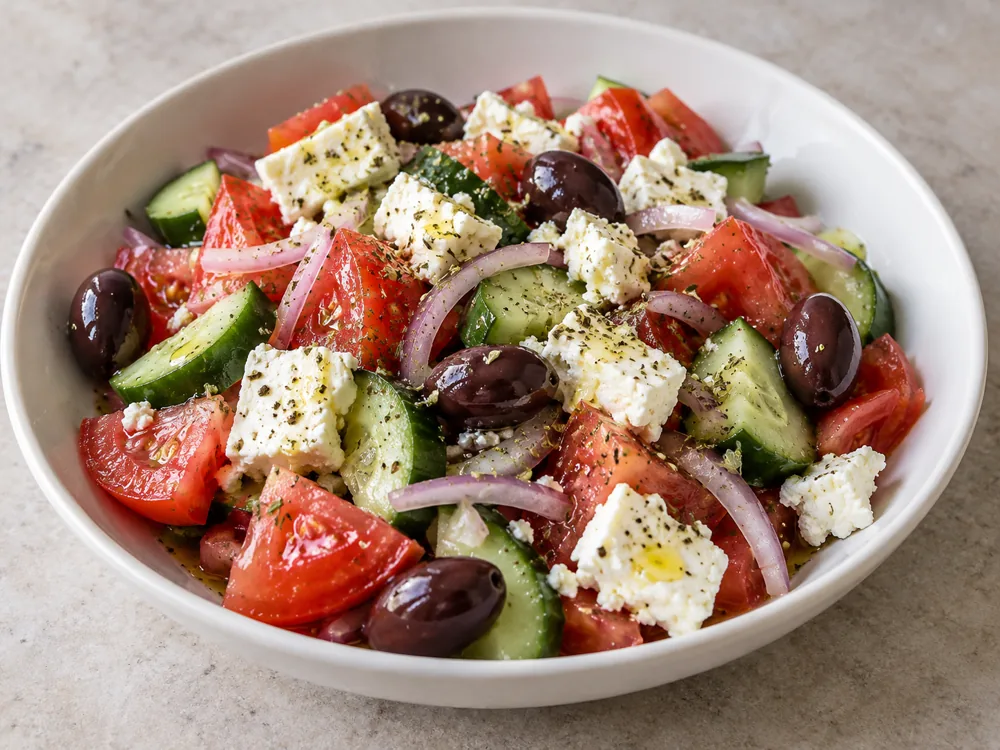
Feta is the cheese in a Greek salad, which Wikipedia describes as tomatoes, cucumbers, onion, feta and olives, dressed with salt, Greek oregano, lemon juice and olive oil.
Wikipedia notes that the original dish is distinguished by having no lettuce, and that an American-style Greek salad adds lettuce and serves the feta in cubes mixed with the vegetables, a style rarely met in Greece.
It also fills filo pastries: Wikipedia names spanakopita, the spinach pie, and tyropita, the cheese pie, as the notable Greek dishes.
PDO feta is traditionally made in firm and soft styles. The soft one is almost spreadable, sells for less, and mostly goes into pies.
Pies also take the trímma, the crumble left over when feta is sliced, which Wikipedia says is usually given away free on request because it cannot be sold.
Away from salads and pies, feta is often served with olive oil or olives and a sprinkle of oregano, and it can be grilled or used in sandwiches and omelettes.
Cheese.com's own suggestions run wider: feta in quiches and pies, crumbled over pasta, or blended into dips, sauces and dressings.
Which Dishes Are Built Around Goat Cheese?
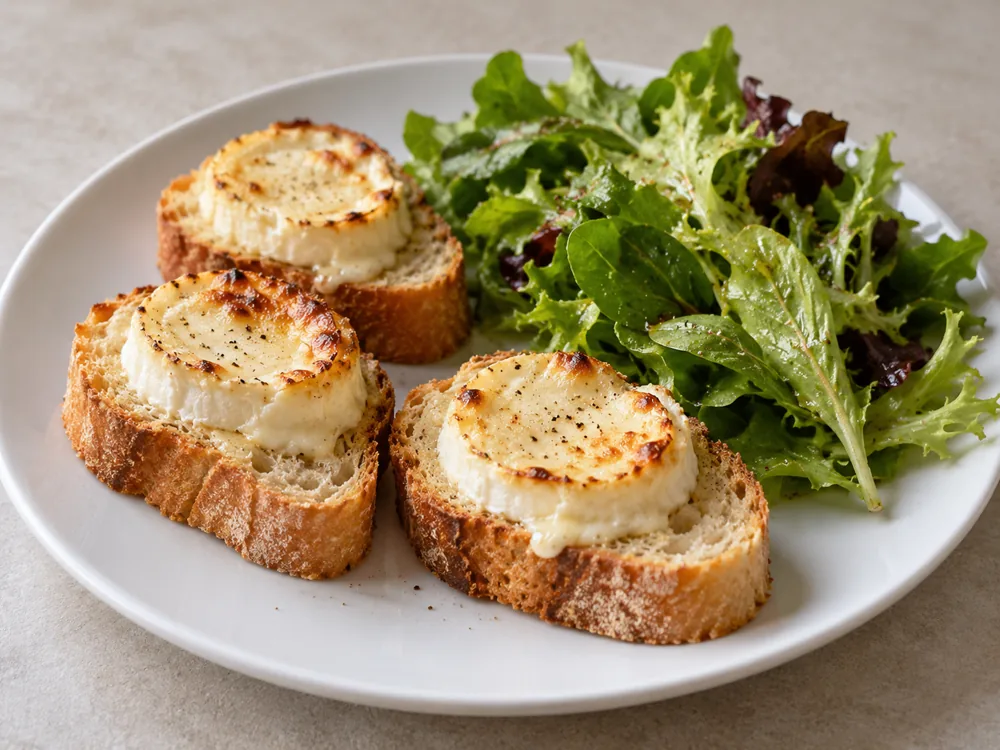
The classic hot use is chèvre chaud, a French dish of goat cheese broiled on French bread. Wikipedia says it is often served with a green salad and vinaigrette, olive oil or balsamic vinegar.
Cheese.com's writer uses chèvre in quiches, tarts and salads, with caramelised onions, and sprinkled over pizza.
Those uses lean on the soft, spreadable texture Cheese.com describes for fresh chèvre.
Can You Use Goat Cheese Instead of Feta?
As a stand-in for feta in a cold salad, goat cheese works if you expect less salt. By the USDA figures it carries about 40% of feta's sodium, so the same weight seasons the dish far less.
The texture changes too, because soft goat cheese will not give the separate crumbly pieces that feta does. A firmer, aged goat cheese gets closer, though the USDA sodium figure is for the soft type.
Quiche and salad are the two dishes Cheese.com names for both cheeses, which makes them the least surprising places to swap one for the other.
Used as a replacement for goat cheese, feta makes a recipe noticeably saltier unless the added salt comes down.
In numbers, 100 g of feta in place of 100 g of soft goat cheese adds about 680 mg of sodium (1,140 mg against 459 mg). A soft-style feta narrows the texture gap, since Wikipedia calls it almost soft enough to spread, but it is still a cheese matured in brine.
Goat cheese in place of feta brings about 40% of the sodium and soft pieces rather than crumbles. Feta in place of goat cheese adds about 680 mg of sodium per 100 g.
Is Goat Cheese or Feta Safe in Pregnancy?
Pasteurised feta appears on both agencies' lists of lower-risk cheese in pregnancy. The NHS names feta among safe pasteurised soft cheeses, and the CDC lists feta made with pasteurized milk as a safer choice.
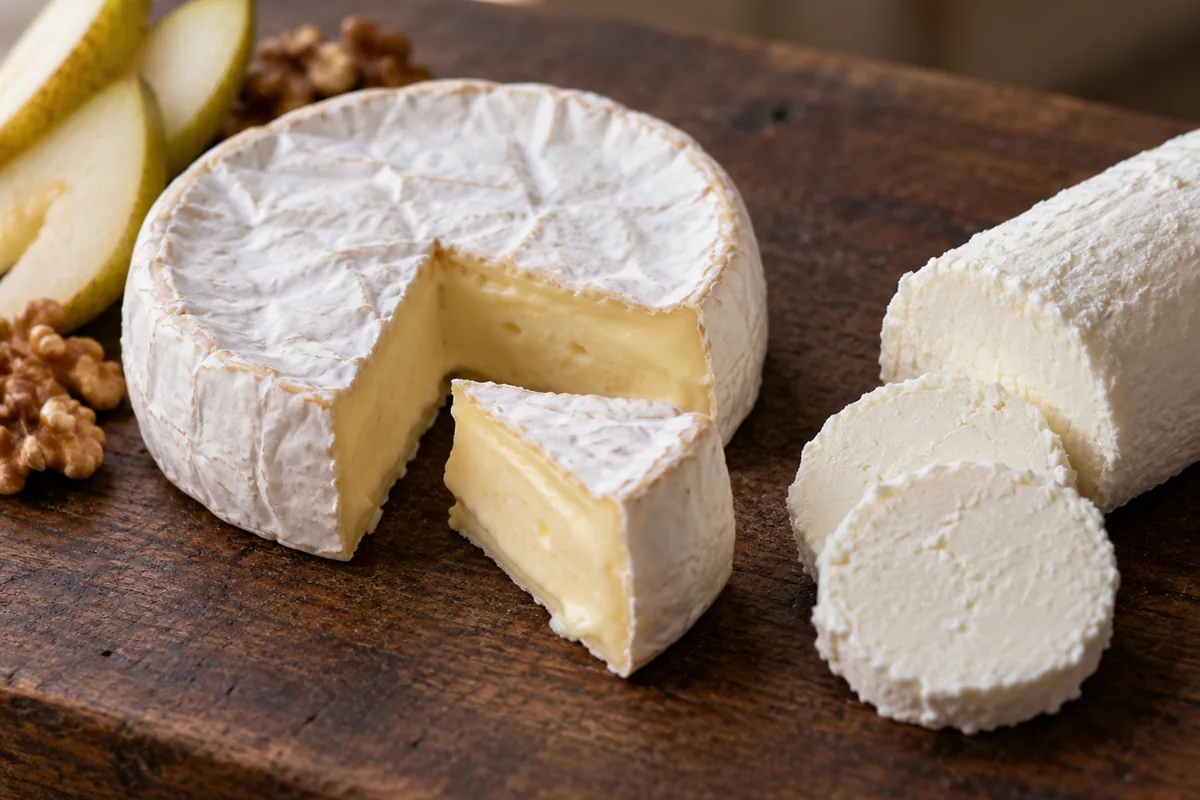
Goat cheese depends on its coating. The NHS allows pasteurised goats' cheese without a white coating (rind), but says pasteurised or unpasteurised mould-ripened soft cheeses with a white coating, such as brie, camembert and chèvre, must be thoroughly cooked.
The NHS explains why: unpasteurised or soft ripened dairy foods may contain listeria bacteria, which can cause listeriosis, and listeriosis can cause miscarriage or stillbirth, or make a newborn baby very unwell.
Raw milk changes the answer for both cheeses. The CDC lists soft cheese made from unpasteurized milk as riskier and notes that pregnant women are 10 times more likely to get a Listeria infection.
Cooking settles it either way, since the NHS counts any cheese cooked until steaming hot as safe.
For pasteurized soft cheese, the CDC puts a number on cooking: heated to an internal temperature of 165°F or until steaming hot.
How Do You Buy and Store Each One?
Feta reaches shops in two ways, according to Wikipedia. It is cut and sold straight from the barrel or metal vessel it matured in, or packed as standard-weight blocks in sealed plastic cups with some brine.
Feta dries relatively quickly, even in the fridge. For storing cheese longer than a week, Wikipedia says feta belongs in brine or lightly salted milk.
Chèvre is sold as logs or small rounds, per Cheese.com, and some are rolled in herbs, spices or other coatings.
The NHS says most milk, cheese and butter bought in supermarkets is pasteurised, and that the packaging confirms it.
Goat Cheese or Feta: Which Should You Buy?
Pick by the job the cheese has to do. Feta brings salt and crumble to a salad or pie, while fresh goat cheese brings a soft tang that spreads on bread or bakes into a tart.
Buy feta for Greek salad, spanakopita and dishes that need salt in separate pieces. Buy goat cheese for chèvre chaud, tarts and spreads, and when you want less sodium.
SOURCES & REFERENCES
Goat Cheese vs Feta FAQ
Short answers to the questions shoppers ask most about this pair.
Protected Greek feta is sheep's milk, with goat's milk allowed up to 30% of the mix. In the US, most cheese sold as feta is made from cow's milk.
Feta. USDA lists 1,140 mg of sodium per 100 g for feta and 459 mg for soft goat cheese.
In a cold salad, yes, with two changes: soft goat cheese has about 40% of feta's sodium, and it will not give the separate crumbly pieces that feta does.
The NHS allows pasteurised goats' cheese without a white coating. White-coated mould-ripened chèvre must be thoroughly cooked, pasteurised or not.