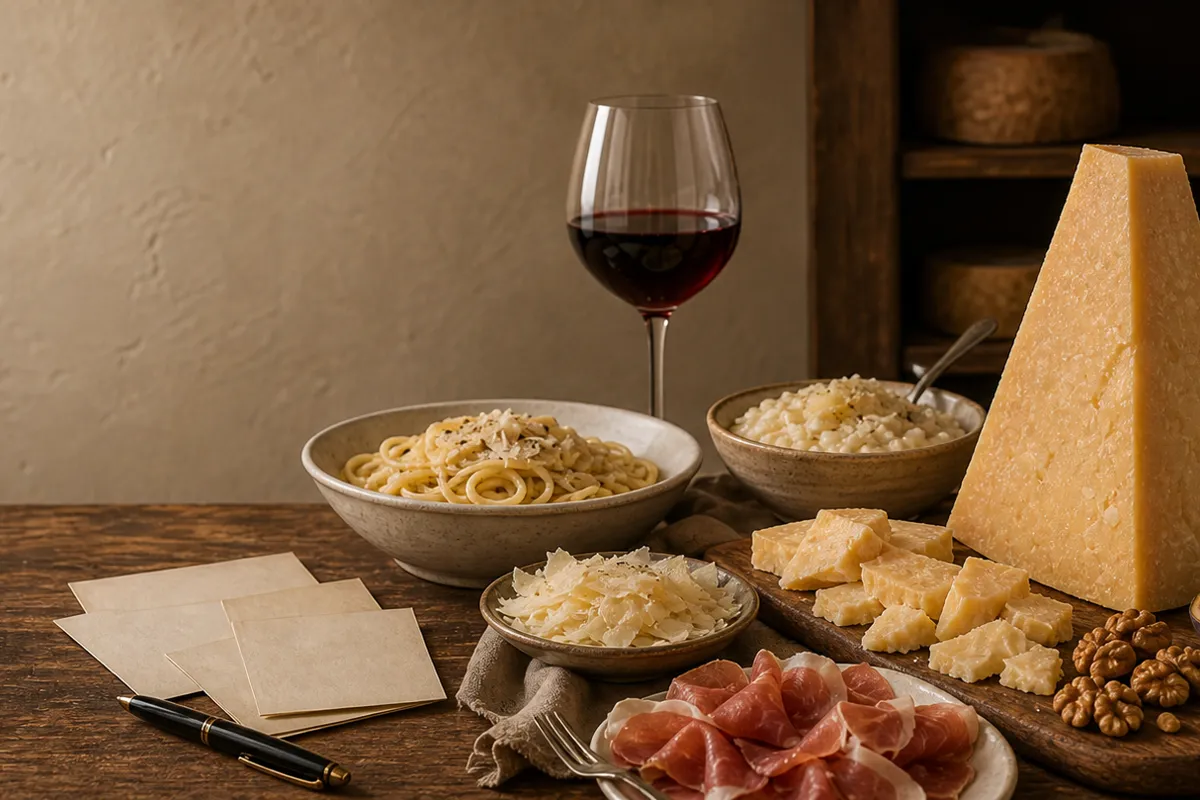
The age of the wheel decides the partner: the Parmigiano Reggiano consortium publishes separate wine, honey, jam and beer lists for young, 24-month and long-aged cheese.
Every list below was written for PDO Parmigiano Reggiano, which must age for at least 12 months under its production rules. A wedge that states its age gives you the first clue to the right glass or jar.
In This Article
How Can You Tell How Old Your Parmesan Is?
Read the label first: on a pre-packed piece of Parmigiano Reggiano, the production specifications require the label to state the minimum maturation time, and that month count is the one to match against the lists below.
A piece with rind from the side of the wheel lets you count the months yourself, because that rind carries a stencilled band with the dairy's number and the month and year of production. Pieces cut from the flat top or bottom of a wheel, such as the central part, show none of these marks.
The consortium's FAQ puts most of the cheese on the market between 24 and 36 months old and sets no maximum age: wheels reach 40 months to over 100.
Culture magazine notes that Parmigiano Reggiano carries aging seals at 18, 24 and 30 months. Of these, only the 24-month seal matches a row of the consortium's wine, honey, jam and beer lists exactly.
How Does Aged Parmesan Look, Feel, and Taste?
Aged Parmesan changes in ways a buyer can see and taste, and the change starts in the paste: lactic bacteria release enzymes that break the proteins into free peptides and amino acids, a process called proteolysis.
The consortium ties the cheese's structure and character to the same breakdown and says they show most fully from about 24 months, while 36, 48 or more months bring flavours and aromas it calls unparalleled.
Two cues show before the first bite. Colour deepens from light creamy yellow toward intense straw yellow with longer maturation, and the small white dots in the paste are tyrosine crystals, which mark the stage of maturation.
Caseificio del Milanello, a Parmigiano Reggiano dairy, adds that these crystals give cheese aged over 40 months an unmistakable crunch.
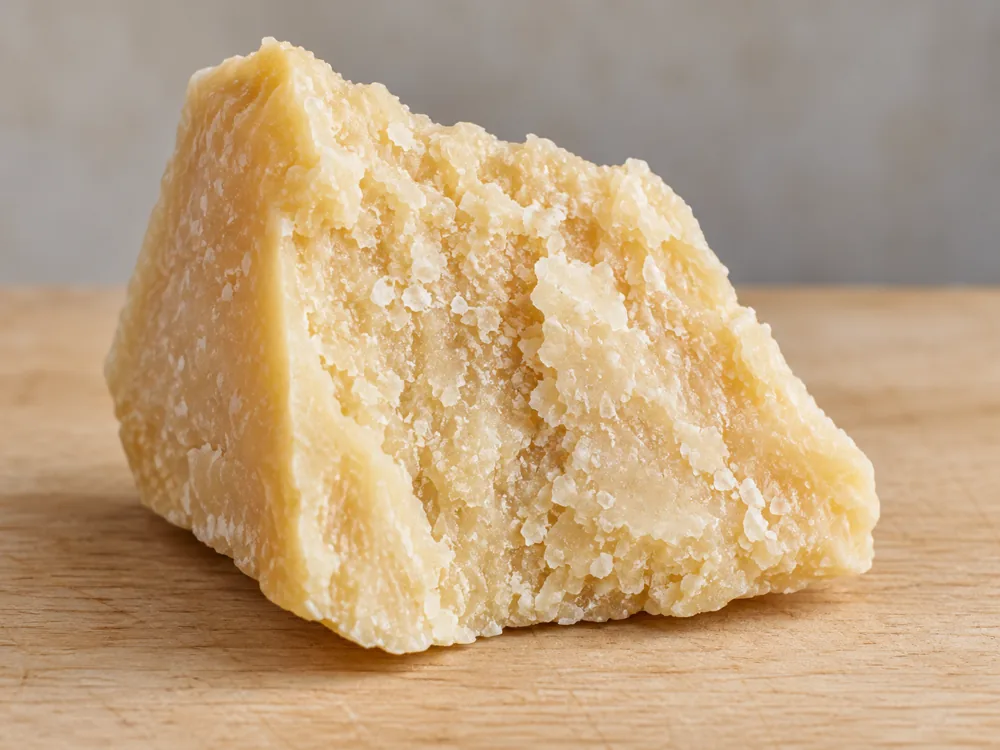
In the mouth, granularity, crumbliness and solubility all grow with age, and the consortium says texture alone tells a taster almost at once whether a piece is 12, 24 or 36 months old.
In the consortium's description, flavour moves in a set direction: sweetness is more pronounced in less-aged cheese, saltiness increases with maturation, bitterness stays a weak and often herbaceous note, and spiciness rises with age without being meant to turn excessive.
| Age | Flavour and texture described |
|---|---|
| 12 months | Delicate milk and butter, yogurt-like acidity, fresh grass and wildflower notes, no sharp spiciness and no granularity |
| 24 months | Lactic acidity opening into white pepper and meat broth, with tropical and dried fruit and a granularity that starts to linger |
| 35 to 45 months | Strong aromatic intensity with pronounced spicy and smoky notes; at 36 months, meat broth, cheese rind, melted butter and spices |
| Over 40 months | A full, lingering taste of warm spices, chestnut and meat broth |
| 60 months | Very dry and crumbly, with spice notes fading and leather and toasted aromas blending with a lactic freshness |
For tasting, the consortium's guide gives an ideal temperature of 60 to 62°F, which for a refrigerated piece means taking it out at least 1 hour ahead and opening the vacuum pack at least 30 minutes before.
The dairy Caseificio Traversetolese gives a warmer serving temperature, about 18 to 20 °C or about 64 to 68°F, which it says lets the cheese express all its aromatic and taste notes.
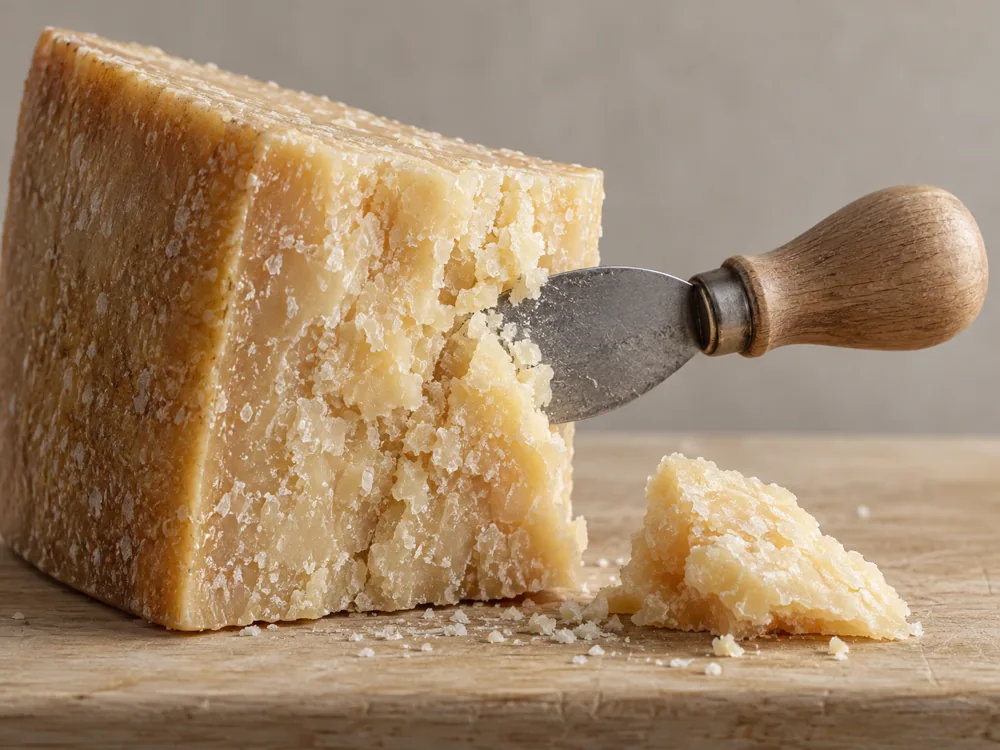
The consortium's guide adds that the cheese is not sliced but broken into chunks with the traditional almond-shaped knife, whose tip is pressed into the paste and used as a lever to break off small pieces.
Which Wine Goes with Parmesan at Each Age?
Match the wine to the month count: the consortium's wine lists run from sparkling wine or a light white for young cheese to structured reds past 40 months and sweet wine at 60, and Caseificio Traversetolese's list moves the same way, ending with Passito, Marsala and a slightly sweet Lambrusco at 48 months or more.
| Age | Parmigiano Reggiano consortium | Caseificio Traversetolese | Gourmetaly |
|---|---|---|---|
| 12 months | Spergola, Pignoletto, Malvasia, Lambrusco, English sparkling wine, Bacchus, Seyval Blanc, Ortega, Spumante, Cava | 12 to 18 months: Prosecco, Sauvignon Blanc, dry Malvasia | Franciacorta and Trento DOC, Lambrusco, Vernaccia di San Gimignano |
| 24 months | Spergola, Lambrusco, English sparkling rosé, barrel-fermented Bacchus, Pinot Noir, Rondo, Regent, Tempranillo from Ribera del Duero, Malbec from Argentina | Vermentino, Chardonnay, dry Lambrusco | Sangiovese di Romagna, Chianti Classico, Dolcetto d'Alba, Rossese di Dolceacqua |
| 36 months | No 36-month row | Barolo, Amarone della Valpolicella, sweet Malvasia | Brunello di Montalcino, Barbera d'Asti, Primitivo, Montefalco red, Taurasi |
| 40 months or more | 40 months: Cabernet Sauvignon, Merlot, Barbera, Pinot Noir Reserve, Rondo, Regent, Triomphe d'Alsace, Rioja, Premier Cru from Burgundy or Bordeaux, Hermitage, Zinfandel. 60 months: Passito, Marsala Superiore, English late harvest, English vermouth, mead in a modern semi-dry style, Tawny Port, Madeira, Meio Seco, Sauternes | 48 months or more: Passito, Marsala, Lambrusco Rosso Amabile | No row past 36 months |
For a board with a 12-month and a 24-month wedge, Spergola and Lambrusco appear on both of the consortium's lists. Bacchus appears on both too, but the 24-month list asks for a barrel-fermented Bacchus.
Caseificio Traversetolese's general pairing guide adds dry, aromatic Sauvignon Blanc or Riesling, and Prosecco or Champagne, for the cheese's graininess and strong flavour.
Secret Food Tours ties full-bodied reds such as Chianti to the cheese's nutty, savory notes, granular texture and intense umami.
Which Wine Suits a 12- to 18-Month Wedge?
At 12 months the consortium describes moderate saltiness and an elastic, moist texture. It pairs that cheese with sparkling wines of moderate persistence or with light-bodied still whites.
In the cheese's home region the consortium singles out sparkling wines made by the Charmat method or by bottle refermentation.
From the United Kingdom it lists classic-method sparkling wines from white grapes with short lees ageing, such as non-vintage wines from Sussex or Kent, and internationally it counts Crémant and Cava among the top choices.
For 12- to 18-month cheese, Caseificio Traversetolese calls Prosecco a dry, fresh sparkling wine that balances the cheese's sweetness, and dry Malvasia a typical wine of the Parma area that brings out its lactic notes.
Franciacorta and Trento DOC split the guides: Gourmetaly puts these sparkling wines with the 12-month wheel, while Secret Food Tours says their complexity elevates aged Parmigiano Reggiano.
Which Wine Suits a 24-Month Wedge?
At 24 months the consortium asks for wine with balance, roundness and lingering freshness.
In the home region it prefers long-aged traditional-method sparkling wines based on Spergola, and from the United Kingdom it picks English sparkling rosé made from Pinot Noir for structure and freshness.
Caseificio Traversetolese's 24-month whites are Vermentino, a structured white whose acidity balances the savouriness, and Chardonnay, for a structure that accompanies the cheese without covering it.
Gourmetaly names Sangiovese di Romagna and Chianti Classico among its 24-month reds, and CIU Travel pairs medium-bodied reds with its 24-month cheese.
Which List Fits a 30- or 36-Month Wedge?
A wedge labelled 30 or 36 months falls in the 24-to-36-month range the consortium gives for most of the cheese on the market, yet its wine page has no row between 24 and 40 months.
Caseificio Traversetolese, Gourmetaly and CIU Travel fill that gap with their own 36-month picks, and the other lists cut the ages in different places.
| List | Age bands | 30-month wedge | 36-month wedge |
|---|---|---|---|
| Consortium wine page | Over 12, 24, 40 and 60 months | No row; nearest 24 and 40 | No row; nearest 24 and 40 |
| Consortium honey and compote pages | Over 12, 24 and 35 to 45 months | No row; nearest 24 and 35 to 45 | 35 to 45 |
| Consortium beer page | Over 12, 24, 35 to 45 and 60 months | No row; nearest 24 and 35 to 45 | 35 to 45 |
| Consortium sensory guide | 12 to 18, 22 to 24, 30 to 36 and over 40 months | 30 to 36 | 30 to 36 |
| Caseificio del Milanello | Young 12 to 20, medium 24 to 30, mature 36 to 40 and extra-aged over 40 months | Medium | Mature |
| Caseificio Traversetolese | 12 to 18, 24, 36 and 48 months or more | No row; nearest 24 and 36 | 36 |
| Gourmetaly | 12, 24 and 36 months | No row; nearest 24 and 36 | 36 |
| CIU Travel | 12, 24, 30 and 36 months | 30 | 36 |
For a 30-month wedge, CIU Travel's list has a row of its own: it moves from medium-bodied reds at 24 months to full-bodied reds at 30 and 36 months. The same wedge falls in Milanello's medium band, the age it gives Lambrusco Concerto.
A 36-month wedge gets different bottles: Caseificio Traversetolese names Barolo and Gourmetaly names Brunello di Montalcino, and no wine appears on both lists.
At 36 months Caseificio Traversetolese gives you both a tannic and a soft-tannin red: it calls Barolo a structured, tannic red that enhances the cheese's intensity, and credits Amarone della Valpolicella with aromatic richness and soft tannins.
Barbera is the one still red that two age lists share: Gourmetaly lists Barbera d'Asti at 36 months and the consortium lists Barbera at 40.
On the honey, compote and beer pages a 36-month wedge sits inside the 35-to-45-month row, and the beer page itself describes the 36-month cheese in that row.
The consortium's 2019 note filled the wine gap differently from its wine page: it names a good Marsala for 36-month cheese, while the wine page lists Marsala Superiore only for 60-month cheese.
Labels need not land on a row either: Milanello's own wheels are labelled 13, 27 to 28, 36 to 38 and 48 months, none of which is a row on the consortium's wine page, though 48 months clears its 40-month threshold.
Which Red Wine Suits Parmesan Aged 40 Months or More?
Beyond 40 months, the consortium moves to structured, full-bodied reds that can balance the cheese's sharpness and savoury intensity.
The tannin request reverses at this age: where it wants smooth tannins at 24 months, the consortium now wants red wines with bold tannins and long persistence to stand up to the richness, and in its home region it prefers still reds with high tannin content and barrel ageing.
Which Sweet Wines Go with the Oldest Parmesan?
At 60 months the consortium turns to rich, sweet wines, and it calls passito wines made from local grapes top-tier choices.
From the United Kingdom it lists late-harvest Bacchus, Huxelrebe and Madeleine Angevine plus craft vermouths from Asterley Bros and Sacred, whose herbal complexity it says matches the cheese's depth.
Caseificio Traversetolese starts its sweet wines earlier, with sweet Malvasia at 36 months, whose velvety sweetness it says balances the cheese's savouriness. At 48 months or more it names Passito and Marsala, saying Marsala's sweetness balances the cheese's intensity.
A wedge aged between 48 and 60 months gets opposite advice: the consortium's wine page is still on bold-tannin reds and Caseificio Traversetolese already on Passito and Marsala.
For wheels past 36 months, Passito and Marsala are the two wines that the consortium and Caseificio Traversetolese both name.
Which Lambrusco Should You Pour with Parmesan?
Lambrusco is the one wine that five guides all name for Parmigiano Reggiano: the consortium, Caseificio Traversetolese, Gourmetaly, CIU Travel and Secret Food Tours. Which Lambrusco to pour changes with the age of the wedge.
Caseificio Traversetolese pairs dry Lambrusco with 24-month cheese and the slightly sweet Lambrusco Rosso Amabile with cheese aged 48 months or more.
Lambrusco runs from bone-dry to dessert-sweet, and the label tells you which: secco means dry, semisecco sits in the middle and dolce is sweeter.
Among its home-region picks, the consortium names Lambrusco at 12 months for fans of lightly tannic sparkling reds, especially Lambrusco di Sorbara, and at 24 months it picks what it calls structured sparkling reds, such as Lambrusco Reggiano and Lambrusco Mantovano.
Caseificio del Milanello splits Lambrusco by age too. It pours a soft, fruity Lambrusco Concerto with medium-aged cheese and a more structured Lambrusco Oro with older cheese.
Lambrusco is the sparkling red of the cheese's home region, made mostly in Emilia-Romagna in northern Italy. Secret Food Tours credits its effervescence and red fruit with balancing the cheese's intensity.
Caseificio Traversetolese adds that Parma and Emilia-Romagna have paired Parmigiano Reggiano with Lambrusco and Malvasia for centuries, and that dry Lambrusco's sparkle and slightly acidic notes make the cheese more accessible and lighter on the palate.
On temperature, Lesley Balla of Taste of Home says Lambrusco tastes best chilled.
Which Honey, Jam, or Balsamic Suits Each Age?
Culture magazine calls honey or a balsamic vinegar from Modena the most typical pairing for Parmigiano Reggiano.
The consortium's honey and jam advice follows the same age steps as its wine lists. Young cheese gets light, floral honey and soft fruit compotes, and long-aged cheese gets more complex sweetness.
| Age | Honey | Jam or compote |
|---|---|---|
| 12 months | Acacia, linden | Apricot, peach or kiwi compote; mandarin marmalade |
| 24 months | Wildflower, citrus | Pear, cherry, quince or fig jam; bitter orange or lemon marmalade |
| 35 to 45 months | Mountain wildflower, orange blossom | Strawberry with black pepper, pumpkin compote, chestnut jam |
Acacia honey is the consortium's most immediate match because its sweetness is clean and almost neutral. Linden honey adds a fresh, slightly mentholated note that the consortium says suits the cheese's milky side.
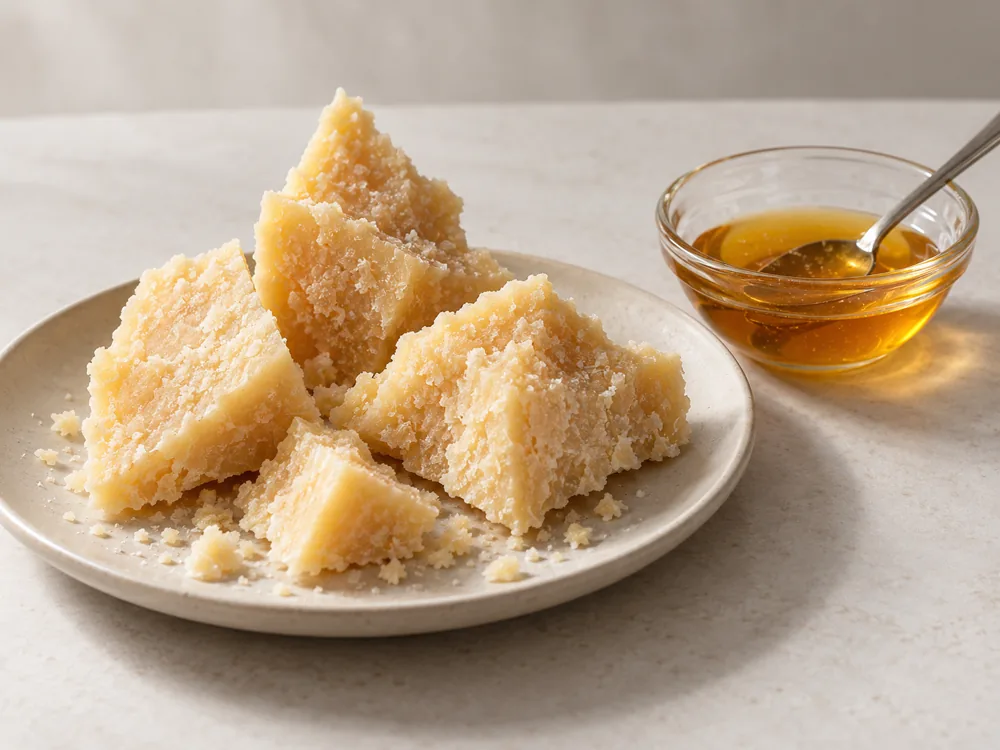
At 24 months the consortium turns to wildflower honey for its varied aromatic richness, and to citrus honey for a more defined, fragrant and slightly acidic note. Past 35 months it moves to a rich, varied mountain wildflower honey, or to a floral, citrusy orange blossom honey that makes a soft and unexpected contrast.
At 12 months, apricot or peach compote gives a smooth, sweet result, kiwi compote suits those who want less sugar and adds a refreshing acidic twist, and a slightly bitter but delicate mandarin marmalade is the third route.
At 24 months, the consortium calls pear jam the classic choice, with cherry or quince adding a tangier note.
Fig jam and bitter orange or lemon marmalade also suit that age, because their slight bitterness contrasts with the cheese's residual sweetness.
For cheese aged 35 to 45 months, savoury notes of meat broth, rind and spice lead. The consortium answers them with a sweet contrast such as chestnut jam.
Strawberry compote offers the other route, and the consortium says cheese of this age has the complexity to carry more structured partners: strawberry with black pepper, or pumpkin compote spiced with ginger.
Caseificio del Milanello adds a few drops of traditional balsamic vinegar to shavings of medium or mature cheese. For older wheels it prefers an onion or pumpkin mustard to jam.
The two named grades of balsamic differ: for cheese over 40 months the consortium names Traditional Balsamic Vinegar of Modena or Reggio Emilia PDO, while Wine and Travel Italy accepts aged Balsamic Vinegar of Modena IGP, whose tangy sweetness it sets against the cheese's salty, umami richness.
Which Fruit, Nuts, and Cured Meats Go with Parmesan?
Lynne Rossetto Kasper's The Splendid Table (1992) gives an uncooked antipasto from Reggio that puts Parmigiano Reggiano beside artisan-made balsamic vinegar and fresh pears.
She fans thin slivers of 3 ripe Anjou or Comice pears on salad plates, sets a knob from 3 to 4 ounces of cheese at the base, and moistens it with drops from 1 tablespoon of balsamic. Her wine is a Sauvignon Blanc from the Bolognese hills or from Friuli.
The recipe serves six, with 4 or 5 slivers on each plate and a little lemon juice over the pears so that they do not turn brown, and Kasper says it is best assembled and then eaten right away.
Her note allows a commercial balsamic in place of the artisan kind, blended at ¼ teaspoon of dark brown sugar to 1 tablespoon of vinegar.
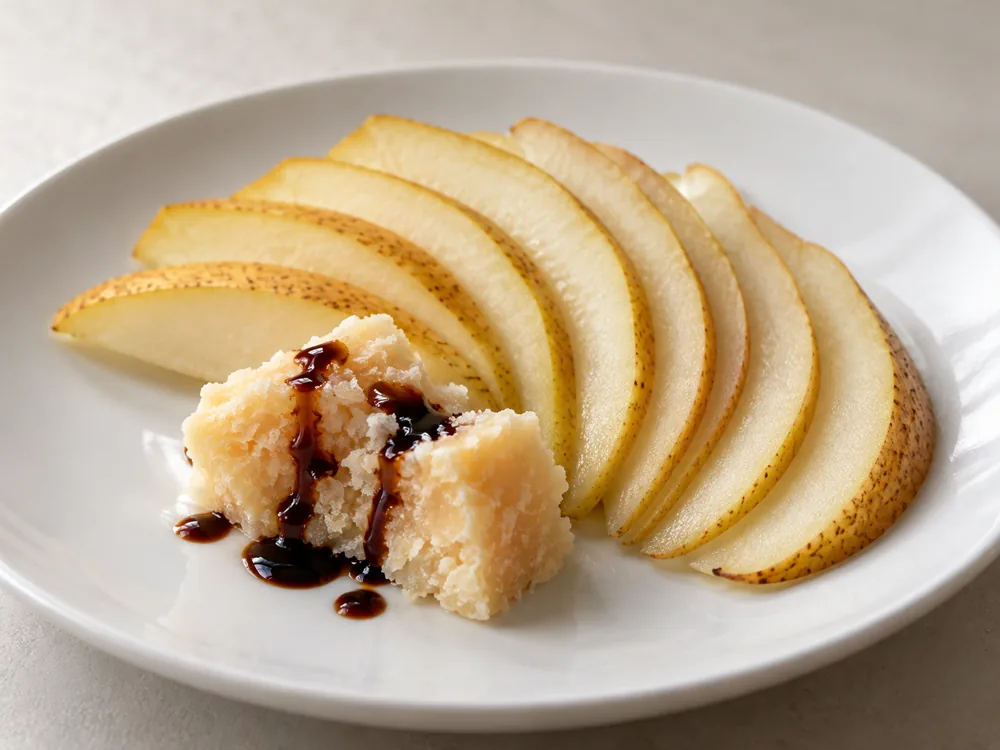
The Wine and Travel Italy site widens the fruit list to both fresh and dried fruit and gives each a job: fresh figs, pears and apples add juiciness, while dried apricots, dates and raisins answer the cheese's nutty notes with natural sweetness.
The same site pairs the cheese with acacia or chestnut honey plus walnuts or almonds, which add crunch, and suggests that trio for aperitifs or as a dessert alternative.
For aged cured meats it names Prosciutto di Parma and Mortadella di Bologna, and its reason is texture: the savoury, melt-in-your-mouth meat against the crumbly richness of the cheese.
Which Beer, Fortified Wine, or Grappa Pairs with Parmesan?
The consortium's beer pairings follow the same age steps, from pils with young cheese to barley wine at 60 months.
| Pairing | Why It Works |
|---|---|
| Pils, pale ale or saison | 12 months: the consortium says fresh, milky notes suit both bottom- and top-fermented beers. |
| Helles, bitter, bock or IPA | 24 months: savoury depth balanced between sweet and salty makes this age extremely versatile, per the consortium. |
| Doppelbock, tripel or strong Belgian ale | 35 to 45 months: rich beers for aromas of meat broth, cheese rind, melted butter and spice. |
| Imperial stout, quadrupel or barley wine | 60 months: the consortium calls for equally complex beers. |
| Marsala or Trentino grappa | 36 months: the consortium's 2019 serving note pairs this cheese with fruit, honey and a complex wine, a good Marsala or even a Trentino grappa. |
At 12 months the consortium suggests German Kellers Pils, Anglo pale ales and blonde ales, and Belgian blonde, which brings peach, tropical fruit, bread, cracker and acacia honey notes. For bolder tastes it offers stout or porter, whose roasted cocoa, prune and licorice notes it says enhance the tasting, and saison for a balance of acidity and hops.
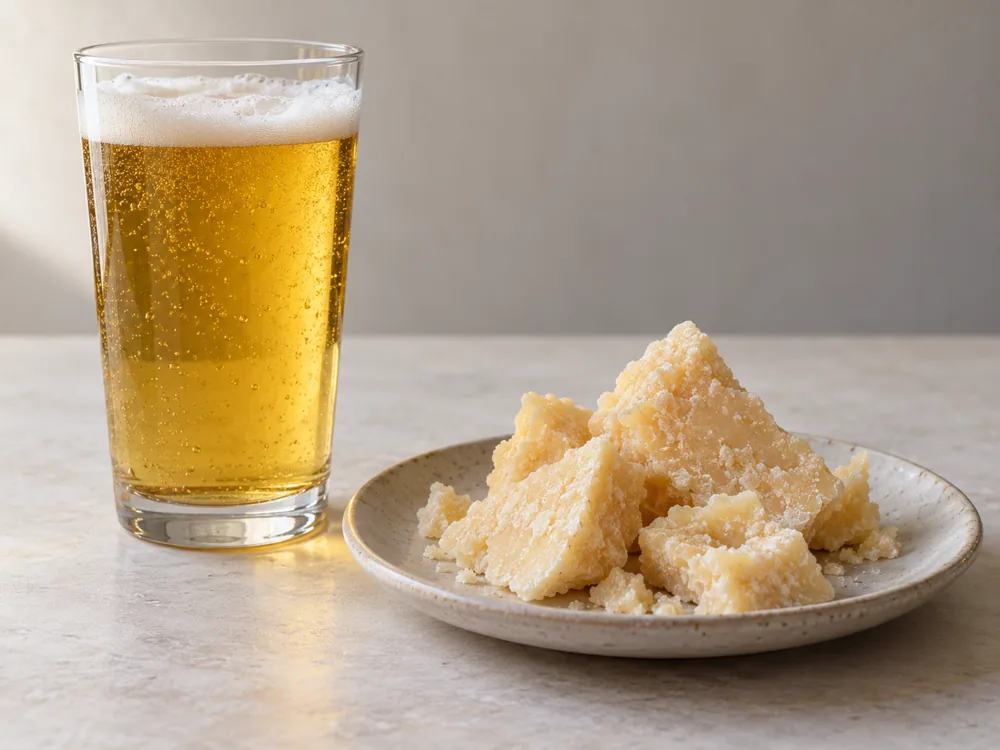
At 24 months the consortium names Belgian Dubbel for malt, biscuit and chocolate notes, Helles for wildflower honey tones, Blanche for bright acidity and British Bitter for earthy, herbal aromas. Hop-forward IPAs bring resinous, balsamic notes, and Belgian Blonde Ale enhances the cheese's vegetal hints.
From 35 months the beers get heavier: the consortium describes a strong Belgian ale at around 8.5% alcohol, whose lively carbonation cleanses the palate, a doppelbock with roasted depth, Rauchbier from Bamberg for smokiness, and fruity, acidic sour beers.
For 60-month cheese, the beer page describes a monument of flavour with dried fruit, spice, undergrowth like dried mushrooms and roasted nuances. It lists fruity tripels with candied citrus, oatmeal and coffee stouts, aged barley wines that echo the cheese's spice, and oud bruin with acidic, woody notes.
CIU Travel's beer list follows its own ages: wheat beer for 12-month cheese, IPAs at 24 months and Double IPA at 30 and 36 months.
The consortium's sensory guide adds fortified wines, beside full-bodied ones, for cheese aged more than 40 months, which it calls a special treat.
How Do Salads, Pasta, and Risotto Change the Parmesan Match?
The consortium's sensory guide ties each age to a use, and the use changes what sits beside the cheese.
- 12 to 18 months: salads and cold dishes.
- 22 to 24 months: all traditional Italian dishes.
- 30 to 36 months: filled and baked pasta, or an after-dinner tasting with fruit and honey.
- More than 40 months: a special treat to savour with a glass of wine.
For filled and baked pasta, the guide points to the crumbly 30- to 36-month cheese. It describes that age as bold and pronounced, with notes of spice, nuts and meat stock.
Caseificio del Milanello is more specific about pasta: it uses 24-month cheese in stuffed tortellini, cappelletti and tortelli with herbs, and in fresh tagliatelle with ragù or pappardelle with mushrooms, where it says the grated cheese binds the sauce.
For baked pasta such as lasagne or rosette it moves to a more mature cheese that adds depth and holds up against meat, béchamel and pasta sheets. Baked pasta goes to older cheese at both, but filled pasta splits them: 24 months at Milanello against 30 to 36 months in the guide.
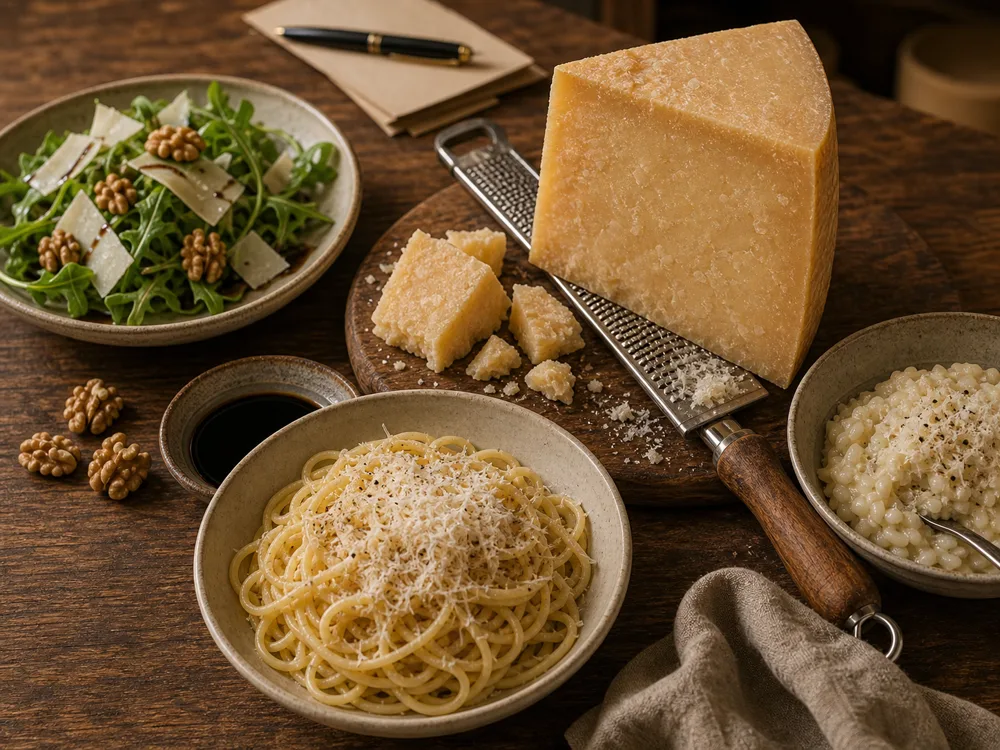
Salads split them too. The guide puts 12 to 18 months in salads and cold dishes, while Milanello keeps its 13-month cheese for creams, mousses and crostini and calls for medium-aged shavings on salads and carpaccio, where it says they add savouriness and aroma without masking the other ingredients.
For risotto, Milanello stresses the creaming and picks 36-month cheese when aromatic ingredients such as porcini or truffle are in the pan, because it adds depth without overpowering the seasoning.
In a 2019 consortium article, chef Luca Marchini, president of JRE Italia, described a risotto that had been on his menu until shortly before: baked leek and rocket with a cream of 24-month Parmigiano Reggiano, oysters and raw rhubarb.
The pre-dessert then served at his L'Erba del Re restaurant wrapped a 30-month cheese centre in a white chocolate shell. Black cherry jam and traditional balsamic vinegar of Modena went with it.
Which Dishes Beyond Pasta Take Parmesan?
The consortium's 2019 article calls it a myth that Parmigiano Reggiano only adds a touch of flavour to first courses, and says chefs also pair it with fruit and vegetables, meat, fish and dessert.
Marchini points out that some traditional Italian dishes already combine fish and cheese, such as stuffed calamari filled with parsley, garlic, ricotta, Parmigiano Reggiano and chopped squid.
For a creative version he imagines squid cooked on a kamado with a very thin crumble layer of Parmigiano Reggiano, flour, butter and liquorice, and he says every fish risotto could have the cheese stirred in.
Milanello ties the choice of age to how much the cheese should show: younger cheese complements a dish without overpowering it, while mature and extra-aged cheese takes centre stage.
Its 27-month cheese goes into pumpkin or leek veloutés for savoury notes without overwhelming the dish, and heartier soups such as lentil soup or pasta and beans take older cheese for structure and character. It adds that a cleaned rind can be simmered in broth for a deep umami flavour.
In second courses it uses medium-aged cheese in aubergine gratins and chicken rolls for flavour and texture, and a more mature cheese in shavings over steak or roasted meat, where it says the shavings give a distinctive but balanced contrast.
For desserts it makes savoury cheesecakes, light biscuits, mousses and even ice cream or sorbet from younger wheels, and it serves medium-aged cheese with honey or fruit compotes.
Mature and extra-aged cheese appears in shavings with dark chocolate and a drizzle of traditional balsamic vinegar, which Milanello describes as an elegant meeting of sweet and savoury.
What Clashes with Parmesan?
Rough tannin is the first clash: for 24-month cheese, the consortium wants any red wine to have smooth, well-integrated tannins.
White wine drops out after 40 months, when the cheese gains a touch of astringency.
At 60 months the cheese turns very dry and can taste bitter. The sweetness the consortium asks for is perceptible but moderate.
Beer can clash at 12 months: the consortium's beer page asks for one that neither overpowers the cheese nor is overpowered by it, and warns against beers that pull out metallic notes.
Honey can clash by flattening the cheese: the consortium wants a 24-month honey that sustains the cheese's balance without flattening it, and for cheese aged 35 months and over it asks for honeys with complex sweetness.
SOURCES & REFERENCES
It depends on the age, and Lambrusco is the one wine that five guides all name. The Parmigiano Reggiano consortium lists sparkling wines or light whites for 12-month cheese, balanced wines with smooth tannins at 24 months, full-bodied reds past 40 months and sweet wines such as Tawny Port at 60 months.
Yes. Culture magazine calls honey or Modena balsamic the most typical pairing, and the consortium starts with acacia honey for young cheese and moves to mountain wildflower or orange blossom honey at 35 to 45 months.
Pears come first: The Splendid Table serves pear slivers with Parmigiano Reggiano and balsamic vinegar, and the consortium calls pear jam the classic match for 24-month cheese. Figs, apples, dried apricots, dates and raisins appear on the Wine and Travel Italy list.
The consortium suggests pils, pale ale or saison for 12-month cheese, helles, bock or IPA at 24 months, and doppelbock or tripel for cheese aged 35 to 45 months.
The consortium steers away from rough tannin at 24 months and from white wine past 40 months, when it moves to structured, full-bodied reds.