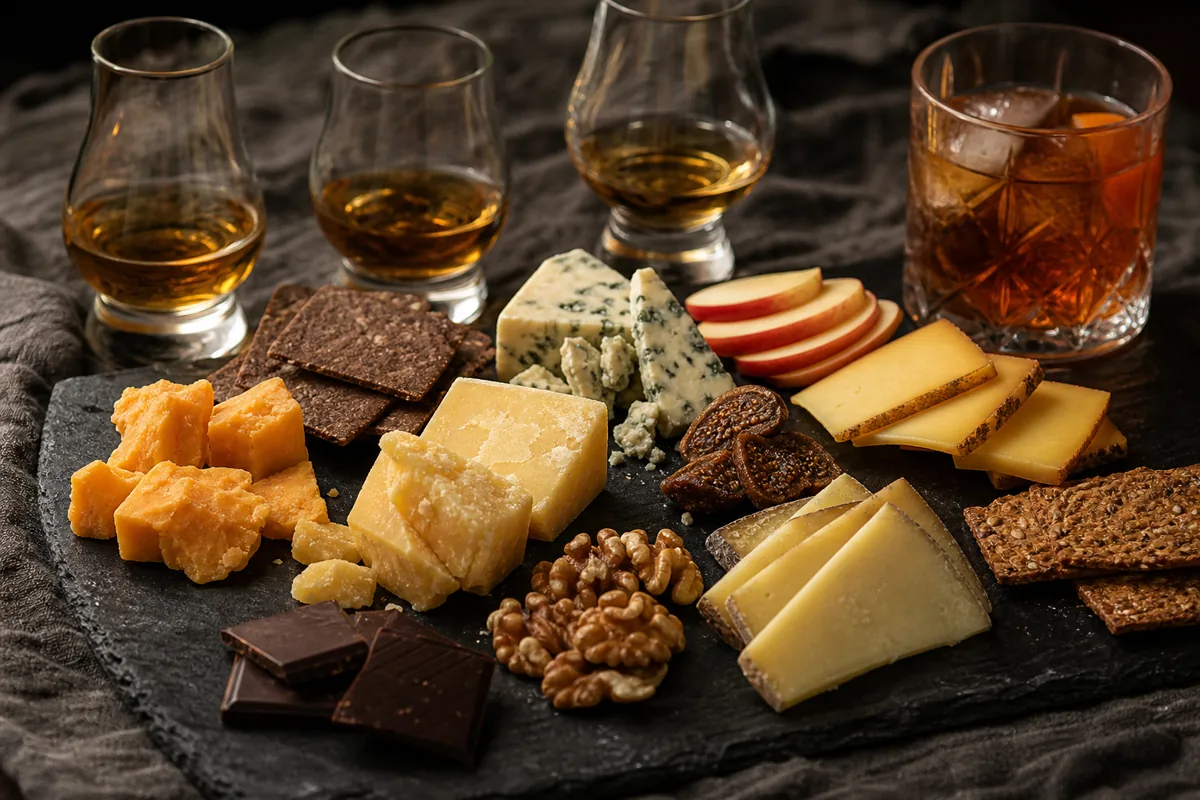
Start from the whiskey in your glass: in most pairing guides, bourbon and rye go with aged Gouda and cheddar and smoky Scotch with alpine-style, clothbound or blue cheese, while Saxelby pairs a clean Japanese single malt with a soft, creamy cheese.
Salt is where the advice splits. Saxelby Cheesemongers warns against intensely salty cheese with brown spirits, while Bourbon Women pairs blue cheese with higher-proof bourbon.
In This Article
What Cheese Goes with Whiskey?
Aged, nutty cheeses with some fat appear in most of the guides, and the table sorts them by whiskey style and by who recommends them.
| Whiskey style | Cheeses named | Who recommends it |
|---|---|---|
| Bourbon | Aged Gouda, sharp or clothbound cheddar, blue cheese, Brie or triple crème | Wisconsin Cheese, Bourbon Women, Chowhound, Whisky Advocate |
| Rye | Aged or bandaged cheddar, Gouda, Parmigiano-Reggiano, Roquefort | Wisconsin Cheese, Saxelby, Chowhound, Michael Veach |
| Smoky or peated Scotch | Alpine-style cheese, clothbound cheddar, blue cheese | Wisconsin Cheese, Saxelby, Whisky Advocate |
| Balanced Speyside malt | Mature cheddar, mature firm cheese | Whisky Advocate |
| Irish pot-still whiskey | Chèvre, Cashel Blue | Whisky Advocate |
| Japanese whisky | Camembert, Kunik or another soft, creamy cheese for clean single malts; Parmigiano Reggiano for Yamazaki 12 and Nikka 12 | Saxelby, Culture, Cheese Scientist |
Wisconsin Cheese, the consumer site of the Dairy Farmers of Wisconsin, reduces the exercise to one principle: match intensity. Its guide pairs aged cheddar with rye, Gouda with bourbon, and alpine-style cheese with Scotch.
Bourbon Women, in a guide by Sydney Ferrara, frames its pairings around flavor intensity, fat content, sweetness, salt, and spice.
Stephen Beaumont of Whisky Advocate adds an order of operations: start with geography, then match complementary characteristics. His reasoning is that a drink and a food that developed alongside each other tend to partner well.
Why Is Whiskey Harder to Pair Than Wine?
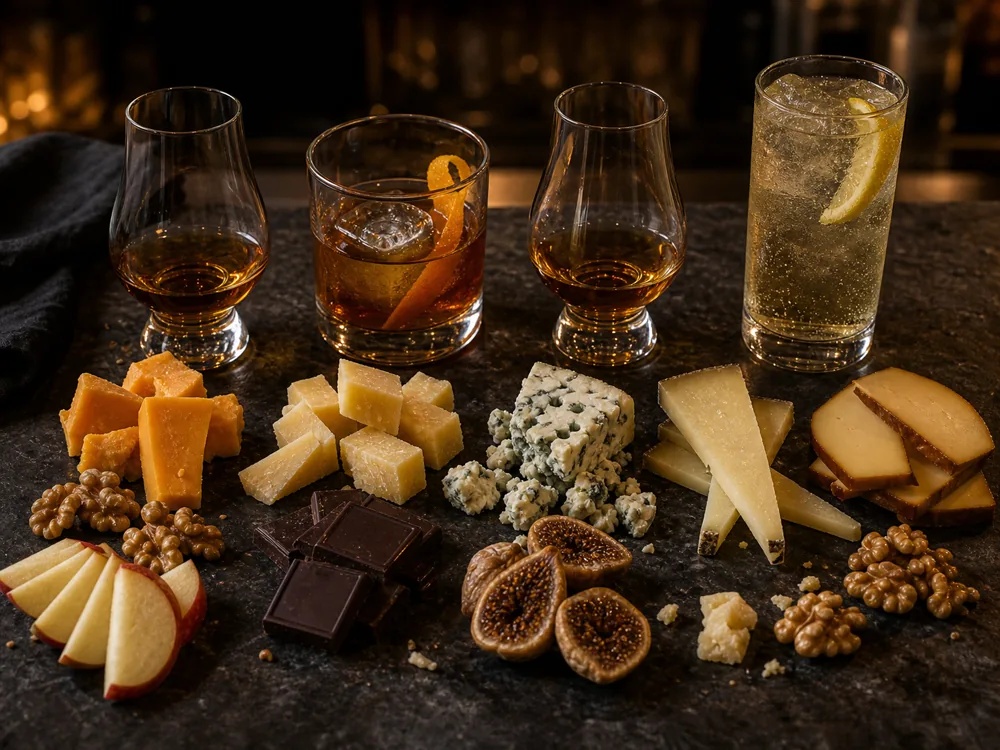
Whiskey runs at about 40 percent alcohol, against roughly 14 percent for wine. Cathryn Haight of Culture magazine says that strength can wash away the taste of more delicate wedges, and she calls proper whiskey pairings "less obvious and less abundant."
Wisconsin Cheese names fat as the counterweight: the fat in a nutty, smooth cheese such as Gouda or cheddar helps balance the burn of the ethanol.
Gordon Dundas of Ian Macleod Distillers, in Master of Malt's feature on Scotch and cheese, says stronger whiskies have a more robust mouthfeel, so hard cheeses are usually a good match.
Ivy Ronquillo, who owns Second Mouse Cheese Shop in Pleasantville, New York, ties the cheese to the whiskey's weight. In Culture she says that smoky or peaty whiskies need a cheese that is just as weighty.
She also says that pronounced vanilla, caramel, or peppery notes suit a wide range of cheeses, from earthy Brie to yeasty washed rinds to nutty alpine styles, while tropical-leaning drinks work with young goat cheeses.
Grain and barrel shape the match too. Beaumont writes that the high rye content of Canadian whiskies can suit tangy goat cheeses or aged Goudas, and that a sherry-casked malt can develop raisiny, nutty notes that suit dry, crumbly cheeses such as Grana Padano or Parmigiano Reggiano.
Ronquillo adds that whiskeys heavily flavored by repurposed barrels are tougher to pair.
What Cheese Goes with Bourbon?
Match the cheese to the kind of bourbon you pour. Bourbon Women's guide, published in January 2026, gives six matches, from sharp cheddar for a classic Kentucky straight bourbon to fresh goat cheese for a lower-proof one, each with a reason.
| Cheese | Bourbon style | Reason given |
|---|---|---|
| Sharp cheddar | Classic Kentucky straight bourbon | The cheese's tangy bite and crystalline texture meet caramel, vanilla, and oak sweetness. |
| Brie or triple crème | Wheated bourbon | Rich, buttery cheese suits the softer mouthfeel of a wheated bourbon. |
| Blue cheese (Stilton, Gorgonzola, Roquefort) | Higher-proof or barrel-strength bourbon | Salt and funk stand up to the proof, and the bourbon's sweetness reins in the cheese. |
| Gouda, aged 18+ months or smoked | Higher-rye bourbon | Nutty, caramelized flavors echo the oak, and rye spice adds balance. |
| Semi-aged or aged Manchego | Bourbon finished in wine, port, or sherry casks | A nutty, slightly sweet cheese suits dried-fruit, wine-influenced notes. |
| Fresh goat cheese | Lower-proof, easy-drinking bourbon | The cheese's tang and freshness contrast with the bourbon's sweetness. |
To tie each pair together on the board, Bourbon Women adds a bridge ingredient, such as honey or fig jam for blue cheese and apple slices or honey for cheddar.
For a soft cheese, the other bourbon matches are mostly bloomy rinds. Francesco Lafranconi of Carver Road Hospitality, quoted by Chowhound, recommends rich double and triple creams like Brie, and Beaumont pairs Brie de Meaux with Woodford Reserve Double Oaked.
Saxelby suggests a young, delicate bloomy-rind goat cheese such as Lake's Edge, or a creamy fresh chèvre, for bourbon.
For harder cheeses, Wisconsin Cheese calls bourbon, made mainly from corn and aged in barrels, a classic starting point for newcomers. It says bourbon needs a robust cheese and picks Edelweiss Creamery's Grazier Aged Gouda, because aging gives Gouda the extra weight.
Lafranconi also names clothbound cheddar, where the bourbon's sweetness meets the cheese's nutty, caramelized notes. Beaumont suggests a bold cheese such as Cowgirl Creamery's Red Hawk, a medium Manchego, or a young Raclette for a rich, full-bodied bourbon.
What Cheese Goes with Rye Whiskey?
Wisconsin Cheese describes rye as distilled from more than 51 percent rye grain, with a spicy or slightly fruity flavor. It pairs rye with aged or bandaged cheddar, which it says is rich enough to soak up the heat left from each sip.
Lafranconi prefers dense cheeses such as Parmigiano-Reggiano or Gouda, whose robust texture and flavor hold up against the rye's spiciness. Saxelby picks Jake's Gouda, a well-aged cheese with crunchy protein crystals and a Marcona almond sweetness that lets the rye shine.
Ronquillo's rye pick is a whiskey-washed Munster from Redhead Creamery, served on caramelized onion crackers with Michter's US-1 Single Barrel Straight Rye. She calls the cheese "ridiculously delicious and savory-sweet."
Michael Veach, a Kentucky Bourbon Hall of Fame historian, ran a direct tasting of rye with cheese. He and Rosemary Miller tasted three ryes, Michter's US 1, Old Overholt Bonded, and Kentucky Peerless Double Oak, against seven store-bought cheeses, one whiskey at a time.
Seaside Rugged Mature English Cheddar was their favorite with Michter's, with Roquefort a close second. With Old Overholt they both picked Roquefort, and with Peerless Veach preferred Emmi Le Gruyère while Miller preferred Roquefort.
Miller found the sixth cheese on Veach's list, Mitica Parmigiano Reggiano, too salty: it overwhelmed or dried out each of the three ryes, though Lafranconi names Parmigiano-Reggiano as a rye match.
Veach also found the Boar's Head Aged Gouda completely overpowered the Peerless, so the aged Gouda the guides recommend was not a clear win here. These results come from one tasting by two people with seven store-bought cheeses.
What Cheese Goes with Scotch and Irish Whiskey?
For a smoky or peated Scotch, Wisconsin Cheese pairs alpine-style cheese, a robust, hardy cheese whose nuttiness gently contrasts with the peatiness of smoky styles such as Islay Scotch.
Saxelby wants something firmer and headier with a bit of funk for peated Scotch, naming Cabot Clothbound Cheddar. Beaumont finds that peatier Island whiskies complement blues, with Stilton and a somewhat smoky island malt as one pair.
For a floral, honeyed Highland whisky, Saxelby suggests Winnimere, a smoked, meaty cheese that brings weight. Beaumont finds that Speyside malts favor mature, firm cheeses.
Beaumont pairs a proper Cheddar with a balanced Speyside, and Cheese Scientist describes matured cheddar as savory with a touch of sourness that contrasts with the long, fruity aftertaste of Dalmore 15 Year Old.
A creamy cheese changes the choice. Beaumont matches Brillat-Savarin with a rich, round Speyside that has little or no peat, even one finished in a port pipe.
Dundas pairs Glengoyne 12 Year Old, a bourbon-influenced whisky, with Brie because the cheese is light and creamy, tastes sweeter beside the whisky's vanilla and calms its zestiness.
For Brie de Meaux, Cheese Scientist says the subtleness of the soft cheese means a big, powerful whisky will not work. It suggests the fragrant Glenmorangie 18 Year Old, a Scotch with honey, dates, fresh figs and a long, sweet, nutty finish.
At cask strength, Dundas pairs aged Parmigiano-Reggiano with the 59.2 percent cask-strength Glengoyne. He says a harder, flavoursome cheese cuts through high strength, its crystals contrast with the whisky's fruit, and the flavors still balance into a long combined finish.
Beaumont adds that salty Taleggio suits the briny character that sometimes develops in a coastal whisky.
Beaumont says pot-stilled Irish whiskey and Cashel Blue seem made for each other, and that the lightness and depth of a whiskey with a high proportion of pot-still spirit makes sense with goat's milk cheese.
What Cheese Goes with Japanese Whisky?
For a clean Japanese single malt, Saxelby recommends a soft, creamy cheese such as Nancy's Camembert or Kunik. It describes many Japanese single malts as clean and harmonized, and The Whisky Club, an Australian whisky retailer, describes Japanese whisky as balanced, with light, fruity, floral and complex oak notes.
Ronquillo goes the other way and pairs a 10-year sherry-cask Japanese whisky with a Gran Reserva Manchego, where the sharp cheese breaks up the light, sweet spirit.
For a named bottle, Culture matches four Japanese whiskies with named cheeses, and Cheese Scientist pairs Nikka 12 Year Old with Parmigiano Reggiano.
| Whisky | Cheese | Paired by | Reason given |
|---|---|---|---|
| Mars Shinshu Iwai Tradition (honey, woodsiness, baking spices) | Cypress Grove Midnight Moon, an aged goat's-milk cheese in the Gouda style | Culture magazine | Plays up the brown butter notes. |
| Kikori, a rice-based whiskey (vanilla, floral aromas) | Vermont Shepherd Verano, a sheep's-milk wheel | Culture magazine | Nutty notes meet the floral aromas, and the sheepy notes melt into a toasty umami harmony. |
| Suntory Yamazaki 12 Year Old (honeyed, dried-fruit notes) | Parmigiano Reggiano PDO Solo di Bruna | Culture magazine | The cheese is the caramel-corn version of Parmigiano Reggiano, and it meets the honeyed, dried-fruit notes. |
| Nikka Coffey Grain Whisky (vanilla, tropical fruit) | Cascadia Creamery Sawtooth | Culture magazine | The cheese's meaty, smoky notes are smoothed out by the whisky's rich vibrancy. |
| Nikka 12 Year Old (dark chocolate, fruitcake) | Parmigiano Reggiano | Cheese Scientist | The whisky's flavors augment the cheese's fruity and nutty qualities. |
Culture describes Nikka Coffey Grain as Japanese whisky with a bourbon-like profile of vanilla, tropical fruit and savory, boozy dessert. It says Kikori is made from 100 percent locally grown rice and is not Scotch-style.
What Whiskey Goes with the Cheese You Already Have?
If the cheese is already on your board, work backwards from it. In his 2022 Whisky Advocate guide, Beaumont tasted one cheese from each of six families and named a bottle for each.
| Cheese family | Cheese tasted | Whisky | Reason given |
|---|---|---|---|
| Goat or sheep | Chabichou du Poitou | Redbreast 12 Year Old | The dryness of the weeks-old chèvre draws forward the whiskey's sweetness. |
| Semi-firm | Young Gouda | Macallan 12 Double Cask | Sherry accents play against the nutty cheese, and the Gouda's richness draws out fruit and vanilla. |
| Washed rind | Chaumes | Crown Royal XO | Big aromas with mild flavors need a spirit of subtle complexity and soft bouquet. |
| Bloomy rind | Brie de Meaux | Woodford Reserve Double Oaked | Brie and Camembert often carry saltiness and acidity from the rind, which calls for a bolder, sweeter partner. |
| Hard or aged | 3-year-old Cheddar | Glenlivet 12 Year Old | The whisky underscores the cheddar's creaminess, and the cheese heightens the malt's nutty, fruity flavors. |
| Blue | Colston Bassett Stilton | Talisker 10 Year Old | A Scottish partner that matches the Stilton in strength and assertiveness. |
Sherry and other wine casks come up with Gouda and Manchego in three guides. Beaumont's Macallan 12 Double Cask meets young Gouda, Ronquillo's sherry-cask Hakata meets Gran Reserva Manchego, and Bourbon Women pairs bourbon finished in wine, port, or sherry casks with semi-aged or aged Manchego.
For a smoked cheese, cheese writer Patrick McGuigan and whisky journalist Becky Paskin, in an Academy of Cheese video, pair smoked cheeses with sherry-cask whiskies such as Benromach 15 Year Old.
Should Cheese for Whiskey Be Salty or Mild?
It depends on what the salt meets: the guides that accept a salty cheese set it against a sweet or high-proof pour, in a higher-proof bourbon, an Old Fashioned, a honeyed Scotch or a sweeter whisky.
| What the salty cheese meets | Cheese | Verdict and holder |
|---|---|---|
| Brown spirits in general | Intensely salty or acidic cheeses | Avoid: they taste harsh beside high-ABV drinks (Saxelby Cheesemongers, which suggests a young, creamy cheese for bourbon) |
| Higher-proof or barrel-strength bourbon | Blue cheese: Stilton, Gorgonzola, Roquefort | Pair: salt and funk stand up to the proof (Bourbon Women) |
| Old Fashioned | Aged cheddar, Gouda, blue cheese, alpine-style cheese | Pair: the cocktail's sweetness balances the saltiness of mature cheese (Cheese.com) |
| A bolder, sweeter whisky such as Woodford Reserve Double Oaked | Brie de Meaux, with saltiness from the bloomy rind | Pair (Whisky Advocate) |
| Honeyed Scotch: Aberfeldy 12 Year Old | Hebridean Blue, sharp and salty | Pair (Matthew Cordiner, in Master of Malt's feature) |
| Michter's, Old Overholt and Peerless ryes | Roquefort | Both tasters ranked the blue cheese first or second with all three ryes (Veach and Miller tasting) |
| Michter's, Old Overholt and Peerless ryes | Mitica Parmigiano Reggiano | Miller found the salt overwhelmed or dried out each rye, while Veach noted fruit, spice, or oak notes (Veach and Miller tasting) |
Which Cheeses Don't Work with Whiskey?
Lafranconi says to avoid Époisses de Bourgogne and other very strong, pungent cheeses with whiskey, because they can overpower the rest of the board.
Beaumont adds that uniting bourbon with made-for-melting American cheese is not going to do anyone any favors.
Goat and sheep cheese depends on the bottle. Beaumont says these cheeses tend to be more delicate than cow's milk cheeses, so weighty bourbons and straight ryes should generally be avoided with them, and he points to Irish pot-still whiskey instead.
Saxelby and Bourbon Women do put goat cheese with bourbon, but with conditions: Saxelby wants the cheese young and delicate, and Bourbon Women specifies a lower-proof, easy-drinking bourbon.
Beaumont adds that when the wrong whisky meets the right cheese, no amount of changing the glass, water, or ice will rescue it.
How Do Temperature, Water, and Ice Change the Match?
Beaumont argues that because whisky's aromatics are both intense and key to appreciating it, how they are delivered can make or break a pairing. He lists temperature, dilution, and the shape of the glass as the levers.
With blue and aged hard cheeses he suggests softening the whisky's aroma to avoid strength battling strength. A glass wider than a chimney-like Glencairn or a sherry copita does this, as does watering the whisky slightly so it becomes less densely aromatic and more perfumey.
Beaumont says ice helps with soft cheese. A triple cream Camembert or Brie can have a bold, stinky character but a very soft, creamy texture, so the stinky character clashes with a room-temperature, full-strength whisky and the soft texture gets battered by it, until chill and dilution mute the spirit.
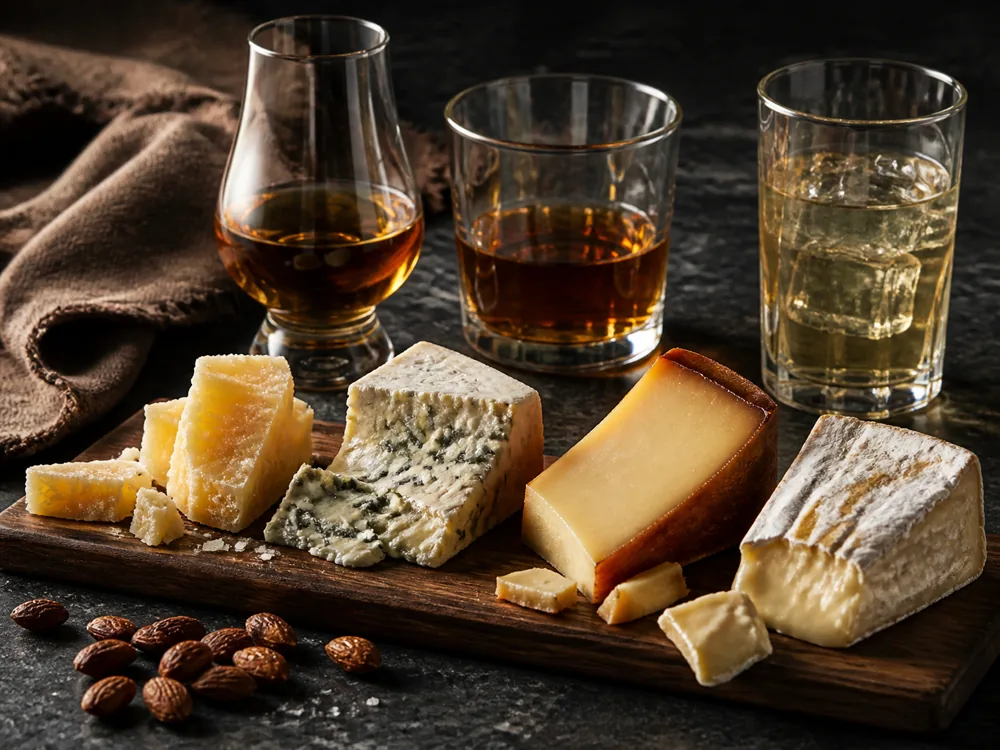
For the cheese, Saxelby says to let it come to room temperature so the butterfat softens and the aromatics are easier to detect, and Cheese.com says coldness can hide a cheese's subtle notes.
The CDC says to never leave perishable food out for more than 2 hours (or 1 hour if exposed to temperatures above 90°F), and it lists dairy among the perishable foods. That limit, 2 hours or 1 hour if exposed to temperatures above 90°F, applies to a cheese board warming toward room temperature.
What Cheese Goes with a Whiskey Cocktail?
For an Old Fashioned, a Manhattan or a Whiskey Sour, the matches below come from Cheese.com's cocktail guide, published in November 2024 and labeled a sponsored article, which builds its examples on bourbon or unspecified whiskey.
- Old Fashioned (bourbon, sugar, bitters): aged cheddar, Gouda, blue cheese, or alpine-style cheese. The guide says a quality bourbon such as Woodford Reserve gives honey and dried-fruit notes that suit the texture and nuttiness of hard cheeses, and the sweetness balances the salt of mature cheese.
- Manhattan (bourbon, sweet vermouth, bitters): Gouda, Parmigiano Reggiano, or the softer Harbison, whose warm spices meet the cocktail's caramel notes.
- Whiskey Sour (whiskey, lemon juice, simple syrup, Angostura bitters, and often egg white): Lincolnshire Poacher, a cheddar-style cheese, or Gruyère, an alpine-style cheese, because the citrus and silky texture cut through rich, creamy textures.
Haight adds that the cinnamon-spice notes of a rye such as Michter's US-1 might also suit a Manhattan.
How Do You Set Up a Whiskey and Cheese Tasting?
Run the tasting from light to complex, as Cheese.com orders it: start with lighter combinations, such as a Whiskey Sour with young or soft cheeses, then move on to an Old Fashioned with aged cheeses.
For a host with one bottle, Beaumont says balanced Scottish single malts, not too peaty or rich, seem to pair best with a wide variety of cheeses, as on a typical cheese board.
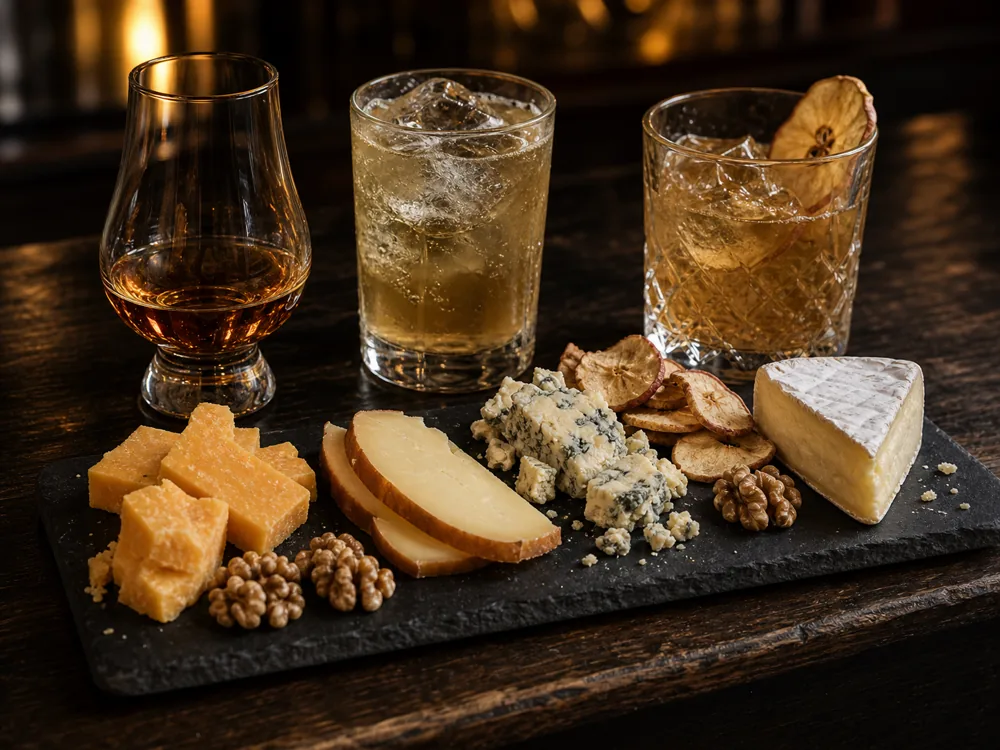
Saxelby adds that the rind is worth tasting and smelling, but nobody needs to feel compelled to eat all of it.