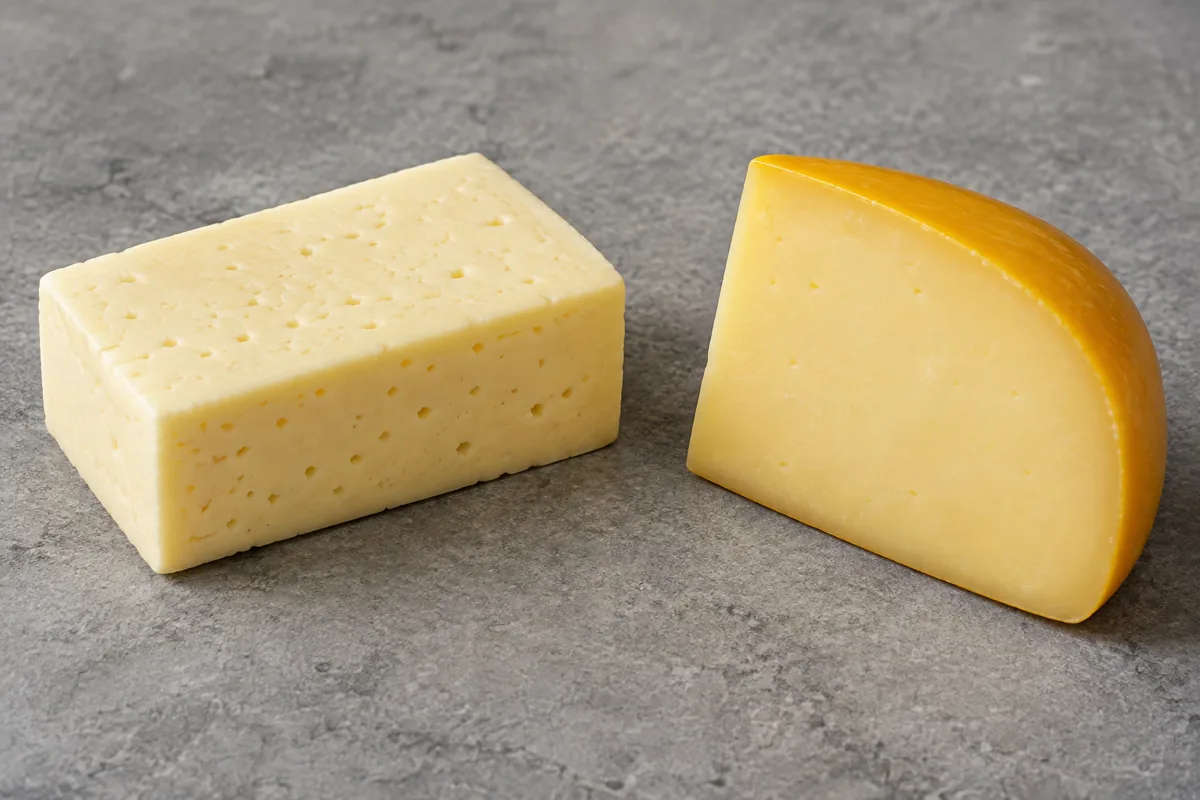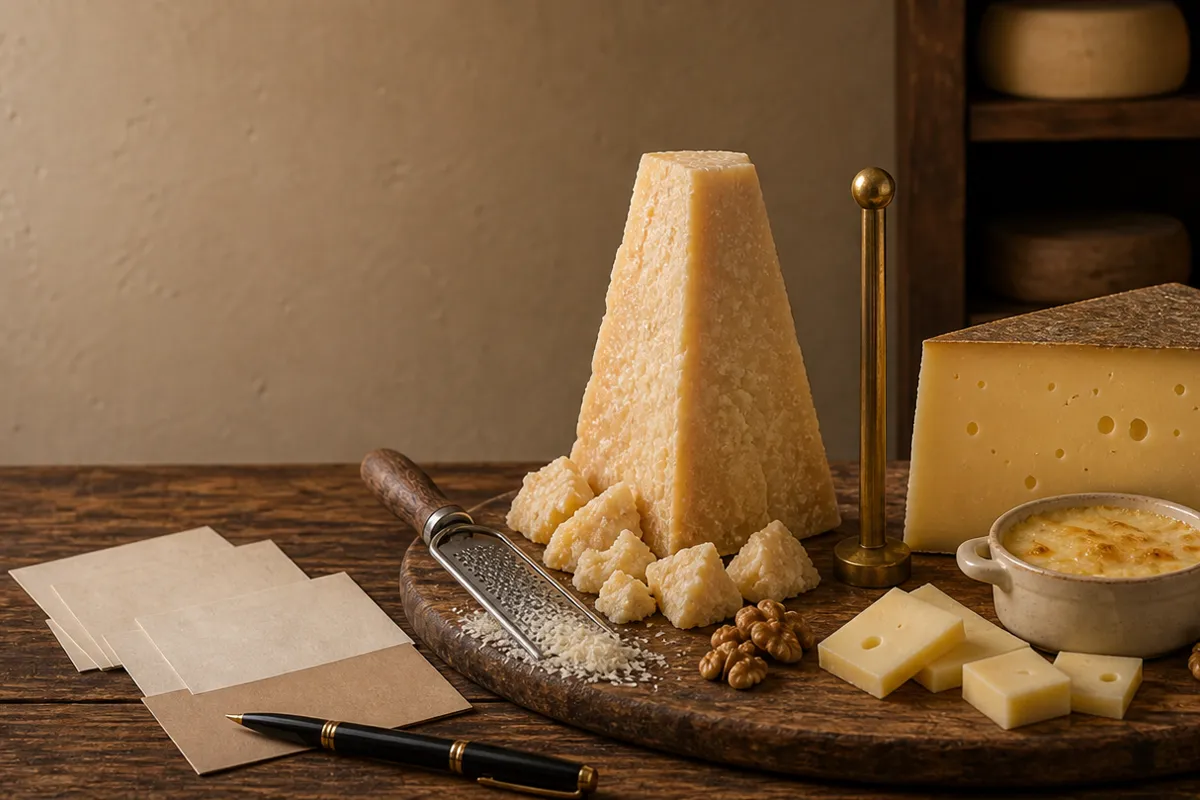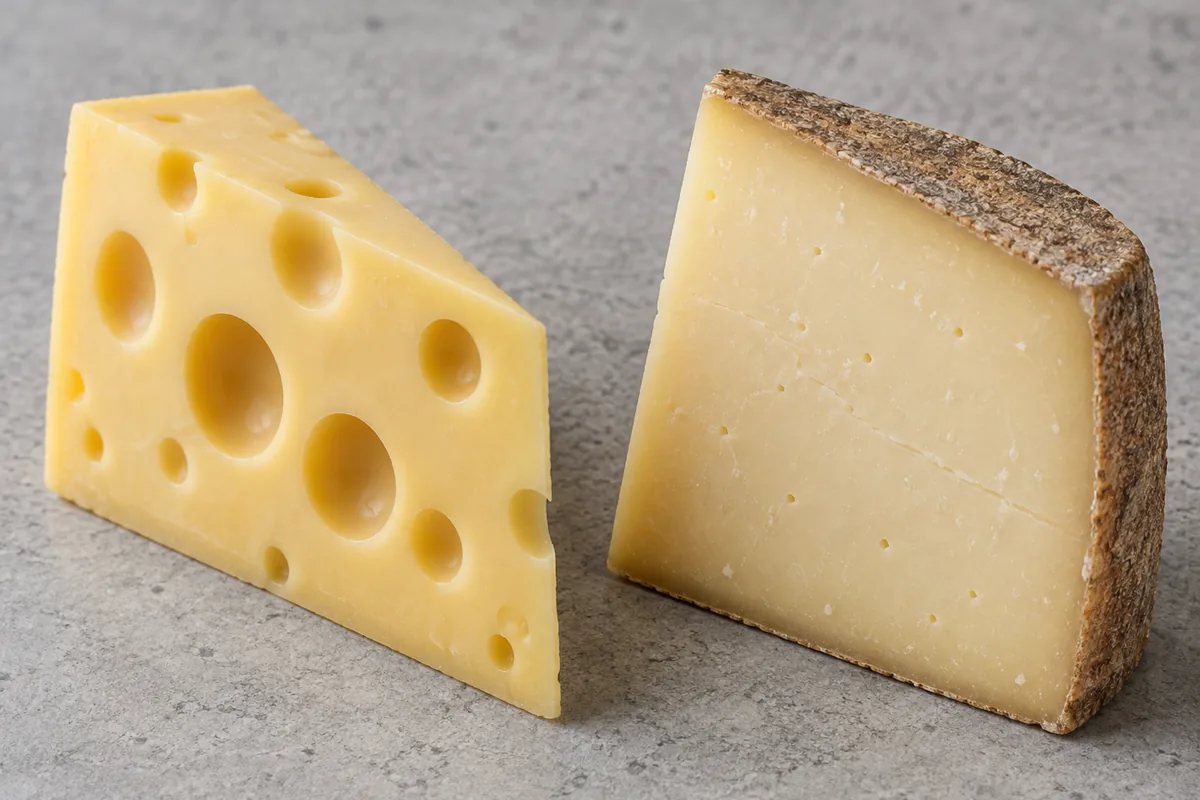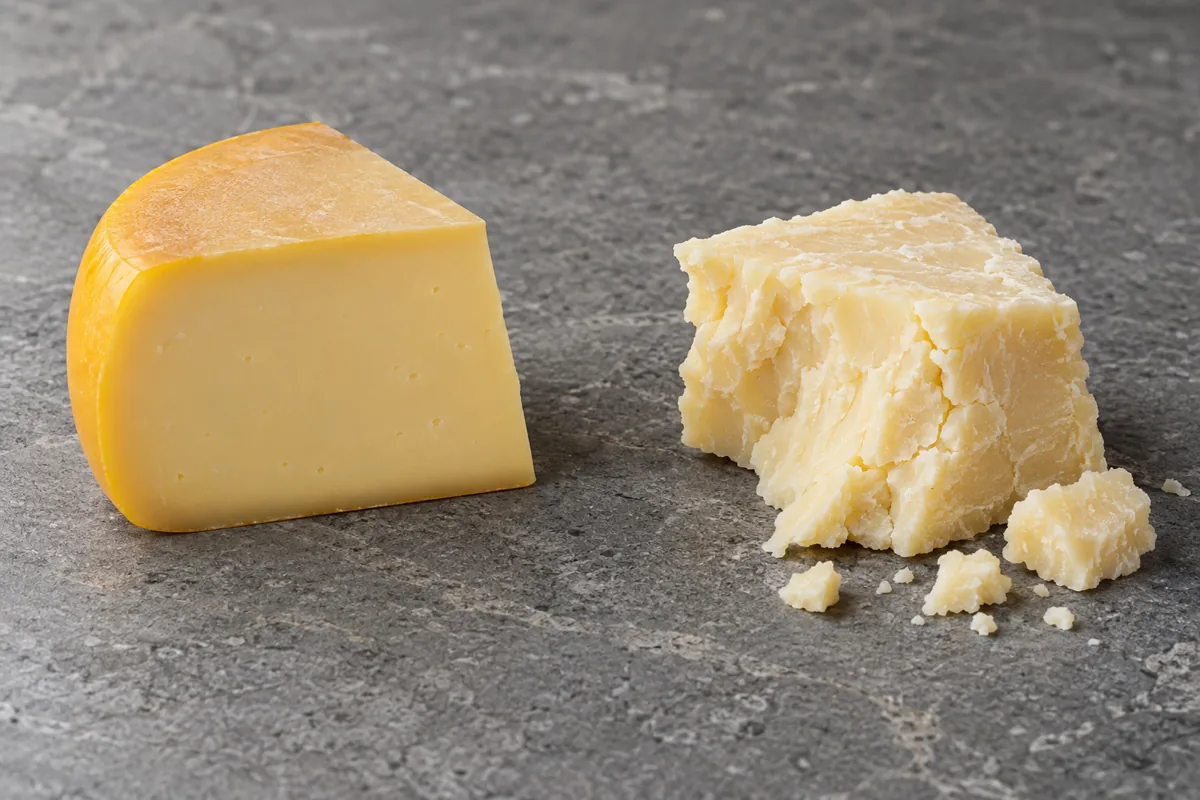
The split between Dutch Gouda and English Cheddar starts in the cheese vat, where one curd is washed with water and the other is stacked and turned, and it grows as both cheeses age.
In This Article
What Is the Difference Between Gouda and Cheddar?
Both are cow's milk cheeses named after places: Gouda after the city of Gouda in South Holland, and the cheese called Cheddar after the village of Cheddar in Somerset, England.
Gouda is also made from goat's or sheep's milk, and Cheddar has goat's and sheep's milk variations too.
Gouda is a family of cheeses that runs from young and elastic to old and hard, and from low-fat to high-fat, so the name alone does not tell you which end of that range a wedge comes from.
| Attribute | Gouda | Cheddar |
|---|---|---|
| Curd step | Washed curd: some whey drained and water added (Wikipedia) | Cheddaring: curd cut, stacked and turned (Wikipedia) |
| Young texture | Soft (European Commission) | Smooth and slightly elastic (Cheese.com) |
| Aged texture | Hard, with tiny protein crystals (Cheese.com) | Crumbly, with calcium lactate crystals, often after more than six months (Wikipedia, Cheese.com) |
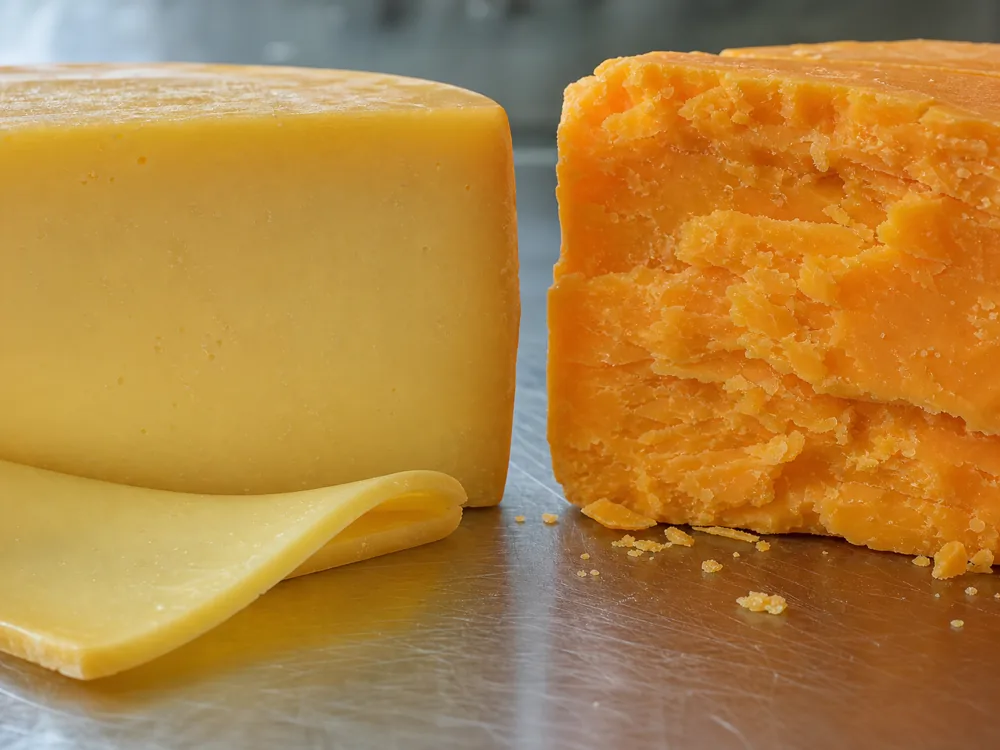
| Natural colour | Pale yellow inside (Cheese.com) | Off-white to pale yellow, and orange only when a colouring such as annatto is added (Wikipedia) |
Why Is Some Cheddar Orange and Some White?
The orange comes from a colouring, not from age. The commonly used one is annatto, extracted from the seeds of the tropical achiote tree, and it was originally added to imitate the colour of high-quality milk from grass-fed Jersey and Guernsey cows.
Beet juice is another plant extract used for the colour, and Kraft, which Wikipedia calls the largest US producer of Cheddar, uses annatto together with oleoresin paprika. Cheese.com calls traditional Cheddar white and says many consumers associate the vibrant orange colour with it.
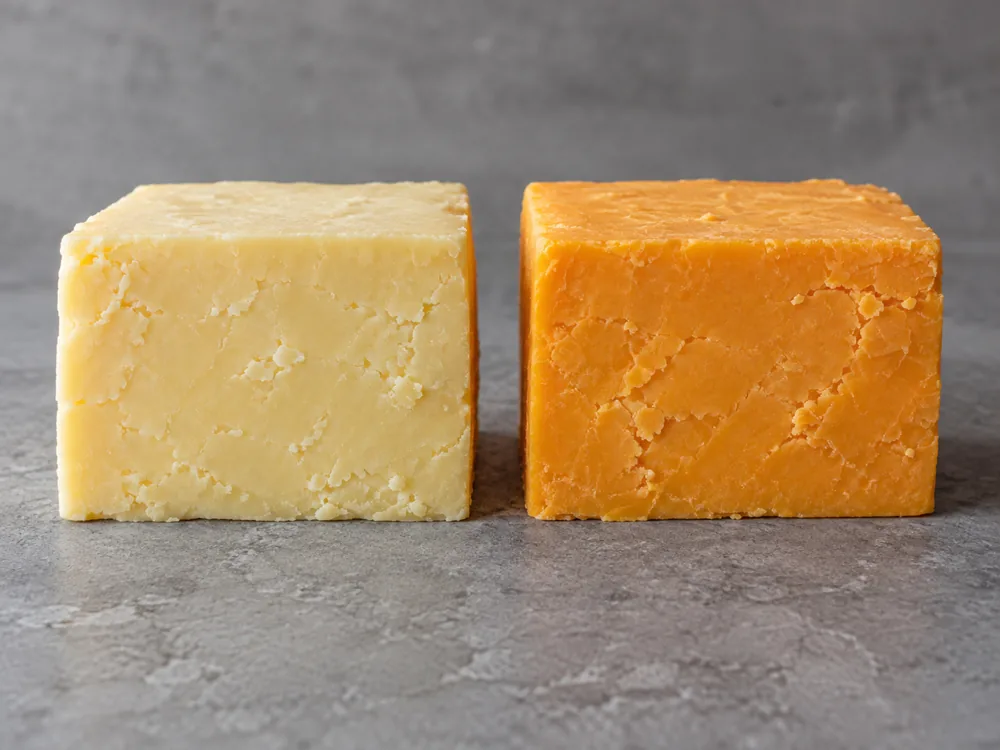
An orange Cheddar is not older or sharper than a pale one, because the orange comes from an added colouring such as annatto. On taste, Cheese.com says the colour does not affect it, while Wikipedia says annatto may add a sweet, nutty flavour.
In the United States, Cheddar without annatto is often labelled white Cheddar or Vermont Cheddar, whether or not it was made in Vermont. On a US label those words point to the absence of colouring, not to a place.
Why Does Gouda Taste Sweeter and Cheddar Sharper?
Gouda's sweeter taste starts with water. After the curd forms, Gouda makers drain some of the whey and add water, which carries away lactose, so the bacteria make less lactic acid.
As it ages, Gouda develops what Wikipedia calls a caramel sweetness with brothy, malty or nutty undertones, and Cheese.com describes its flavour growing more intense and complex.
The sweetness has limits. In Wikipedia's description, Gouda's flavour runs from mild and creamy to harsh and acidic with age, with a finish from silky to sharp, and cheese writers have called a Gouda aged past two years almost butterscotch in flavour.
Cheddar takes a different route. Its curd is heated, kneaded with salt, cut into cubes to drain the whey, and then stacked and turned, the extra step called cheddaring.
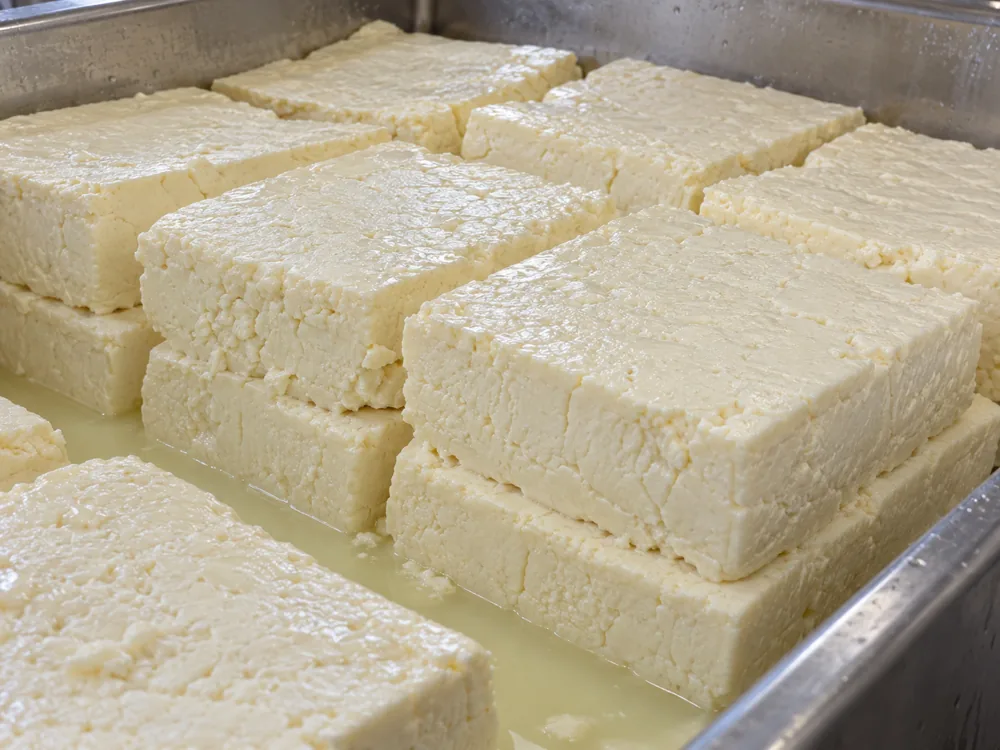
Cheddar's sharpness is linked to the level of bitter peptides in the cheese, and Cheese.com describes its taste moving from mild and creamy to sharp and tangy with age.
As Cheddar ages, enzymes break its proteins and fats into new compounds, which gives aged Cheddar its sharper taste and turns it from smooth to crumbly.
Sharp does not always mean hard. Wikipedia describes New York-style Cheddar in the United States as particularly sharp and acidic, though it tends to be somewhat softer than the milder varieties.
Even the original cheese points two ways. In 1864 the dairyman Joseph Harding described the ideal Somerset Cheddar as firm yet mellow, with a flavour approaching hazelnut, while Wikipedia describes Cheddar made in the classical way as tending to be sharp, pungent and often slightly earthy.
How Are Gouda and Cheddar Salted and Wrapped?
Salt enters the two cheeses at different points. Cheddar takes its salt in the curd during cheddaring, while Gouda curds are pressed into round moulds for several hours and the cheese is then soaked in brine, which gives the cheese and its rind a distinctive taste.
After a few days of drying, the cheese is given a yellow wax or plastic-like coating to stop it drying out. The two protected Dutch Goudas mature in the open air, turned and checked regularly, as a dry rind forms.
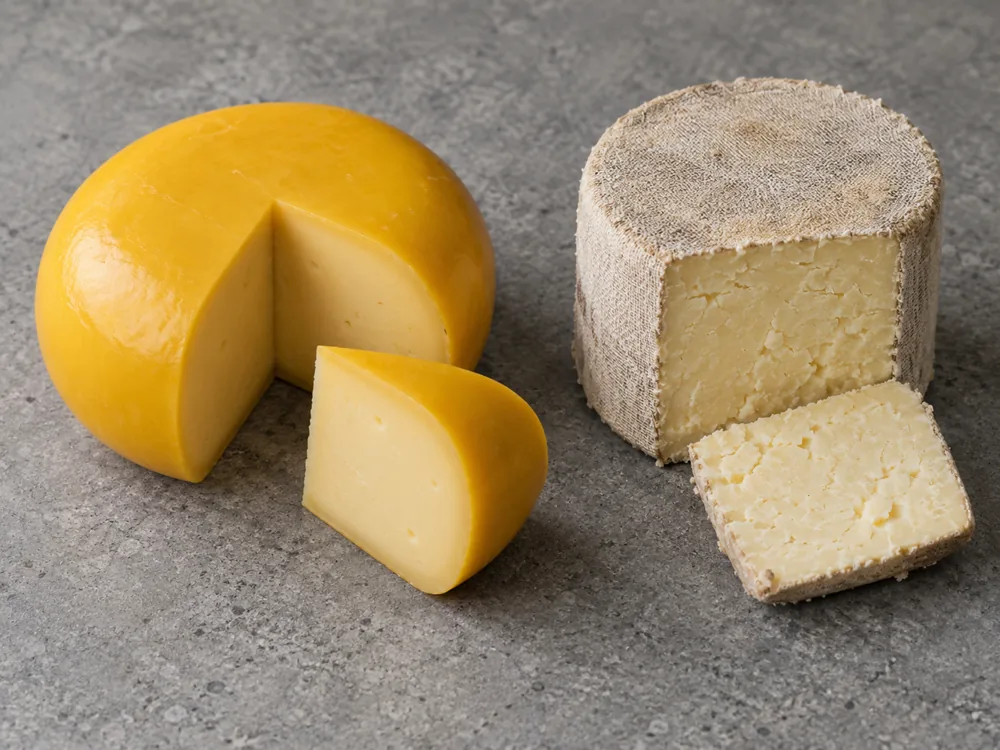
Cheddar was more commonly packaged in larded cloth, which kept contaminants out while still letting the cheese breathe, and it can still sometimes be found sealed in black wax.
How Does Age Change Gouda and Cheddar?
Gouda comes with a fixed age ladder and Cheddar mostly does not. Dutch cheesemakers use six age classes, from 4 weeks for young Gouda to 12 to 21 months for very old.
| Class | Age |
|---|---|
| Young | 4 weeks |
| Young matured | 8 to 10 weeks |
| Matured | 16 to 18 weeks |
| Extra matured | 7 to 9 months |
| Old | 10 to 12 months |
| Very old | 12 to 21 months |
The protected Dutch Goudas can take more than a year to mature fully, turning firmer and a deeper golden colour on the way, and older Goudas take on a slight crunchiness from crystals.
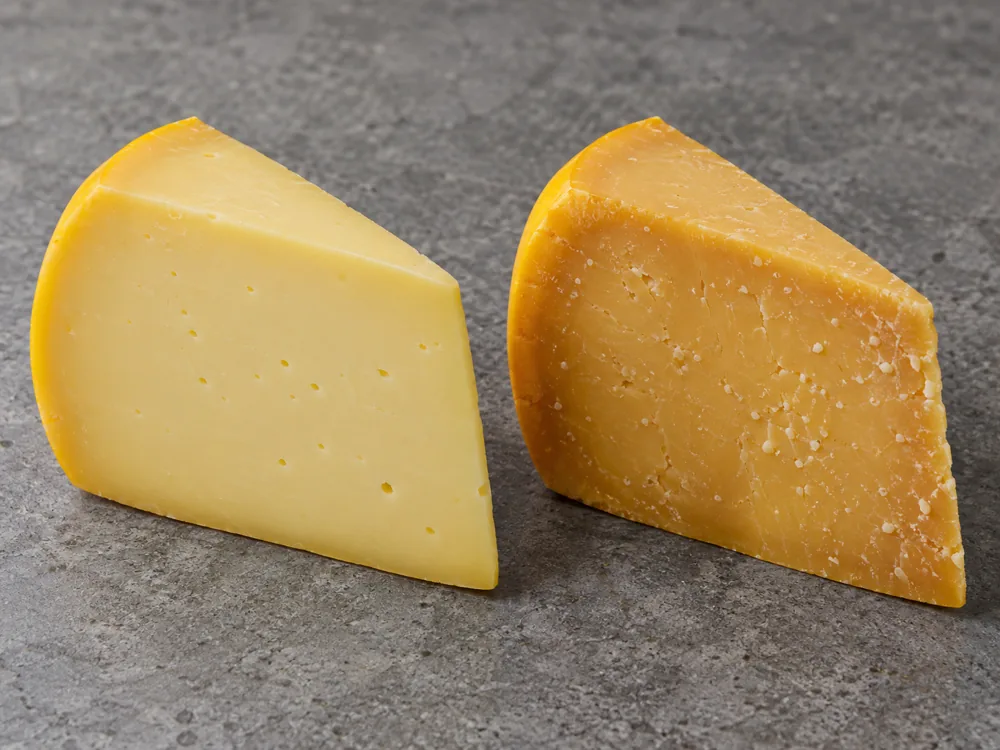
Longer ages turn up outside the ladder. Wikipedia's summary boxes list 1 to 36 months for Gouda, past the ladder's 21 months, and 3 to 24 months for Cheddar.
In the United Kingdom, Cheddar is usually sold as mild, medium, mature, extra mature or vintage, and strong, extra-mature Cheddar, sometimes called vintage, needs 15 months or more. Sharp Cheddar is usually aged over a year, and mild Cheddar is younger.
The words change with the country. In the United States they run mild, medium, sharp, extra sharp, New York style, white and Vermont, and Australians buy Cheddar by strength alone, as mild, tasty or sharp.
Cheddar needs a steady setting to age. It is kept at a constant temperature, often in special facilities, and some is still matured in the caves at Wookey Hole and Cheddar Gorge, which Wikipedia calls an ideal environment for maturing cheese.
Gouda also comes as smoked Gouda with its smoky flavour and as flavoured Goudas, alongside the young and extra-aged cheeses.
A Dutch Gouda class names an age range, while a Cheddar word such as mature or sharp shifts with the country, so months printed on the pack are the clearest guide to a Cheddar's age.
Which One Melts Better, Gouda or Cheddar?
Young Gouda and mild Cheddar both belong among the good melting cheeses, and the aged versions of both melt less well. Young Gouda is suitable for melting, while aged Gouda is drier, has a more rigid protein structure and often turns grainy or oily when heated.
Cheddar splits the same way: a mild one melts into a creamy sauce, while an aged one tends to hold its shape or turn a bit oily under high heat.
Age changes the melt through moisture and protein. As cheese ages it loses water and turns denser and firmer, and its proteins, which first break into smaller fragments, later form tighter bonds that leave the structure less flexible when heated.
Young cheeses such as young Gouda and mild Cheddar combine high moisture with little protein cross-linking, which lets them melt smoothly and stretch.
Wisconsin Cheese generally counts a cheese aged six months or more as aged, a line that on the Dutch ladder falls between matured at 16 to 18 weeks and extra matured at 7 to 9 months.
Moisture is the gap you can measure. USDA's standard records give Gouda 41.5 g of water per 100 g against 36.8 g for Cheddar, and Gouda's moisture ranges from 25 to 46%, so a drier aged wedge holds less water than the record shows.
For an aged wedge of either, Wisconsin Cheese suggests grating it finely and mixing it with milk or cream in a sauce.
It also says that blending an aged cheese with a younger, high-moisture one improves the melt, with Gouda mixed with buttery fontina among its examples, and that a little acid such as white wine or lemon juice helps the cheese emulsify so it separates less.
Can You Use Gouda Instead of Cheddar?
Their uses overlap on a cheeseburger and in a melted sandwich, where Cheese.com names both uses for Gouda and for Cheddar.
The flavour is where they part: Cheese.com calls Gouda mild, sweet and nutty and Cheddar mild to sharp and tangy.
| Use | How It Works |
|---|---|
| Melted on sandwiches | Named by Cheese.com for both Gouda and Cheddar. |
| Burgers | Named by Cheese.com for both, with young Gouda as the Gouda that suits melting. |
| Soups and casseroles | Named by Cheese.com for Cheddar. |
| Grating | Aged Gouda, which Cheese.com calls excellent for grating. |
Matched by age, they share more jobs. Wisconsin Cheese names an extra-aged Cheddar and an aged Gouda, Marieke Overjarige, together as cheeses with concentrated, sharp flavours that suit grating or sprinkling, while it ties creamy melts to young cheeses.
For cooked dishes, Cheese.com says Cheddar melts well in macaroni and cheese and grilled cheese sandwiches.
For pairings, Cheese.com matches Gouda with wines and crackers, and Cheddar with fruit, crackers and wine, adding that Cheddar's sharp flavour pairs well with fruits, nuts and cured meats on a board.
In the Netherlands, cubes of Gouda are a common snack with Dutch mustard or with beer in Bruin cafés, and older Gouda is sometimes topped with sugar or apple butter.
Is Gouda or Cheddar Healthier?
In USDA's standard records, Gouda has fewer calories and less fat, and Cheddar has less sodium.
| Nutrient | Gouda | Cheddar |
|---|---|---|
| Energy | 356 kcal | 403 kcal |
| Fat | 27.4 g | 33.3 g |
| Protein | 24.9 g | 22.9 g |
| Sodium | 819 mg | 653 mg |
| Calcium | 700 mg | 710 mg |
| Carbohydrate | 2.22 g | 3.37 g |
Per 100 g, that is a gap of 47 kcal and 5.9 g of fat in Gouda's favour, and 166 mg of sodium in Cheddar's. Gouda also carries 2 g more protein, while calcium differs by only 10 mg.
The two records are not equally fresh: most of the Gouda values date from analyses in 1976, while the Cheddar record was updated in 2015 and 2017.
Gouda itself varies widely. Wikipedia, citing a 2018 Journal of Dairy Science review, gives Gouda a fat content of 21 to 49% by weight and a salt content of 0.9 to 2.4%, so the nutrition panel on your own wedge can sit well away from the Gouda column above.
Can You Eat Gouda or Cheddar With Lactose Intolerance?
Cheddar carries very little lactose. Its USDA record lists 0.12 g of lactose per 100 g, the average of five samples that ranged from 0.10 to 0.18 g, against 3.37 g of carbohydrate.
Carbohydrate and lactose are separate lines, then, and USDA's Gouda record gives 2.22 g of carbohydrate per 100 g. If you are limiting lactose from cheese, look for a lactose line on your Gouda's pack.
Can You Eat Gouda or Cheddar When Pregnant?
Cheddar is on the NHS safe list and, when made with pasteurized milk, on the CDC safer list for cheese in pregnancy, and Gouda's place depends on its texture and milk. The CDC notes that pregnant women are 10 times more likely to get a Listeria infection.
The NHS lists pasteurised or unpasteurised hard cheeses, pasteurised semi-hard cheeses, such as edam, and pasteurised soft cheeses as safe to eat, and it names cheddar among the hard cheeses. It also says any foods made from unpasteurised milk must be thoroughly cooked.
Gouda is described as semi-hard to hard by Cheese.com, as running from young and elastic to old and hard by Wikipedia, and as soft when young by the European Commission, which also describes it turning firmer as it matures.
Gouda can be made from pasteurized or unpasteurized milk, and Boerenkaas, a form of Gouda, is made from unpasteurised milk, so check the label for the milk first.
An unpasteurised Gouda described as hard is on the NHS line for pasteurised or unpasteurised hard cheeses. One described as soft, elastic, semi-hard or firmer is covered by the NHS line that any foods made from unpasteurised milk must be thoroughly cooked.
The CDC lists hard cheese, when made with pasteurized milk, as a safer choice and names Cheddar among its examples. It lists unpasteurized (raw) milk and dairy products made from raw milk as riskier, so a raw-milk Cheddar or Gouda is on its riskier list.
Served cold, Gouda is also described as a pasteurized soft, elastic, semi-hard or firmer cheese, a type the CDC list does not cover, so ask a midwife or doctor whether your Gouda counts as a hard cheese.
The CDC also lists unheated cheese sliced at a deli as riskier and deli-sliced cheeses heated to 165°F or until steaming hot as safer, so a pasteurized Cheddar or Gouda sliced at a deli and not heated is on its riskier list.
The NHS lists any cheese that's been cooked until steaming hot as safe to eat, which covers Gouda or Cheddar cooked until steaming hot.
Does the Name on the Label Guarantee Anything?
No, because both names are generic. The name Cheddar has no protected designation of origin and the cheese is made all over the world, and Gouda is a widely recognised type of cheese.
Gouda's name goes back to the town's cheese market: in 1395 the town gained a right that tied the farmers of the county of Holland to selling their cheese there, and production later spread to North Holland and across the Netherlands.
The protection sits on longer names, and the European Commission lists only two for Gouda: Noord-Hollandse Gouda and Gouda Holland.
| Protected name | Registered | What it requires |
|---|---|---|
| Noord-Hollandse Gouda (PDO) | 1996 | Milk only from the province of Noord-Holland, in a variety the European Commission calls less salty |
| Gouda Holland (PGI) | 2010 | Milk from dairy farms across the Netherlands (European Commission) |
| West Country Farmhouse Cheddar (PDO) | 2007 | Milk from and making in Somerset, Dorset, Devon or Cornwall with traditional methods (Wikipedia) |
| Orkney Scottish Island Cheddar (PGI) | 2013 | Cheddar produced in Orkney (Wikipedia) |
Wikipedia also lists as protected the Boerenkaas farmer's cheese, a form of Gouda that some 300 Dutch farmers still make in the traditional manner from unpasteurised milk.
The bare word Cheddar is not tied to its village either. Wikipedia says only one producer is now based in the village of Cheddar, and that Cheddar traditionally had to be made within 30 miles of Wells Cathedral.
The style and quality of cheeses labelled Cheddar vary greatly worldwide, and some processed cheeses are packaged as Cheddar.
The Slow Food Movement goes further than the PDO. Its Cheddar presidium argues that only three cheeses should be called original Cheddar, and requires making in Somerset with traditional methods such as raw milk, traditional animal rennet and a cloth wrapping.
Gouda or Cheddar: Which Should You Buy?
Buy by the dish and the age, because the young versions of both cheeses melt well and the aged versions pull apart in flavour.
- Smooth melt: young Gouda or mild Cheddar.
- Grating: aged Gouda or an extra-aged Cheddar.
- Sharp, tangy bite: an aged Cheddar.
- Caramel sweetness: an aged Gouda.
- Less sodium: Cheddar, and fewer calories: Gouda.
- A named place: a protected name such as Gouda Holland or West Country Farmhouse Cheddar, not the bare word.
For a cold sandwich cheese in pregnancy, a pasteurized Cheddar that was not sliced at a deli is on both the NHS safe list and the CDC safer list. For a cold one where sharpness is the point, an aged Cheddar fits the tangy description Cheese.com gives it.
SOURCES & REFERENCES
Gouda vs Cheddar FAQ
Young Gouda and mild Cheddar both melt smoothly. Aged versions of both melt less well, and Wisconsin Cheese says aged Cheddar can turn a bit oily under high heat.
Gouda's curd is washed with water, which carries away lactose so less lactic acid forms. Cheddar's curd is cheddared instead, and its sharpness is linked to the level of bitter peptides in the cheese.
In USDA's records, Gouda has 47 kcal less and 5.9 g less fat per 100 g, while Cheddar has 166 mg less sodium. Calcium is almost the same.
No. The orange comes from an added colouring such as annatto, and Cheese.com says the colour does not affect taste, while Wikipedia says annatto may add a sweet, nutty flavour.
Very little. USDA's Cheddar record lists 0.12 g of lactose per 100 g.
No. The European Commission lists two protected Gouda names in the EU, Noord-Hollandse Gouda and Gouda Holland, and Wikipedia also lists Boerenkaas, a form of Gouda, as protected.