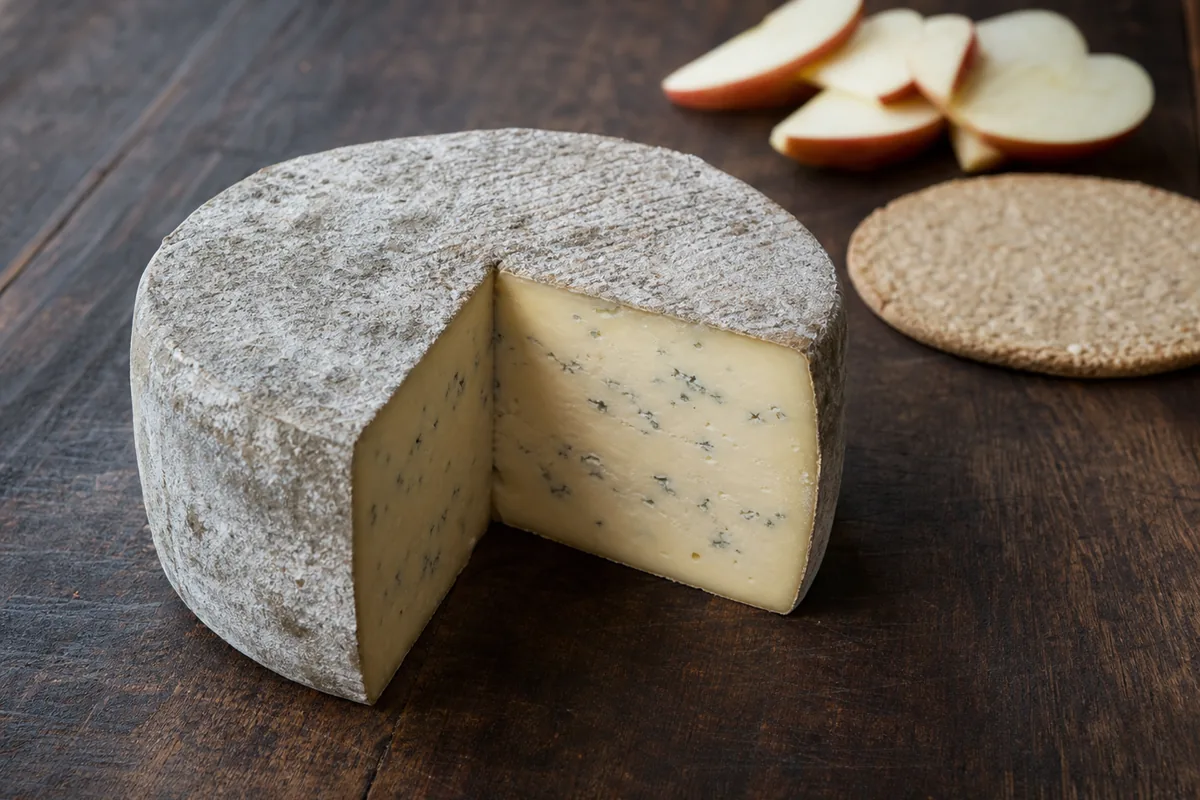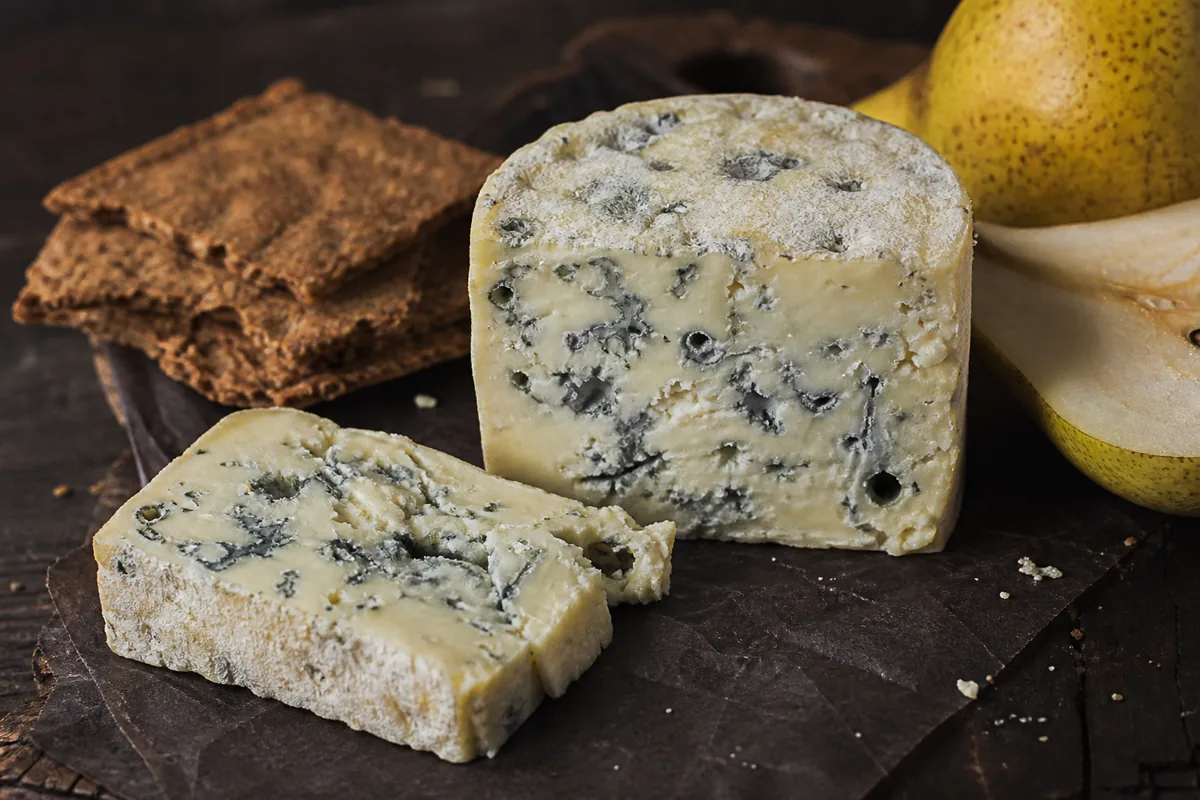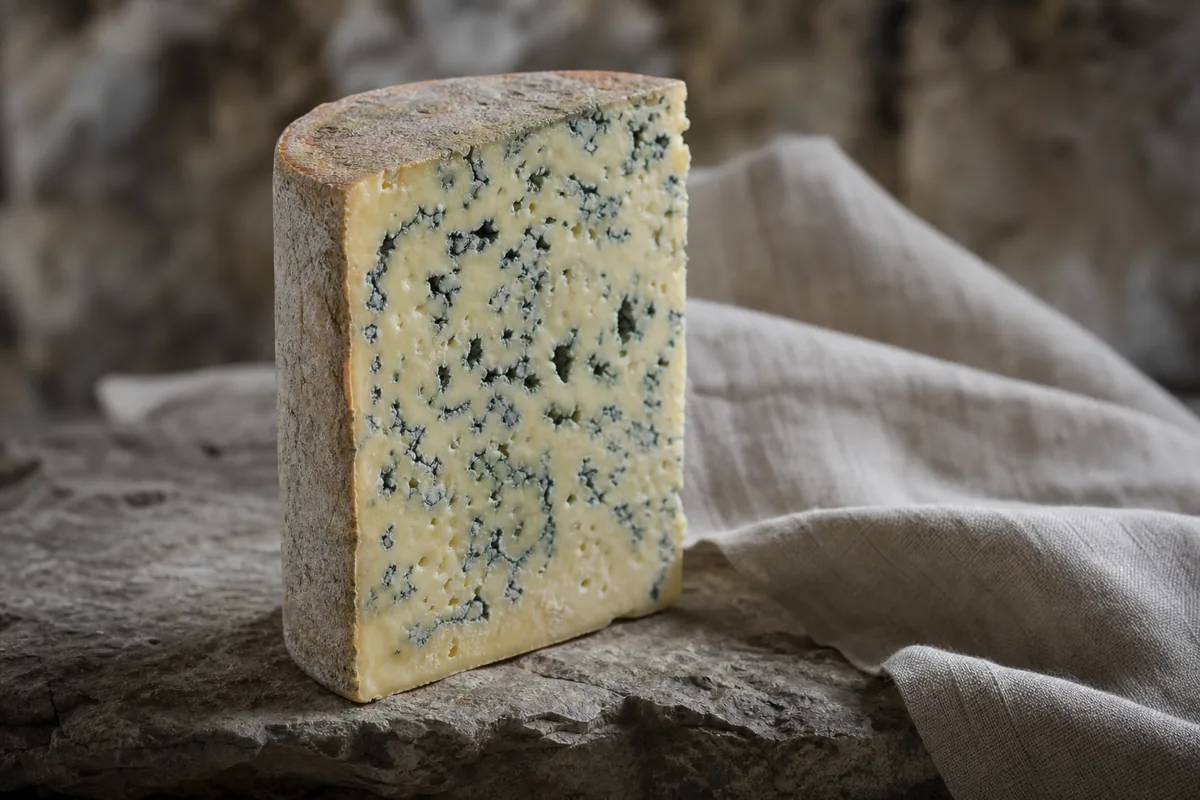
Cabrales is a raw-milk blue cheese from a small mountain area of Asturias in northern Spain. Its specification says it is made only in registered artisan dairies inside that area and finished in natural caves.
Its paste is white in places with blue-green veins, and the official specification calls the flavor slightly spicy.
In This Article
What Makes Cabrales a PDO Cheese?
Spain's agriculture ministry provisionally recognized the Cabrales denomination of origin by an order of 9 May 1981, and the name is now a Protected Designation of Origin.
The Consejo Regulador, the regulatory council, audits the dairies and the ripening caves against the written specification at least once a year.
Milk must come only from registered herds inside the production zone, and the cheese is made only in registered artisan dairies there.
- Production zone: 18 villages of the Cabrales municipality, plus Oceño, Cáraves and Rozagás in Peñamellera Alta.
- Milk: raw and whole, from registered herds.
- Ripening: in registered caves, where the specification says most of the ripening happens.
- Seal: a numbered counter-label issued by the council once the checks are finished.
The checks reach back to the milk. The council inspects herds to verify the raw milk and checks milk collection centers so it can be traced, and during its audits it takes samples of finished cheese for physico-chemical and sensory tests in accredited laboratories.
Herds themselves are not certified: the certificate goes only to the dairy-and-cave operators that use the PDO mark, and the certifying body is accredited to the ISO/IEC 17065 product-certification standard.
That is why "Spanish," "Asturian" or "cave-aged" on a label does not make a blue cheese Cabrales. The name belongs to cheese made, ripened and certified under these rules.
Which Milk Can Cabrales Use?
The specification allows raw, whole milk from cows, sheep or goats, either one kind or a mixture of two or three. Foods and Wines from Spain describes it a little more narrowly, as essentially cows' milk or a mixture of two or three types.
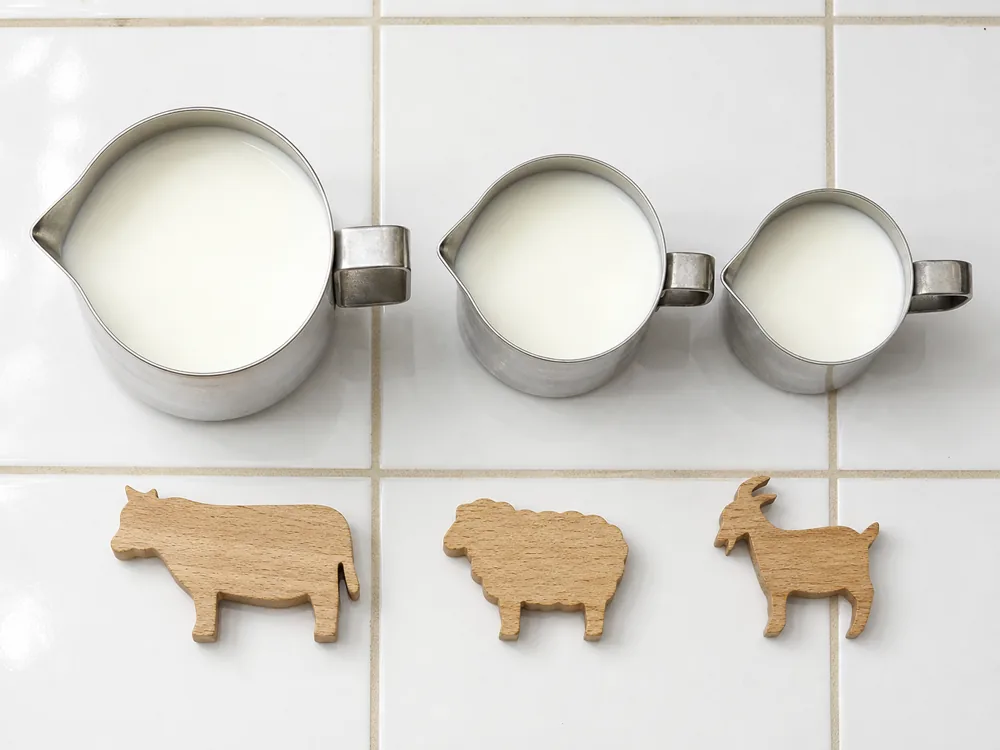
Cabrales began as a seasonal shepherds' cheese, made in mountain huts from the mixed milk of every animal. Today it is made all year, and the specification says dairies use cow's milk alone outside the seasons when goat and sheep milk are available, mainly spring and summer.
The seasons follow the grazing calendar. The specification says the alpine pastures above 800 meters were used in summer by cattle, sheep and goats from the villages below, and with consumers far away over poor roads, the owners camped beside the herds turned the milk into cheese themselves.
Culture reports that today's versions are more commonly made from raw cow's milk alone, although the cheese was traditionally made from a mix of cow's, sheep's and goat's milk. The specification sets no fixed share for each animal, and it singles out goat milk, giving it special importance for the cheese's sensory qualities.
A Cabrales made with cow's milk alone and one made with all three milks both sit inside the specification, so the protected name does not say which milk a given wheel contains.
How Is Cabrales Made?
The specification describes a slow, gentle make: little rennet, a long set, small curd pieces and pressing by the cheese's own weight.
| Step | What the specification says |
|---|---|
| Coagulation | Animal rennet in a small amount; milk held at 22 to 35 °C for at least 1 hour, normally 2 to 3 hours |
| Cutting | Curd cut gently into rounded pieces of 1 to 2 cm |
| Molding | Cylindrical molds called arnios for 2 to 4 days, turned a couple of times so the cheese presses itself |
| Salting | Dry salt on the top face for at least 12 hours, then on the other face for at least 12 hours |
| Airing | About 15 days before the cheeses go to the caves |
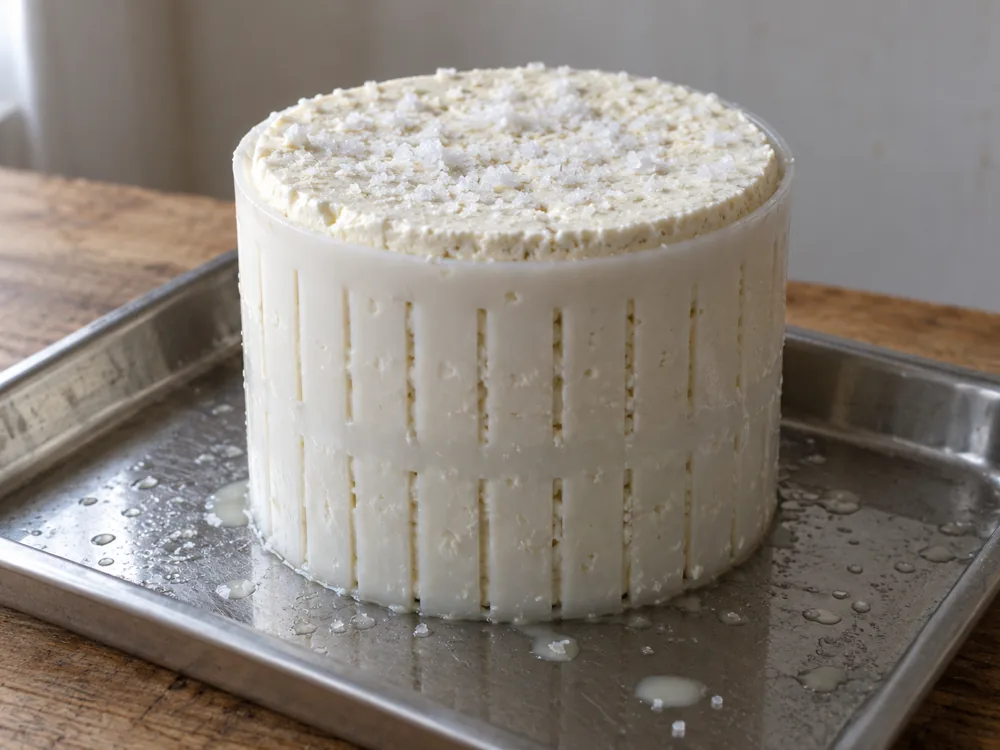
The slow set has a stated purpose. The specification asks for little rennet and at least an hour at temperature so the curd turns out mixed acid-lactic, one that sets through lactic acid as well as rennet.
Because the rennet is of animal origin, Cabrales is not a vegetarian cheese; Foods and Wines from Spain names it as rennet from the stomach of kids, or powdered rennet.
The two sources disagree on the holding temperature. Foods and Wines from Spain gives 22 to 23 °C (71 to 73 °F) for the same one-hour minimum, a much narrower window than the specification's 22 to 35 °C.
The specification is the text the council audits against, so its wider range is the one that sets what counts as inside the rules.
According to the specification, most blue cheeses get Penicillium spores added during making. Cabrales does not need them, because the mold seeds itself naturally in the ripening caves.
Why Does Cabrales Ripen in Natural Caves?
The specification says a suitable cave is deep, has its entrance facing north, has at least two openings to the outside so air can blow through it, and has running water. Caves sit between 800 and 1,200 meters above sea level, and the higher ones are considered better.
Those features set the climate inside. With one opening for access and another acting as a vent, a draft the specification calls the soplado runs through the cave, and together with the running water it leaves the air moving gently, above 90% humidity and at 6 to 10 °C.
Mold covers the cave walls, mainly Penicillium roqueforti, and the air currents carry its spores onto the cheese, where they germinate and spread through the paste. Wheels sit on wooden shelves called talameras and are turned and have their rinds cleaned from time to time.
The caves exist because of the rock: the specification describes the limestone mass of the Picos de Europa as one of the thickest in Europe, a karst landscape whose air-and-water dynamics open caves of different sizes and characters. Some stand near a herder's hut or house, but most are far away and reached by difficult mountain paths.
Foods and Wines from Spain adds that caves are allotted to individuals or groups, and that in many cases the right to use a cave, or part of one, passes from generation to generation.
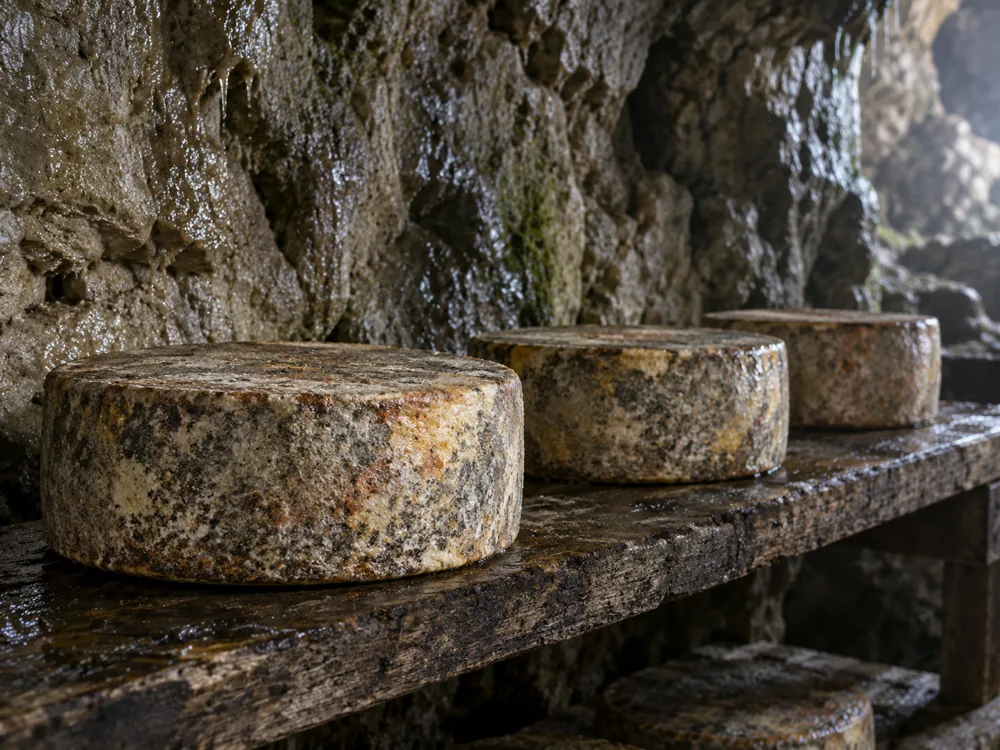
Sources give different cave conditions and different times in the cave.
| Source | Temperature | Humidity | Time in the cave |
|---|---|---|---|
| Specification (council file) | 6 to 10 °C | Above 90% | 2 to 5 months |
| Foods and Wines from Spain | 8 to 12 °C | 90% | 2 to 5 months |
| Culture | 45 to 55 °F | Around 90% | 2 to 6 months |
| Cheese.com | Not stated | Not stated | 2 to 5 months |
Every source agrees on the two-month floor; the ceiling is five months in three of them and six in Culture. The specification's range sits about two degrees below the Foods and Wines figure, and Culture's 45 to 55 °F (about 7 to 13 °C) overlaps both.
Caves are spread over a 400-meter altitude band, each with its own openings and running water, so the figures may describe different caves.
The two-month minimum also runs from the day the curd is made, so it covers the molding, salting and about 15 days of airing as well as time in the cave. The 2-to-5-month cave stay is a separate figure in the specification.
The specification text reads "2 a 55 meses", which looks like a typo; we show it as 2 to 5 months because Foods and Wines from Spain and Cheese.com give 2 to 5.
What Do the Paste and Rind Look Like?
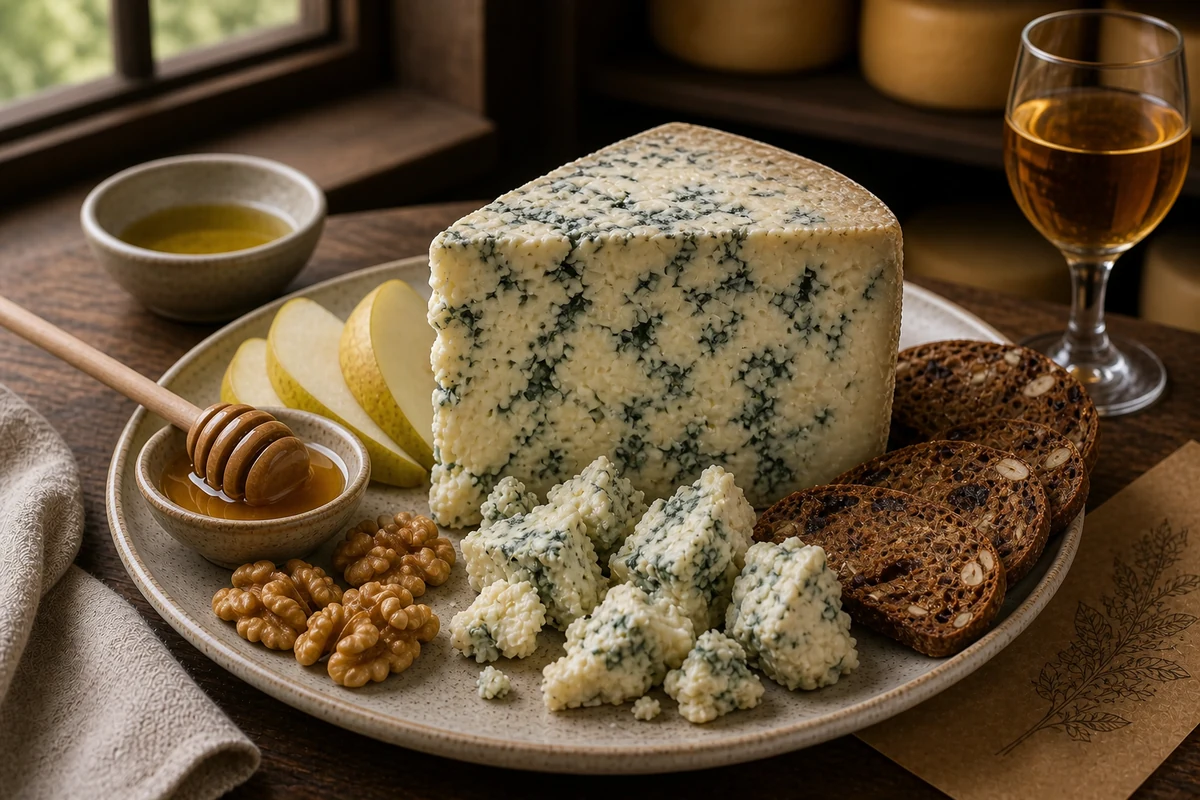
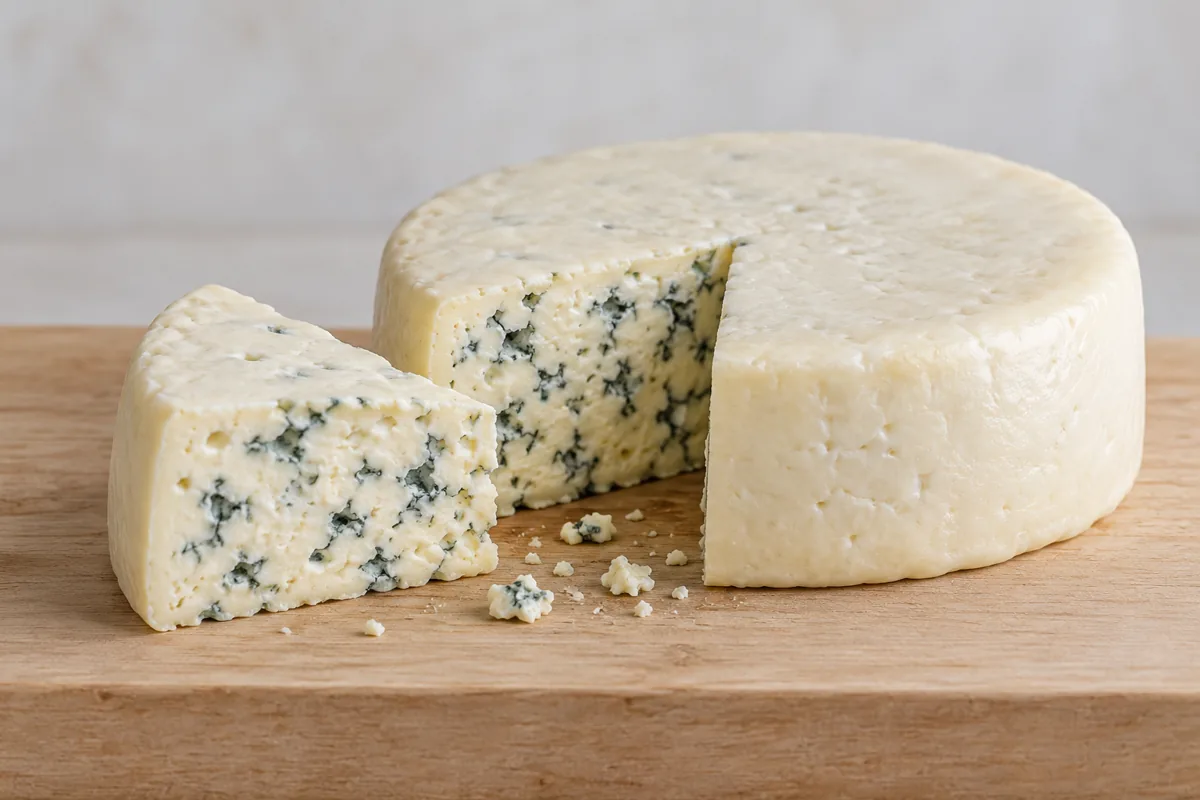
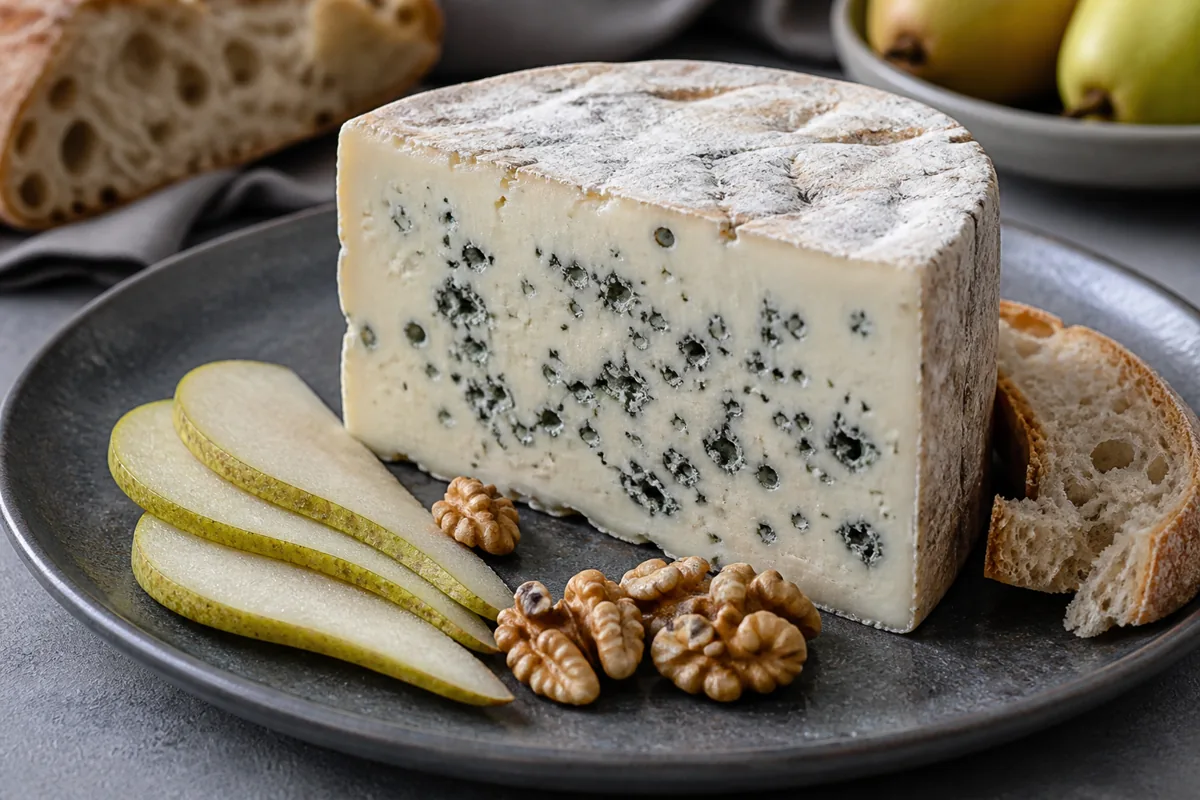
The specification describes a compact paste without eyes, white in places with blue-green veins. The rind is soft, thin and unctuous, gray-brown to orange, with possible yellow-reddish zones.
The paste is unctuous, but how firmly it holds together depends on how far the cheese has fermented. Two wedges of PDO Cabrales can therefore feel different under the knife.
Foods and Wines from Spain ties that range to ripening length, from semi-soft to soft, and the council's tasting manual names a semi-soft to soft, unctuous paste as the ideal, taking it as a sign that the cheese had enough time in the cave.
Both also say the veins darken as the cheese ripens, from light to dark blue-green, but they must never turn black.
The council's tasting manual narrows the variable measurements to a diameter of 10 to 25 cm and a weight of up to 4 kg. Culture lists a wheel about 7 to 8 inches across and 4 to 5 inches high, weighing 6 lb.
The rind feels slimy to the touch, which Foods and Wines from Spain and the council's manual both attribute to the microbes that grow on the outside during ripening. Red or yellow patches come from the same growth.
The sources describe the inside slightly differently. The specification says the paste is compact and without eyes, while Culture describes holes and pockets of blue and crunchy granules of crystallized amino acids.
The council's manual explains how both can hold: the small cavities where the mold grows are technically necessary and should mostly stay under 0.3 cm, and raw milk can add a few fermentation eyes, though they should be few at a glance.
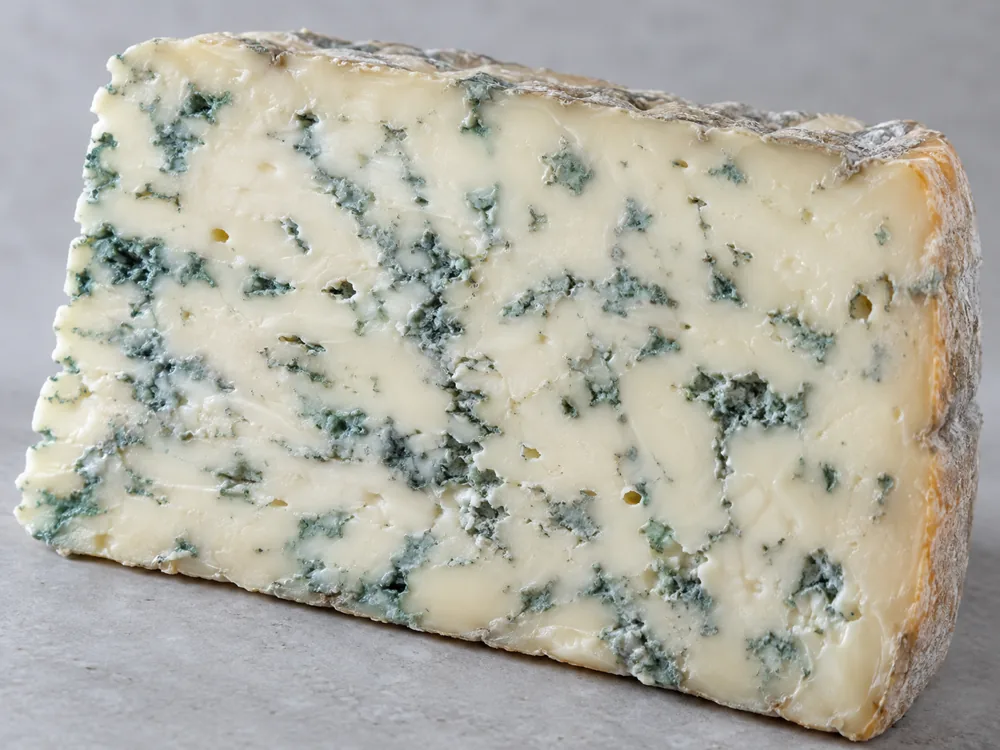
The paste color is ivory-white, per the same two sources, and may shift a little with the milk used while staying the same throughout the wedge.
What Does Cabrales Taste Like?
Every source calls Cabrales strong, but each uses different words for it.
| Source | How it describes the flavor |
|---|---|
| Specification | Slightly spicy, stronger when made with pure or mixed sheep or goat milk |
| Foods and Wines from Spain | Medium piquancy, a pronounced and persistent aftertaste, and a clean aroma with hazelnut and almond notes |
| Cheese.com | Acidic, salty and sharp, with piquant and spicy notes and a strong aroma |
| Culture | Often wild and spicy in flavor and aroma, with salt notes that grow stronger as the cheese ages |
The words run from slightly spicy to sharp, and the sources give three separate reasons for the strength. The first is milk: the specification and Foods and Wines from Spain both tie the stronger flavor to sheep or goat milk, pure or in a blend, and Foods and Wines puts the most intense aroma with goat milk.
The second is age, which Culture links to salt notes that grow stronger over time, and it adds that mixed-milk wheels can taste more acidic and more complex.
The third is the mold. Foods and Wines from Spain and the council's tasting manual both say lactic notes form the base, but because Penicillium is the essential microorganism, its lipolytic (fat-splitting) activity releases a wide range of complex compounds.
Going by the specification's wording, a wheel made with cow's milk alone should sit at the gentler end.
What Goes With Cabrales?
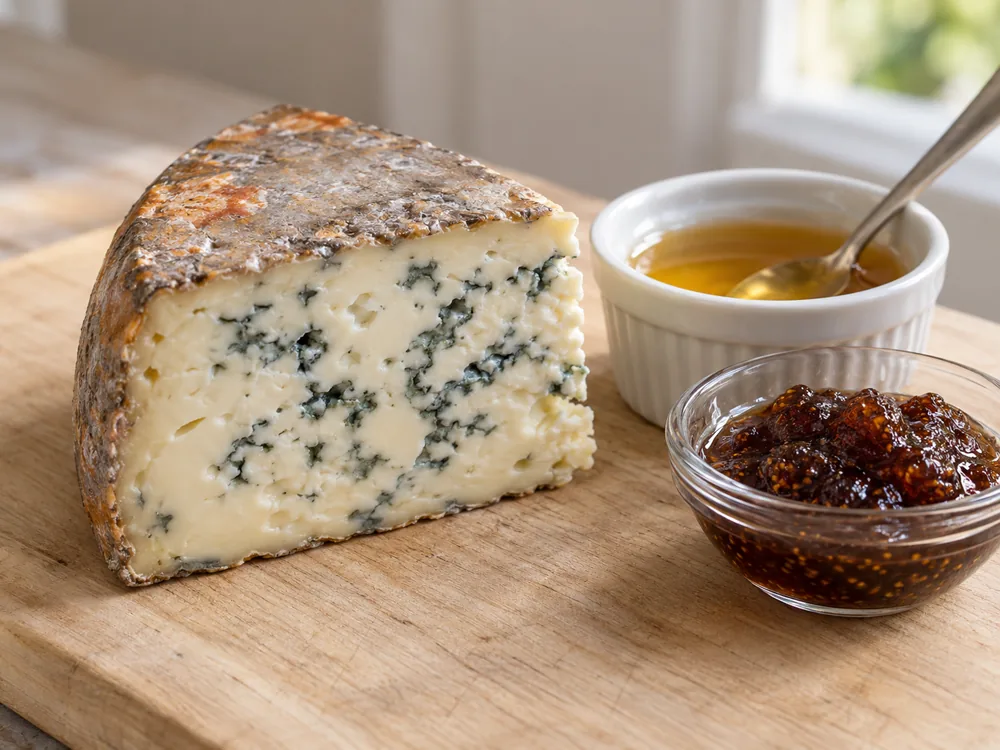
Culture says Cabrales is best paired with something sweet, like honey or fig jam, to mellow its intensity. Cheese.com lists crusty bread, honey and fresh fruit.
The Enciclopedia de Gastronomía says plates served with its Cabrales sauce suit a reserva red wine because the flavors are strong and need power, and Directo al Paladar likewise suggests a quality red with its veal.
With endives in the sauce, the Enciclopedia prefers a very cold, semi-sweet white such as gewürztraminer, Riesling or Mosel, because the bitterness of endives would overpower any red.
| Pairing | Type | Why It Works |
|---|---|---|
| Honey | Food | Culture and Cheese.com both suggest it; Culture says sweetness mellows the cheese. |
| Fig jam | Food | Culture's example of something sweet to pair with it. |
| Crusty bread and fresh fruit | Food | Both listed by Cheese.com. |
| Red wine | Wine | The Enciclopedia de Gastronomía names a reserva, and Directo al Paladar a quality red, for dishes made with the cheese sauce. |
| Semi-sweet white | Wine | Gewürztraminer, Riesling or Mosel, very cold, for endives in the sauce, per the Enciclopedia de Gastronomía. |
How Do You Cook With Cabrales?
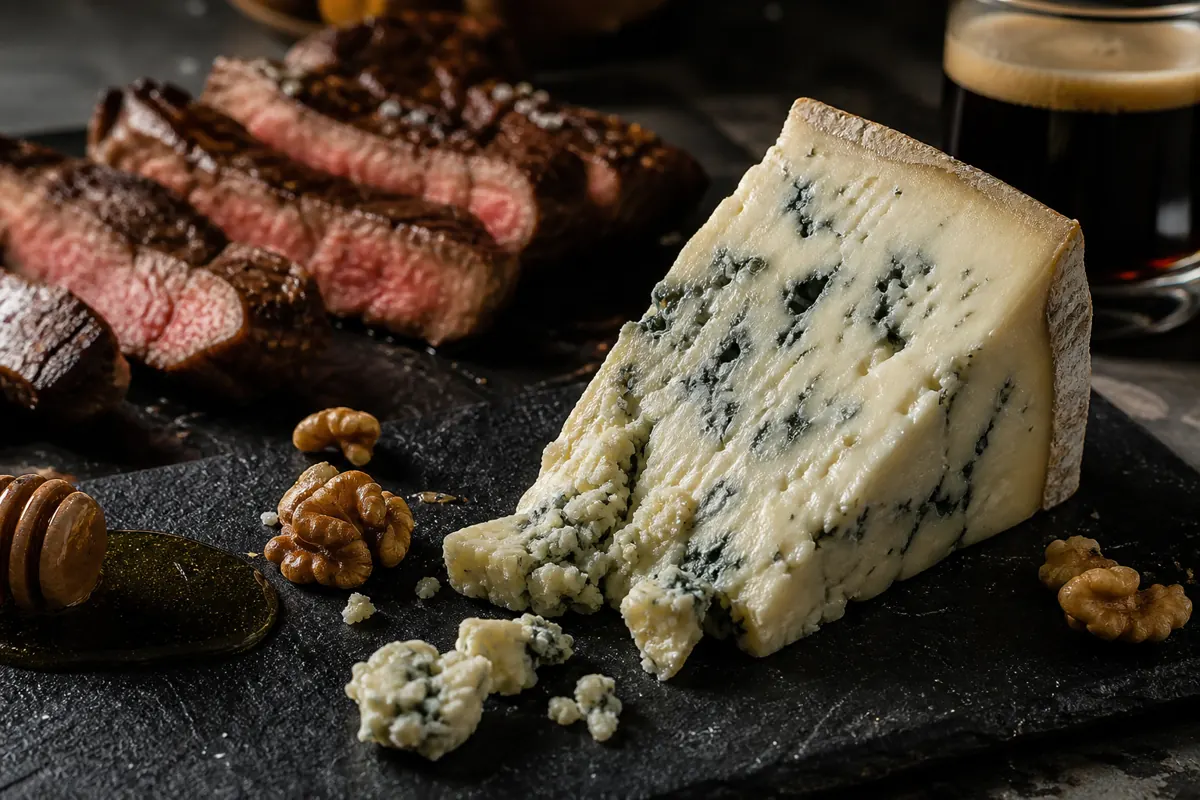
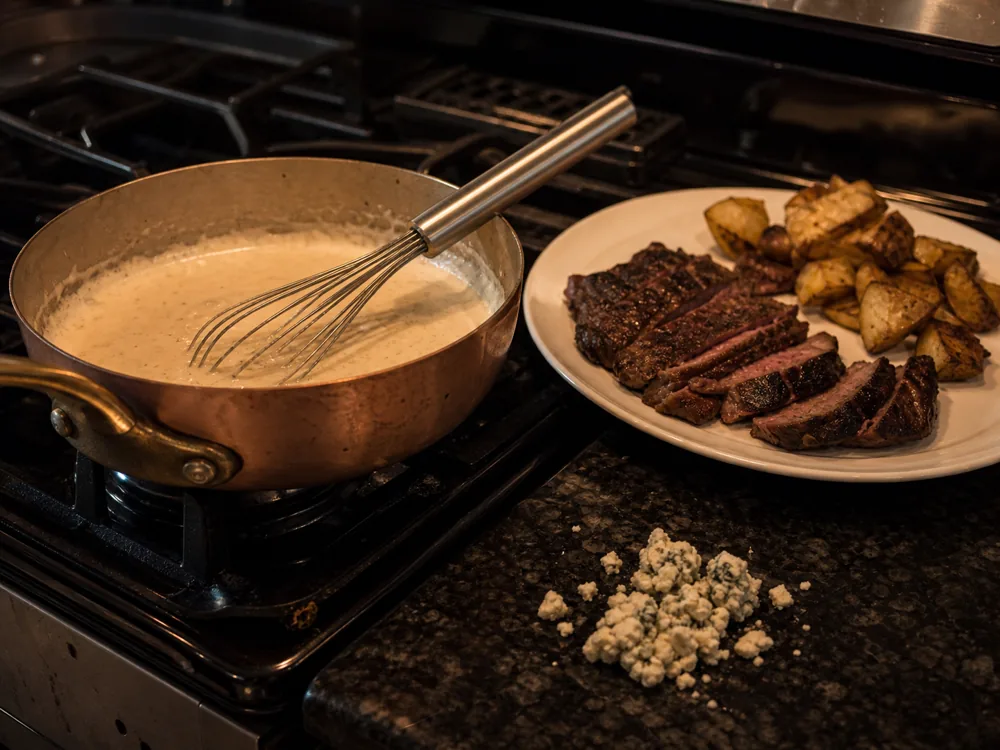
The classic Asturian use is salsa de Cabrales, a cream sauce for beef. The Enciclopedia de Gastronomía serves it with entrecôte, tenderloin or escalopes, pan-fried, and Directo al Paladar spoons it over veal tenderloin medallions seared on a hot griddle.
| Point | Enciclopedia de Gastronomía | Directo al Paladar |
|---|---|---|
| Cabrales | 100 g, preferably three-milk | 75 g |
| Cream and fat | 100 g liquid cream and 50 g butter | 50 ml cream |
| Serves | 4 | 2 |
| Method | Melt the cheese with the butter, stir in the cream, bring to a boil and reduce for a thicker sauce | Mix the cheese with the cream, bring to a boil over low heat while whisking, then strain |
Both recipes cook the cheese into the cream rather than stirring it in cold, and the Enciclopedia version adds butter. Divided by servings, the Enciclopedia sauce uses 25 g of cheese per person and Directo al Paladar's about 37 g.
Directo al Paladar explains the cream: the cheese is so strong that it is mixed with cream so its flavor stays noticeable without covering the veal, and one or two spoonfuls go over each medallion.
The Enciclopedia says the same sauce can be made cold or hot and that the flavor changes radically between the two, so it calls the cold one Roquefort sauce and the hot one Cabrales, the version Asturians serve with beef. It adds that either can be made with any blue cheese, and Directo al Paladar agrees that another good-quality blue works when Cabrales is missing.
Beyond beef, the Enciclopedia describes the classic way to serve endives as boiling them for a couple of minutes in salted water, draining them and covering them with the hot sauce, though the more frequent version uses the cold one. It lists fresh-ground black pepper, dill or a touch of cinnamon as variations but suggests making the plain sauce first to learn its flavor.
The Enciclopedia says to taste before serving because the sauce is very strong, and that its aroma can linger in the kitchen for days.
What Should You Look for When Buying Cabrales?
The specification requires the words Denominación de Origen Protegida "Cabrales" on every label. Cheese sold to consumers also carries a label and counter-label made of a red band between two green bands, the council's logo and a number issued by the council.
The specification says wheels were once wrapped in plágano (sycamore maple) leaves to ease handling in the trade. Foods and Wines from Spain says the practice has been discontinued and describes the current wrapper as food-grade paper printed with green leaves, so the wrapper has changed while the red and green label stays.
The May 2025 specification says the cheese is packed in special food-grade paper, with sturdier materials allowed for portions. Culture says most wheels that reach the United States have natural rinds and are foil-wrapped, so wrappers vary even though the red and green label does not.
The specification calls the numbered counter-label the guarantee of origin, so ask the seller to show it when a wedge has been cut from a wheel.
Because the specification allows cow's milk alone or several mixtures, ask the seller which milks went into the wheel you are buying.
What Counts as a Faulty Cabrales?
The council's tasting manual separates a strong Cabrales from a faulty one by listing defects for appearance, texture, and smell and taste. Strength is expected, and the manual lists a very weak smell, or an absent or excessive piquant sensation, among the defects.
| Check | What the manual wants | Defects it lists |
|---|---|---|
| Shape | Cylinder with flat faces, slight concavity allowed; straight or slightly convex sides | Faces and sides strongly domed, faces excessively concave, size outside the limits |
| Rind | Natural, soft and thin, without cracks or odd marks | Very thick and hard, black or very dark, dry and split, no sign of enough cave time |
| Paste color | Ivory-white and the same throughout | Dark brownish, patchy light and dark areas |
| Mold | Growing evenly through the whole paste, light to dark blue-green | Little or no growth, very uneven growth, yellow tones inside the mold, lines showing the paste was pierced |
| Cavities | Small mold cavities, few fermentation eyes | Many large eyes, very large cavities that spoil the cut |
| Texture | Semi-soft to soft and unctuous, with very fine grain and medium-low stickiness | Dry, hard and crumbly, gummy when chewed, grainy with lumps, sticky enough to cling to the palate |
| Smell and taste | Intense, clean and pleasant smell; balanced flavor with medium piquancy | Very weak smell; dirty, stable-like, rancid, musty or strange notes; strong ammonia; no or excessive piquancy; heavy salt; marked bitterness or astringency; short or unpleasant aftertaste |
In the manual's terms, sparse veining is a flaw rather than a style, and so is a pierced look; the mold is meant to spread through the paste on its own.
How Should You Store Cabrales?
The CDC says to keep a refrigerator at 40°F (4°C) or below.
For serving, the CDC says perishable food, a group that includes dairy, should not stay out for more than 2 hours, or 1 hour above 90°F. A wedge on a warm picnic table therefore has a shorter limit than one on an indoor board.
Follow the date on the pack and the seller's advice for how long a cut wedge keeps.
Can You Eat Cabrales When Pregnant?
Cabrales is made from raw milk. For cheese in pregnancy, the NHS says "pasteurised or unpasteurised soft blue-veined cheeses," such as Danish blue, gorgonzola and roquefort, "must be thoroughly cooked."
The CDC lists soft cheese made from unpasteurized milk, including blue-veined types, as riskier, and says pregnant women are 10 times more likely to get a Listeria infection. It names hard cheese made with pasteurized milk among the safer choices.
Whether Cabrales counts as soft is not settled: the specification calls its paste unctuous, and Cheese.com calls the texture creamy and firm.
The two-month ripening minimum is a production rule in the specification.
SOURCES & REFERENCES
Raw, whole milk. Foods and Wines from Spain describes cow's milk alone or a mixture of two or three milks, and the specification allows cow, sheep or goat milk alone or mixed.
At least two months counted from the day the curd is made, according to the specification. Sources give cave times of two to five or six months.
No. The specification requires raw, whole milk.
No. The specification says the Penicillium seeds itself naturally in the ripening caves, where air currents carry spores from the walls onto the cheese.
The NHS says pasteurised or unpasteurised soft blue-veined cheeses must be thoroughly cooked, and the CDC lists soft raw-milk blue-veined cheese as riskier. Whether Cabrales counts as soft is not settled, so ask a midwife or doctor.
Culture suggests honey or fig jam, and Cheese.com lists crusty bread, honey and fresh fruit. For dishes made with a Cabrales sauce, the Enciclopedia de Gastronomía suggests a reserva red wine.
Both recipe sources say it can. The Enciclopedia de Gastronomía says the sauce works with any blue cheese, and Directo al Paladar says another good-quality blue can stand in.