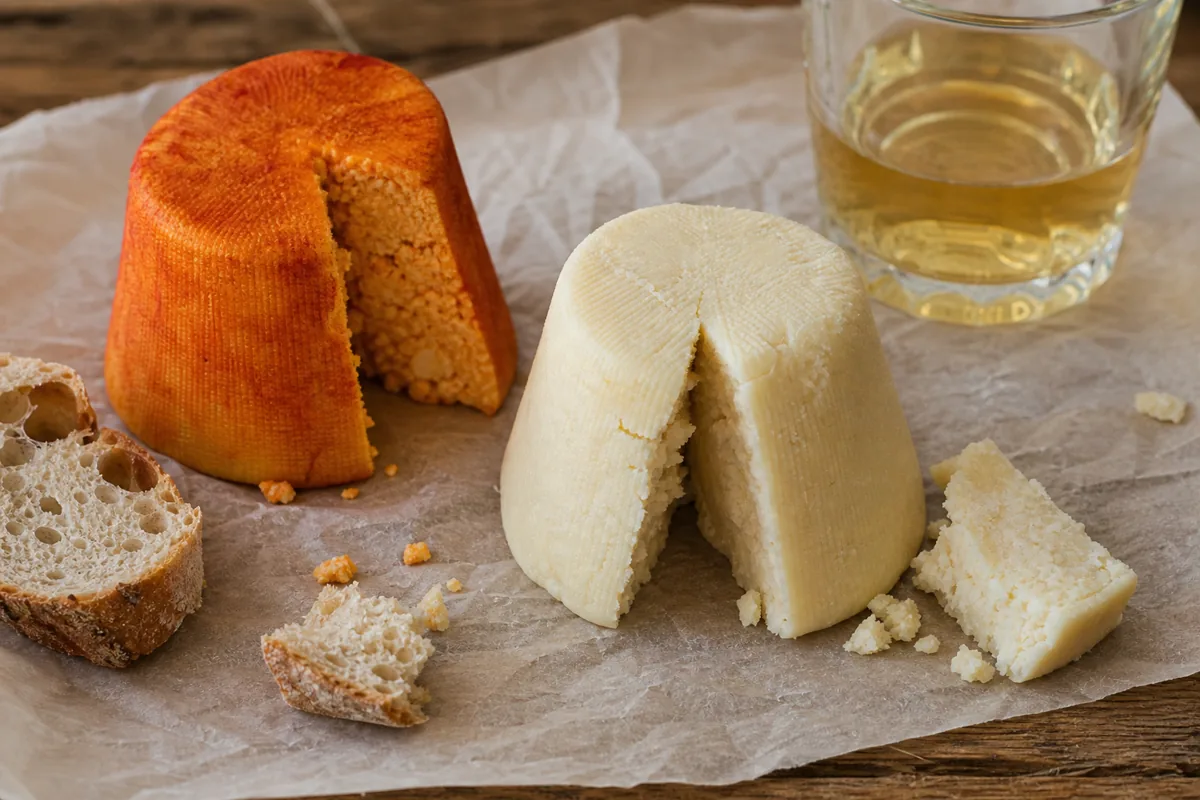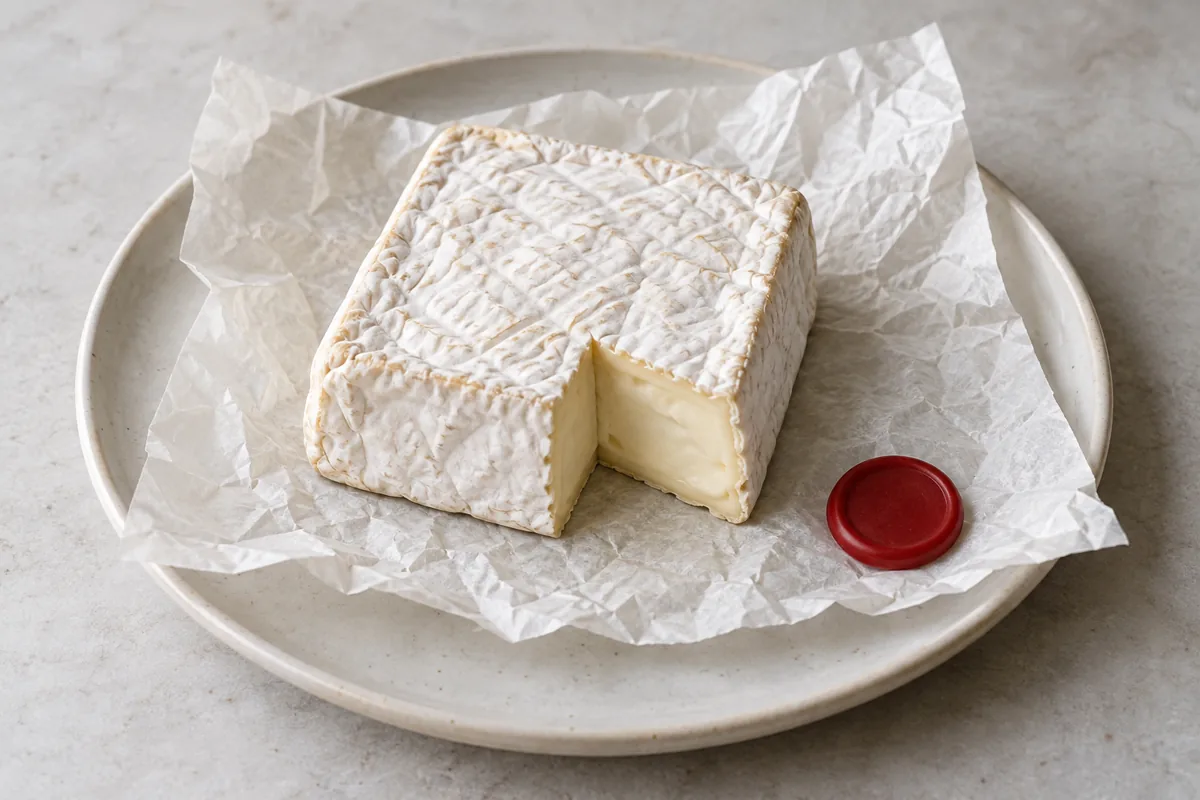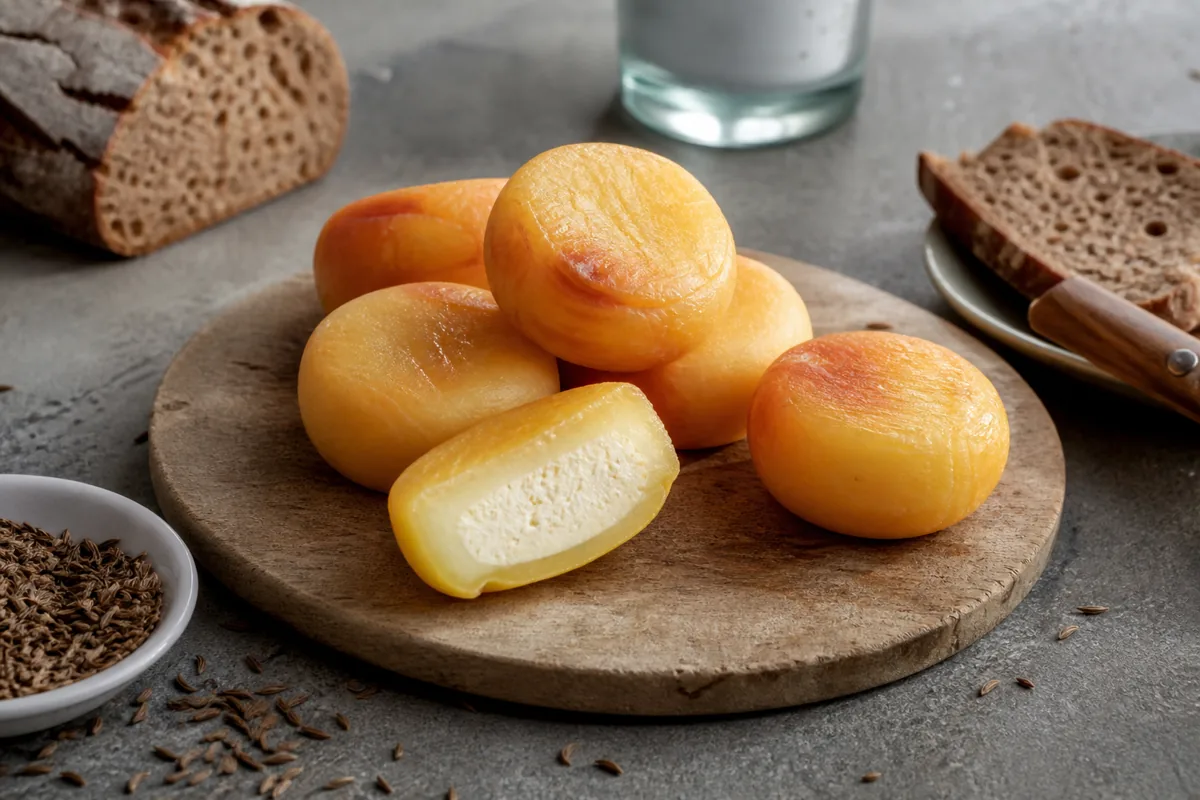
Harzer is a German ripened sour-milk cheese made from very low-fat quark. Harzinger, a current producer, lists under 1 percent fat and 30 grams of protein per 100 grams for its products.
The cheese ripens from the outside in: a young piece has a crumbly white core, and a fully ripe one is golden and slightly translucent all the way through.
Harzinger ties its flavor range, from mild-aromatic to hearty and spicy, to that stage.
In This Article
What Is Harzer Cheese?
Harzer Käse is a sour-milk cheese, or Sauermilchkäse: the milk is skimmed and acidified into quark, and the curd is set by lactic acid rather than rennet. The FAO/WHO draft individual standard for Harzer Käse, written for a June 1968 committee session, specifies pasteurized skimmed cow's milk and lists Mainzer Käse as a synonym.
The same draft sets the limits for a ready-to-eat piece.
Under the German cheese ordinance, Harzer is a standard variety and is made only in the lean grade.
Where Does Harzer Cheese Come From?
Harzer production began in the 18th century in the Harz region, where skimmed sour milk was left over from butter-making.
The northern Harz foothills around Bad Harzburg, Vienenburg and Immenrode are examples of where the cheese began, yet Harzer is now made almost entirely outside the Harz, in Hesse, Lower Saxony, Saxony, Saxony-Anhalt and Thuringia.
The name Harzer Käse is not a protected designation of origin. Harzinger, for example, names the Breitunger Käserei in Wohlmirstedt as the dairy that makes its Harzer, so the maker on your pack says more about a piece than the word Harzer does.
The dairy's own history shows the move: Harzinger says its Harzer originally came from Breitungen in the Harz, and that the cheese has 125 years of tradition in the Breitunger Käserei, whose home village Wohlmirstedt lies in Saxony-Anhalt.
How Is Harzer Cheese Made?
The FAO/WHO draft describes lactic-acid coagulation of pasteurized skimmed milk, with the drained acid curd pressed in bags or cloths, or in draining drums, to remove the whey.
The curd is then mixed with sodium carbonate and calcium carbonate (up to 3 percent of the curd's weight) and with salt, molded, and inoculated with bacteria that produce red and yellow smear.
Harzinger names one of those smear organisms as Brevibacterium linens, which it sprays onto some of its varieties as a salt-water mix.
The quark that arrives at the dairy has more than 30 percent dry matter, which makes it crumbly, and some already ripened cheese is mixed in with the ripening salts.
That ripened cheese, called Kulturkäse, speeds up ripening and brings in the dairy's house cultures, which work alongside the souring bacteria already in the quark. The usual souring bacteria are Lactobacillus bulgaricus and Streptococcus thermophilus, with a random yeast flora whose makeup varies.
Harzer's warm first stage and its total ripening run on different schedules in the FAO/WHO draft and in German Wikipedia, so no single day count describes every Harzer.
| Source | Initial ripening | Time to ripeness |
|---|---|---|
| FAO/WHO draft standard (June 1968) | About 3 days at 16 to 22°C and very high humidity | 5 to 15 days, depending on local storage conditions |
| German Wikipedia | About 24 hours at 30°C, then 1 to 3 days at 10 to 14°C | 2 to 4 weeks is treated as ideal ripeness |
Souring bacteria, house cultures and yeasts vary between dairies, which could be part of why the two schedules differ.
Why Is Harzer So High in Protein and Low in Fat?
The milk is skimmed before the cheese exists, and the curd is acid-set quark, so almost none of the fat that a whole-milk cheese carries enters the make. Harzinger's glossary sets its under 1 percent fat against more than 20 percent for Edam.
The glossary adds a cholesterol comparison of about 7 mg per 100 g of Harzer against about 105 mg per 100 g of Emmentaler.
| Source | Protein | Fat | Energy and salt |
|---|---|---|---|
| Harzinger labels (Minis) | 30 g | 0.5 g (0.3 g saturated) | 125 kcal; salt 2.5 g with noble mold, 3.8 g plain or with caraway |
| Verbraucherzentrale Bayern | 37 percent (basis not stated) | Under 1 percent | Not given |
| German Wikipedia (Handkäse article) | 25 percent (basis not stated) | Under 1 percent | Not given |
Harzer's protein is 30 grams per 100 grams on Harzinger's label and 37 percent from the Bavarian consumer association, while German Wikipedia puts the related Handkäse lower, at 25 percent, and neither percentage can be compared with the gram figure.
The fat figures are shares of the whole piece, while the FAO draft and German Wikipedia cap fat as a share of dry matter, at 10 percent.
With the draft's 68 percent moisture ceiling, dry matter is at least 32 percent of a piece, so a cheese at both limits would hold up to 3.2 g of fat per 100 g. That is our calculation from the draft's limits, not a measured value, and the standard therefore allows more fat than Harzinger's label shows, so only the panel on your pack says what is in the piece you hold.
Salt is the figure that is not low, at 2.5 to 3.8 grams per 100 grams across the three Harzinger Minis varieties. If you are watching it, the noble-mold Minis sit at the low end, at 2.5 grams, against 3.8 grams for plain or caraway.
Is Harzer the Same as Handkäse?
Not quite, though the line falls in different places: Handkäse is one of the names a Harzer can carry, describing its form, in Harzinger's glossary, while German Wikipedia describes it as its own standard sour-milk variety tied to Hesse, the Rhine-Main area, Rheinhessen and the Palatinate.
Since 23 September 2010, Hessischer Handkäse has protected geographical indication status, with production and packaging in Hesse. The quark need not come from Hesse, so the protected name fixes where the cheese is made and packed and not where its quark comes from.
The name Handkäse comes from forming the curd into small discs by hand.
German Wikipedia's Handkäse article also warns that the name covers more than one cheese: around Rhine-Main the sour-milk cheese called Handkäse is treated under Mainzer Käse, and in the Odenwald the name is also used for a soft cheese, the Odenwälder Frühstückskäse.
Mainzer Käse is another name for Harzer in the 1968 FAO/WHO draft, and a similar but separate sour-milk cheese beside Olmützer Quargel in German Wikipedia.
German Wikipedia calls Handkäse relatively soft among sour-milk cheeses and gives its own make: two days at 25 to 28°C and 80 percent humidity, a brine spray, and for some types a second spray with red-culture brine and two more days.
Both cheeses start from lean sour-milk quark and are served the same marinated way, but only the Hessian name is protected, so if you want the protected cheese, look for Hessischer Handkäse on the pack.
What Does Harzer Cheese Taste and Smell Like?
Young Harzer is mildly lemony and sharp, according to German Wikipedia, while a mature piece is piquant and spicy with a characteristic intense smell. Harzinger describes the same range as mild-aromatic to hearty and spicy and ties it to ripeness.
Texture shifts along the same path: German Wikipedia calls a young Harzer hard and a riper one softer.
Caraway is the typical spice for Harzer, and Harzinger sells its Minis plain, with noble mold or with caraway.
Harzinger's glossary places caraway in the make: ripening cultures, ripening salts and sometimes caraway go into the quark, and only then are the loaves shaped.
The FAO/WHO draft lists "cumin seeds" as its only optional addition, while the German sources name Kümmel, which is the German word for caraway.
Why Do Some Harzer Have White Mold and Others Orange Smear?
Verbraucherzentrale Bayern says Harzer comes either with a white noble-mold coating or with an orange-brown, slimy layer. Harzinger names its plain Gelbkäse and its Edelschimmel versions separately, so the pack tells you which surface you are buying.
The 1968 FAO/WHO draft and German Wikipedia's Harzer article both describe a smear surface, and German Wikipedia adds that the cheese has no rind.
German Wikipedia's Handkäse article places mold surfaces on Handkäse instead: unlike Harzer and Mainzer Käse, it says, Handkäse can be made as a noble-mold cheese with Camembert-type cultures (Penicillium camemberti), and the Hausmacher Art type carries a white layer of Geotrichum candidum.
Verbraucherzentrale Bayern and Harzinger, by contrast, describe white noble-mold versions of Harzer itself, and Harzinger says its noble-mold cultures are applied evenly over the cheese.
How Can You Tell How Ripe Harzer Is?
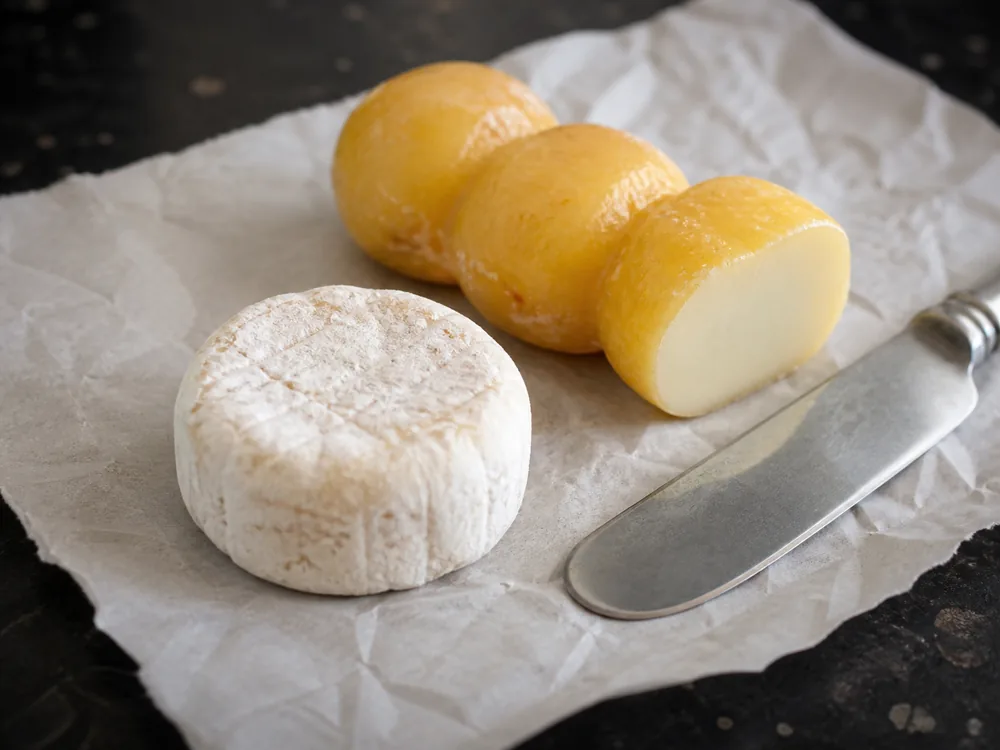
Cut a piece and look at its core. Harzer ripens from the outside in, so the white curd core shrinks toward the center while the paste around it turns golden and translucent, according to German Wikipedia and Verbraucherzentrale Bayern.
Ripening does not stop at the dairy: German Wikipedia notes that the cheese keeps ripening in transport, in the shop and at the consumer, and Harzinger says its packaging is breathable so ripening can continue.
Harzinger dates its three stages against the best-before date, counting the weeks still left on the pack.
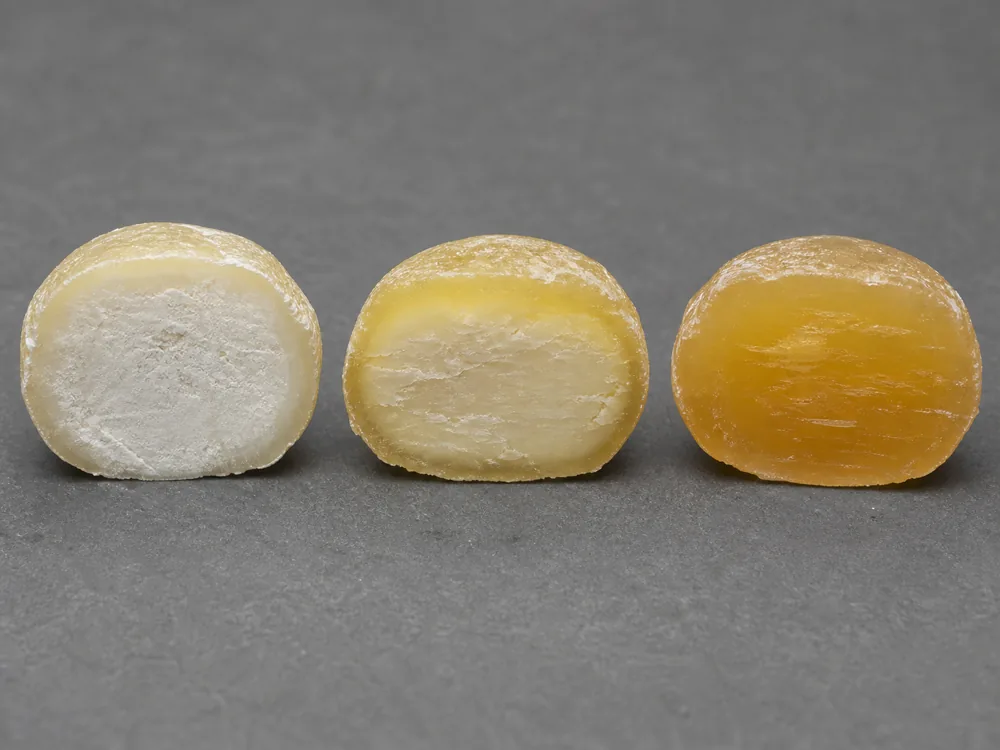
German Wikipedia gives a longer guide for a refrigerated pack: a mild piece with a white core 5 to 6 weeks before the date, an aromatic piece with a small core 3 to 4 weeks before, and a strong, fully ripened piece without a core 1 to 2 weeks before. Past that point the cheese loses its crumbly texture entirely and can turn runny.
The two date scales do not line up: Harzinger calls a piece young until about 3 weeks before the date, while German Wikipedia's refrigerated scale still calls it mild at 5 to 6 weeks and aromatic at 3 to 4. So treat the date as a rough guide and judge the stage by the white core, which is what both scales describe.
Harzinger adds that every stage has the same ingredients, so which one you choose is a matter of taste and texture.
A broad crumbly white core means mild, a small core means aromatic, and no core means strong and golden throughout. The weeks left before the date point toward a stage, but the two sources count them differently.
How Do You Eat Harzer Cheese?
The best-known preparation is Handkäse mit Musik, in which sliced cheese is marinated in vinegar, oil, onions and spices according to Verbraucherzentrale Bayern, and German Wikipedia adds pepper and caraway.
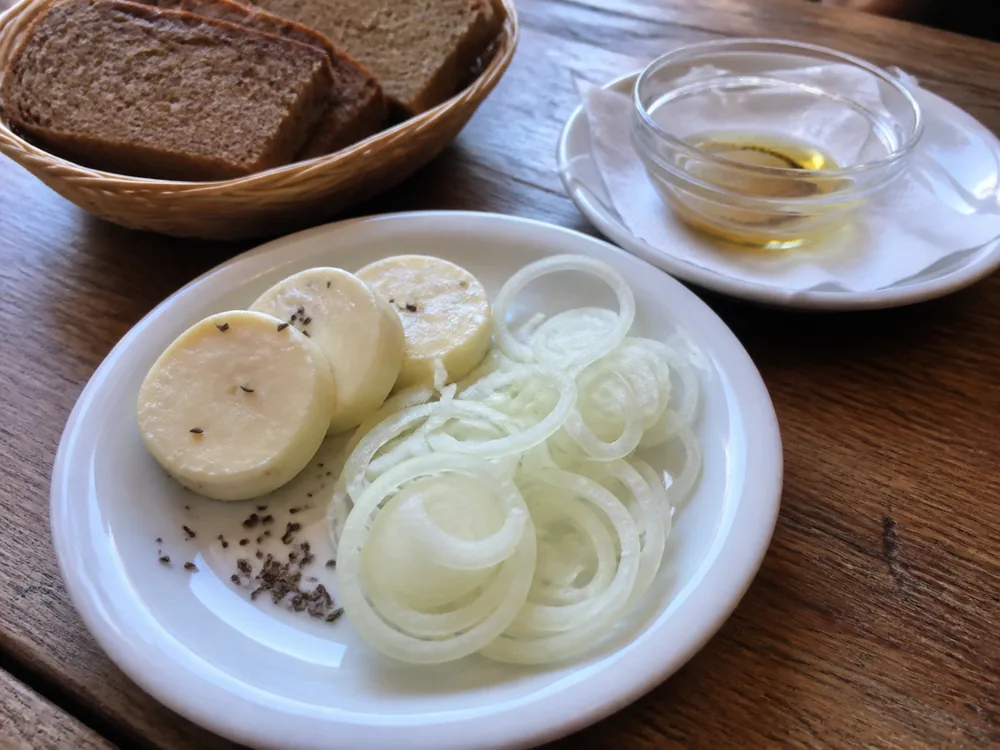
- Marinated: sliced with onions in vinegar, oil, pepper and caraway, the Handkäse mit Musik method.
- On bread: with dark bread and beer or cider, according to German Wikipedia.
- As a cold meal: with Schmalz (rendered fat) or mustard and gherkins, which Verbraucherzentrale Bayern calls the usual way.
To eat Handkäs mit Musik the traditional Frankfurt way, leave out the fork: a piece of cheese goes on buttered bread, preferably strong whole-grain or rye, a little of the marinade is pushed on top with the knife, and the whole is bitten off.
The marinade is onions, vinegar and oil with pepper and salt, sometimes with a little water or a splash of apple wine or wine, and caraway can go into it if the cheese was not already made with caraway. The same marinade is used for other cheeses such as Limburger or Munster, and for sausages.
Ohne Musik means the marinade without onions, and Handkäsbrot is a different dish: the cheese is mashed with a fork, mixed with butter or quark and pressed onto a slice of bread.
For a drink, German Wikipedia's Handkäse article says a dry white wine is also drunk with it in the wine regions of Rheinhessen and the Palatinate, and Harzinger says full-bodied white wines suit Harzer especially well because the cheese is slightly salty.
Harzinger also names hyssop (Ysop) as a strong spice for a marinade in which Harzer can be left to take on a spicier flavor.
Does Harzer Cheese Melt?
It does: Utopia's recipe for Harzer chips notes that the cheese melts strongly outward, so the slices need space on the tray. The recipe cuts the cheese very thin and bakes it at 170°C top and bottom heat for 15 to 20 minutes.
For the recipe you need 200 g of cheese, a seasoning of choice, such as rosemary, salt, pepper, paprika or chili, and a well-sharpened knife to cut the thin slices.
Watch the tray so the chips neither darken too far nor come out before they are properly crisp, and bake them just before eating, ideally while still warm, as the recipe says.
Can You Eat Harzer Cheese When Pregnant?
Neither NHS nor CDC names Harzer or any sour-milk cheese, so the answer depends on which of their cheese categories a given piece fits.
Under NHS guidance, pasteurised soft cheeses such as cottage cheese, feta and ricotta are safe, as is pasteurised goats' cheese without a white coating, while pasteurised or unpasteurised mould-ripened soft cheeses with a white coating, such as brie and camembert, must be thoroughly cooked.
A white-mold Harzer has the white coating that NHS ties to mould-ripened soft cheeses. Neither agency says where a smear-ripened sour-milk cheese belongs, so their lists do not settle it.
A piece with no white coating whose pack says pasteurised is closest to the NHS pasteurised soft cheeses, but that is an inference; if the milk is unpasteurised, NHS says foods made from unpasteurised milk must be thoroughly cooked, and CDC lists soft cheese from unpasteurized milk as riskier.
Both agencies accept heat: NHS lists any cheese cooked until steaming hot, and CDC lists pasteurized soft cheese heated to an internal 165°F or until steaming hot.
Is Harzer Cheese Vegetarian and Lactose-Free?
Harzinger states that its Harzer is made without animal rennet and carries the V-Label for vegetarian products, and the FAO/WHO draft likewise describes coagulation by lactic acid.
If your pack comes from another maker, check its own label for the rennet and the V-Label.
Harzinger lists residual lactose of under 0.1 percent for its range and labels its Minis gluten-free and lactose-free, a figure that belongs to its products rather than to Harzer in general.
How Do You Buy and Store Harzer?
The common loaf shapes are small round Taler, cylindrical Stangenkäse, and several small loaves packed in a row and sold as a Harzer Roller.
Harzinger calls its Minis its smallest Harzer rolls, at 23 kcal per piece, and sells them as plain Gelbkäse, with noble mold or with caraway, alongside cylinders such as the Stangenkäse with noble mold and the Goldstange with caraway.
Harzinger says to keep its cheese cool and in the original packaging, which is breathable so the cheese can keep ripening.