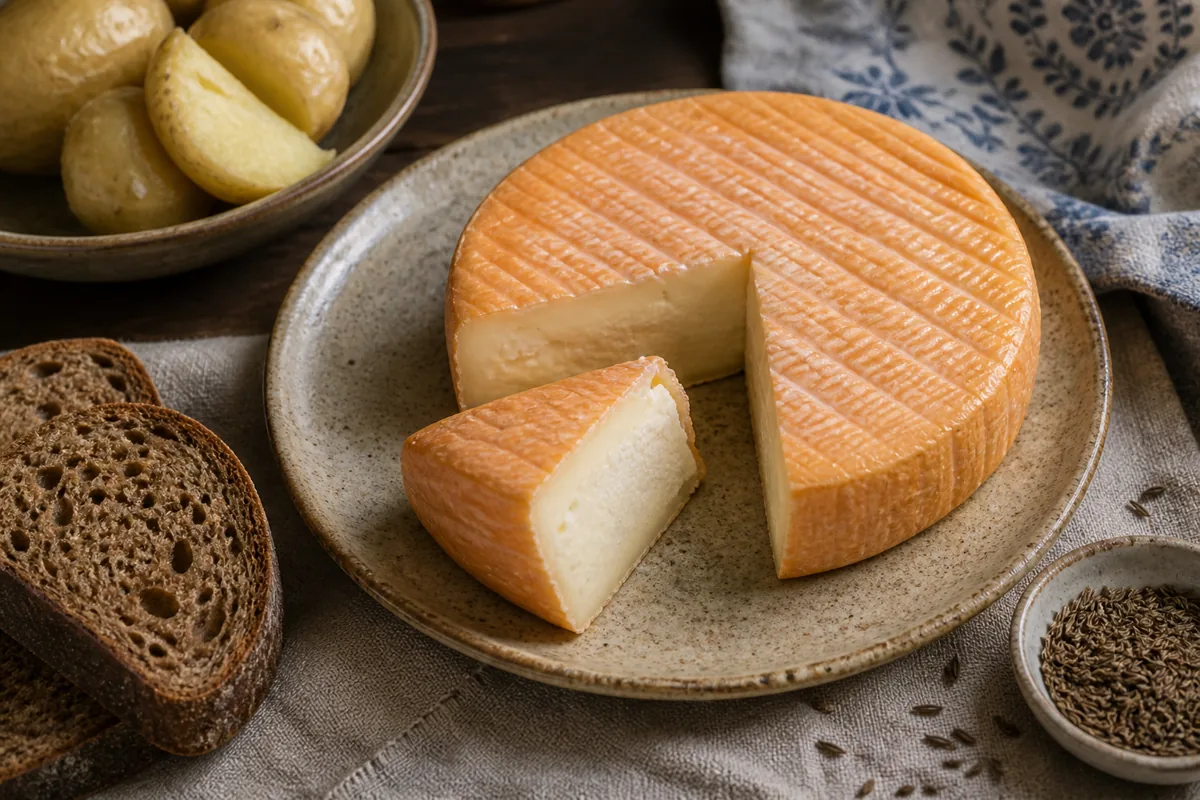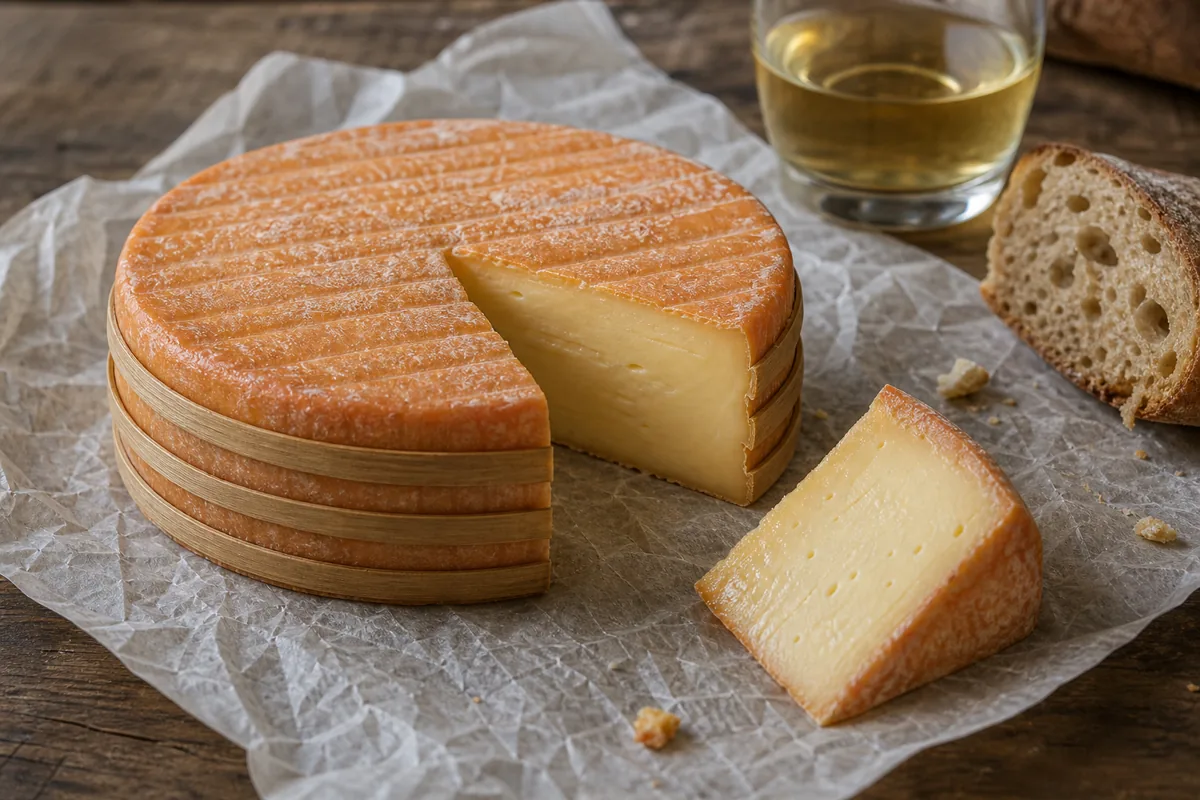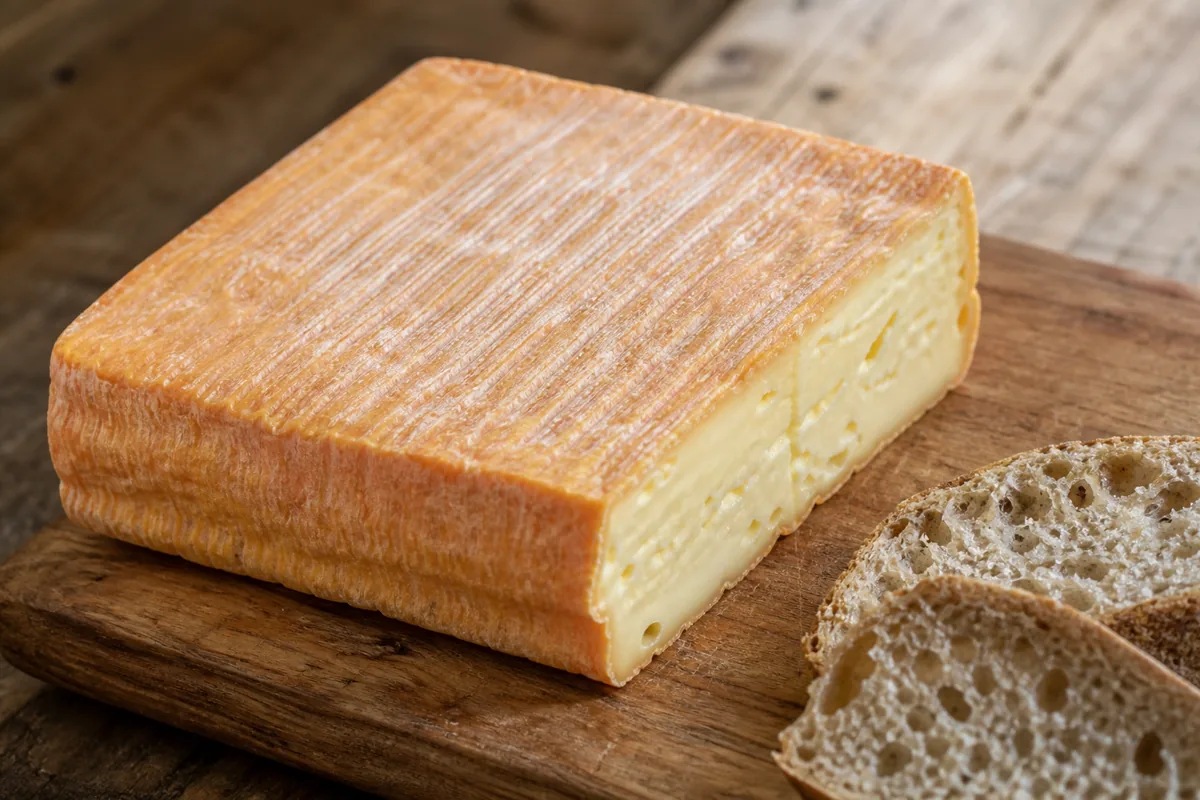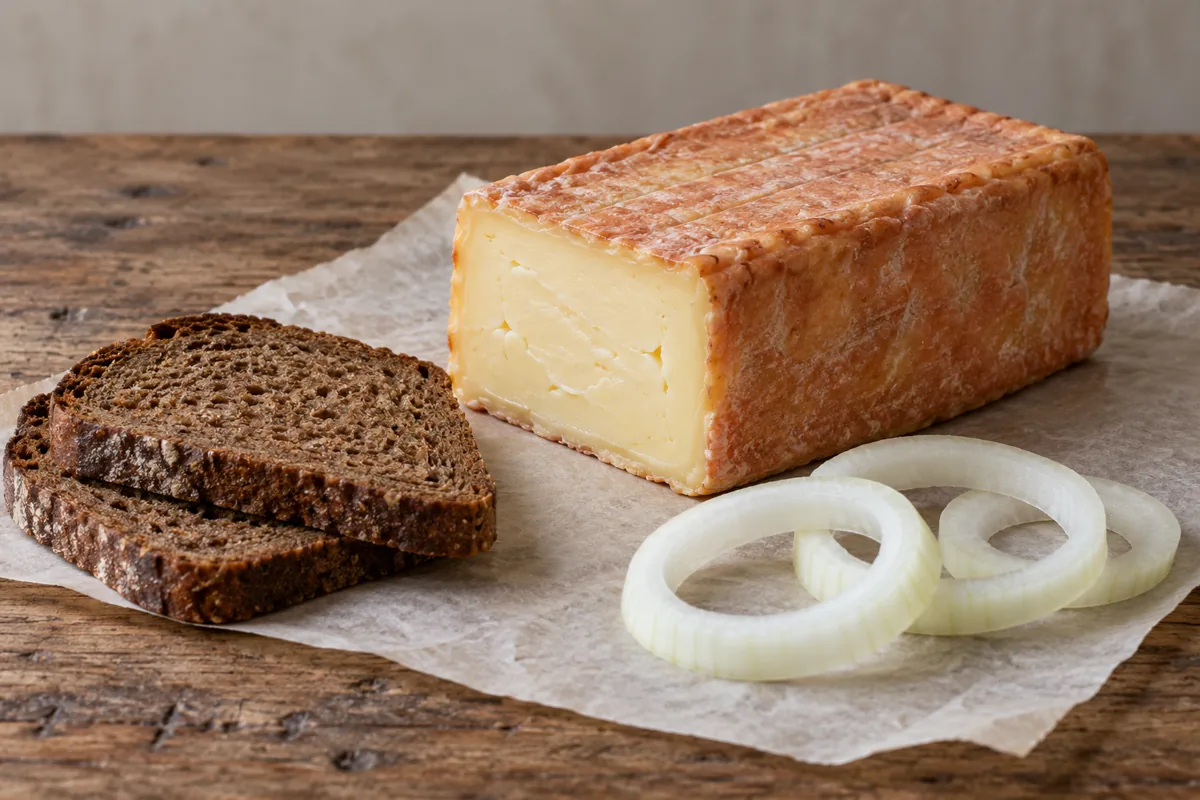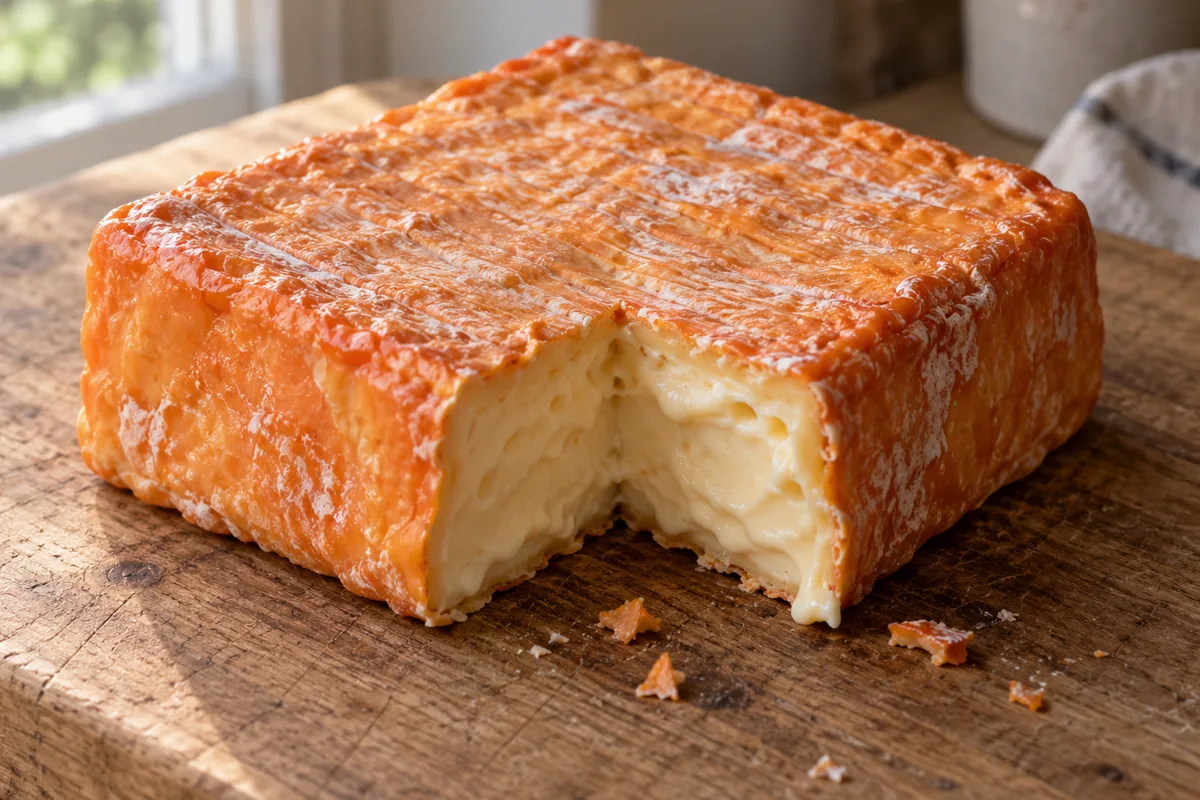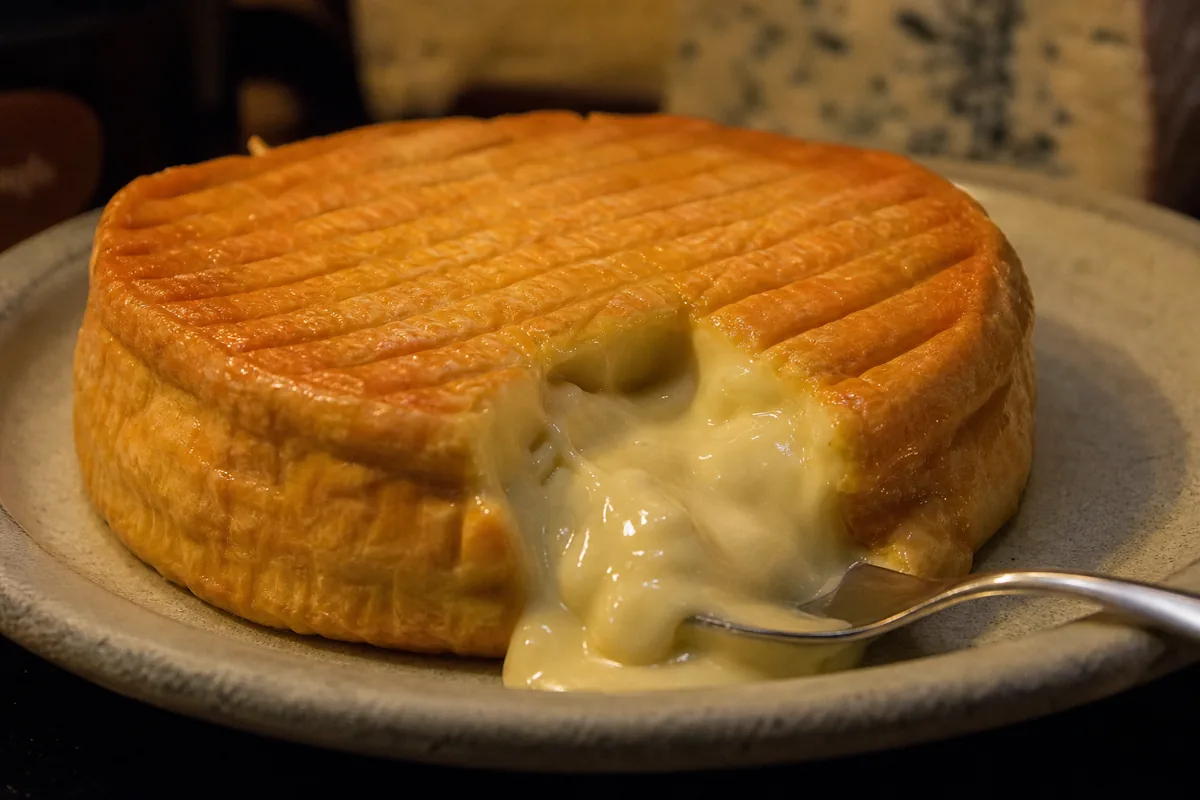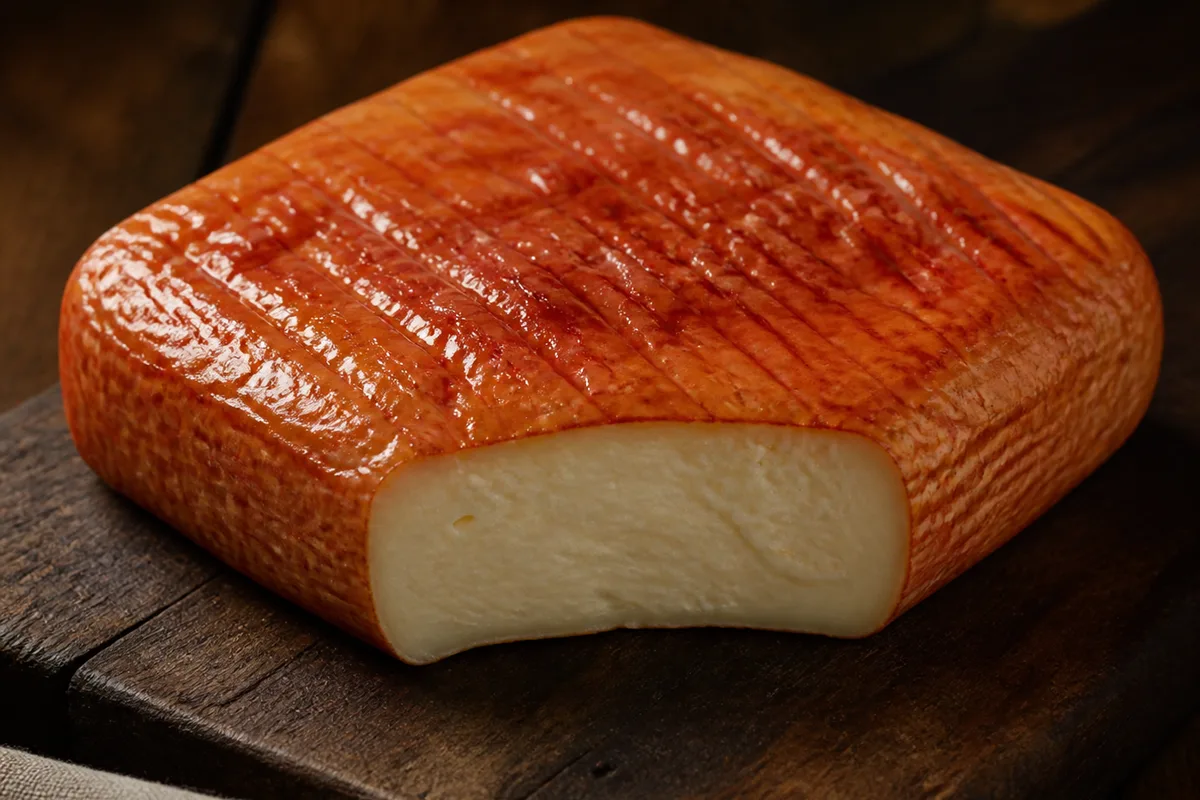
Maroilles is a square, washed-rind cheese made from cow's milk in Thiérache, a hedged farming region that straddles the Nord and Aisne departments of northern France.
INAO, the French body that oversees protected names, sums it up as a sustained odour set against the gentleness of the paste.
You can buy it in four AOP sizes, from the standard square down to the Quart, with minimum ripening of 21 to 35 days.
In This Article
What Does Maroilles Taste and Smell Like?
The smell comes first. INAO's June 2014 specification text describes a sustained odour of cellar, damp brick and undergrowth, with a slight ammonia note.
INAO's product page lists milky, lightly salty notes on a supple paste, and the specification adds acidity and a slight bitterness, with a curdled-milk flavour at the end of the minimum ripening and notes of hazelnut and garlic.
The same text describes a rich, creamy paste that is evenly white to cream with a few small mechanical and fermentation openings, and it says the faces of the square carry the marks of the ripening racks.
Paroles de Fromagers, a French cheese-trade site, says the cheese is “definitely not as strong as you think it is,” though the same page also calls its taste “strong, pronounced.”
Where Is Maroilles Made, and Why Is It Square?
Milk production, cheesemaking and ripening must all happen inside the AOP zone, which INAO places in the south of the Nord and the north of the Aisne, within the natural region of Thiérache.
The specification also ties the cows to the landscape: they graze at least 170 days a year, in bocage, the hedged pasture Thiérache is known for.
The square shape comes from the traditional moulds. INAO says they were first made from Thiérache forest wood so hard that it could not be bent into a round.
The specification names beech and ash for those moulds and contrasts them with the more pliable woods of other cheese regions, where round cheeses developed.
The AOP page traces the cheese to a monk at the Abbey of Maroilles in the 10th century, and English Wikipedia gives 962. INAO's 2011 specification text is more careful: medieval charters of 1174 and 1245 show the abbey's monks promoting cheesemaking, but it calls it conjectural to say they describe today's soft, washed-rind cheese.
That text finds Maroilles named as a distinct product in a French dictionary of 1723, under the spelling Marolles.
A court judgment of July 1955 at Château-Thierry upheld the name, and an AOC decree followed on 24 May 1976, with Wikipedia dating the AOP to 1996.
INAO's texts report the court's reasoning: the cheese draws its value from the area's milk, the bacterial flora particular to the region and cellars special to its subsoil, which the court held could not be matched in another region.
In 2020 the AOP page counted 117 milk producers, 6 farmhouse makers, 11 production plants and 2 maturing plants, marketing 4,286 tonnes.
What Do Maroilles Cows Eat?
On top of the 170 grazing days, INAO's June 2014 text gives each cow at least 30 ares of grass (3,000 square metres), and at least 15 of those ares must be grazed. It also requires hedges along at least 90 linear metres for every hectare of main forage area.
While the cows graze, grass must make up at least 65% of the coarse-fodder dry matter on average, and never less than 25% on any day. Concentrate feed is capped at 1,800 kg of dry matter per cow per year.
At least 80% of the coarse fodder eaten in a year must come from inside the zone, and the permitted list goes beyond grass to whole-plant maize, straw, lucerne and local by-products such as brewery grains, endive roots and beet pulp.
INAO ties the rules to the land: Thiérache gets more than 900 mm of rain a year on clay and marl soils that hold moisture, which suits grass but makes it hard to harvest and store, so other local fodder covers the gaps.
The hedges serve the pasture too: INAO says they shelter the grass from sudden temperature swings, keep moisture in and add to the variety of plants in the meadow, which it credits with influencing the cheese.
Neither specification text sets a breed. The local Maroillaise cow had no herd-book, was never dominant and has disappeared, and after the First World War herds could not be rebuilt from local breeds alone, according to INAO's 2011 text.
How Is Maroilles Made?
INAO's specification fixes the sequence from renneting to cellar.
- Renneting: the milk is first acidified with lactic starters, then renneted at 32 to 38 °C, with starters added within 72 hours of the oldest milking
- Moulding: the curd is cut into cubes, part of the whey is drained, and the curd sits in square moulds for at least 16 hours in a room at 16 °C or above, with at least three turns
- Salting: dry salt, dry salt followed by brine, or brine alone
- Drying: at least 48 hours in a dedicated room before the cellar, while Wikipedia describes about ten days in a ventilated area
- Cellar: bare brick, stone or an inert material, at 90% humidity or more and 9 to 16 °C
- Washing: brushing or washing with a salt solution that may be seeded with surface cultures, mostly Brevibacterium linens, with at least one brushing required
The washing does two jobs. According to INAO's 2011 text, constant care with brush and salt water speeds the settling of the red-orange ferments and keeps the blue moulds that Thiérache's climate favours from persisting on the surface.
The same section says the rind is washed several times in salt water, yet the only fixed minimum is one brushing, so how often it is washed is left to the ripener as the cheese develops.
Sources also disagree on the mould being cleared: INAO's 2011 text and French Wikipedia name blue mould, while English Wikipedia names a natural white mould.
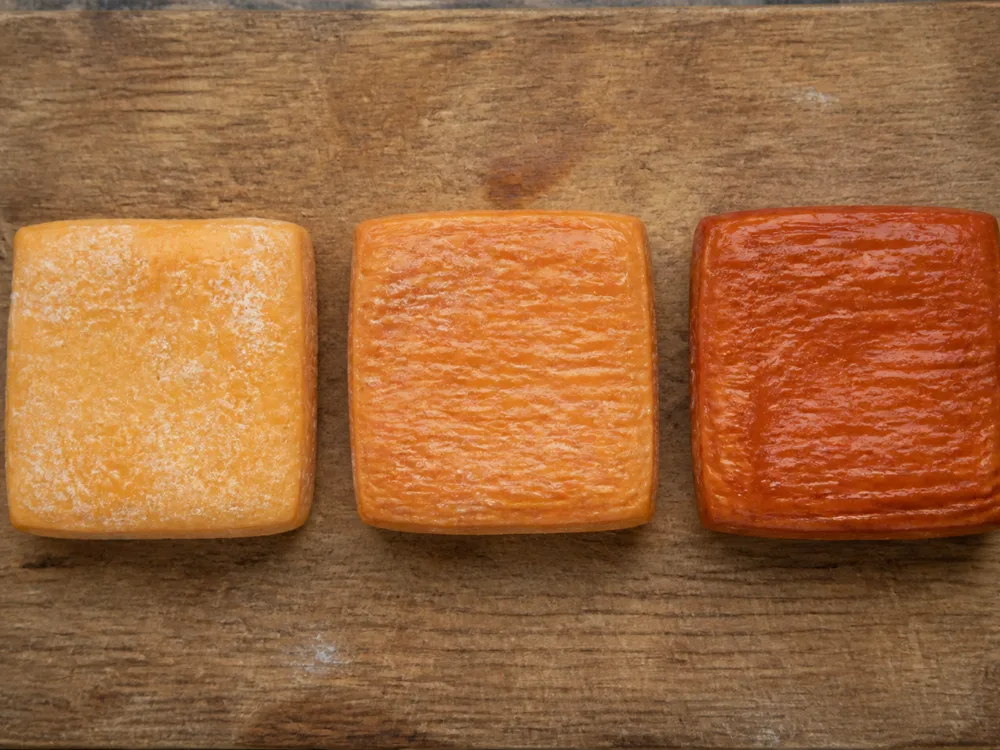
The colour is not added. The specification bans all colourants and says the orange comes only from the natural red ferments.
Why Does Maroilles Ripen in Damp Cellars?
French Wikipedia credits the red ferment, Brevibacterium linens, with making the carotene that colours the rind orange and with much of the cheese's strong aroma and flavour.
Farm cellars were of brick, sometimes blue stone, damp, aired and mild, and faced south-west, conditions INAO says suit the red ferment. Today's cellars may use inert materials instead of brick, but INAO's 2011 text says the original atmosphere is recreated faithfully.
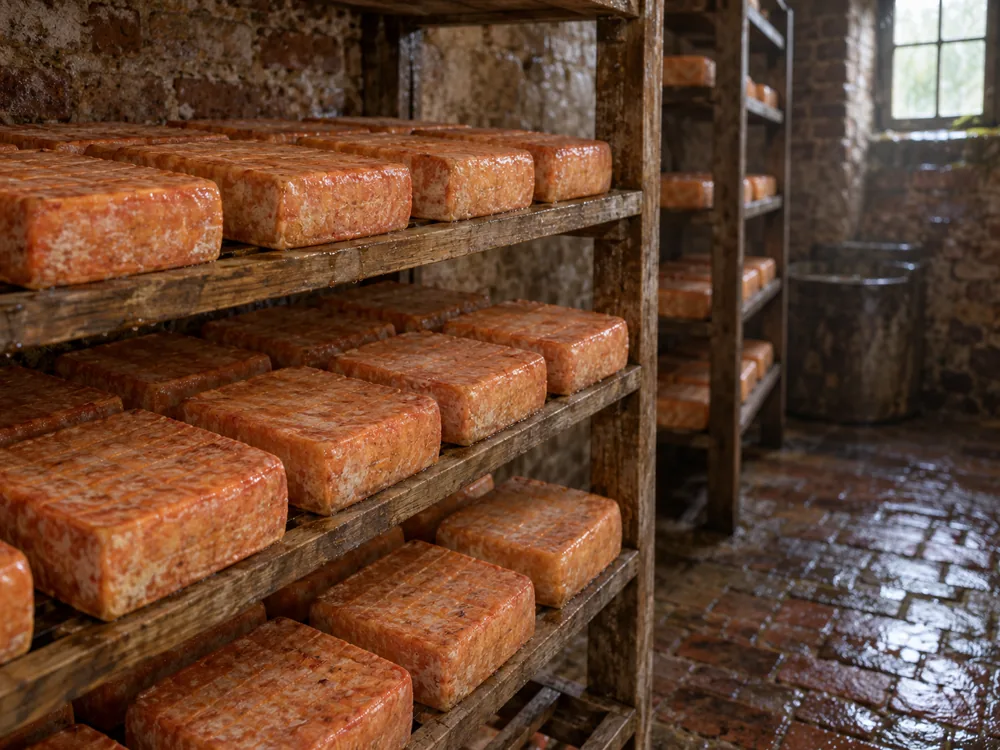
Maroilles began as a farm cheese, with the farmer ripening and selling it. From the end of the 19th century, ripeners bought the unripened cheese, called Maroilles blanc, at markets or farms and brought it to maturity in their own cellars.
What Are the Four Maroilles Sizes?
The AOP covers the standard square and three smaller formats, Sorbais, Mignon and Quart, and the minimum ripening is counted from the day the milk is renneted.
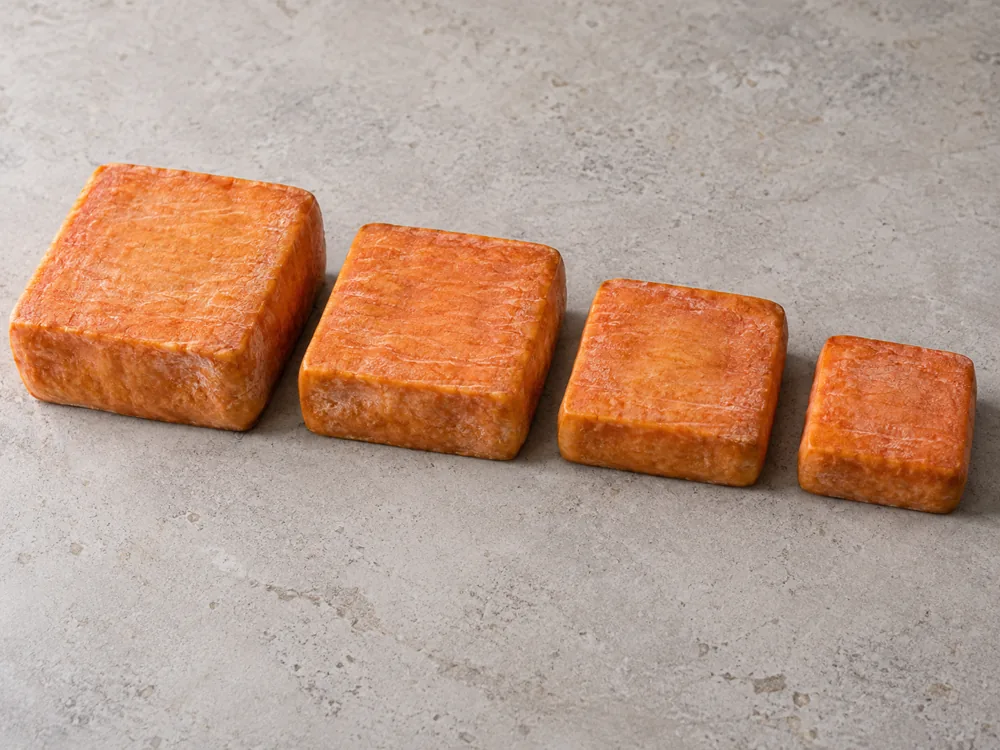
| Format | Mould side (INAO) | Height (Wikipedia) | Weight (Wikipedia) | Minimum ripening (INAO) |
|---|---|---|---|---|
| Maroilles, standard | 12.5 to 13 cm | 6 cm | About 700 g | 35 days |
| Sorbais | 12 to 12.5 cm | 4 cm | 550 g | 28 days |
| Mignon | 11 to 11.5 cm | 3 cm | 350 g | 28 days |
| Quart | 8 to 8.5 cm | 3 cm | 180 g | 21 days |
Because the count starts at renneting, the clock runs through the drying days before the cheese reaches the cellar.
Sources split on the two smallest formats: INAO's table gives 28 days for Mignon and 21 days for Quart, while Wikipedia gives three weeks and two weeks.
English Wikipedia's weeks match the older 1986 decree that INAO's page still lists, which counts five, four, three and two weeks from the day of manufacture. The 2011 and 2014 specifications count days from renneting instead, so INAO's figures are the later ones.
The names are fractions of the standard square: French Wikipedia labels Sorbais ¾, Mignon ½ and Quart ¼. Its weights of about 540, 360 and 180 g are exact fractions of the 720 g it gives the standard, which it also calls Gros.
The AOP page says smaller sizes tend to be sweeter and suggests them to delicate palates.
INAO's minimum dry matter per cheese follows the same steps: 360 g for the standard square and 270, 180 and 90 g for the Sorbais, Mignon and Quart.
All four formats must contain at least 45 g of fat per 100 g of dry matter. With the required 50 g of dry matter per 100 g of cheese, INAO's specification translates that to at least 22.5 g of fat per 100 g of cheese.
On the label, INAO's 2014 text requires the appellation name in letters at least two thirds the size of the largest lettering, together with the INAO logo and the EU AOP symbol.
It allows no other qualifier beside the name except trademarks and the words Sorbais, Mignon or Quart, and it asks for no age statement, so the format word is the only wording that points to a minimum ripening.
To choose a size, read the format word beside the AOP name: it fixes the minimum ripening at 35 days for the standard square, 28 for Sorbais and Mignon and 21 for the Quart, counted from renneting. The AOP page's remark that smaller sizes are sweeter comes with no measurement.
How Does Maroilles Change as It Ripens?
INAO's product page says a chalky heart is present at the end of the minimum ripening, and that in a longer-aged cheese the heart recedes and the aromas become franker.
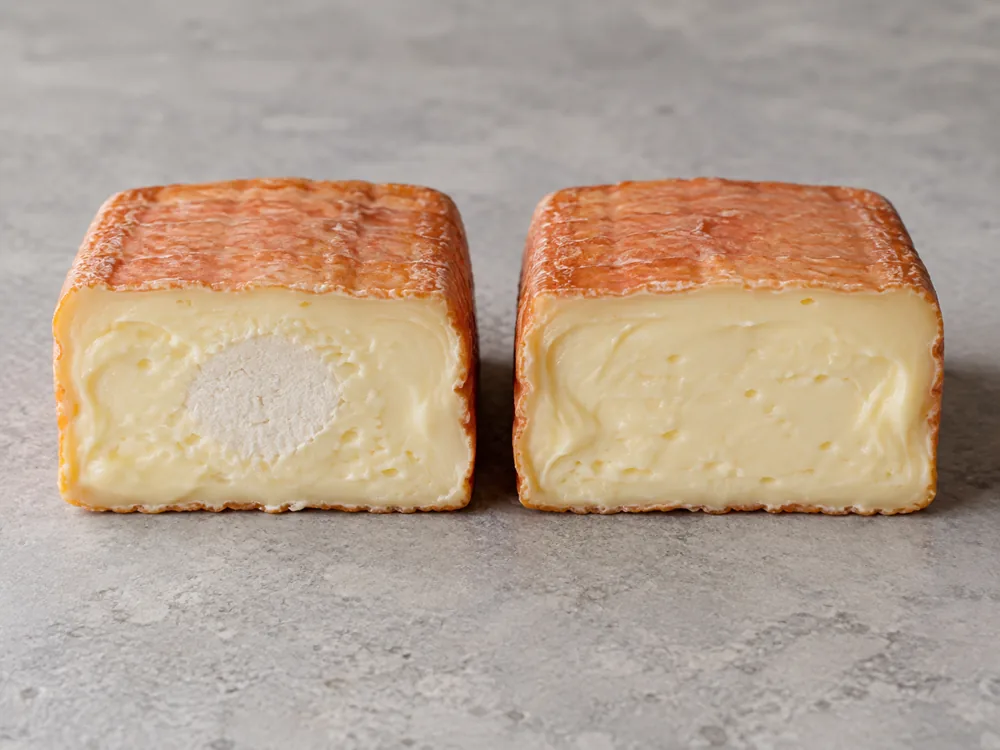
The specification calls the ripening centripetal, working from the rind inward, so the centre is the last part to soften.
The specification describes the same shift in the paste: supple to the touch, with a firmer centre that softens as ripening continues, and a flavour that grows more powerful and more typical of the cheese.
Past the minimum, Wikipedia says cellar periods of up to four months are not uncommon.
The ranges for a best age differ widely. The AOP page gives 3 to 5 weeks depending on size, French Wikipedia puts the optimum at 5 to 7 weeks for an average 700 g square, and English Wikipedia's infobox spans 2 to 16 weeks.
French Wikipedia also gives two seasons, July to March citing Le Monde and May to August after 8 to 10 weeks of ripening, while INAO's 2011 text describes production as having no seasonality. Because the ranges overlap rather than agree, the cut face, where INAO says the chalky heart recedes with age, is a more direct check than the calendar.
If you check the rind, the specification says a sound square is evenly red to orange and more or less damp.
Is Maroilles Made With Raw Milk and Animal Rennet?
The specification allows three treatments for the cow's milk: raw, thermised or pasteurised. Wikipedia describes both a pasteurised industrial version and an unpasteurised farmhouse version.
Farmhouse cheese is a small share. Wikipedia reports that about 6% of the 2,126 tonnes made in 2005 came from ten farmhouse producers, and French Wikipedia lists 265 tonnes from 11 farmstead producers against 3,867 tonnes from three industrial processors in 2013.
The AOP page's own tag reads raw milk, but the specification it summarises allows raw, thermised and pasteurised milk, so the tag is not a rule for every square.
When you pick up a square labelled AOP Maroilles, the name alone does not tell you the milk treatment.
The rennet is stated without ambiguity: the specification requires rennet from calf's stomach, so Maroilles is not vegetarian.
The specification lists the only other additions: harmless cultures of bacteria, yeasts and moulds, calcium chloride and salt. It allows skimming but bars standardising the protein and bars concentrating the milk before coagulation.
Can You Eat Maroilles When Pregnant?
If you are pregnant, neither the NHS nor the CDC names Maroilles or washed-rind cheese as a group, so the answer rests on what each says about soft cheese, raw milk and heat.
The CDC lists soft cheese made from unpasteurized milk, with queso fresco, brie, camembert and blue-veined cheese as its examples, among the riskier choices, and says pregnant women are 10 times more likely to get a Listeria infection. INAO describes Maroilles as a soft cheese and the AOP allows raw milk, so a raw-milk square fits that description.
The NHS lists any food made from unpasteurised milk, with soft ripened goats' cheese with a white coating as its example, among the foods that must be thoroughly cooked, and says unpasteurised or soft ripened dairy foods may contain listeria.
On heat, the NHS counts any cheese cooked until steaming hot, including soft cheese, as safe, and the CDC lists pasteurized soft cheese heated to an internal 165°F or until steaming hot as safer.
The published tart recipes below give oven times but no internal temperature, so they do not show whether a slice reaches that point.
How Do You Eat Maroilles?
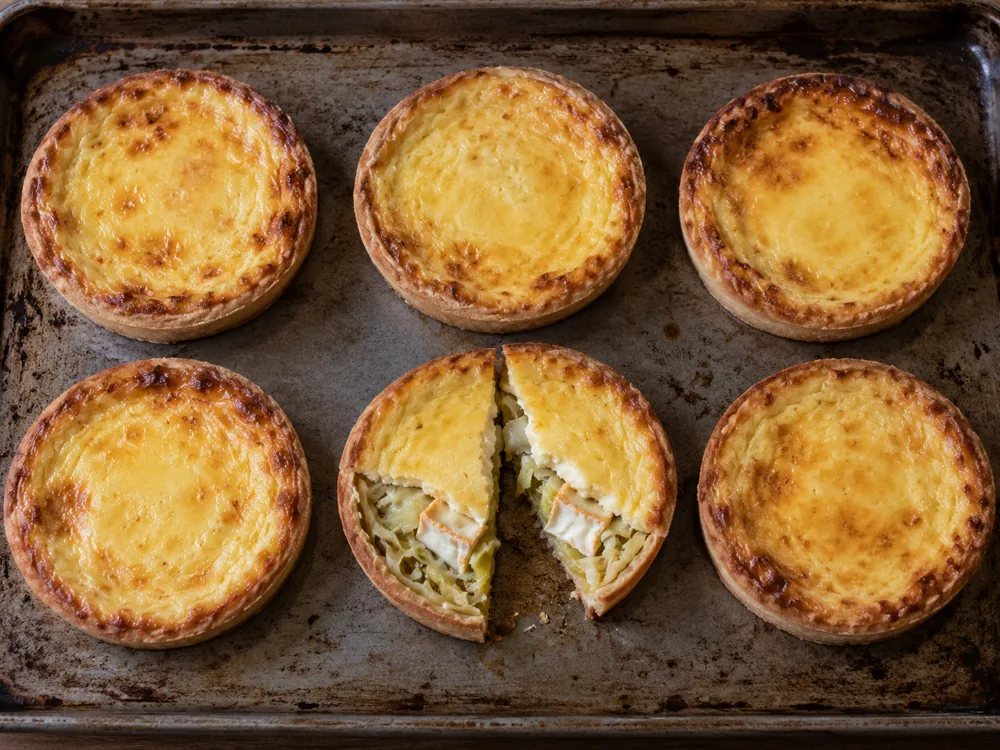
The dish most tied to the cheese is the tarte au Maroilles, called flamiche or goyère depending on the source, and the AOP page lists it as a popular recipe.
| Source | Base | Maroilles | Filling | Oven |
|---|---|---|---|---|
| Qui veut du fromage | Bread dough in 12 cm tartlet moulds | 200 g, diced or thinly sliced over 320 g of leeks | 2 eggs, 150 ml semi-skimmed milk, pepper | 190 °C for 25 minutes |
| Paroles de Fromagers | Shortcrust pastry | 250 g, sliced on the base, with caramelised onion on top | 2 eggs, 20 cl heavy cream, salt, pepper | 180 °C for 30 to 35 minutes |
Two things hold across both: the cheese goes into a baked custard of eggs and dairy, and it is sliced or diced rather than grated. The base changes from shortcrust to bread dough, and the vegetable is leek in one and caramelised onion in the other.
Four more dishes on Paroles de Fromagers show the cheese used in other ways: melted into a cream sauce, baked in slices on pork or between potato layers, and tossed cold into a leek salad.
| Dish | Maroilles | How the cheese goes in | Heat |
|---|---|---|---|
| Chicken with Maroilles and mushroom sauce | 200 g, diced | Stirred with 200 ml of crème fraîche into the pan until melted and the sauce is hot and creamy | Stovetop, medium-low heat |
| Pork tenderloin with Maroilles | 150 g, sliced | Laid over browned tenderloins spread with Dijon mustard, with hot crème fraîche on the side | Oven at 200 °C for 15 to 20 minutes, until melted and lightly browned |
| Potatoes with Maroilles | 150 g, sliced | Layered over 1 kg of sliced potatoes with garlic and finished with a top layer, then 200 ml of cream poured over | Oven at 180 °C for 45 minutes to 1 hour |
| Leek salad with Maroilles | 150 g, diced | Tossed with 4 blanched leeks and a balsamic vinaigrette, then chilled at least 30 minutes | None for the cheese, served cold |
French Wikipedia adds that Maroilles traditionally goes into sauces for pork filet mignon or roast rabbit, and that a goyère is a savoury tart served as a hot starter.
If you serve Maroilles on a board, the AOP page names seeded baguette, sourdough, country bread and herb baguette, and its list goes on to bread with lardons, sesame baguette and raisin or fig bread.
What Do You Drink With Maroilles?
If you want a drink with Maroilles, beer is the match that turns up most often, in two of the three sources below.
- AOP page: amber beer, Loire, Burgundy and Bordeaux reds, brut champagne, dry whites from Burgundy, Alsace and Savoie, pommeau, apple juice and sparkling rosé
- French Wikipedia: beer as the usual match, including abbey beers and high-fermentation ales such as 3 Monts and La Choulette, and champagne, though the wine loses finesse
- Paroles de Fromagers: coffee, a common pairing in parts of the former Nord-Pas-de-Calais
If you prefer red wine, the sources disagree. The AOP page lists reds from the Loire, Jura, Bordeaux, Burgundy and Rhône, while French Wikipedia, citing Pierre Casamayor, says light reds are overwhelmed by the cheese's strong aromas and a more structured wine can turn metallic.
The same French Wikipedia passage has Casamayor also allowing an aged marc de Bourgogne or marc de Champagne and a very aromatic white such as a late-harvest Gewurztraminer.
Paroles de Fromagers calls the coffee pairing surprising, combining the intensity of the cheese with the richness and bitterness of the coffee. French Wikipedia ties the habit of dipping Maroilles in coffee to the breakfast scene in the film Bienvenue chez les Ch'tis, and words it as a practice the region's inhabitants are said to have.
Is Vieux Lille the Same as Maroilles?
Vieux Lille starts as a Maroilles and is taken much further. French Wikipedia describes a Maroilles paste made in the Avesnois, salted twice, whose ripening is stretched over several months by repeated washing in salt water.
After 5 to 6 months the paste turns greyish and sticky, and the cheese keeps longer than Maroilles. It has no rind and a slightly ammoniacal smell, and its taste is stronger, saltier and a little sharp.
It was originally made for winter, French Wikipedia says, when neither milk nor cheese could be found.
It goes by Gris de Lille and Puant de Lille, and was formerly called Maroilles gris. French Wikipedia treats Fort de Béthune as a separate product, made from leftover cheeses worked with white wine.
Boulette d'Avesnes is another derivative. French Wikipedia says it is hand-shaped into a cone from fresh white Maroilles mixed with parsley, tarragon and cloves, then coated in paprika or annatto, which gives it a red-brown colour and a slightly sharp, acrid taste.
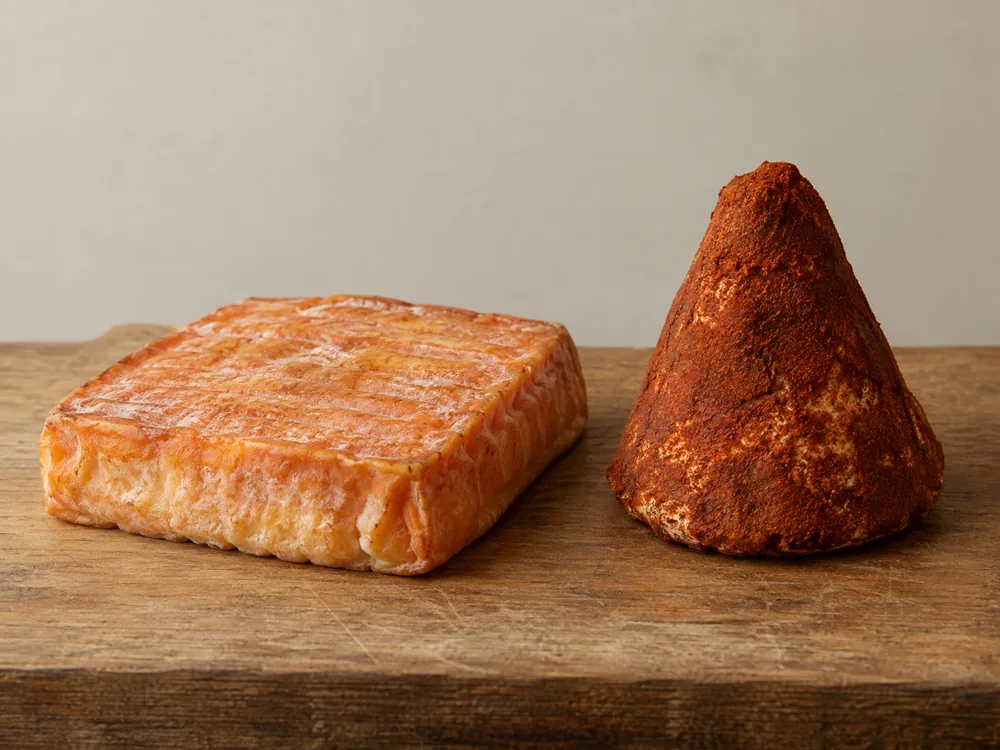
INAO's specification lists only the standard square and the Sorbais, Mignon and Quart as AOP formats, and Vieux Lille is not among them.
Which Cheeses Are Similar to Maroilles?
If you want a similar cheese, Paroles de Fromagers names Munster from Alsace as sharing Maroilles's characteristics, and Limburger as the one better known in the United States.
The match with Munster and Limburger rests on the shared washed-rind style.
French Wikipedia lists the cheeses ripened with the same red-ferment strain, Brevibacterium linens: Munster Géromé, Époisses, Fourme de Montbrison, Năsal, Limburger, Herve, Tilsiter and Appenzeller.
The semi-hard Appenzeller is on that list, so the shared strain says more about rind colour than about texture.
English Wikipedia names a closer relation, a Maroilles family of northern French cheeses made by very similar methods: Baguette Laonnaise, Boulette d'Avesnes, Boulette de Cambrai, Cœur d'Arras, Cœur d'Avesnes, Dauphin, Gris de Lille, Guerbigny and Rollot.