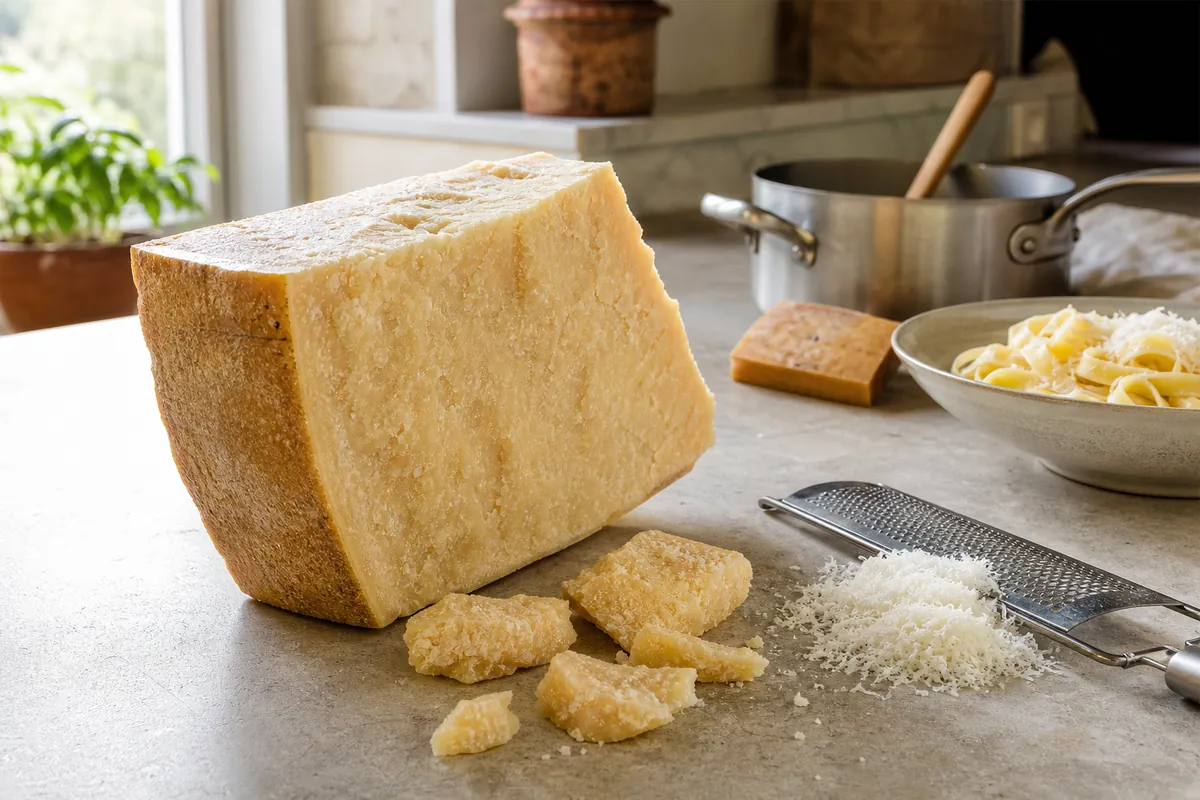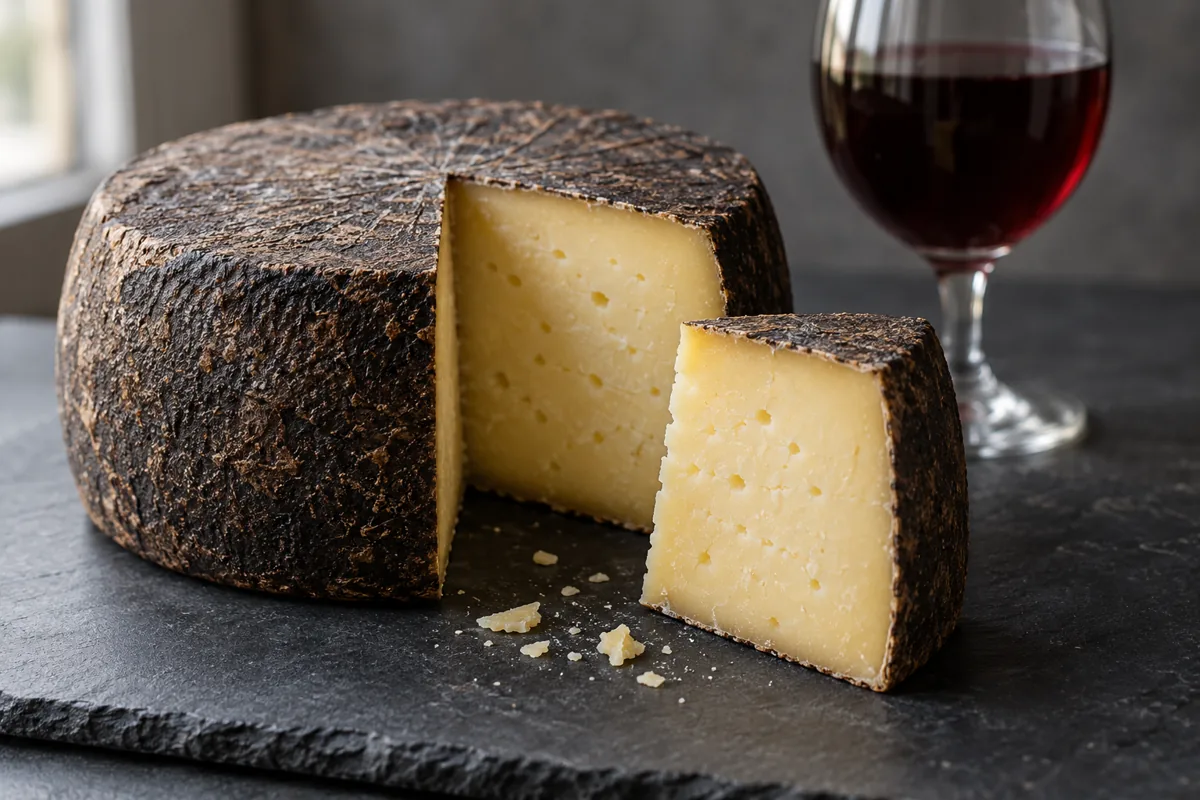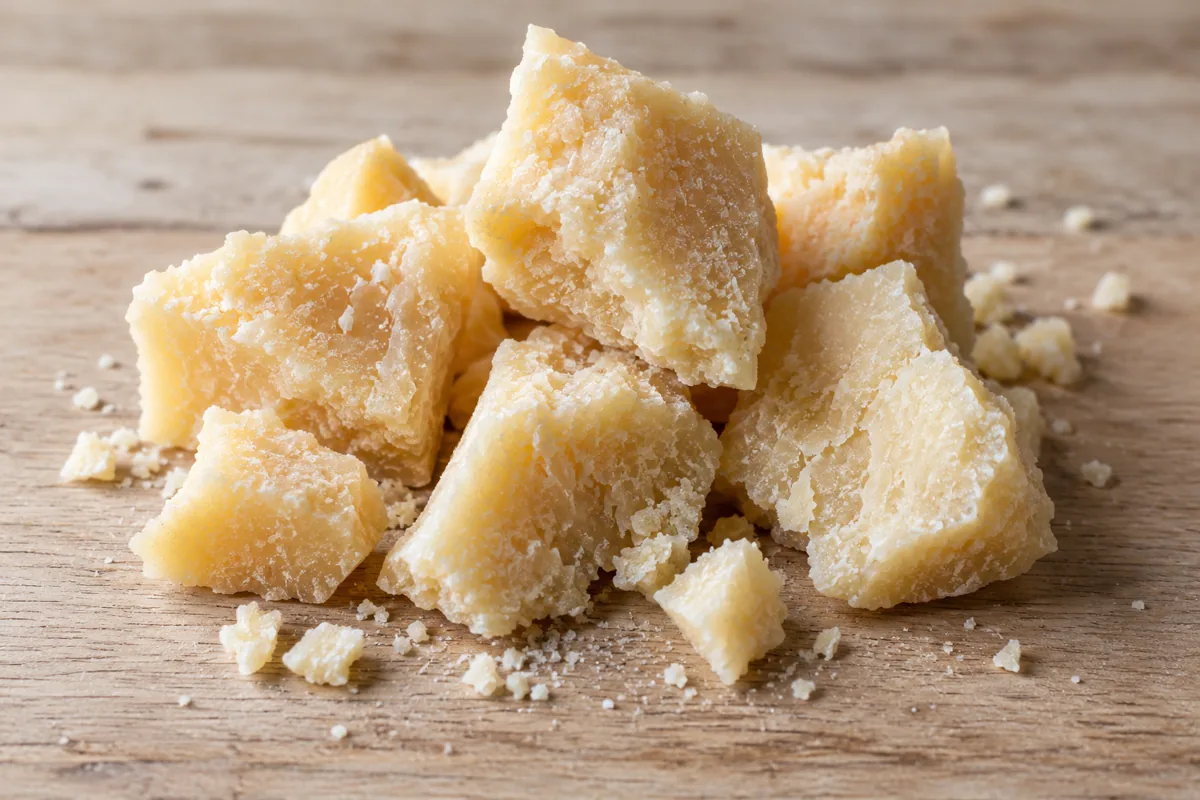
Sbrinz is an extra-hard, full-fat raw-milk cheese from Central Switzerland. Its wheels mature standing on edge for at least 18 months, and that long drying period is what lets you plane a younger piece into curls, break an older one into chunks or grate either over food.
Age and serving form belong together. If you buy solely by the name, you may come home with a brittle wedge when you wanted curls or a younger roll when you wanted crystalline chunks.
At the grater, Sbrinz can work as an alternative to Parmesan. Beyond that shared use, full-fat milk, a silage ban, upright ripening and the curl-to-chunk progression give the Swiss cheese its own logic.
In This Article
What Is Sbrinz?
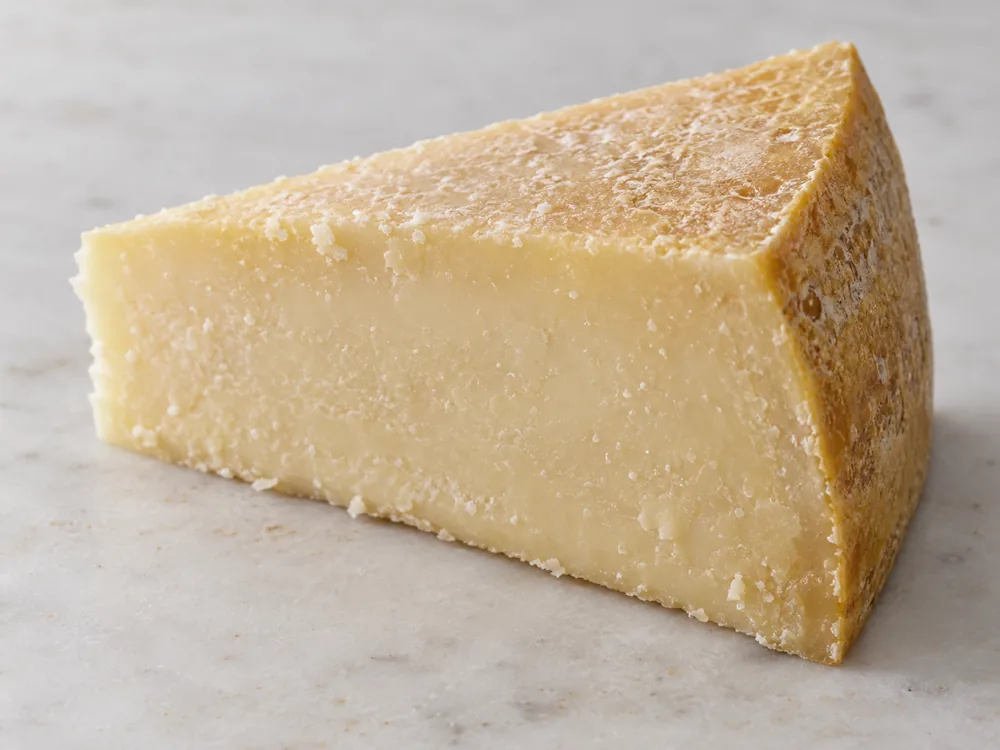
The protected cheese has an extra-hard ivory-to-pale-yellow paste, a firm dry rind and a slightly convex side. Its registered production area covers Lucerne, Schwyz, Obwalden, Nidwalden and Zug, plus defined milk zones in St. Gallen and Aargau.
A wheel weighs 35 to 48 kilograms, so most buyers meet Sbrinz as a portion, planed rolls, broken chunks, or grated cheese.
Some directories stop at 45 kilograms, but the registered range reaches 48, a difference that matters only when you buy a whole wheel.
The paste should be ivory to pale yellow and closed. The specification allows no holes or a few up to about 6 millimeters.
Sbrinz has a long trading history, with a written reference from 1530 to a “Brientzer käss.” At that point the wording identified a place of origin; the modern protected name developed later.
By the 17th century, the word had travelled back from Italy and was being used for full-fat hard Alpine cheese from Central Switzerland and the Bernese Oberland. That cross-border history helps explain why Sbrinz is so often compared with Italian grating cheeses today.
What Are the Milk and Feeding Rules for Sbrinz?
Sbrinz is made exclusively from raw milk, and the specification forbids thermizing or pasteurizing it first. The only treatment it allows before cheesemaking is storage in a refrigerated tank.
Farms must milk inside the protected area, and no farm may sit more than 30 kilometers from the dairy. Rennet goes in no later than 24 hours after the last milking that supplies the batch.
On those farms, the cows live mainly on permanent meadow grass and hay from the area, and that roughage has to supply at least 70 percent of their ration on a dry-matter basis.
Silage cannot even be stored on the farm, and peanut cake and urea-containing feed are banned too, so a retailer's “grass and hay only” summary is close to the rule but turns a 70 percent minimum into an absolute.
No cattle breed is mandatory, although Brown Swiss supplies most of the milk in trade descriptions. A 45-kilogram wheel can absorb more than 600 litres, or about 160 US gallons, so even a small retail wedge represents a substantial volume of milk.
How Sbrinz Is Made
At the dairy, the raw milk is partly skimmed and worked in a copper vat with rennet and mostly thermophilic lactic cultures.
Tradition points to calf rennet, yet some retail Sbrinz is labelled vegetarian. If the rennet decides your purchase, check the package or ask the seller about that wheel.
After pressing, the specification has the dairy store the hooped wheels until salting, which stops them from sagging and gives the wheel its cylindrical form.
After brining, workers wash the wheels with a brush or coarse cloth to make the surface smooth and even, and they soften the angles by hand where the flat face meets the convex side.
Why Sbrinz Ages Standing Up
Every wheel ripens standing on edge and spends its first 12 months under care inside the protected area.
That practice becomes striking at the St. Karli warehouse in Lucerne, where up to 60,000 wheels stand on edge and part of the store lies below the Reuss river's water level.
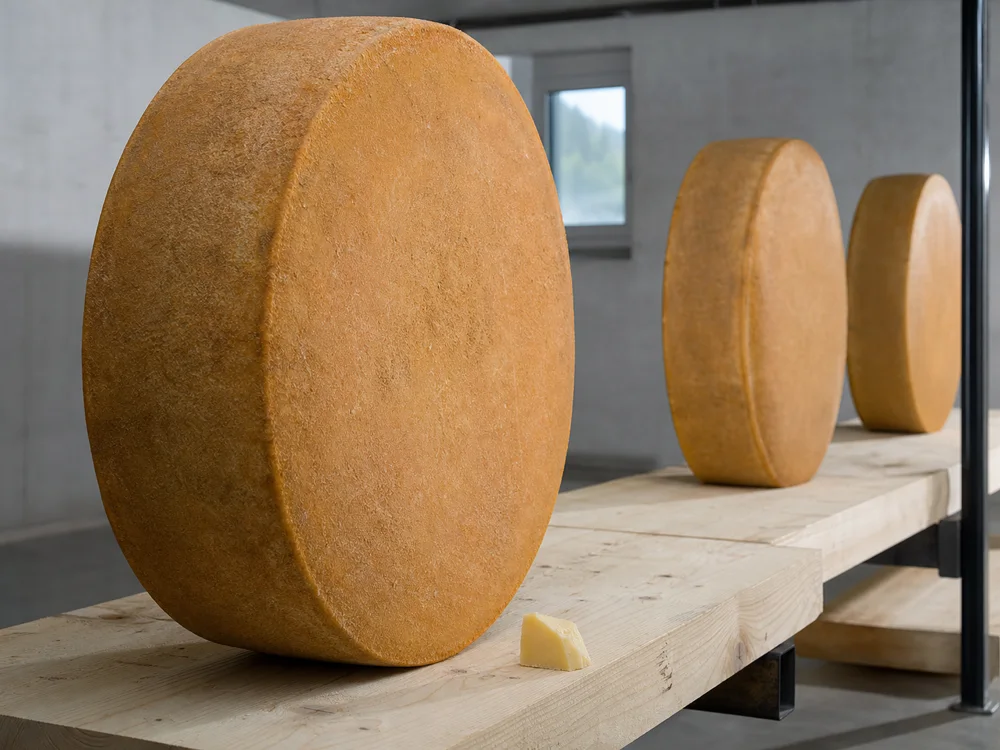
The wheels are judged well before they reach you. Buyers first classify deliveries at about four months, then a neutral AOP commission examines the Class 1 lots at 11 to 12 months.
The specification scores holes, paste, aroma, and exterior shape and keeping quality at up to 5 points each. A wheel may carry the Sbrinz name only with at least 18 of 20 points, no criterion below 4, and no downgrade later in ripening.
The quality score sheet rewards a closed paste most highly and lowers the score as holes become larger or more numerous. That is why an occasional opening can be acceptable without making a holey wedge typical.
Because the total must reach 18, a wheel that scores 4 for holes needs 14 of the other three criteria's 15 points, so holes beyond the specification's 6 millimeters pass only when everything else is close to perfect.
How Does Age Determine the Serving Form?
Sbrinz cannot reach consumers before 18 months, but that date is only the first useful stage. The texture keeps drying after release, so the form on the pack becomes a practical guide to how you should serve it.
| Age or label | What changes for you |
|---|---|
| 18 months | First legal release; pliable enough for wafer-thin Hobelrollen |
| 22 to 24 months | Fuller flavour and a harder body suited to grating or breaking |
| 30 months, Gold Label | A named premium stage in the producer's quality rules |
| 36 to 48 months | More crumbly, crystalline and assertive on a cheese board |
There is a small grey area between 22 and 24 months: the quality rules allow non-planed forms from 22 months, while practical serving guidance often waits until about 24 months for chunks. At the counter, simply tell the seller whether you want curls or pieces that fracture cleanly.
Around two years, the paste becomes harder and more willing to fracture than bend. A roll for curls and a wedge for chunks are different purchases, even when both carry the same protected name.
The quality rules count age from the production month to the delivery month or delivery-note date, so a stage is a count of months, not days.
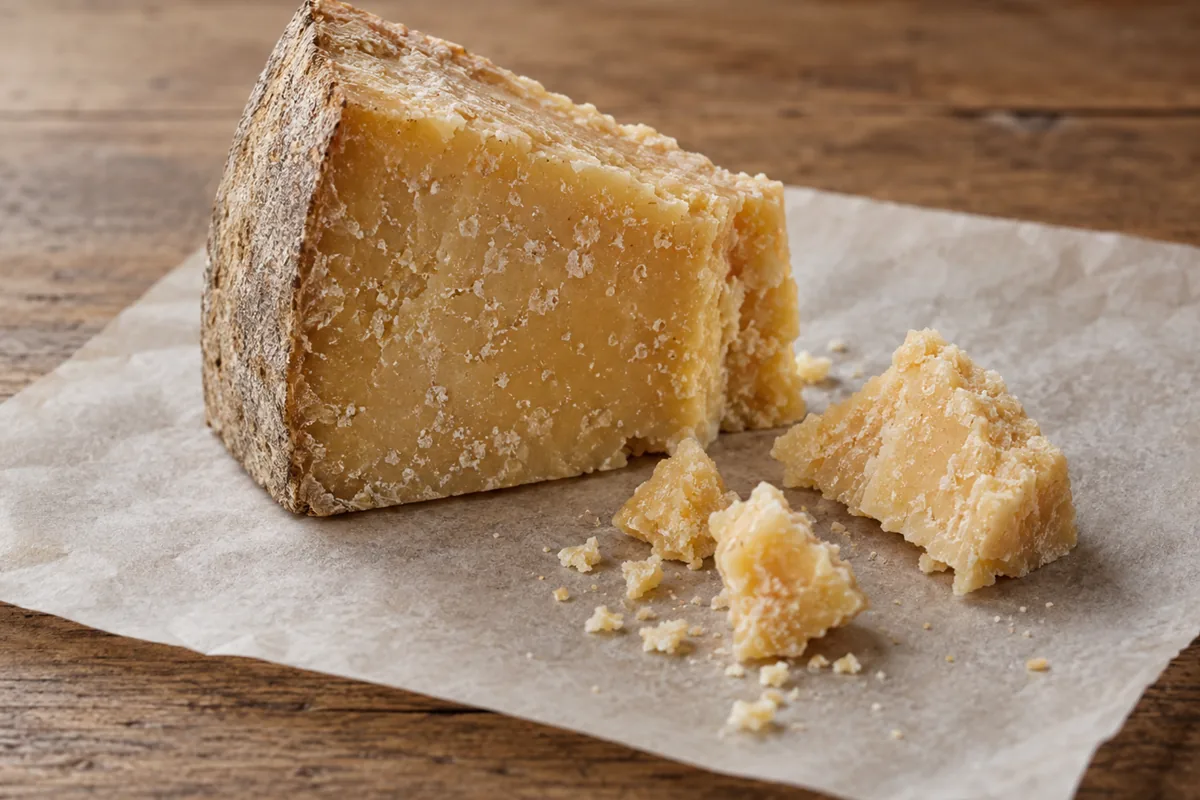
At 36 to 48 months, expect a crumblier paste, finer crystals and a stronger flavour. Very old Sbrinz can keep intensifying, but age is useful only when it matches the texture you want.
For a cheese platter, a three- to four-year wheel gives you the most obvious crystals and spicy aroma. For a salad or aperitif curl, the younger stage is easier to handle and usually more elegant.
Planed curls start at 18 months. Chunks become practical from 22 to 24 months, and cheese of 36 months or more is crumblier, with fine crystals.
What Does Sbrinz Taste Like?
You can expect fruit, spice and lightly roasted notes, with roasted chicory behind the fruit and a faintly astringent finish. The dry, grainy paste makes those flavours feel more concentrated than they would in a moist table cheese.
A younger piece can still feel fairly mild and fruity, while a three-year wedge tends toward nutty, spicy intensity. Crystals and crumbliness become more noticeable as moisture leaves the paste.
Between your fingers, the paste yields only slightly before it breaks. Its dry, faintly adhesive body and grainy crystals explain why Sbrinz works so well as a shaving, chunk or grated finish.
Age pushes the aroma and spice forward, but it does not erase the fruit. At 18 to 22 months you still get a comparatively gentle version; older wedges trade some of that restraint for savoury depth.
Two wheels of the same age can still differ slightly, because summer pasture, winter hay, the dairy and the cellar all leave small traces.
How Should You Serve Sbrinz: Curls, Chunks, or Grated?
Planed curls, broken chunks and grated cheese each suit a different age of Sbrinz, so match the form to the piece you actually bought.
For wafer-thin Hobelrollen, start with younger Sbrinz and use a Sbrinz plane or an ordinary vegetable peeler. Pre-packed curls save the work, but cutting them yourself lets you serve them before they dry at the edges.
Let the piece lose its refrigerator chill briefly before planing; a very cold wedge is more likely to splinter than curl. The same practical guide moves to broken chunks at about 24 months, when the harder paste begins to favour fracture.
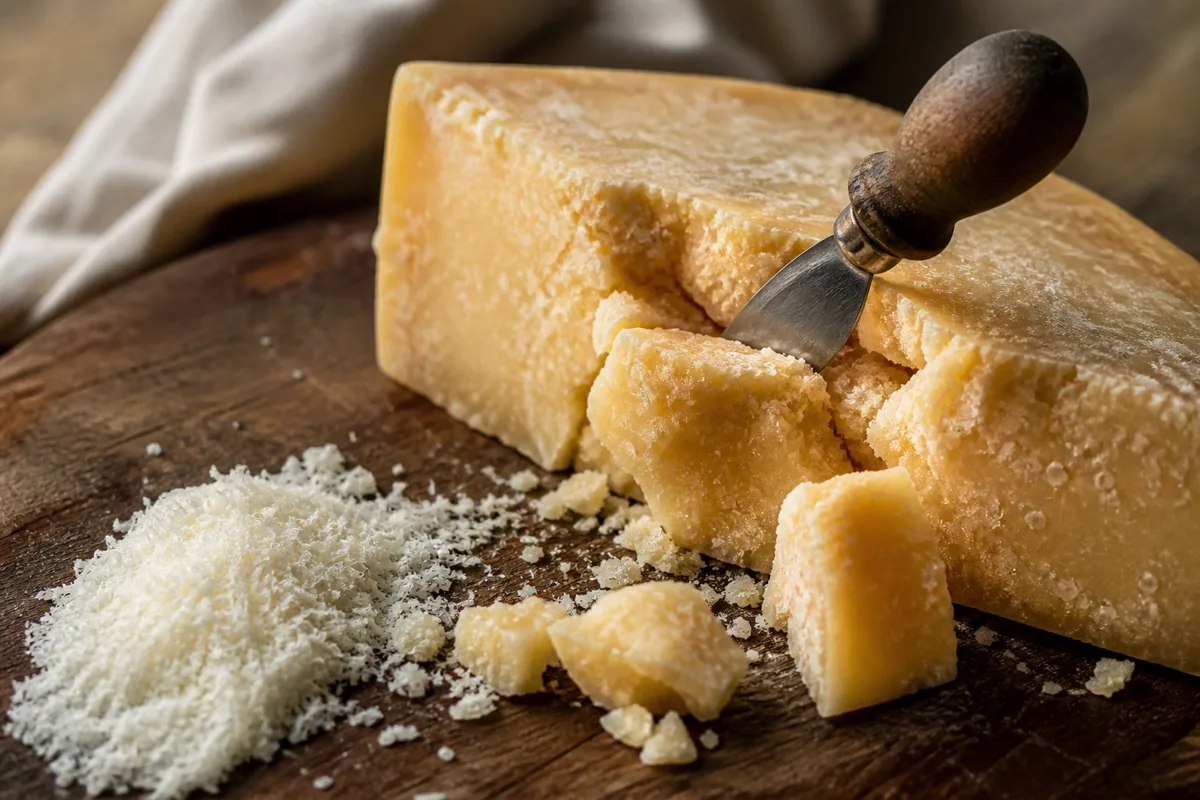
To make chunks, set the pointed, slightly curved Sbrinz cutter into a ripe wedge and lever off irregular morsels. A normal slicing knife fights the brittle structure and often leaves you with thin crumbs instead.
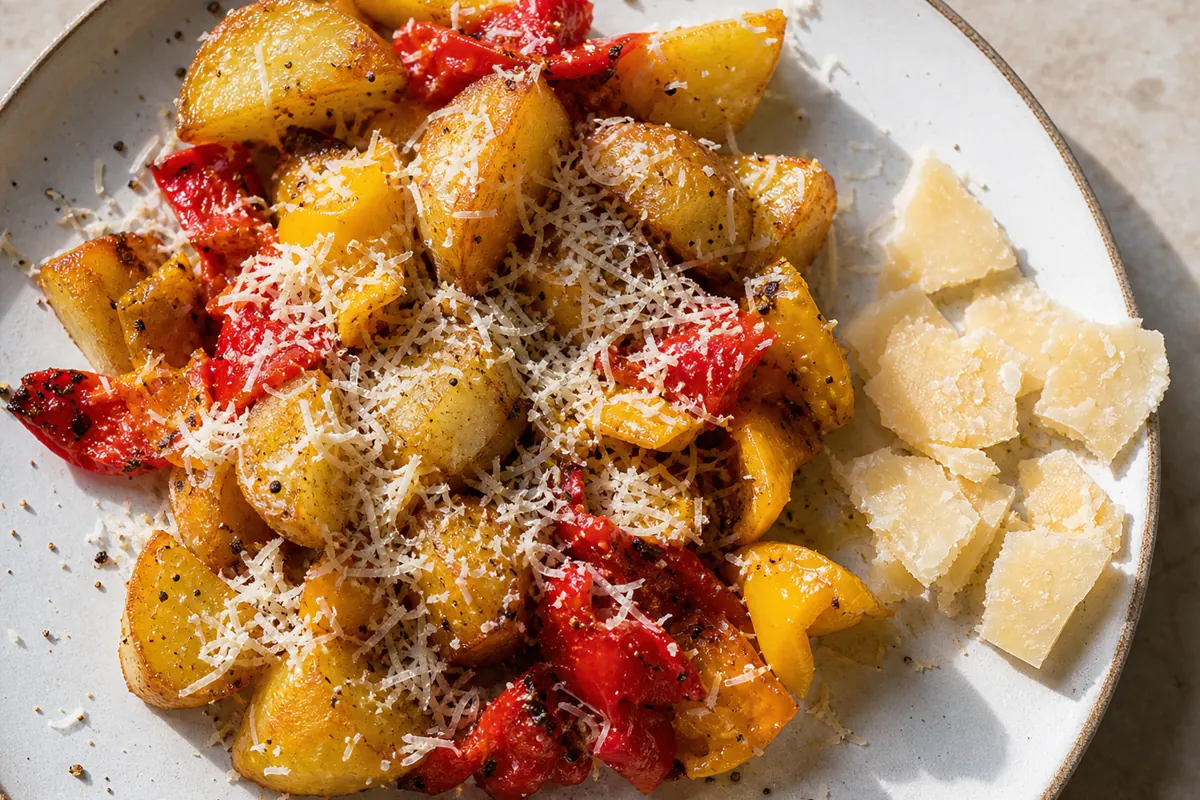
An ordinary grater is all you need for pasta, risotto or a browned topping. Here, even a younger portion works because the grater supplies the fracture that an older wedge produces on its own.
| Use | How It Works |
|---|---|
| Planed curls | Use wafer-thin curls for aperitifs or scatter them over salad as you would Parmesan shavings. |
| Broken chunks | Serve bite-size pieces with wine or sparkling cider once the cheese is old enough to fracture cleanly. |
| Grated finish | Grate a portion over pasta, risotto or an au gratin dish. |
| Baked and browned | The dry cheese can season savoury pastries, gratins and potato dishes such as Rösti. |
| Soup | Grate a little into barley soup; remove the hard rind before eating it, or simmer the rind for flavour and take it out before serving. |
| Pesto | Its dry, crushable paste can replace an Italian hard cheese in pesto when you want a fruitier, spicier result. |
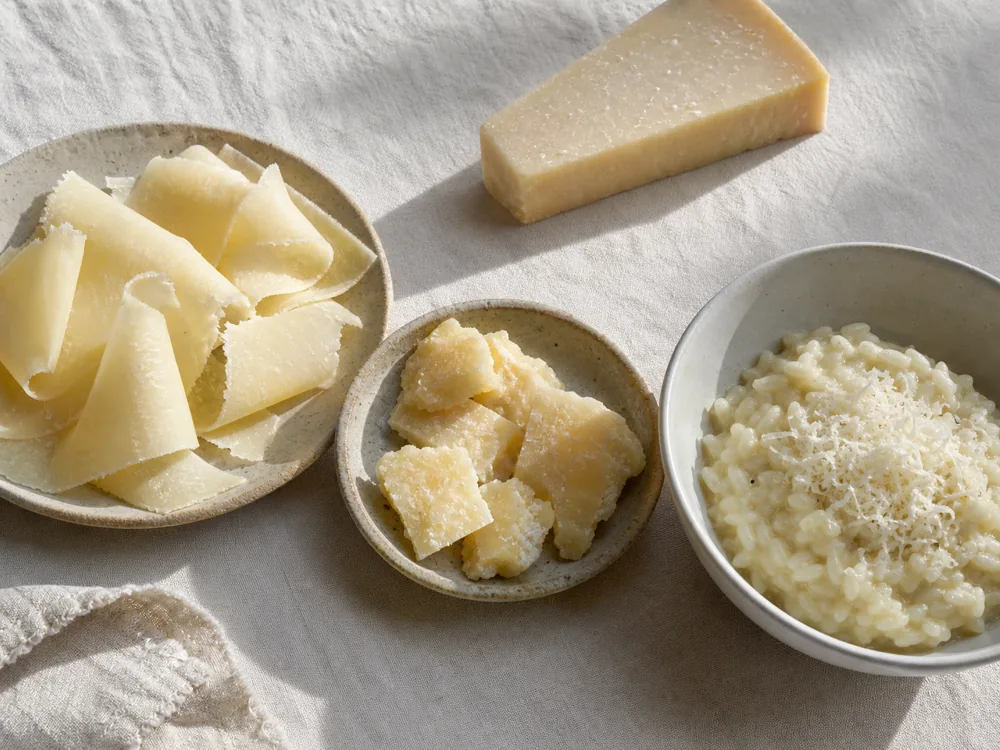
Use Sbrinz confidently for gratins and browned toppings, but do not assume it behaves like a fondue cheese in a smooth sauce. Its documented strength is the dry grated finish, not long, elastic melt.
Under a gratin, the higher fat level can give Sbrinz a quicker, creamier melt than Parmesan. Over pasta, you will notice its fruitier, roast-edged flavour as much as its texture.
Sbrinz vs Parmesan
If you are choosing between Sbrinz and Parmesan, begin with the form you need. Sbrinz can make curls as well as chunks and gratings, while Parmigiano-Reggiano is the more familiar brittle grating cheese.
Milk composition helps create that difference: Sbrinz carries at least 45 percent fat in dry matter, while the Italian grana styles are made from partly skimmed milk and sit lower. The extra fat helps explain why Sbrinz can feel less stark when melted over a gratin.
Flavour points in different directions too: Parmigiano-Reggiano leans nutty and deeply savoury, while Sbrinz brings fruit, tart spice and faint roast notes such as chicory. Choose by the effect you want in the dish rather than by a general ranking of intensity.
Parmigiano-Reggiano also begins with raw cow's milk, but it mixes whole morning milk with naturally skimmed evening milk and can be released from 12 months. Sbrinz starts six months later and is sold through age-defined serving forms.
Grana Padano can reach the market from nine months and permits silage in the cows' diet, whereas Sbrinz bans it.
| Cheese | Milk, ripening, and wheel |
|---|---|
| Sbrinz | Raw cow's milk, skimmed by machine or creaming; 45% fat in dry matter; silage banned; 18 months minimum; 35 to 48 kg wheel; curd cooked to 54 to 57 C. |
| Parmigiano-Reggiano | Raw cow's milk, part-skimmed; about 32% fat in dry matter; 12 months minimum; wheel of about 38 kg; curds heated to 55 C. |
| Grana Padano | Milk may carry slightly less fat and come from several days; cows may be fed silage; at least 9 months. |
Flavour shifts from wheel to wheel, so the surest differences between the three are the milk rules, minimum age, wheel size and the forms each cheese is meant to be served in.
What Should You Pair with Sbrinz?
With younger curls or chunks, Chasselas and sparkling cider keep the aperitif fresh. Once Sbrinz reaches about three years and gains more spice and crystal crunch, an aromatic Gewürztraminer or a stronger dry white can meet it without disappearing.
If you prefer red, choose enough structure for the older cheese; Barolo and aged Cabernet are the bolder examples. A malty Trappist beer or matured strong ale follows the same principle while echoing the roasted edge.
| Pairing | Type | Why It Works |
|---|---|---|
| Wine or sparkling cider | Drink | Either refreshes the palate after a concentrated broken chunk. |
| Chasselas (Fendant) | Wine | This light Swiss white suits younger curls and an aperitif setting. |
| Gewürztraminer | Wine | Its aroma can meet an older Sbrinz of around three years. |
| Tannic red wine | Wine | Barolo or aged Cabernet has enough structure for the oldest, spiciest wedges. |
| Trappist or strong ale | Drink | Malt and mature ale flavours echo the cheese's roasted edge. |
| Fig mustard or honey | Food | A small dab rounds the salty, spicy finish without hiding it. |
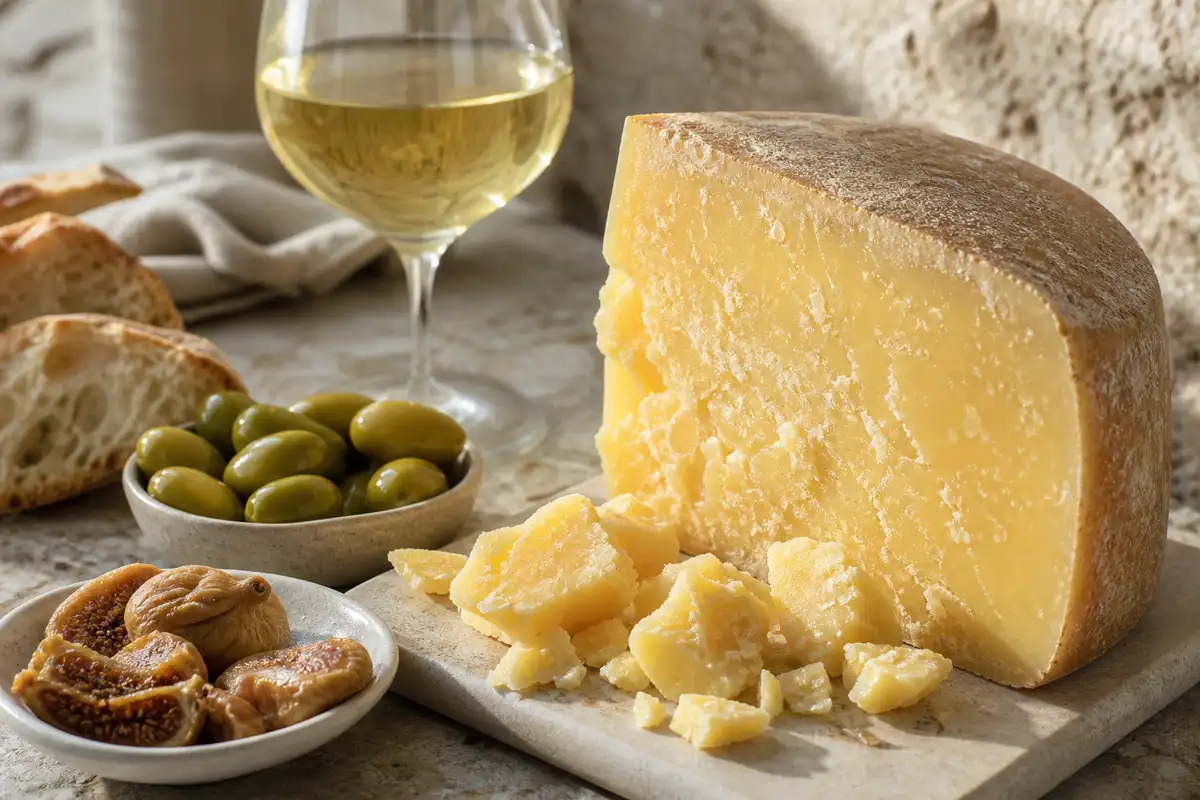
| Fruit and nuts | Food | Grapes, pear or figs soften the salt, while walnuts and almonds mirror the nutty notes. |
For an aperitif board, plan on roughly 20 to 30 grams of Sbrinz per person within a 40-to-60-gram cheese portion. Two or three small chunks plus a few curls give you both textures without letting this concentrated cheese dominate the whole plate.
What Sets Sbrinz Apart from Alp-Sbrinz and Hobelkäse?
Alp-Sbrinz narrows the cheese to summer production in small dairies on high pastures. At roughly 50 tonnes a year from eight Alpine operations, it is a much smaller branch of the protected cheese.
Summer pasture can bring a more floral character, while most standard Sbrinz comes from valley dairies. The “Alp” wording therefore tells you about place and season before it tells you whether you personally will prefer the flavour.
Hobelkäse on its own refers to a different extra-hard Alpine cheese from the Bernese Oberland, traditionally made in wheels no heavier than 15 kilograms. With “Sbrinz,” however, protected words such as Hobelkäse or gehobelt describe a qualifying mountain or Alpine Sbrinz product.
On a label, “Sbrinz Hobelkäse” is a protected Sbrinz product, while plain “Hobelkäse” is the other cheese, so read the whole name.
Why Is Sbrinz Expensive?
Sbrinz usually costs more than mass-market hard cheese because every wheel ties up a large volume of raw milk, cellar space and labour for at least 18 months. Small village dairies must also brush, turn and inspect wheels that cannot be sold quickly.
Extra-aged wheels cost more again because fewer remain in the cellar long enough to reach that stage. Ready-planed rolls also include processing and careful packing, while pre-grated cheese may be cheaper but loses aroma faster after opening.
Production is small beside better-known Swiss cheeses: one 2024 count gives 1,550 tonnes from 20 dairies, compared with 12,395 tonnes of Emmentaler AOP and 8,090 tonnes of Appenzeller. That scale helps explain why you may see Sbrinz at a specialist counter but not in every supermarket.
Most of the cheese remains in Switzerland. Outside it, expect patchier availability and fewer chances to compare ages side by side.
How to Buy Sbrinz
Check the label first. Only a cheese that meets the specification may be called Sbrinz, and pre-packed Sbrinz and wheel labels must show the protected designation.
A whole wheel carries a 60-millimeter casein mark on its flat side with the dairy's approval number, the year, a sequence number, and the Sbrinz logo, plus the production month and day. A wedge cut from the wheel may not show it, so the AOP statement and the age on the pack are the checks that remain.
The age stage is the second check. If a seller quotes only a range, ask whether the piece is Hobelrollen, standard Sbrinz, or Gold Label, because the stages in the age table above decide which form it suits.
Then choose the form: grated cheese for cooking, bite-size pieces for an aperitif, a wedge for breaking at home or sliced curls for immediate serving.
A 200-to-300-gram wedge gives you enough surface to break or grate while keeping more aroma than a pre-grated pack. Buy curls only when their convenience matters, then reseal them promptly because the thin edges dry quickly.
The quality rules explain why a wedge can be refused. They bar cheese with too many or oversized holes, a two-tone or spotted paste, an abnormal color, black spots, cracks, or a sour, bitter, salty, or sweet taste from selling under the Sbrinz name.
The rules sort graded wheels into Class 1, which is Sbrinz, Class 2a for cheese with those faults, called Industrierohware (industrial raw material), and Class 3 for cheese outside the legal composition limits or unfit to eat, such as cheese with butyric fermentation.
Crumbliness needs your judgment: slight to moderate fracture belongs to mature Sbrinz, while a paste that collapses into dust can signal a lower quality class.
How Should You Store Sbrinz, and Is It Safe During Pregnancy?
Wrap Sbrinz in cheese paper or lightly perforated foil so the dry paste does not sweat against plastic. Keep the refrigerator at 40°F (4°C) or below, then give the portion about 30 minutes to lose its chill before serving.
A 30-minute rest fits comfortably within the CDC's two-hour limit for perishable food at room temperature. A board left out through a long evening does not, especially in heat above 90°F, where the limit drops to one hour.
Its low moisture gives an unopened vacuum-packed piece a long refrigerated life, sometimes several months. Once you cut it, plan in weeks rather than months and watch the surface for unwanted moisture or mould.
You can trim a lightly dried edge without discarding the whole wedge. Freezing is possible, but for a cheese prized for its brittle texture and aroma, buying a smaller piece usually protects quality better.
The legal composition limits describe the protected cheese, not the exact nutrition of every retail portion. Use them to understand the style, then use your package for the numbers you actually eat.
One published profile lists about 426 kcal, 34 grams of fat and 30 grams of protein per 100 grams. Those figures are useful context, but the label remains the right source for calories, fat and sodium in your wedge.
Published salt figures range from 12 to 20 grams per kilogram, so read the individual pack if sodium affects your diet.
Sbrinz is officially described as lactose-free, and one specialist profile places lactose below 0.1 gram per 100 grams. It still contains milk protein, so lactose information does not make it suitable for someone with a cow's-milk allergy.
NHS guidance includes pasteurised and unpasteurised hard cheese among the cheeses that are safe to eat in pregnancy. The CDC takes a stricter position, preferring pasteurized hard cheese and listing raw-milk dairy among riskier choices.
Because Sbrinz is both extra-hard and always raw, it fits the NHS wording but lands among the riskier choices under the CDC's. Take the label to your midwife or doctor when deciding whether it fits the advice you follow for cheese during pregnancy.
Plane an 18-month Hobelrollen roll, break or grate cheese of 22 months or more, and check the AOP label, the age stage, and a closed ivory-to-pale-yellow paste before paying.
What Else Do People Ask About Sbrinz?
It is fruity and spicy with lightly roasted notes, roasted chicory and a slightly astringent finish.
No. Sbrinz is a Swiss AOP cheese with its own milk, feed, wheel and ageing rules, although you can use it as a Parmesan alternative at the grater.
Planed curls are wafer-thin curls of Sbrinz made with a Sbrinz plane or an ordinary vegetable peeler. The quality rules release Hobelrollen for planing from 18 months.
It can melt quickly and creamily under a gratin, where the higher fat level helps it brown well. Use another cheese when you need the smooth, elastic behaviour of a classic fondue blend.
It is officially described as lactose-free, with one published profile placing lactose below 0.1 gram per 100 grams. The cheese still contains milk protein.
Yes. Every protected wheel uses raw cow's milk, with no thermization or pasteurization.
Traditional Sbrinz uses calf rennet, although some retail pieces are labelled vegetarian. If that matters to you, check the package or ask the seller about the exact wheel.
No. Hobelkäse on its own is an extra-hard Alpine cheese from the Bernese Oberland with wheels no heavier than 15 kilograms, while Sbrinz wheels weigh 35 to 48 kilograms.