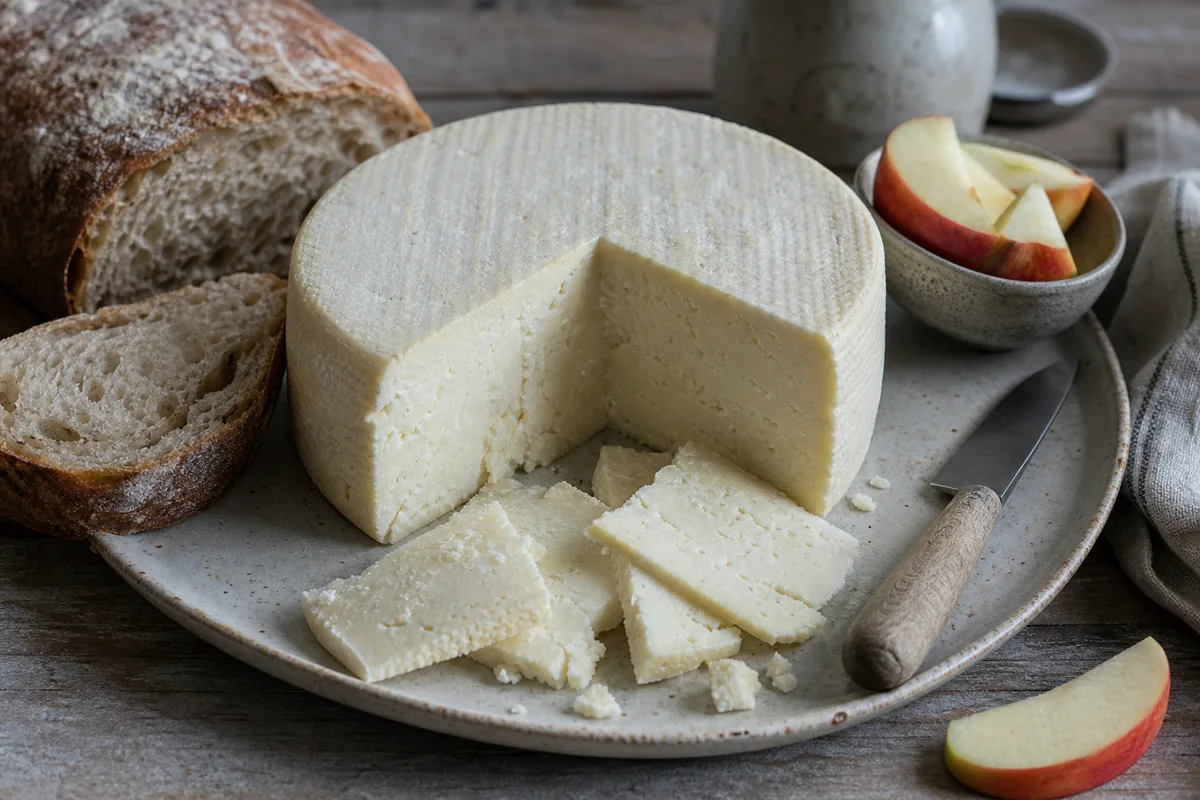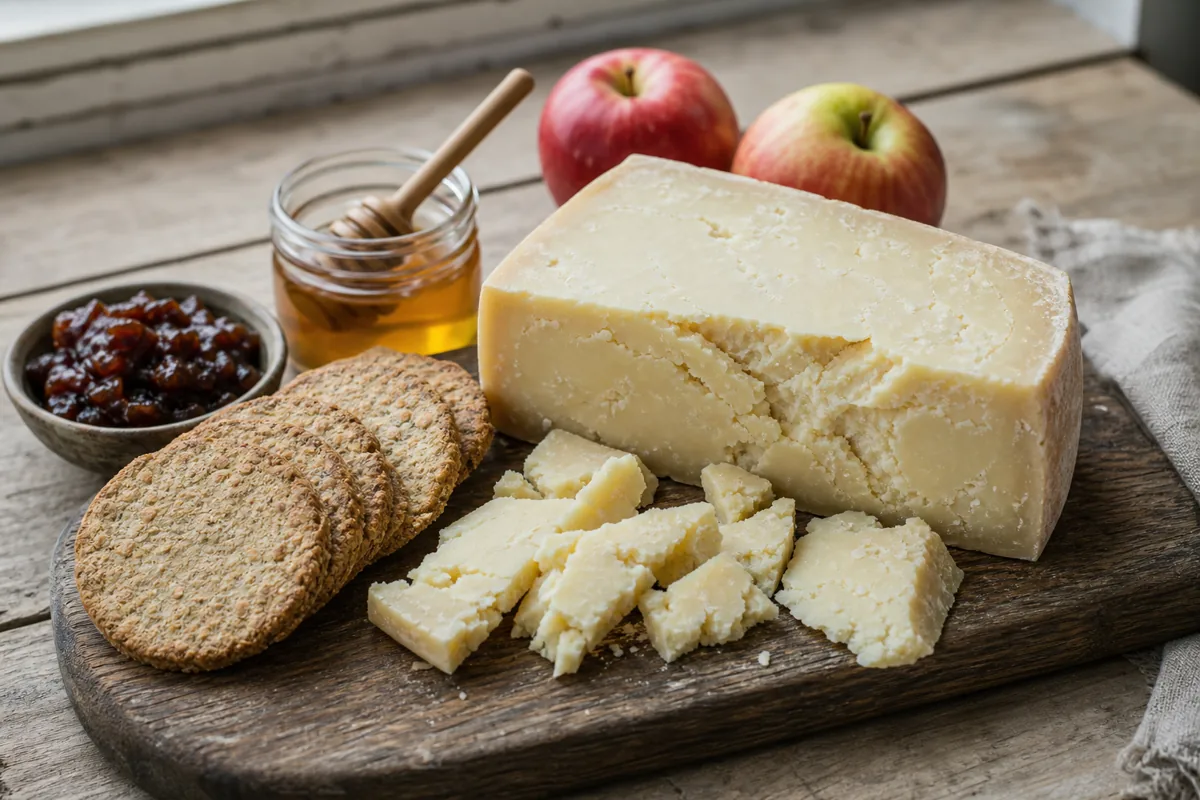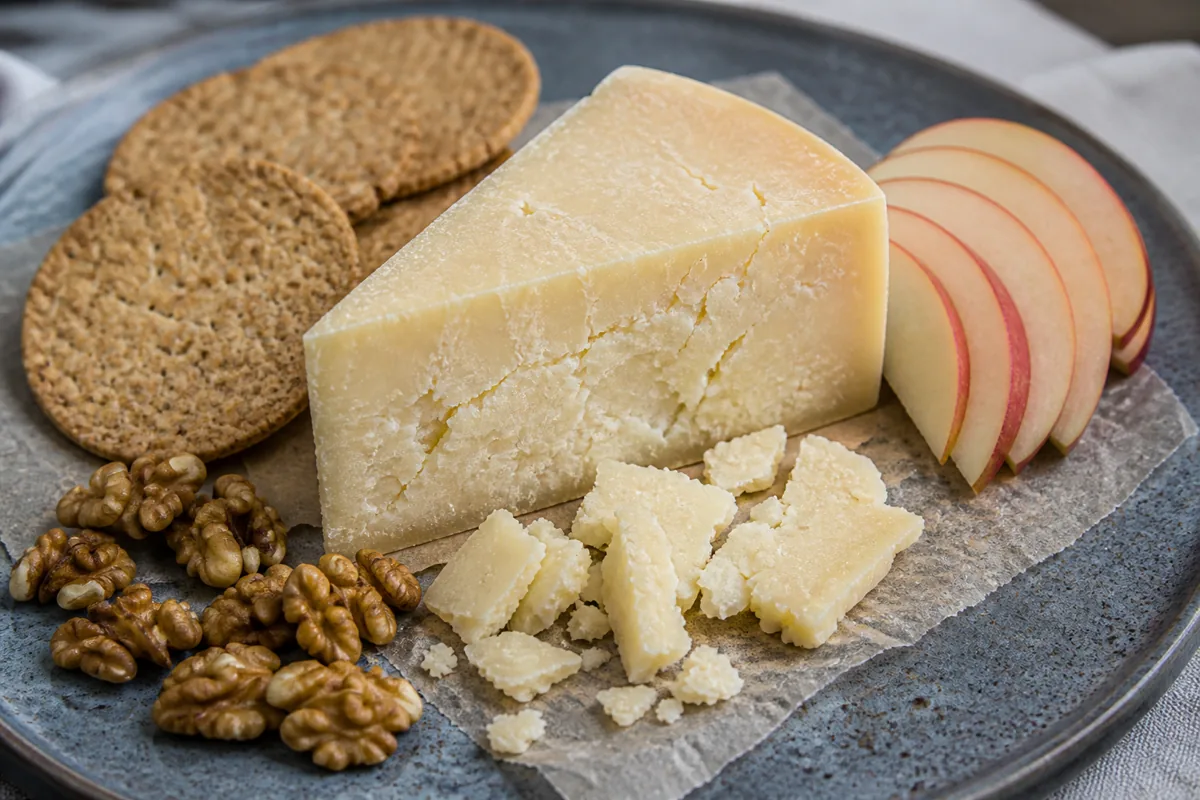
Cheshire is a moist, crumbly cheese made from cow's milk, and the Academy of Cheese's heritage project calls it the oldest named British cheese. Wikipedia says it is still the UK's largest-selling crumbly cheese.
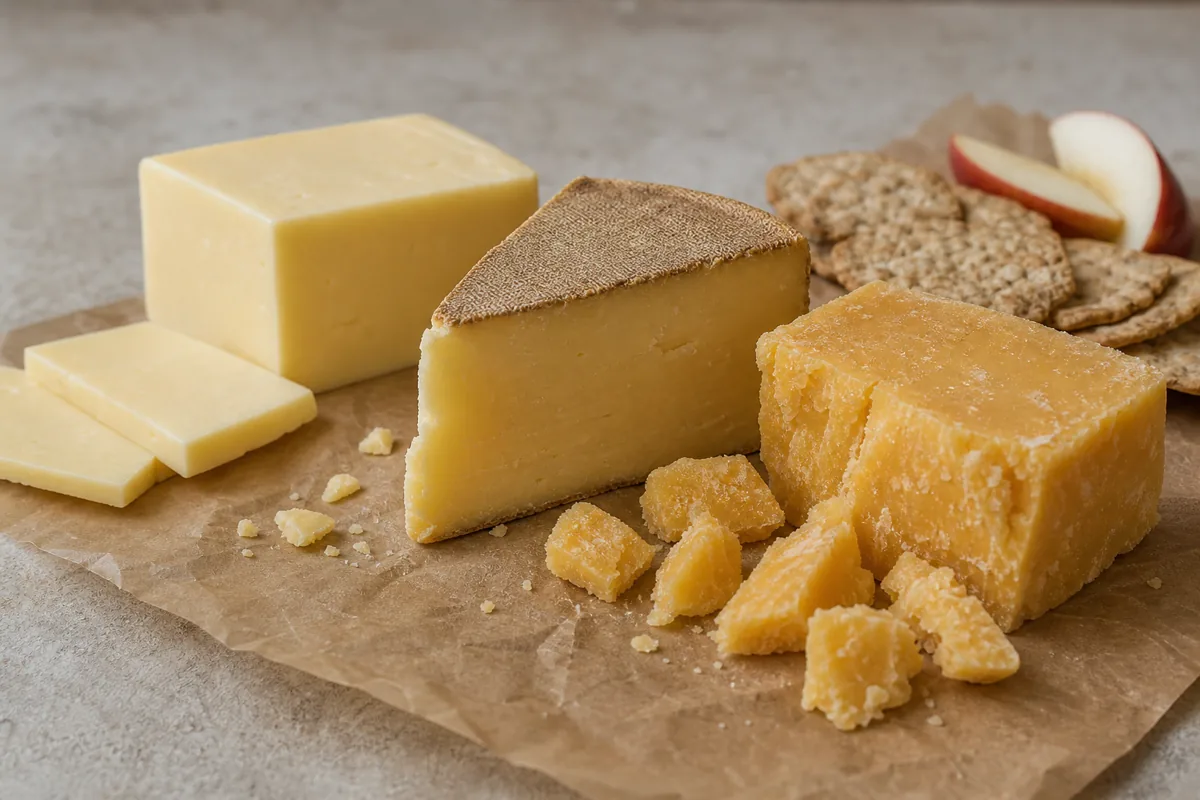
Three versions reach the counter: white, red coloured with annatto, and a rare cloth-bound farmhouse wheel made with raw milk. They differ in milk, rennet and age, so each figure below names its source.
In This Article
What Is Cheshire Cheese?
The Academy of Cheese puts Cheshire in its crumbly make group and gives the Cheshire Plain as its origin. Cheese.com widens the region to neighbouring Denbighshire, Flintshire, Shropshire and Staffordshire.
Belton Farm describes the plain as running from the Mersey Valley in the north to the Shropshire Hills in the south.
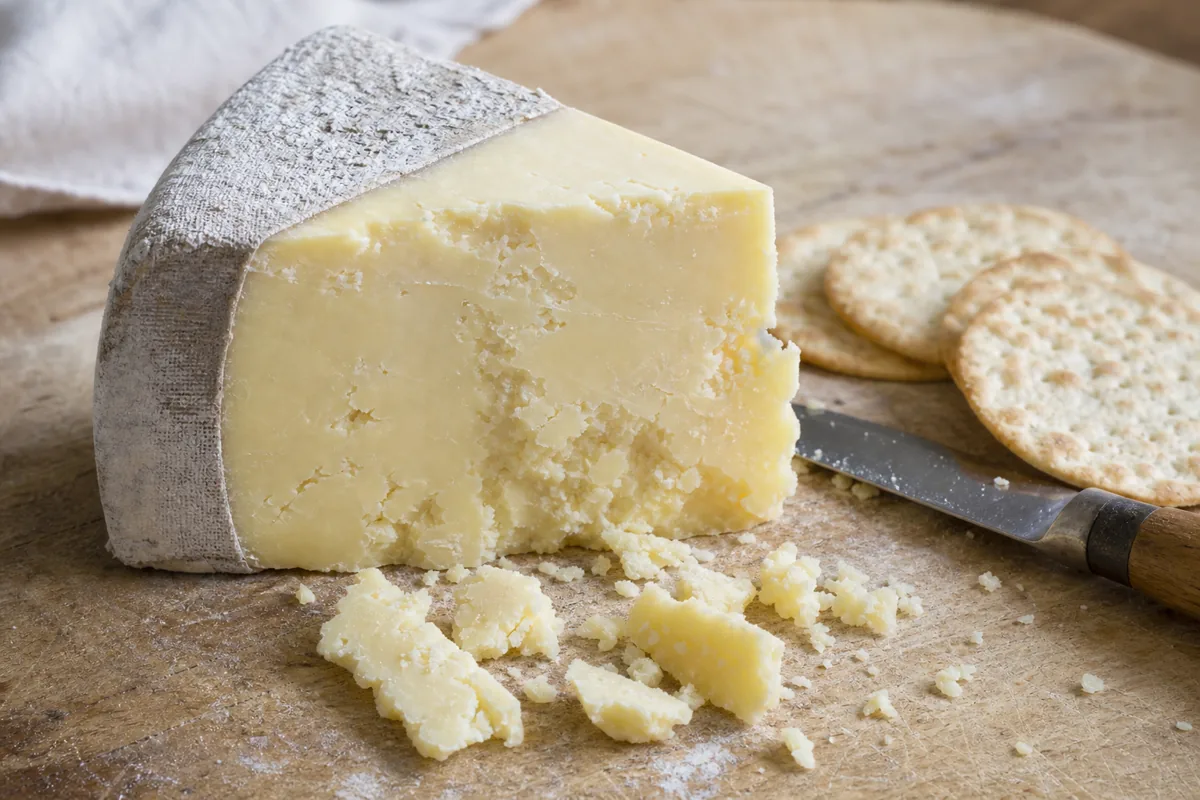
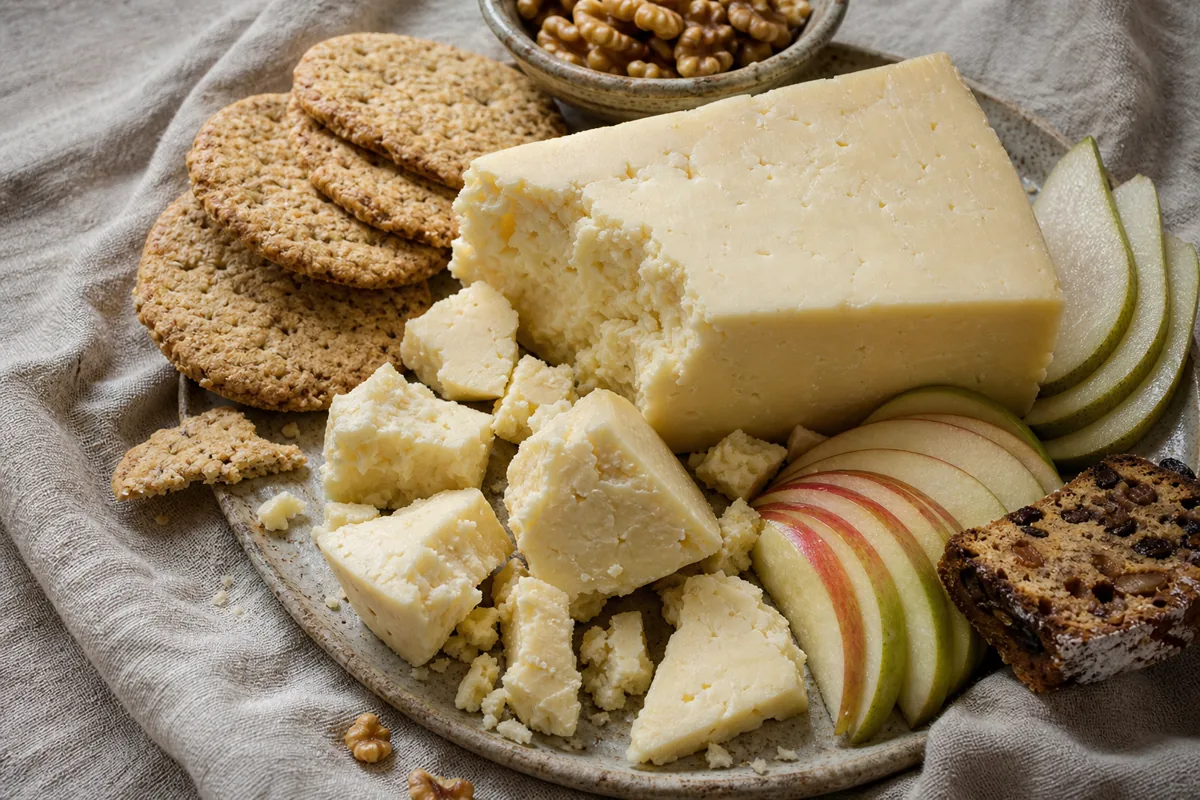
Wikipedia describes a dense, crumbly cheese with a moist texture and a mild, salty taste. It lists three colours: white, which is the original and makes up most production, red and blue.
The name once covered more than one county's cheese: the Academy of Cheese says that in the 17th and 18th centuries cheese from central Cheshire, the borders of Shropshire and Staffordshire, and even south Lancashire and Derbyshire all sold as Cheshire.
Charles Foster, quoted by the Academy, observed that Cheshire became the brand name on the London market partly because it was already a famous name and partly because all of it was shipped out from Chester.
Which Types of Cheshire Cheese Are There?
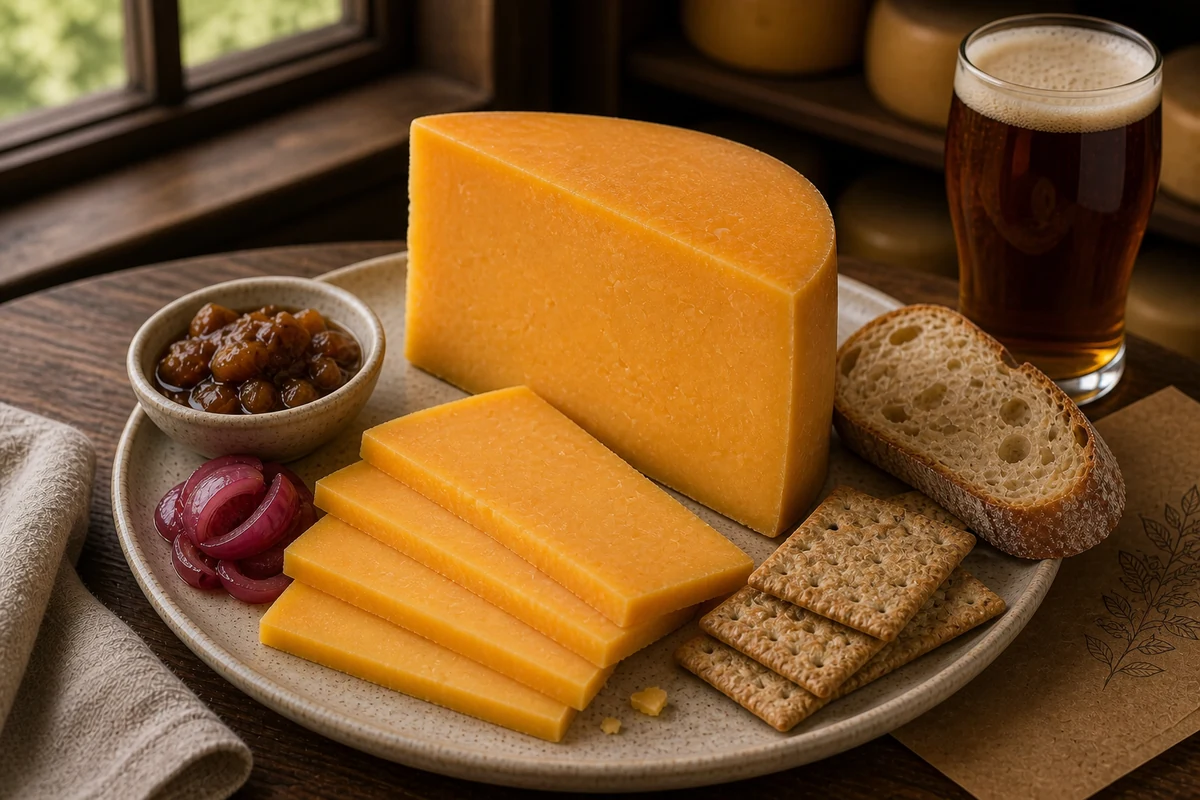
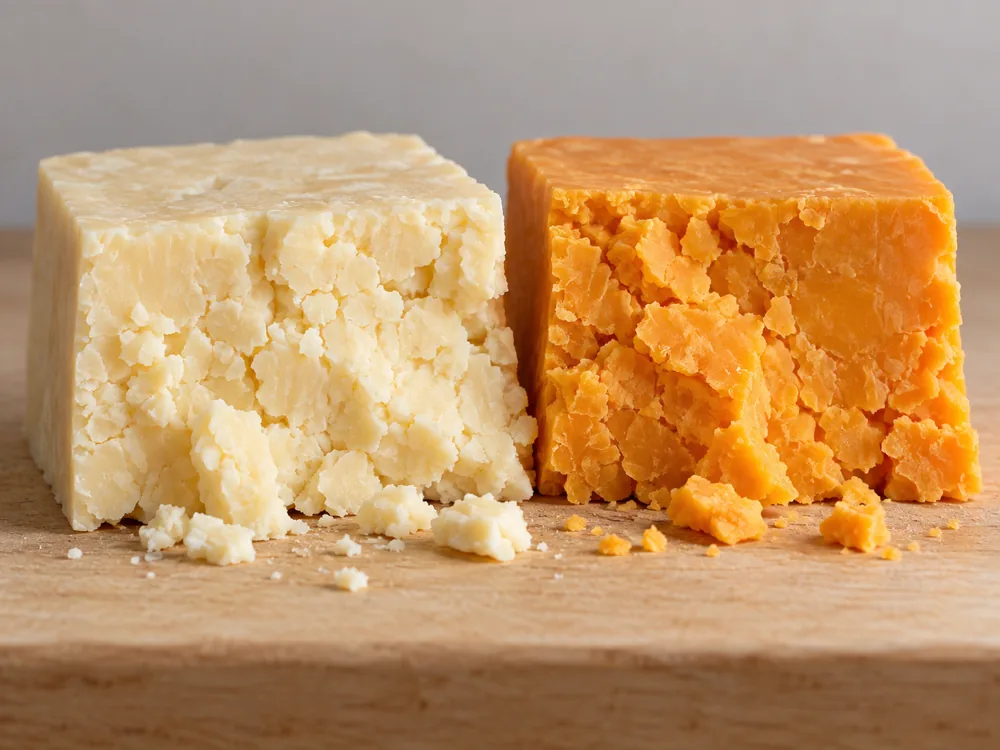
Red Cheshire is white Cheshire coloured with annatto. Wikipedia says red Cheshire, dyed a deep orange, was developed in the hills of North Wales and sold to travellers on the road to Holyhead.
Those travellers came to believe that all Cheshire was orange, Wikipedia adds, so makers in Cheshire itself took up the dye to match what the market expected.
The Academy of Cheese says Belton's red Cheshire gets its colour from annatto. The taste descriptions from these sources match for both colours, so colour is what you choose between at the counter.
Blue Cheshire has blue veins like Stilton, according to Wikipedia, which says production stopped in the late 1980s and has recently been revived.
Wikipedia says Blue Cheshire is less creamy than Stilton and, unlike Shropshire Blue, is not coloured orange, and that London clubs favoured it from the Georgian period.
Cloth-bound Cheshire is the farmhouse form. The Academy of Cheese describes a natural cloth girdle, a wheel of about 8 kg and a paste that runs from ivory white to light red when annatto is added.
Only one farm still makes that cheese with unpasteurised milk, the Academy says. Neal's Yard Dairy names it as Appleby's Cheshire, made by Paul and Sarah Appleby at Hawkstone Abbey Farm on the border of Cheshire and Shropshire.
Neal's Yard Dairy words the count less strictly, calling Appleby's one of a small number of raw-milk, clothbound, farmhouse Cheshires made in England. The two statements leave open whether another raw-milk wheel exists, and the milk line on a label is what would settle it.
| Point | Belton Farm Cheshire | Appleby's Cheshire | Cloth-bound Cheshire in general |
|---|---|---|---|
| Source | Belton Farm and the Academy of Cheese | Neal's Yard Dairy | Academy of Cheese |
| Milk | Pasteurised cow's milk | Raw cow's milk | Raw and pasteurised examples exist |
| Rennet | Vegetarian | Animal | Animal and vegetarian versions exist |
| Colour | White, or red with annatto | Annatto in the ingredients | Ivory white to light red |
| Finish | Matured in vacuum packs | Bound in cloth | Natural cloth girdle |
| Size | 20 kg blocks, 12 kg rounds and 4 kg wheels | Whole wheel of 8.2 to 8.7 kg | About 8 kg |
How Does Factory Cheshire Differ From Farmhouse Cheshire?
The Academy of Cheese says big factories all over the UK make Cheshire, and that it tastes very similar to other mass-produced sharp, crumbly territorial cheeses such as Wensleydale. The original farmhouse cheese, it adds, has a flavour of its own that it links to the mineral-rich soil of the Cheshire Plain.
Wikipedia groups Cheshire with other crumbly northern English cheeses such as Crumbly Lancashire, and says industrial versions tend to be drier and less crumbly, more like a mild cheddar, because that texture is easier to process.
The two accounts disagree on sharpness, the Academy saying sharp and Wikipedia mild, and neither names the cheeses it compares, so neither can say what a particular block will taste like.
Turn the pack over and the label settles it. Belton's 179 g Cheshire lists pasteurised cow's milk, salt, starter culture and rennet, while Neal's Yard Dairy lists Appleby's as raw cow's milk, salt, annatto, cheese cultures and animal rennet.
Belton's label says only rennet, so the vegetarian description in the table comes from the Academy's entry.
Sources call factory Cheshire both sharp and mild, so check what you can verify on the label: pasteurised or raw milk, and the rennet and colour in the ingredient line.
How Is Cheshire Made?
The Academy of Cheese explains the crumble through two steps. First, the curd is scalded at lower temperatures than in cheddar making, so more moisture stays in the cheese.
After the curd is cut, drained, milled and salted, it may rest overnight before pressing. The Academy says that rest stops the curd fusing together as much as cheddar does and helps create a flaky texture.
The Academy's heritage project adds that pressing is mainly about shaping the cheese in moulds rather than extracting water, so the moisture that stays in a Cheshire is settled before the cheese reaches the mould.
For the cloth-bound cheese, muslin goes on after pressing.
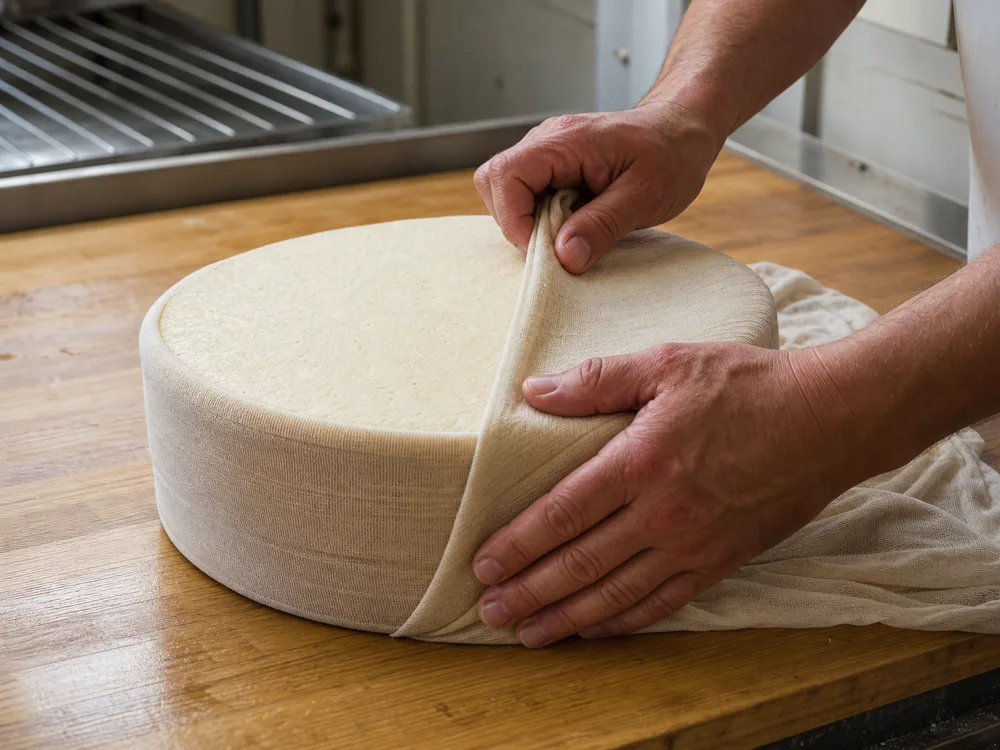
Belton Farm's make, as the Academy records it, starts with pasteurised milk, vegetarian rennet and bulk starter cultures. The curd is cut to thumbnail-size pieces, scalded, pitched onto a draining table, turned by hand, milled, salted and pressed in moulds.
Belton draws its milk from local dairy farms within a 25-mile radius, whose cows graze the Cheshire Plain. The Academy says the plain's rock salt deposits give the milk and cheese a slightly salty taste.
The salt used in Belton's make also comes from local Cheshire salt mines, the Academy adds.
The Beckett family has run Belton Farm in Shropshire since 1922 and also makes cheddar, Caerphilly, Red Leicester and Double Gloucester, according to the Academy.
How Long Is Cheshire Aged?
Published ages for Cheshire run from about a month to four months, and the spread follows the cheese each source describes.
| Source | Cheese described | Age given |
|---|---|---|
| Wikipedia | Cheshire in general | 4 to 8 weeks, depending on variety |
| Academy of Cheese | Belton Farm coloured Cheshire | 10 weeks to 4 months in vacuum packs |
| Cheese.com | Appleby's Cheshire | About 12 weeks |
| Neal's Yard Dairy | Appleby's Cheshire | Average 3 months |
| Academy of Cheese | Cloth-bound Cheshire | Typically 4 months |
Wikipedia's range is younger than any named cheese in the table. Belton sells its mature version at four months, the same age the Academy's heritage project gives as traditional for Cheshire.
Wikipedia explains part of the gap: until the late 19th century the different Cheshires were aged to a hardness that could survive transport by horse and cart, and later by boat, to London.
Younger, fresher, crumbly cheese that needed less storage began to gain popularity towards the end of that century in the industrial North and the Midlands, Wikipedia adds, and it was cheaper to make because it spent less time in store.
The Academy's heritage page also repeats a story that makers on the Dee supposedly kept three recipes, a short-keeping cheese for spring, a mid-keeping one for summer and a longer-keeping one for the winter, and says it is still researching it.
What Does Cheshire Taste Like?
The sources agree on a crumbly texture, and Belton Farm and Wikipedia also mention salt. They differ on how mild or earthy the cheese tastes.
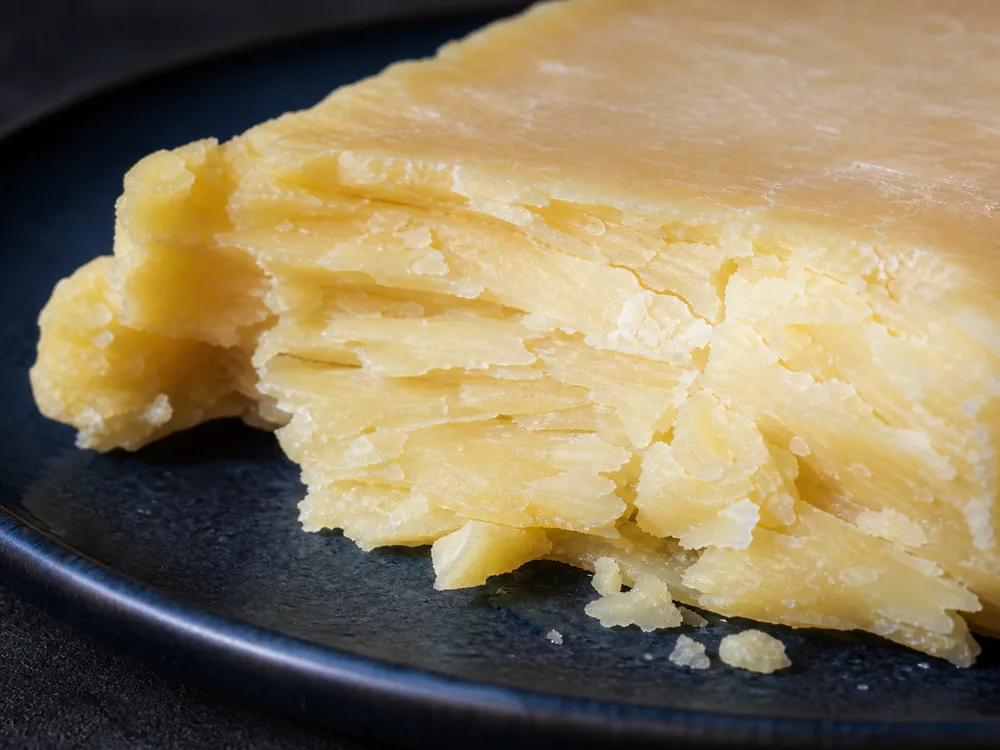
- Academy of Cheese, cloth-bound: moist and crumbly, with zesty and mineral notes and a long finish.
- Belton Farm: light and crumbly, with subtle hints of fresh citrus and a slightly salty taste.
- Neal's Yard Dairy, Appleby's: rich mineral flavours up front, a juicy acidity and a succulent yet crumbly texture.
- Cheese.com, Appleby's: an earthy flavour with a grassy, spicy aroma and piquant notes.
- Wikipedia, Cheshire in general: a mild, salty taste.
The earthy and mineral descriptions come from cloth-bound wheels, including Appleby's raw-milk cheese. Fresh citrus and a light texture come from Belton's pasteurised cheese matured in vacuum packs.
Neal's Yard Dairy says it visits the Appleby farm once a month, tastes every batch made since the previous visit and assesses each by texture, colour and flavour.
What it looks for today is a bright cheese with a juicy acidity and a characteristic crumble.
How Big Was the Cheshire Cheese Trade?
Wikipedia dates the first written mention to around 1580, by the naturalist Thomas Muffet, and calls a supposed Domesday Book reference a myth. The Academy of Cheese says the cheese was first made in Roman Chester.
By the early 17th century the cheese had a reputation: the Academy's heritage page quotes William Camden, in a work it dates to 1610, saying Cheshire cheeses were more agreeable and better relished than those of any other part of the kingdom.
London drove the trade because its usual supplier failed. The Academy says cattle disease and floods in the 1640s hit Suffolk, whose cheese doubled in price as farmers skimmed off the cream for more profitable butter, and the quality fell.
The Academy records the ship James arriving in London with 20 tons of cheese on 21 October 1650, and says Cheshire cheeses, doubted at first by the London cheesemongers, were shipped most years from 1652.
Records from St Bartholomew's hospital in Sandwich show Cheshire priced more than 1 penny a pound above Suffolk cheese, and port books show 364 tons sent to London in 1664.
Ships from Chester then brought 1,000 tons in the 1670s and nearly 2,000 tons by the 1680s, the Academy says. The Academy's heritage page estimates that a 17th-century cow probably made about 240 lb (109 kg) of cheese a year, so 1,000 tons represented the output of some 10,000 cows.
French privateers and war virtually ended the sea trade in 1689, and carriage by land slowly reduced demand until the cheese ships sailed again in 1713. At least 2,600 tons then left the North West in 1717 and 1718, more than double the 1680s, the Academy says.
The cheeses grew with the trade: Peter Venables sent Cheshires of 11.4 lb in 1664, and from 1687 they grew steadily until an average of 20 to 24 lb, roughly 9 to 11 kg, became standard by the end of the century.
London buyers preferred larger cheeses and paid more for them, the Academy says, and the smaller ones were probably sold and eaten locally. That standard size is a little heavier than the 8 kg wheel the Academy describes for cloth-bound cheese today.
From 1739 the Royal Navy bought Cheshire instead of Suffolk cheese, as much as 1,800 tons, according to the Academy. Wikipedia adds that in 1758 the Navy ordered ships to be stocked with Cheshire and Gloucester cheeses.
Wikipedia estimates production at 10,000 tonnes in 1823 and 12,000 tons around 1870, and says sales peaked at around 40,000 tonnes in 1960 before the range of cheeses in the UK grew and they declined. They now run at around 6,000 tonnes a year.
Neal's Yard Dairy says the Appleby family has made Cheshire at Hawkstone Abbey Farm since 1952, and that its own work with them began in the 1980s, when the family looked for new markets for its unwaxed, raw-milk cheese.
Is Cheshire Pasteurized?
Some Cheshire is pasteurised and some is not. Wikipedia says Cheshire is frequently pasteurised, and the product table above gives the milk and rennet for Belton Farm's and Appleby's cheeses.
Cheese.com's Cheshire entry lists unpasteurised milk, but it names Appleby's as the producer, so that line describes one cheese rather than every Cheshire on the shelf.
Belton's label gives these values per 100 g of its Cheshire, and they describe that one pasteurised cheese.
Belton's storage line says to keep the cheese refrigerated and take it out 20 to 30 minutes before you serve it.
Is Cheshire Safe During Pregnancy?
The NHS advice on cheese in pregnancy lists pasteurised or unpasteurised hard cheeses, such as cheddar, gruyère and parmesan, as safe to eat. For semi-hard cheeses, such as edam, it lists only pasteurised ones as safe.
The sources class Cheshire two ways: Cheese.com calls it a hard cheese, and Wikipedia describes it as dense and semi-hard.
If you buy a pasteurised Cheshire such as Belton's, it fits either NHS line. Only a raw-milk wheel such as Appleby's depends on which class applies.
The CDC puts more weight on the milk. Its milk row lists unpasteurized (raw) milk and dairy products made from raw milk as riskier, and its cheese row lists hard cheese made with pasteurized milk as safer.
By the milk row, Belton's pasteurised Cheshire counts as safer and a raw-milk wheel such as Appleby's counts as riskier. The cheese row lists soft cheese made from raw milk, queso fresco-type cheeses and unheated deli-sliced cheese as riskier.
The CDC also says pregnant women are 10 times more likely to get a Listeria infection.
How Should You Serve Cheshire?
| Use | How It Works |
|---|---|
| Sandwiches | Belton Farm calls its Cheshire ideal for crumbling into sandwiches. |
| Salads | Belton Farm also suggests crumbling it into salads. |
| Toast | Belton Farm says the cheese stays on the toast instead of flowing over the sides. |
| Apple pie | Belton Farm suggests a slice of Cheshire to finish a meal with apple pie. |
If you are serving cloth-bound Cheshire, the drink suggestions lean toward red wines and hoppy pale ales.
For Belton's younger cheese, the wine pairings lean white, with one light red.
| Pairing | Type | Why It Works |
|---|---|---|
| Côtes du Rhône or Rioja | Wine | The Academy of Cheese suggests medium-bodied reds such as these for cloth-bound Cheshire. |
| Hoppy pale ale | Drink | The Academy of Cheese names hoppy pale ales for cloth-bound Cheshire, and Belton Farm names a classic pale ale. |
| Chardonnay or Riesling | Wine | Belton Farm and the Academy of Cheese both name these white wines for Belton's Cheshire. |
| Beaujolais | Wine | Belton Farm and the Academy of Cheese name it as a light red for Belton's Cheshire. |
For Appleby's, Cheese.com suggests fresh fruit or a crisp sparkling cider.
SOURCES & REFERENCES
The Academy of Cheese describes cloth-bound Cheshire as zesty and mineral with a long finish. Belton Farm describes its pasteurised Cheshire as light and crumbly with hints of fresh citrus and a slightly salty taste.
Red Cheshire is coloured with annatto to a deep orange, according to Wikipedia, which says the red version was developed in North Wales. White Cheshire is the original and makes up most production.
Some is. Appleby's Cheshire uses raw cow's milk, Belton Farm uses pasteurised milk, and Wikipedia says Cheshire is frequently pasteurised.
Wikipedia gives 4 to 8 weeks. Belton Farm matures its cheese for 10 weeks to four months, Neal's Yard Dairy gives an average of 3 months for Appleby's, and the Academy of Cheese gives about four months for cloth-bound wheels.
The Academy of Cheese suggests medium-bodied reds such as Côtes du Rhône and Rioja, or hoppy pale ales, for cloth-bound Cheshire. Belton Farm names Chardonnay, Riesling, Beaujolais and a classic pale ale for its own cheese.