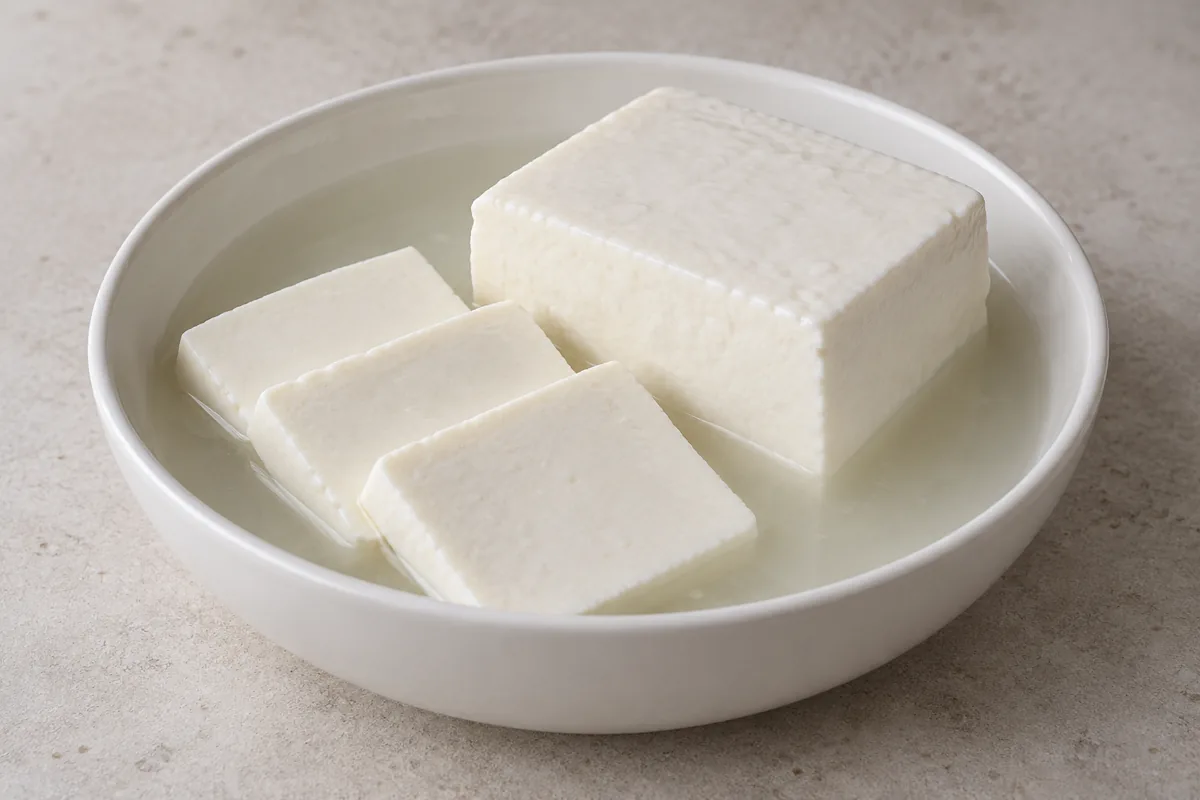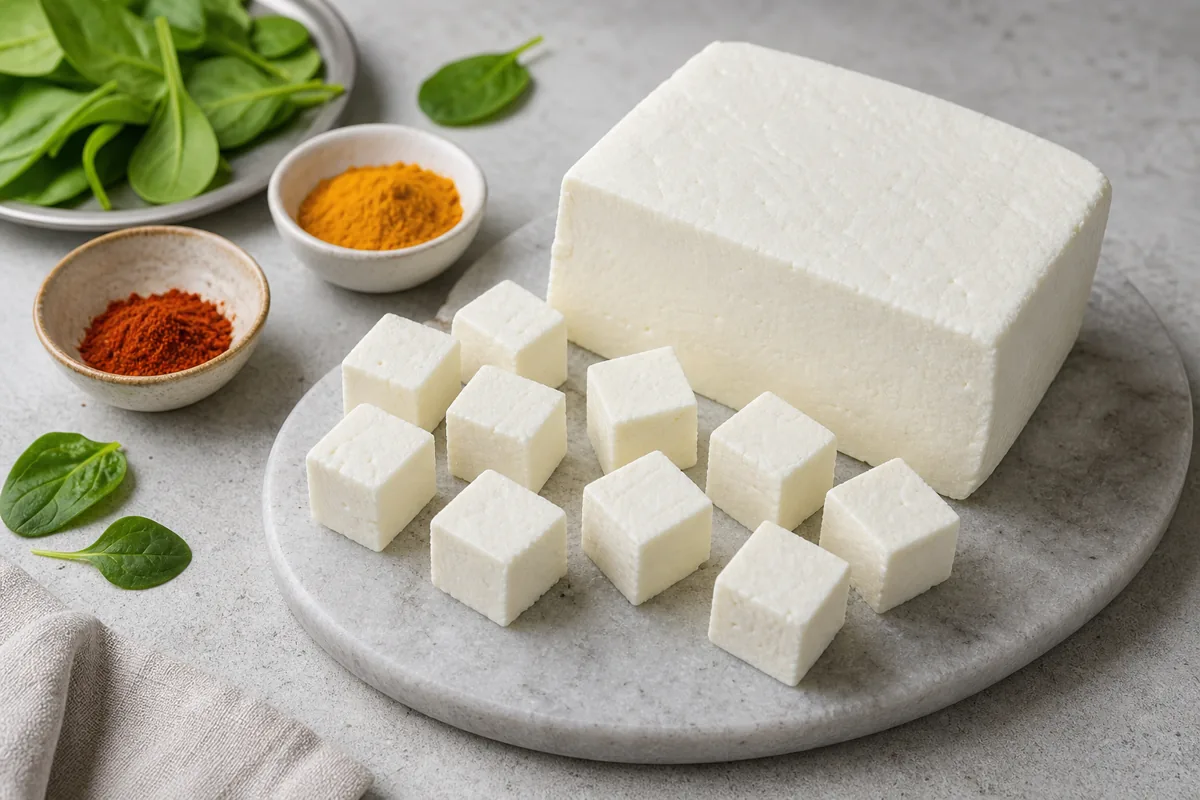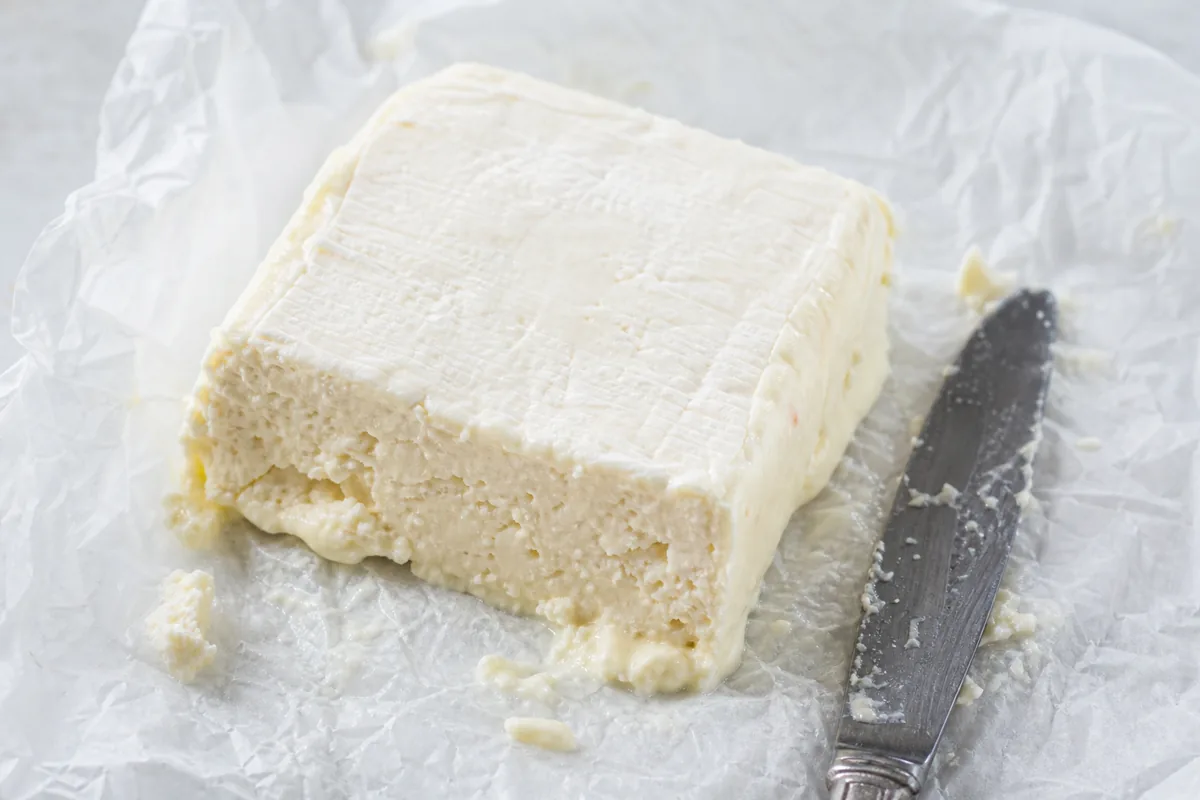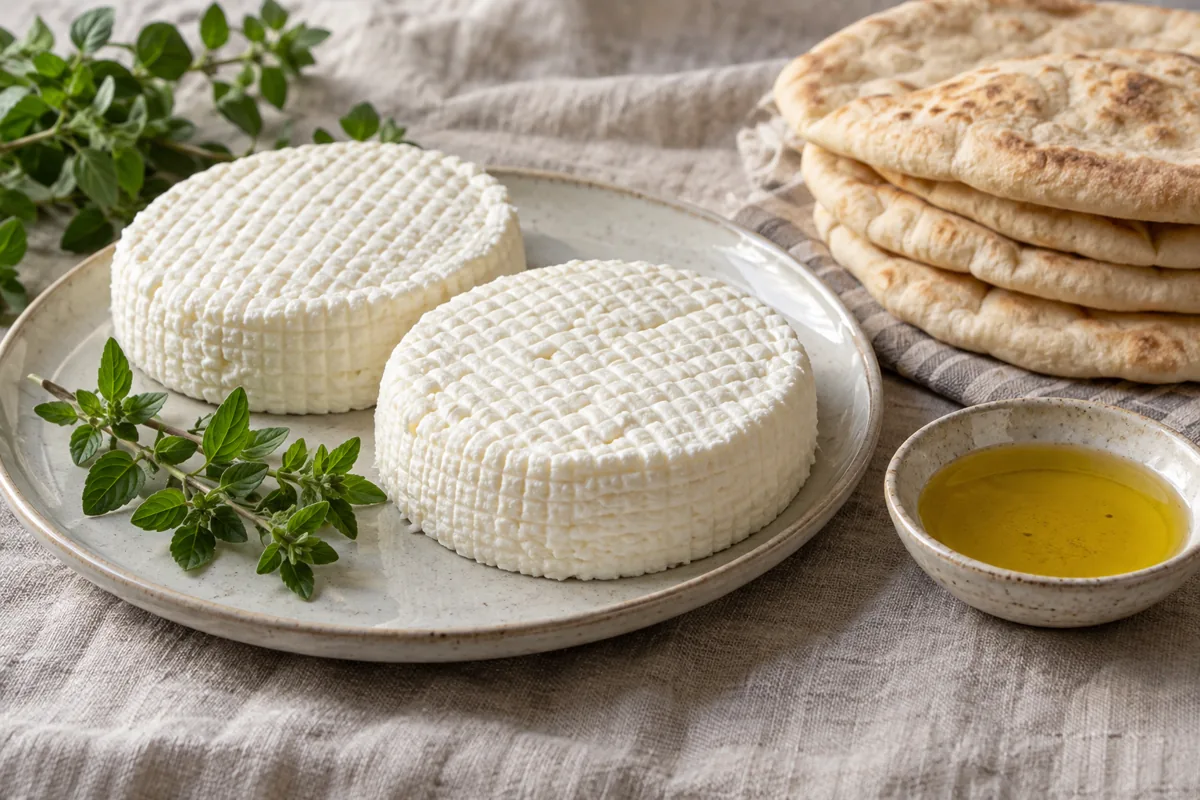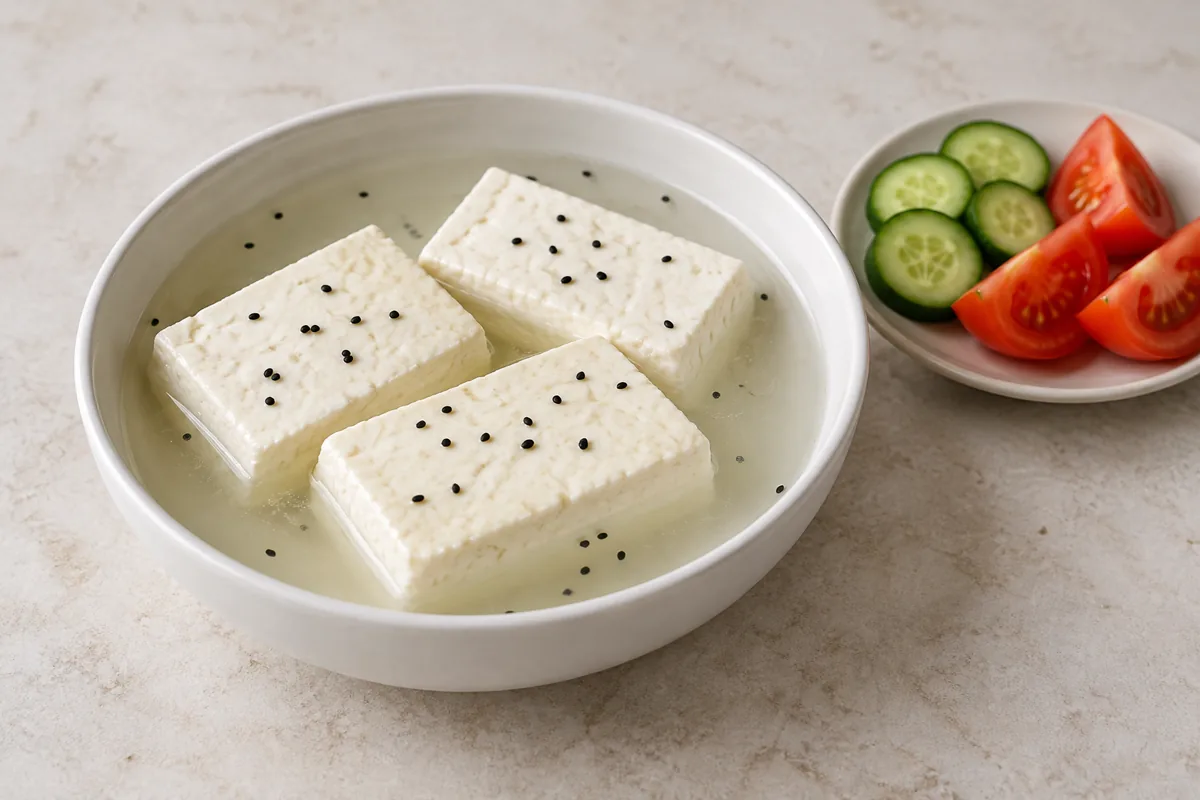
Nabulsi is a white brined cheese named after Nablus, the West Bank city that English Wikipedia gives as its place of origin. The finished curd is boiled and then kept in brine, which leaves it so salty that cooks soak it in fresh water for hours before baking with it.
Its best-known job is knafeh, the dessert of cheese under a crisp dough crust and sugar syrup, and English Wikipedia calls Nabulsi a major ingredient of it.
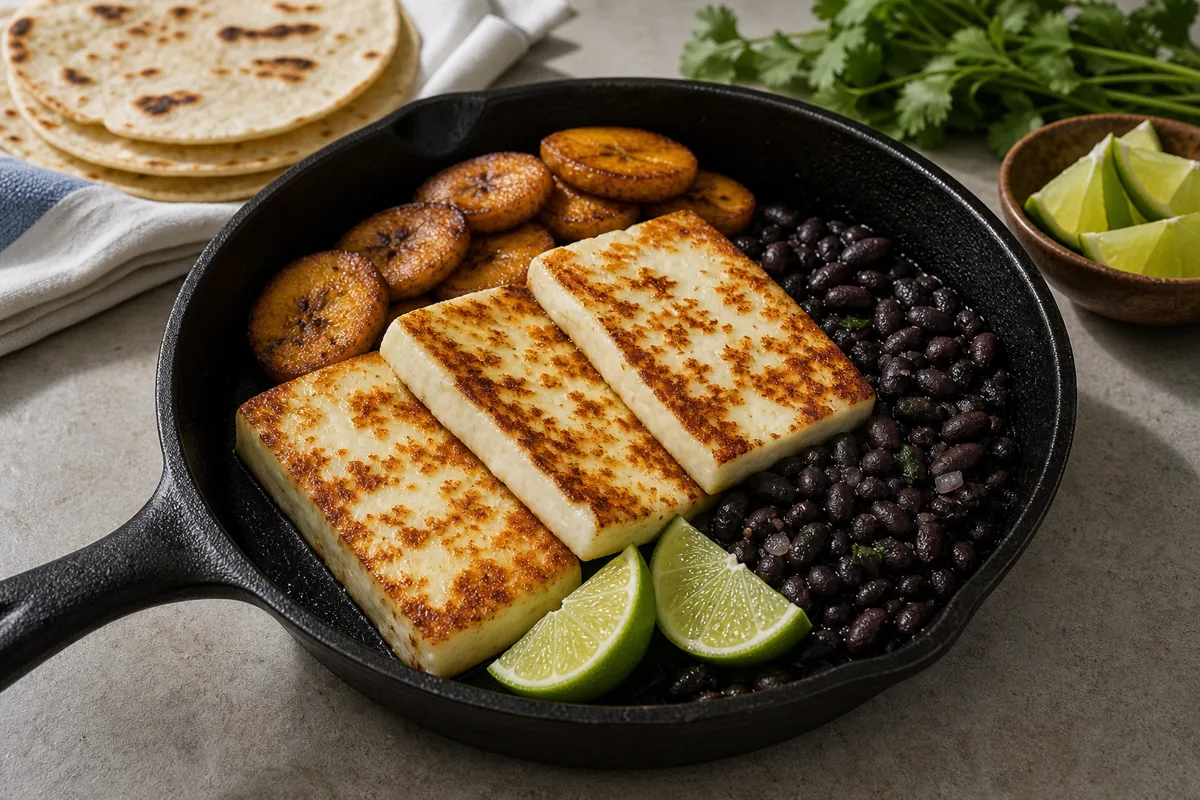
Nabulsi is also a table cheese. English Wikipedia says it is eaten fresh or fried in olive oil, and counts it with Akkawi among the principal cheeses eaten in Jordan.
In This Article
What Does Nabulsi Cheese Look and Taste Like?
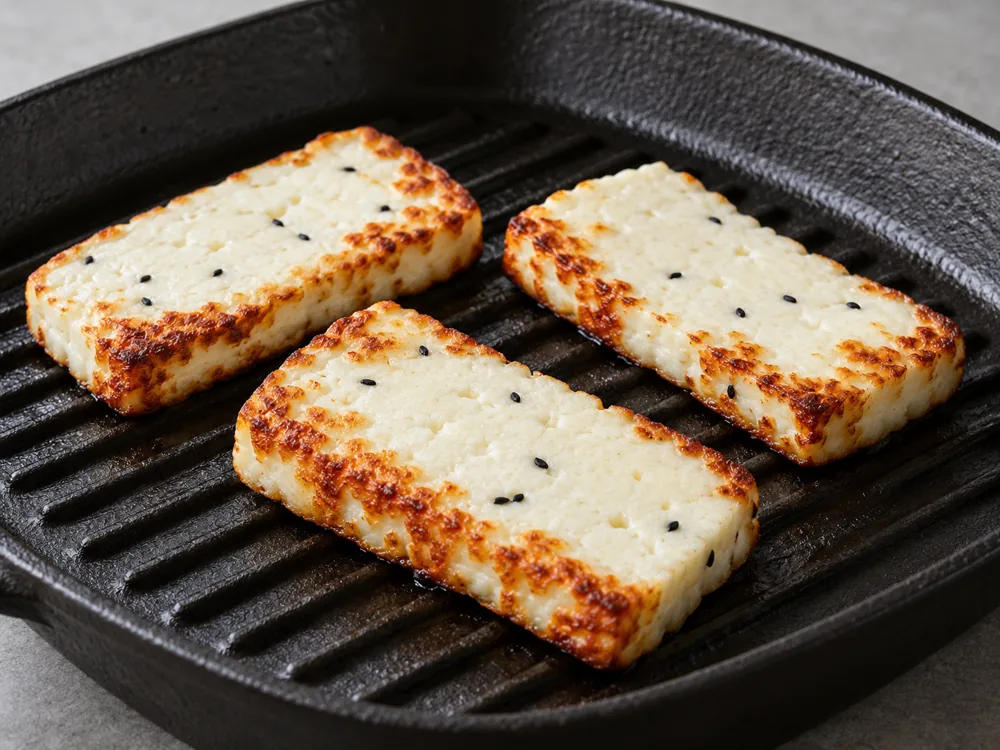
Nabulsi is white, rectangular and semi-hard, with no gas holes, according to English Wikipedia. Karoun Dairies, which makes Nabulsi in the United States, adds a bite you can hear: it calls its cheese a smooth, semi-firm, unripened boiled cheese that squeaks between your teeth.
The seasoning comes from the brine: English Wikipedia says the cheese is traditionally flavoured with mahleb (Prunus mahaleb) and mastic (Pistacia lentiscus) added to the boiling brine.
Nigella seeds, which Karoun says are sometimes called black cumin seeds, are the other common addition, and Karoun lists them on its label.
Not every maker uses them. Sawsan Abu Farha, who publishes her family's Nabulsi recipe on the blog Chef in Disguise, leaves the seeds out and warns that they can darken the cheese.
Her recipe still says where they go for makers who want them: in with the first sprinkle of salt, after the curd has drained for a couple of hours and before the cheese is boiled.
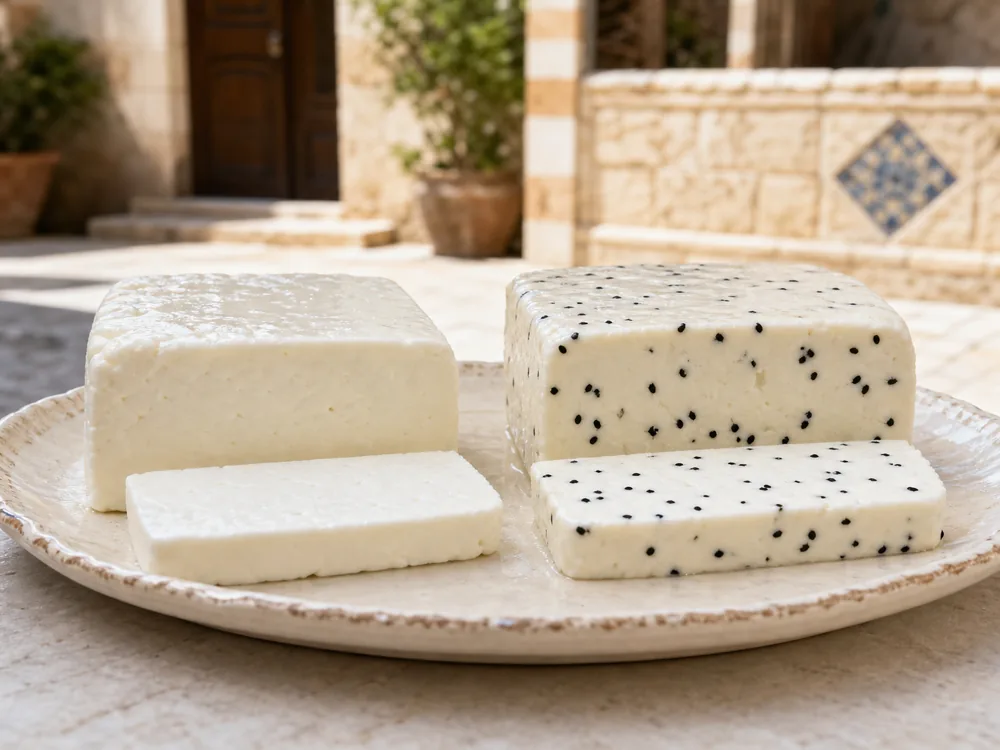
The plain version has a job of its own, since FalasteeniFoodie's knafeh recipe calls for Nabulsi without black seeds.
Which Milk Is Nabulsi Made From?
Sheep's milk comes first in the reference sources. English Wikipedia says Nabulsi is produced primarily from sheep's milk with goat's milk as the alternative.
A 2009 study from Jordanian universities describes the traditional cheese as raw sheep's milk, or a sheep and goat blend, set with rennet and with no starter culture added.
The English article adds that cow's milk can also be used, and that a blend of cow's and sheep's milk makes a cheese called mashmouleh. In the 2009 study that blend was 34% cow's and 66% sheep's raw milk, and the authors bought desalted mashmouleh sold specially for kunafa at local markets.
| Source | Milk | Detail |
|---|---|---|
| English Wikipedia | Primarily sheep, goat as the alternative; cow, sheep or goat all possible | A cow and sheep blend makes mashmouleh |
| Abu-Alruz et al. (2009 study) | Raw sheep, or sheep and goat mixed, for the traditional cheese | No starter culture added; their test cheeses also used raw cow's milk and a cow and sheep blend |
| Chef in Disguise (Sawsan Abu Farha) | Primarily goat; sheep can also be used | Fresh, unboiled milk for home cheese |
| Karoun Dairies | Pasteurized cow's milk | Made with non-animal rennet |
Abu Farha prefers goat's milk: sheep's milk has more fat, protein and milk solids and gives more cheese, she writes, but goat's milk gives a better-tasting cheese that lasts longer.
When a reader asked why her cow's-milk batch lacked the taste of Nabulsi from Palestine, Abu Farha answered that the missing flavour could come from the mastic and mahlab or from the milk, since goat's and sheep's milk taste different from cow's.
A shop-bought block can be any of these, so the label decides. Karoun's reads pasteurized cows' milk, salt, cheese culture, enzymes, spices, nigella seeds and non-animal rennet.
The cheese culture on that label is one difference from the traditional cheese in the 2009 study, which had no starter added, and from Abu Farha's recipe, which lists none.
How Nabulsi Is Made, Boiled and Brined
Nabulsi is boiled after it is made. English Wikipedia gives the order: the milk is heated and set with rennet, and the curds are pressed, cooled, cut, boiled and finally stored in brine.
The same article says it is typically made in spring, when the pastures are green.
Abu Farha's home method puts numbers on each stage.
- Milk and rennet: 5 litres of fresh, unboiled sheep's milk is warmed to 40°C, set with a quarter of a rennet tablet and left undisturbed for 2 hours.
- Draining and pressing: the curd drains in cheesecloth for a couple of hours, then sits under a heavy weight overnight; in a reply to a reader she gives 5 pounds as the weight for this batch.
- Salting: the pressed cheese is cut into rectangles and lightly salted morning and evening for about two days.
- Firming: the pieces then rest in the fridge for 3 to 7 days.
- Boiling: the rectangles go into boiling water for 3 to 5 minutes, or into a boiling brine of 1 cup of salt to 6 cups of water until the cheese starts to bubble slightly.
- Flavouring: half a teaspoon each of whole mastic and mahlab, tied in cloth, goes into the boiling brine; her alternative is the mahlab alone in the brine and a teaspoon of lightly crushed mastic sprinkled between the layers of cheese in the storage jar.
She starts from unboiled milk because boiling the milk stops the large, firm curds Nabulsi needs from forming, and she lifts the set curd out with a plate or a big ladle to keep those curds as large as possible.
The finished cheese is boiled instead. In a reply to a reader she says the boil changes the texture so the cheese holds its shape when grilled or fried.
Boiling also softens the cheese, so Abu Farha lifts it out with a slotted spoon and lets it firm up as it cools.
Salt does the hardening in her method: she says it draws more whey out of the soft cut cheese, and the pieces keep firming in the fridge because of it.
What Goes Wrong When You Make Nabulsi at Home?
Four failures come up in Abu Farha's post and the comments under it, and she names a cause or a fix for each.
| Problem | Cause or fix she gives |
|---|---|
| The milk does not form curd | Ultra-pasteurized dairy, milk overheated until the cultures die, rennet that is too old or too little, or not waiting long enough |
| The cheese will not firm up | No salt sprinkled, or a pressing weight that is too light |
| The cheese crumbles in the boil | Boiling too long, or too short a rest in the fridge beforehand |
| The cheese turns almost liquid in the boil (a reader's report) | Press more whey out in cloth squares before salting, or add powdered milk or cream for more solids |
The first two causes in the top row both come down to heat. Her post blames ultra-pasteurization for killing the bacteria a cheese needs, and a commenter who writes that she is a cheesemaker herself answered that the cause is heat changing the protein structure so it will not form curd.
Abu Farha replied that her cheese-making guide says heat affects the protein structure in milk.
Her replies on store-bought milk are not uniform: in one she says pasteurized cow's milk would work but ultra-pasteurized would not, while in others she says supermarket milk will not make this cheese unless calcium chloride is added.
The reader whose cheese turned almost liquid had salted it for three days and kept it 12 days in the fridge. Abu Farha's first suggestion, which she calls the traditional way, spoons curd into squares of cloth and presses them between two wooden boards to squeeze out as much whey as possible before any salt goes on, giving squares 10 to 15 cm long.
Her second suggestion was powdered milk, which may add milk solids that help the cheese hold together; she says heavy cream, as in a video she linked, would raise the fat and could help the flavour too.
How Salty Is Nabulsi?
Salt is what keeps Nabulsi. English Wikipedia says sellers deliberately raise the salt content to help preserve the cheese in storage.
Abu Farha describes two versions of her family's cheese: a lightly salted, less firm one, and a firmer one whose salting runs for a week instead of about two days. She says the firmer version ends up quite salty, but that the salt is what preserves it.
Researchers use strong brine too, and the 2009 study in the American Journal of Agricultural and Biological Sciences stored its Nabulsi cubes in 18% brine for four weeks.
Karoun's nutrition panel gives the only per-serving figure on this page: 280 mg of sodium per 28 g serving, 9% of the Daily Value, alongside 90 calories, 8 g of fat and 5 g of protein.
Karoun's label describes that serving as a 1-inch cube, and scaled to 100 g the sodium comes to about 1,000 mg. The panel also lists 5 g of saturated fat (25% of the Daily Value), 25 mg of cholesterol, 1 g of carbohydrate and 20% of the Daily Value for calcium.
Those numbers describe one brand's cheese. No source cited here gives a sodium figure for home-made or traditionally brined Nabulsi.
English Wikipedia notes that the high salt content of brined Nabulsi may lead people with hypertension or kidney stone disease to avoid it.
How to Desalt Nabulsi for Knafeh or the Table
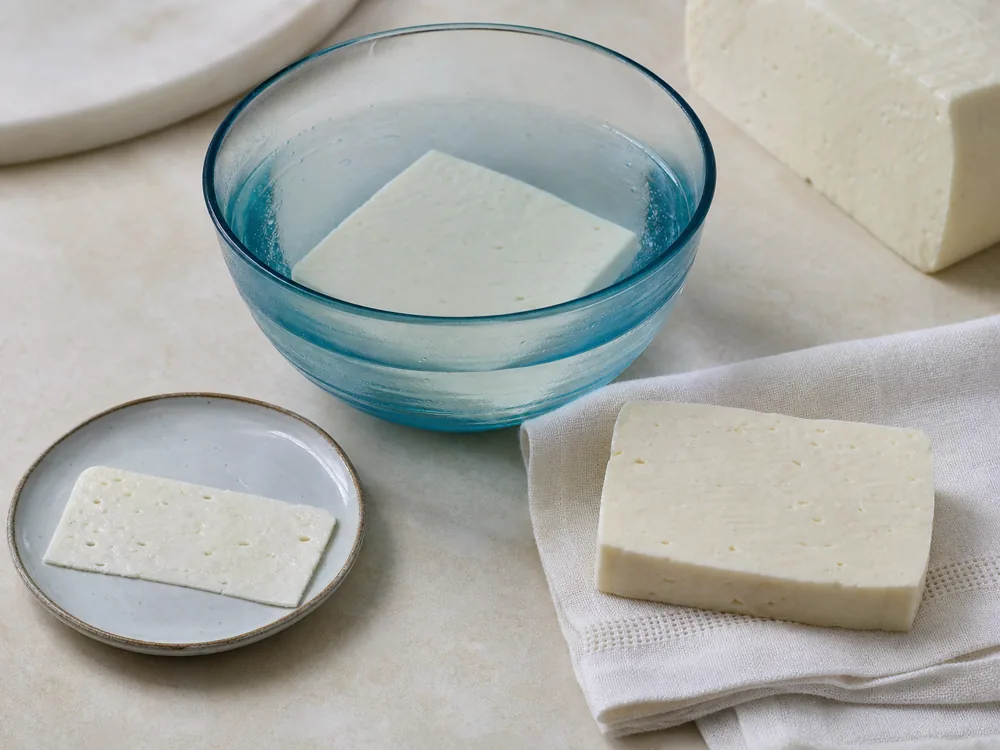
Every source removes the salt with water. English Wikipedia says the cheese is soaked in fresh water, often in the refrigerator, for several hours or overnight, and ties that step to bakery goods and desserts such as knafeh.
Recipe writers set tighter routines for knafeh, and their times differ.
| Source | Water | Time |
|---|---|---|
| English Wikipedia | Fresh water, often in the refrigerator | Several hours or overnight |
| FalasteeniFoodie (knafeh recipe) | Cold water, changed every hour | At least 6 hours for cheese sold in brine |
| Cleobuttera (knafeh recipe, for the Levantine cheeses in her knafeh) | Lukewarm tap water, changed every half hour; bowls go in the fridge if soaking overnight | 2 to 6 hours, until the cheese no longer tastes salty |
| Chef in Disguise (post) | Plain water | Soak overnight, or boil for a couple of minutes |
| Chef in Disguise (replies to readers) | Thin strips, water changed every 3 to 4 hours | Until no longer salty: a day or two in one reply, a couple of hours for her lightly salted cheese |
Fatimah of FalasteeniFoodie explains her 6-hour minimum: cheese sold in a saltwater brine is saltier than cheese sold as a block, and some brands are saltier than others.
Tasbih of Cleobuttera, who calls the cheese Nabulsia, says the time depends on the salt content and on how thin the slices are. She slices the cheese as thin as possible and soaks each cheese in its own bowl, because different cheeses lose salt at different rates.
Abu Farha's advice shifts with the cheese. For the long-keeping, heavily salted version she says to soak thin strips, changing the water every 3 to 4 hours until it is no longer salty, and in another reply she puts a knafeh cheese at a day or two.
For her lightly salted version, a soak of a couple of hours or a boil of a couple of minutes is enough. She and Tasbih both end the soak by taste, once the cheese no longer tastes salty.
Soaking leaves the cheese wet. Tasbih's recipe, which uses shelal and Akkawi, drains the soaked cheese in a colander, squeezes out the liquid and crumbles it, then leaves it to release more moisture while the crust is made.
Does Nabulsi Melt? Frying, Grilling and Knafeh
Heated Nabulsi softens but keeps its shape. English Wikipedia says it becomes soft and elastic when heated, and Abu Farha calls it ideal for frying or grilling.
The 2009 study measured how little it spreads: in its melting test, a 2 cm disc of cow's-milk Nabulsi with no enzyme added, stored at 4°C and heated at 100°C for 15 minutes, measured between 2.45 and 3.1 cm across afterwards.
Karoun says its version can be grilled to a golden crust, and English Wikipedia says the cheese may be fried in olive oil.
Stretch is the harder test. The 2009 study says knafeh needs a cheese that melts and stretches well, and that Nabulsi rarely has those traits when it is made and stored the usual way.
The authors explain stretch through casein, the milk protein: a cheese stretches and melts once some of the peptide bonds or cross-links in it have been broken, which acid or protease enzymes can do.
They add that the traits are scarcest in cheese made from high-quality milk, where little spontaneous fermentation happens in the milk or in the curd before boiling.
Their fix was papain, an enzyme from papaya latex, added to the storage brine at 0.01%. The treated cheese developed a fibrous structure that still melted and stretched well after 4 weeks, which the authors put down to the salt holding the enzyme in check.
Stretch was measured by heating 15 g of desalted cheese on an 80°C hot plate and lifting a plate until the strands tore: papain-treated cheese reached 38 to 73 cm across the test conditions, while untreated cheese never passed 18 cm.
Two of the six enzymes made the cheese fall apart instead, and because the test cheese was made from cow's milk in a lab, the figures say little about a shop-bought block.
Home cooks report the same limit. Tasbih found that Nabulsia on its own came out rather rubbery in knafeh, without the stretch she wanted.
Abu Farha reports the opposite for her own cheese: it stretches when heated, she tells a reader, provided it was soaked the night before. For the long strings seen in videos she suggests Akkawi or a mix of two-thirds Nabulsi and one-third mozzarella.
Tasbih says she could not find good-quality Nabulsia, and the 2009 authors say the usual make and storage rarely give stretch, so the difference may lie in the cheese rather than the cook.
FalasteeniFoodie's recipe solves it with a blend: half a pound each of Akkawi and plain Nabulsi layered with 8 oz of fresh and 4 oz of shredded mozzarella for the cheese pull. The pan then bakes under foil at 450°F for 30 to 35 minutes before the syrup goes on.
The heat source differs between recipes. Tasbih, whose filling is shelal and Akkawi, found that an oven left her crust barely browned and her cheese hard after an hour, so she cooks hers on the stove in 10 to 15 minutes.
As that cheese melts it gives off moisture, which she says can make the crust soggy, so she pats it with a clean cloth while the pan turns.
Knafeh is only one of the dishes the sources name.
| Use | How It Works |
|---|---|
| Other sweets | Abu Farha sweetens the cheese for kataief, the other dessert she names beside knafeh. |
| Savoury pastry | Abu Farha uses it as a stuffing for phyllo, shortcrust pastry or a simple pita pocket, and in cheese fatayer. |
| Fried appetiser | Abu Farha serves fried Nabulsi as an appetiser. |
| Table cheese | Karoun serves it with a little cucumber and tomato to balance the salt of the brine, and suggests it for sandwiches and salads; Abu Farha likes it cubed with watermelon. |
What Can Replace Nabulsi in Knafeh?
The substitutes the sources name are all for knafeh. English Wikipedia says recipes in places without Nabulsi use mozzarella, ricotta or both, sometimes with other softer cheeses, to copy the texture of heated Nabulsi.
FalasteeniFoodie suggests Panela, a sweet cheese or baladi cheese in place of Nabulsi.
When neither Nabulsi nor Akkawi can be found, the same recipe falls back on Panela or queso fresco.
The recipe also rules one cheese out, saying not to use halloumi. Tasbih disagrees in a reply to a reader on Cleobuttera, saying desalted halloumi with mozzarella would work.
Tasbih herself leaves Nabulsia out of her own filling. She builds it from shelal, a Syrian braided cheese she praises for its stretch, and Akkawi for flavour, at a little under 2 parts shelal to 1 part Akkawi and about 800 g in all.
For a knafeh with no Levantine cheese at all, Tasbih's fallback is 800 g of mozzarella, which needs no soaking if it is not salty, though she says the taste will be less authentic.
How Does Nabulsi Differ From Akkawi and Feta?
Abu Farha answers a reader that Nabulsi is very similar to Akkawi but firmer and saltier, and that one can replace the other in most recipes.
FalasteeniFoodie layers half a pound of each into her knafeh, and says more Akkawi can take the place of Nabulsi when it is missing.
Tasbih found Akkawi alone as rubbery as Nabulsia. Videos she watched explain that Akkawi comes in two kinds: baladya, the generic one, which tastes great but stretches poorly, and Tchiki, which has less flavour but good elasticity.
She suspects the Akkawi sold in Egypt differs from the Levantine one, so the same name can cover cheeses that stretch differently.
Asked whether Nabulsi is anything like feta, Abu Farha replied that it is not quite: Nabulsi is firmer in consistency and has a flavour of its own.
Abu Farha says Akkawi and Nabulsi swap in most recipes, with Nabulsi firmer and saltier. Tasbih says the Akkawi type, baladya or Tchiki, decides whether it stretches.
How Long Does Nabulsi Keep?
Karoun gives its cheese a shelf life of 6 months refrigerated. The CDC says to keep a refrigerator at 40°F (4°C) or below.
| Source | Cheese and conditions | Time |
|---|---|---|
| Karoun Dairies | Karoun Nabulsi, refrigerated | 6 months shelf life |
| Chef in Disguise (post) | Lightly salted, boiled in plain water, kept in the fridge | Up to 2 weeks |
| Chef in Disguise (reply to a reader) | Boiled, then kept in an airtight container in the fridge with no brine | A week to 10 days |
Abu Farha's two figures for the lightly salted cheese differ a little, and in her reply she adds that such a cheese needs no brine, since she keeps brine for long storage.
Is Nabulsi Safe to Eat During Pregnancy?
It depends on the milk and on whether the cheese is cooked until steaming hot. Neither the NHS nor the CDC names Nabulsi, so the answer comes from how each agency treats milk, texture and heat.
Wikipedia calls Nabulsi semi-hard and Karoun calls its pasteurized cow's milk block semi-firm, but the NHS does not name Nabulsi, so its line for pasteurised semi-hard cheeses, such as edam, does not settle it. The CDC lists hard cheese and feta made with pasteurized milk as safer but names neither semi-hard cheese nor Nabulsi, so its list does not settle it either.
Raw-milk Nabulsi is not on the NHS safe list, which names semi-hard cheese only when it is pasteurised. The NHS puts any foods made from unpasteurised milk under foods to be careful with.
Abu Farha boils her finished cheese, but neither agency addresses boiling a cheese after it is made, and the CDC's safer list covers hard cheese only when it is made with pasteurized milk.
Heat settles it only when the cheese is cooked until steaming hot, which is the NHS wording.
Listeria has turned up in brined white cheese sold in Jordan. A 2012 survey of 350 samples of five types, including akkawi, boiled cheese and halloumi, found Listeria monocytogenes in 39 of them, or 11.1%.
SOURCES & REFERENCES
Nabulsi Cheese FAQ
Salt preserves it. English Wikipedia says sellers deliberately raise the salt content so the cheese keeps in storage, which is why cooks soak it before using it in sweets.
No. English Wikipedia treats them as two cheeses that are both principal cheeses in Jordan, and knafeh recipes such as FalasteeniFoodie's use them together.
It depends on the rennet. Karoun lists non-animal rennet on its label, while Abu Farha's home recipe uses rennet tablets without naming their source.