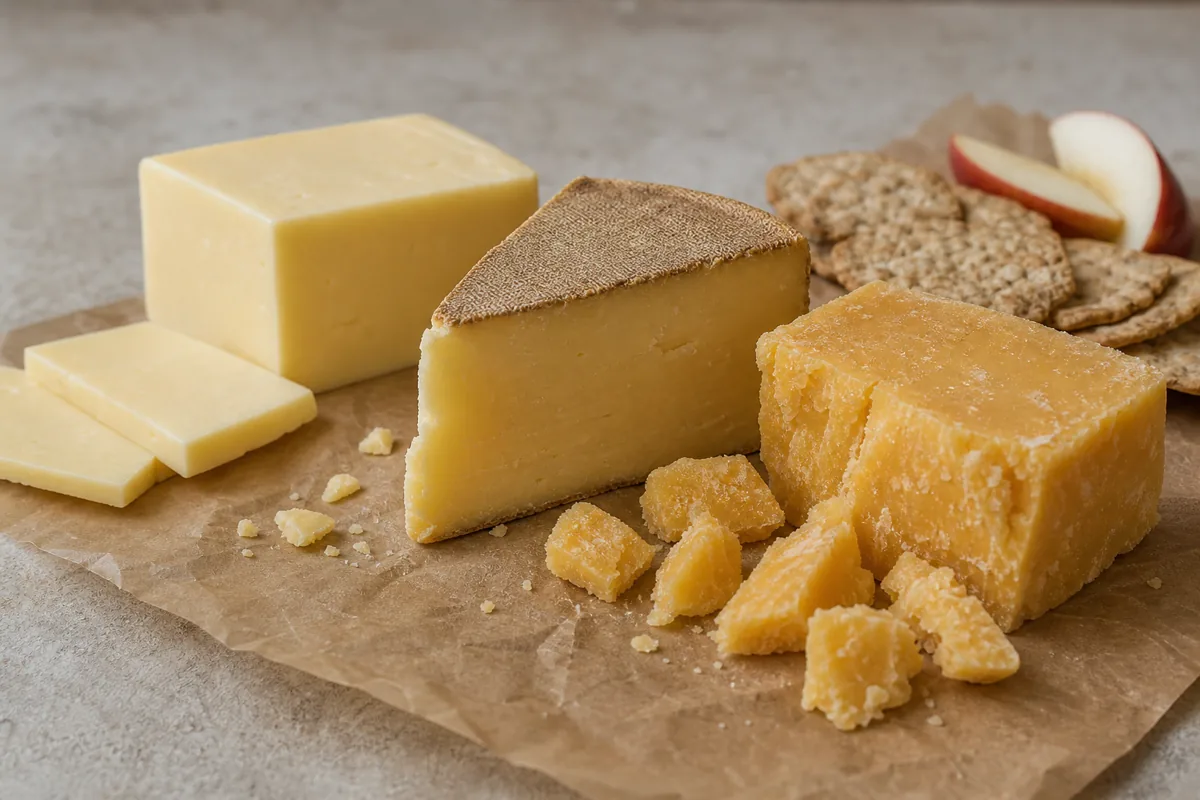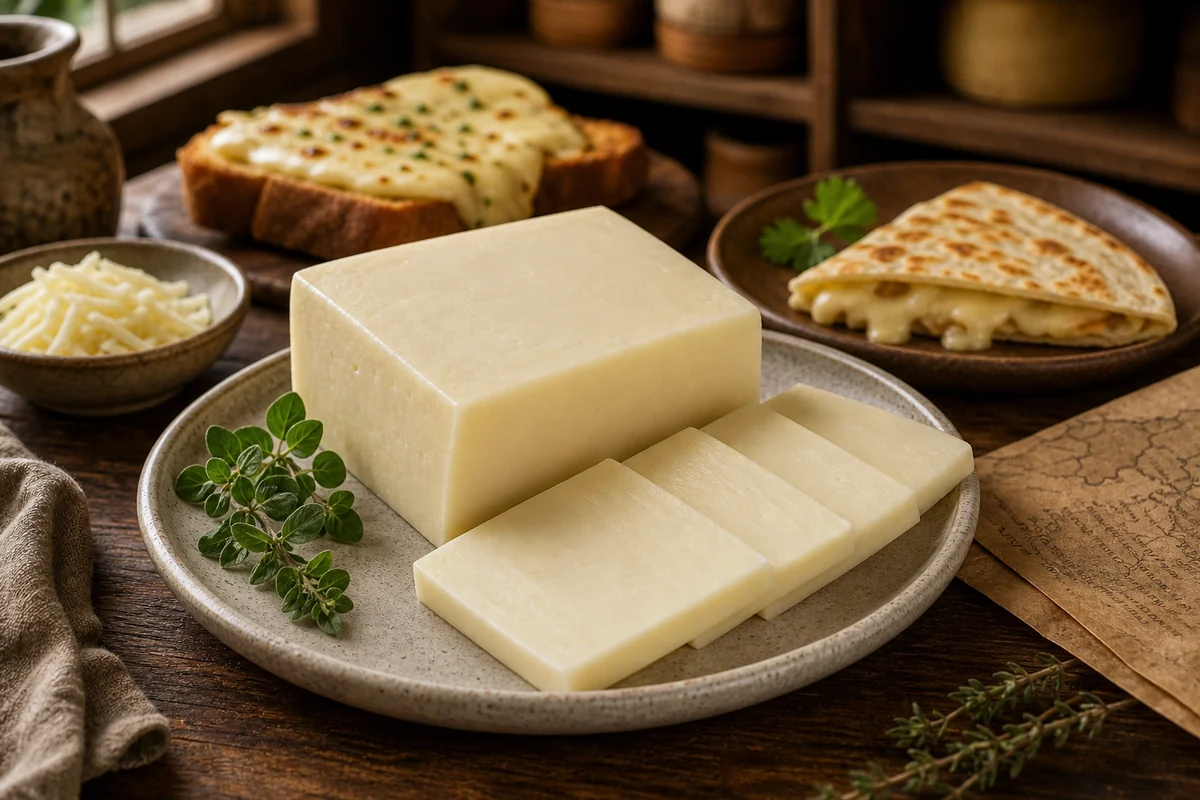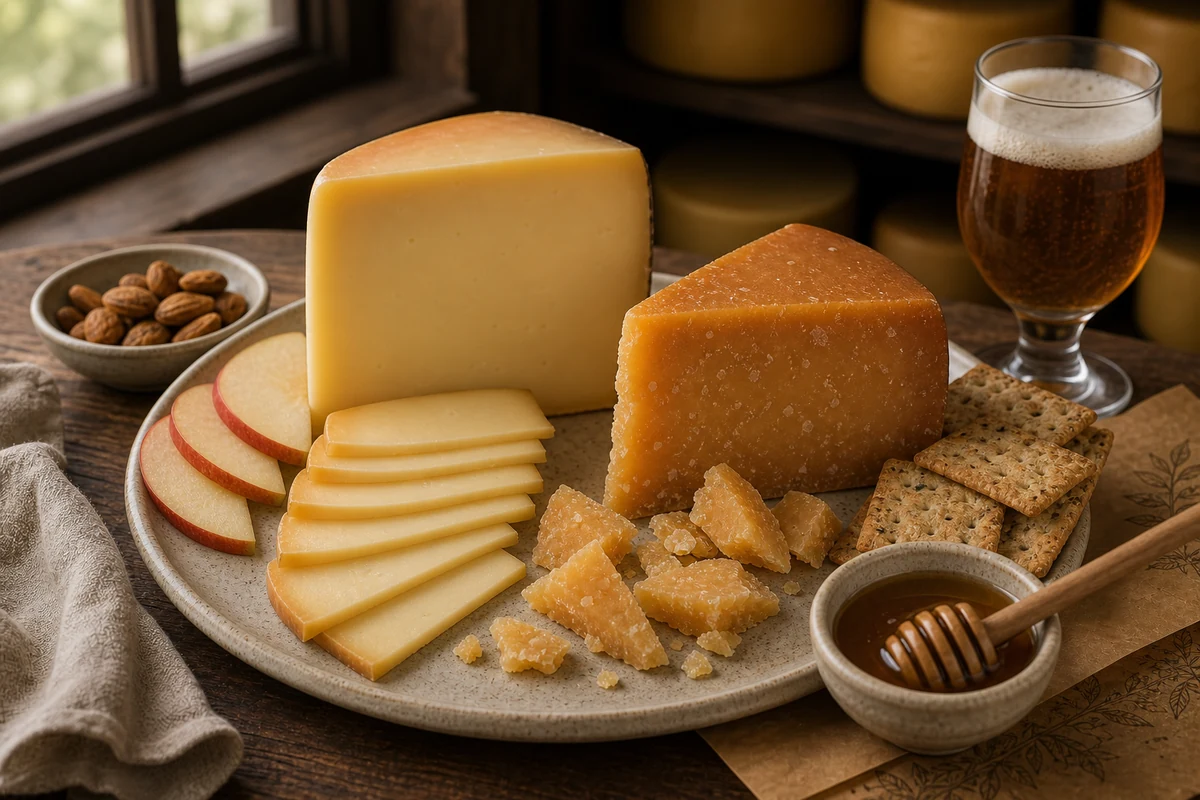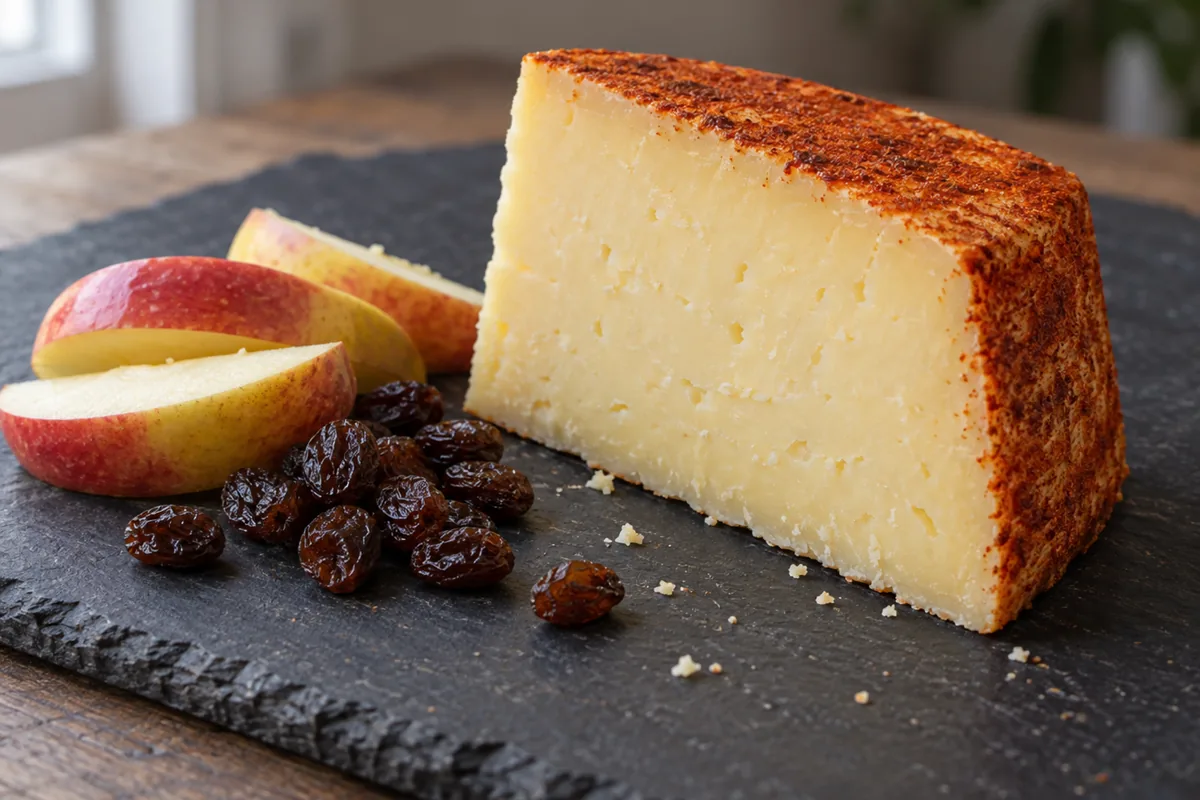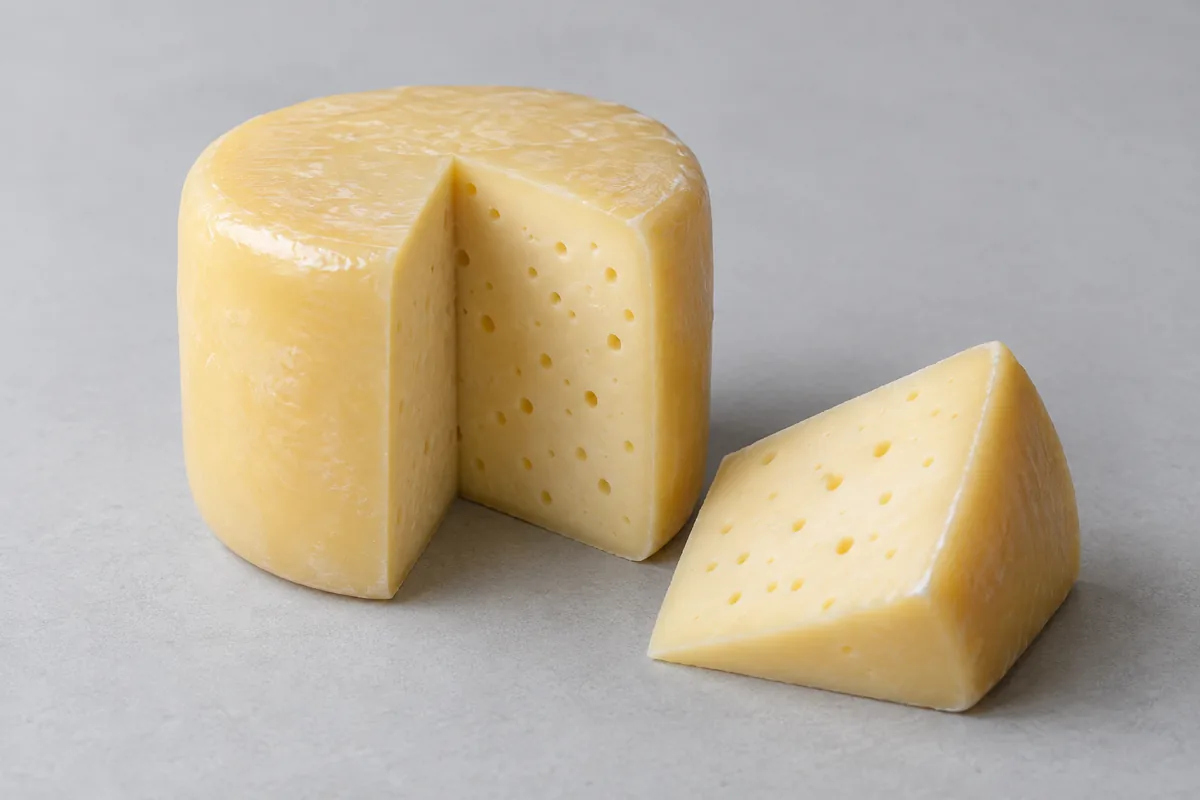
Hushållsost means “household cheese” in Swedish: a young, mild, semi-hard cow's milk cheese that is put on sandwiches more often than it is cooked. English Wikipedia calls it the most popular cheese in Sweden, at about 15,000 tonnes a year, a figure it takes from a Svensk mjölk page archived in 2011.
The name does not promise a Swedish wheel. Its protected status expired in January 2023, and Arla, which sells its wheel as Sweden's most popular hard cheese, makes it in Denmark.
In This Article
What Is Hushållsost Cheese?
A 1968 draft international standard, deposited by Sweden, describes hushållsost as a small cylindrical cheese with smooth consistency, evenly spread round or irregular holes, and a mild, slightly acid flavor, ready to eat at a young age.
The name itself was in print by 1898.
Young means roughly 2 months: Gäsene Mejeri's product text says its cheese is aged from 2 months, and Cheese.com, English Wikipedia and Cheese Professor all give about 60 days.
ICA lists Fjällbrynt's “Hushållsost mild” in a 220 g tube under Mjukost, which Cheese Professor describes as soft processed cheese sold in tubes. Its ingredients are Swedish hard cheese (60 percent), water, melting salts and a preservative, and it carries 7.8 g of fat per 100 g, so it is a different product from the 26 percent wheel.
Is Hushållsost Always Made in Sweden?
No. Hushållsost held Traditional Speciality Guaranteed (TSG) status in the EU and the UK until it expired on 4 January 2023, according to English Wikipedia, though Cheese.com's page still says the cheese enjoys TSG status.
Cheese.com's TSG line can be a leftover from before 2023, and the name alone carries no guarantee of where or how a given wheel was made.
Two current packs show the spread. Arla's 1.1 kg wheel is made in Vium, Denmark, from milk on Danish Arla farms, while Gäsene Mejeri's wheel of about 1 kg lists Sweden as its country of origin and describes milk from the dairy's own farms.
If a Swedish-made wheel matters to you, read the country of production on the pack.
What Does Hushållsost Look Like?
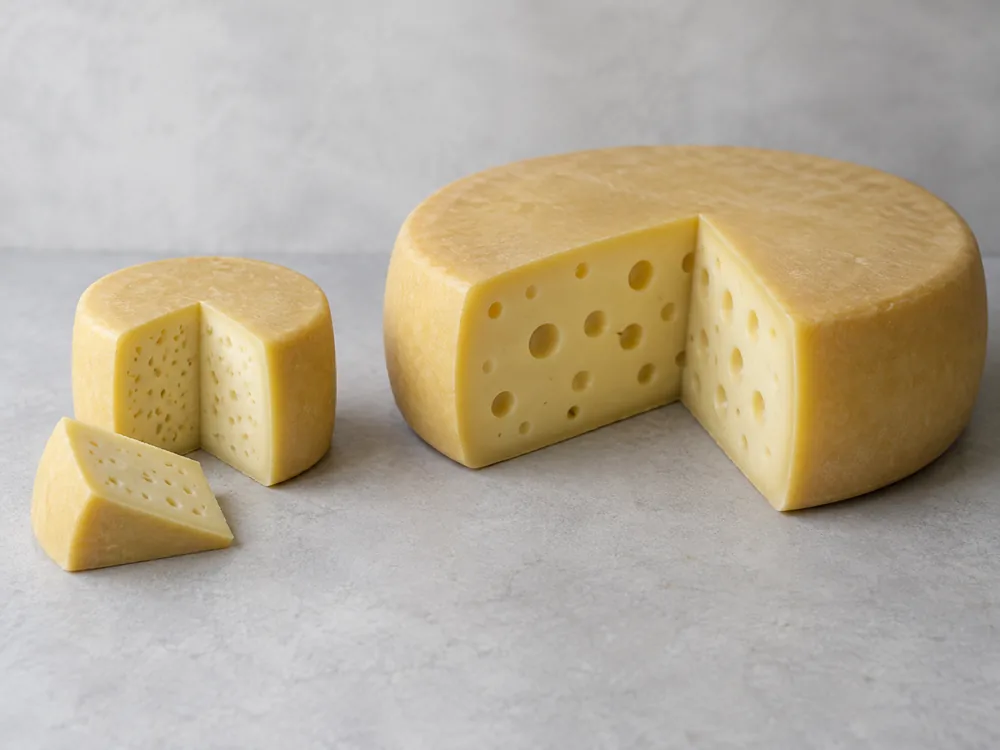
In the 1968 draft standard, the traditional cheese is a small, firm cylinder with evenly spread small holes.
The round holes run 3 to 10 millimeters, and the irregular openings are smaller still, so the cut face looks finely and evenly eyed rather than coarsely holed.
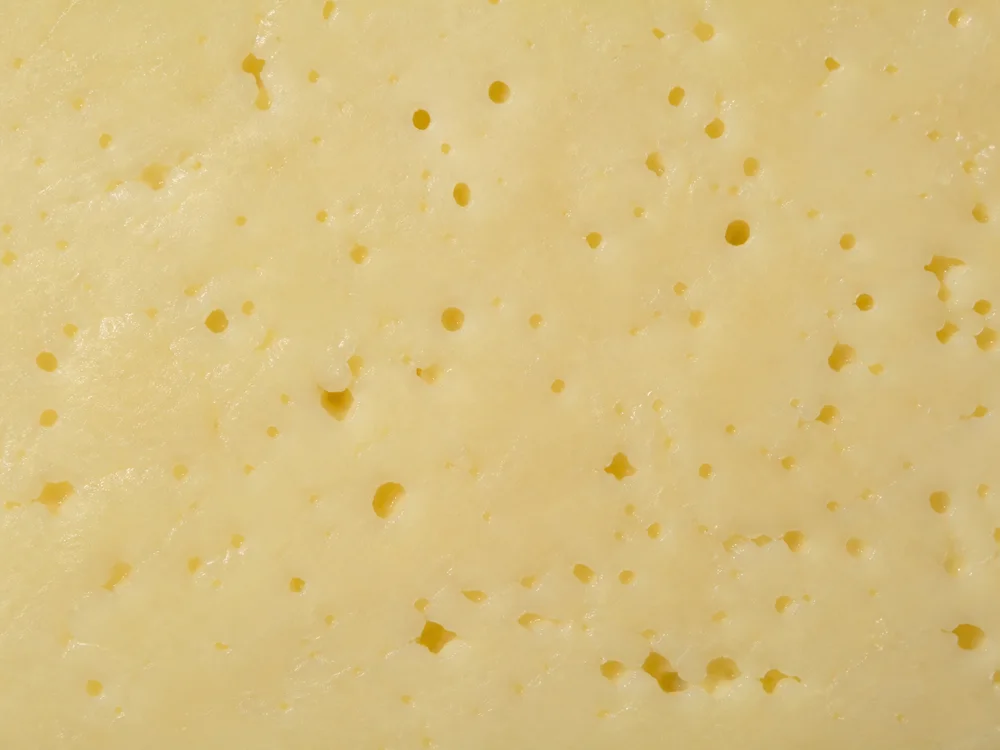
Cheese.com describes the texture as creamy, open and smooth and compares it with Monterey Jack or a firmer mozzarella, which agrees with the draft's slightly pliable paste. The holes are round and irregular in the draft, small and irregular in Cheese.com's description and small and granular in English Wikipedia's.
English Wikipedia says wheels are today wrapped in plastic film before ageing, and Cheese.com says the same, so a wheel you buy today will have a plastic wrap, not a paraffin rind.
The draft also provides for a spiced version flavored with caraway seeds and cloves, sold with the prefix “Spiced”.
How Is Hushållsost Made?
In the 1968 draft, hushållsost is made from pasteurized milk, a starter of harmless lactic acid bacteria, salt and rennet or other suitable coagulating enzymes, with rennetting at 30 to 32°C and the coagulum then heated to 35 to 40°C.
English Wikipedia and Cheese.com both call hushållsost closely related to Port Salut.
Hushållsost was traditionally made on farms in English Wikipedia's account, while Cheese.com calls it a creamery cheese.
What Does Hushållsost Taste Like?
Every description of the taste centers on mildness with a sour edge. Arla calls its wheel mild, creamy and lightly sour, and the 1968 draft says mild and slightly lactic.
The draft's word for the sour edge is lactic, which fits the lactic acid starter its make lists, and both current labels list a starter culture too.
Gäsene Mejeri's product text adds a nutty character with clear saltiness and fresh acidity, and Cheese.com lists the flavor as acidic, buttery, mild, nutty and salty, with a fresh aroma.
Cheese Professor, writing for a US audience in 2021, describes a buttery texture and a pleasing tang.
How Is Hushållsost Eaten and Cooked?
Arla says hushållsost is eaten mainly as a sandwich topping, with cooking and snacking as the other uses.
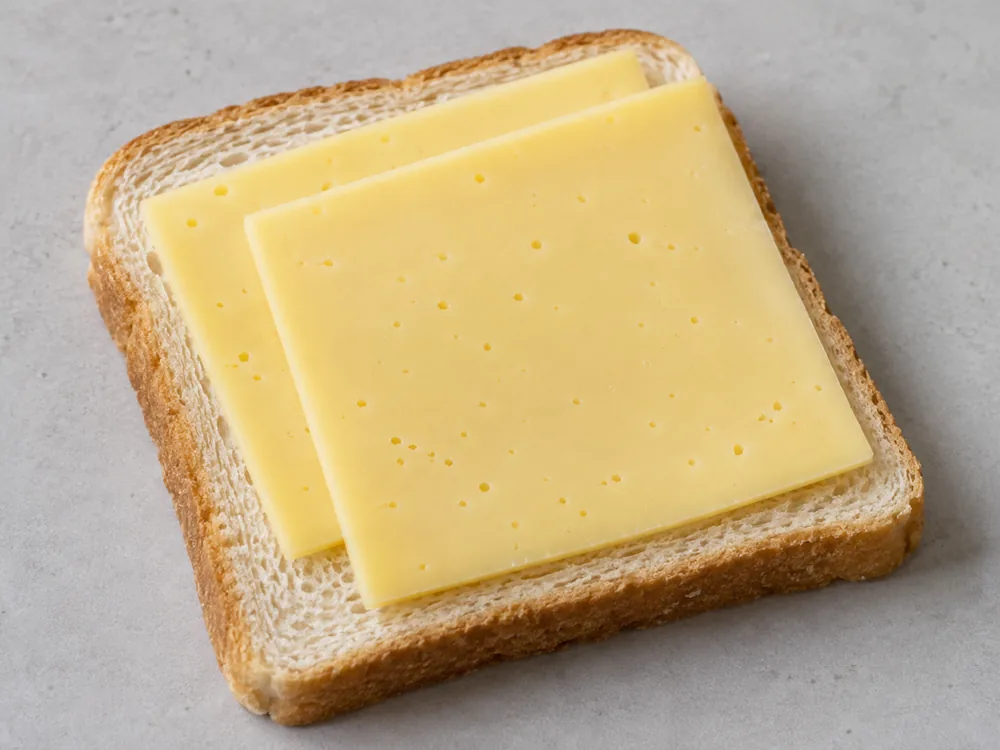
For heat and for serving, Cheese.com lists casseroles, sandwiches, pizza, and buffet and cheese platters.
Cheese Professor says it melts very well and suggests quesadillas.
For a cheese board, Cheese Professor calls it a well-rounded, crowd-pleasing choice and suggests elderflower jam alongside.
How Does Hushållsost Compare with Herrgårdsost and Norvegia?
The same 1968 committee document drafted standards for hushållsost, Herrgårdsost (Sweden) and Norvegia (Norway), which puts all three on the same measures. They are drafts from that year, not current specifications.
| Feature | Hushållsost | Herrgårdsost | Norvegia |
|---|---|---|---|
| Consistency | Semi-hard | Hard | Semi-hard |
| Usual shape | Cylinder | Flat cylinder with slightly convex sides; block allowed | Cylinder with convex sides, or rindless rectangular block |
| Usual weight | 1, 2 or 3 kg | Cylinder 10 to 12 kg; block 12 to 15 kg | Flat cylinder 4 to 12 kg; small cylinder about 0.5 kg |
| Holes | Even; round 3 to 10 mm, irregular pinhead to rice grain | Even; round, regular, 10 to 20 mm | Few to many, evenly spread; round, mainly 5 to 10 mm |
| Flavor in the draft | Mild, slightly lactic | Mild, mellow, nutty | Mild; not normally sold before 6 weeks old |
| Minimum dry matter, main variety | 57 percent | 61 percent | 56 percent |
Weight and hole size separate them fastest. A Herrgårdsost cylinder in the draft weighs 10 to 12 kilograms and carries round holes of 10 to 20 millimeters, against 1 to 3 kilograms and 3 to 10 millimeters for hushållsost.
Age separates them too: Cheese Professor gives about 6 months for basic Herrgårdsost and up to 2 years for older ones, against about 60 days for hushållsost.
Current packs blur the draft's size gap: Arla lists its Herrgård ost as a pack of about 730 g at 28 percent fat, which cannot be a 10 to 12 kilogram cylinder. The draft weights therefore describe whole wheels, and a supermarket piece says little about wheel size.
Class words do not settle it, because the draft calls Herrgårdsost hard while Cheese Professor calls it semi-hard and says Swedes find it significantly softer than the Gruyère or cheddar they compare its flavor with. The draft's dry-matter row in the table, 61 percent against 57, is the firmer measure.
The drafted make groups the cheeses the same way. Rennetting is at 30 to 32°C for all three, but the coagulum is heated to 35 to 40°C for hushållsost and about 38°C for Norvegia, against 42 to 45°C for Herrgårdsost, for which the draft also sets more than 3 months in store at 10 to 18°C.
Together, the dry-matter row and the make put Norvegia with hushållsost and set Herrgårdsost apart.
If you need a stand-in, the draft numbers put Norvegia nearest, with round holes of 5 to 10 millimeters, a mild flavor and a similar coagulum temperature. Norvegia is a Norwegian cheese, not normally sold before 6 weeks old.
Where Can You Buy Hushållsost?
In Sweden, Arla sells hushållsost as wheels of about 1.1 and 2.2 kg, Götene Hushållsost in 500 g and about 1.2 kg pieces, and sliced packs of 300 g and 750 g, in 17 and 26 percent versions.
If you want it for sandwiches, the use Arla names first, its sliced Götene packs of 300 and 750 g are the match, while Arla pitches the round wheel as made to put out and share.
Cheese.com and English Wikipedia describe wheels of 1 to 2 kg, which matches the Arla and Gäsene Mejeri wheels of about 1, 1.1 and 2.2 kg.
Outside Sweden, Cheese Professor reported in 2021 that hushållsost is usually available in IKEA's cheese section, though the selection varies by store. In Swedish shops, ICA lists wheels from regional dairies such as Gäsene Mejeri alongside Fjällbrynt's tube described earlier.
What Does the Percent on a Hushållsost Pack Mean?
The percent on a current wheel is fat in the whole cheese: Arla's 26 percent wheel carries 26 g of fat per 100 g, and English Wikipedia and Cheese.com both tie the 26 percent to whole milk and mention a lighter 17 percent version.
Cheese.com's information box gives a range of 26 to 30 g of fat per 100 g, while both current wheels list a flat 26 g.
Fjällbrynt's mild tube counts the same way: its page states 8 percent fat and credits a blend of lean cheeses for it, against 26 percent on the wheels.
The 1968 draft measures fat another way, as a share of dry matter. Its Hushållsost 60 % requires at least 60 percent fat in dry matter and no more than 40 percent moisture, and its Hushållsost 50 % at least 50 percent and no more than 42 percent.
So you cannot rank a draft figure such as 60 against a pack figure such as 26, because they count different things. The draft also reserves the name for cheese that meets it and requires the lower grades to carry the fat suffix, as in Hushållsost 60 %.
Cheese.com says the low-fat version has a slightly buttery and nutty taste, against the traditional cheese's mild, creamy character with clear salt and fresh acidity.
What Do Hushållsost Labels Say?
Two current wheels, Arla's and Gäsene Mejeri's, show how much the same name can cover.
| Line | Arla wheel | Gäsene Mejeri wheel |
|---|---|---|
| Country of production | Denmark (Vium) | Sweden |
| Milk | Pasteurized milk from Danish Arla farms | Pasteurized Swedish milk |
| Coagulant wording | ystenzym (cheese enzyme) | löpe (rennet) |
| Other ingredients | Salt, starter culture | Starter culture, calcium chloride, salt, preservative E251 |
| Ageing stated | Not stated | From 2 months |
| Wheel weight | About 1.1 kg | About 1 kg |
| Energy per 100 g | 337 kcal | 330 kcal |
| Fat per 100 g | 26 g (17 g saturated) | 26 g (17 g saturated) |
| Protein per 100 g | 25 g | 24 g |
| Salt per 100 g | 1.6 g | 1.6 g |
| Calcium per 100 g | 725 mg | 770 mg |
| Allergen | Milk | Milk |
The nutrition figures sit within a gram or so of each other, so if you are choosing between the two, read the ingredient lines: Gäsene's wheel adds calcium chloride and the preservative E251.
Gäsene's calcium line is the higher one, 770 mg against 725 mg, and 100 g of Arla's wheel gives 91 percent of the daily reference intake for calcium and 56 percent for vitamin B12, at 1.4 micrograms.
The 1968 draft lists calcium chloride and sodium and potassium salts of nitric acid among its optional additions, along with annatto and carotene as coloring at up to 0.06 percent of the cheese by weight. Neither wheel lists a coloring among its ingredients.
Is Hushållsost Vegetarian?
Cheese.com lists hushållsost as not vegetarian, while the two wheels list their coagulant as löpe, the Swedish word for rennet, on Gäsene Mejeri's and ystenzym, which means cheese enzyme, on Arla's.
The 1968 draft allows “rennet or other suitable coagulating enzymes”, so if you are vegetarian, ask the producer to confirm the coagulant for the wheel you are buying.
Is Hushållsost Safe to Eat in Pregnancy?
The NHS lists pasteurised semi-hard cheeses such as edam, and pasteurised or unpasteurised hard cheeses such as cheddar, gruyère and parmesan, among the cheeses that are safe to eat in pregnancy.
Arla calls its wheel a hard cheese, while the 1968 draft, Cheese.com and English Wikipedia call hushållsost semi-hard, so either NHS line may apply. The Arla and Gäsene Mejeri wheels both list pasteurized milk, which fits both lines, but for an unpasteurized wheel counted as semi-hard, the NHS says foods made from unpasteurised milk must be thoroughly cooked, so check the milk line on your pack.
The CDC lists hard cheese made with pasteurized milk among its safer choices and unpasteurized (raw) milk and dairy products made from raw milk among its riskier ones, and says pregnant women are 10 times more likely to get a Listeria infection. Served cold, hushållsost is also described as a pasteurized semi-hard cheese, a type the CDC list does not cover, so ask a midwife or doctor.
The NHS lists pasteurised soft cheeses, including processed cheese spreads, as safe to eat, so if you are pregnant, look for the word pasteurised on the Fjällbrynt tube's pack. Served cold, a pasteurized soft processed cheese is a type the CDC list does not cover, so ask a midwife or doctor.
How Should You Store Hushållsost?
Arla's product page gives a maximum storage temperature of 8°C for its wheel and shows “Hållbarhet 300” without a unit.
Keep your refrigerator at 40°F or below, about 4°C, the CDC advises, which stays under the Arla limit.