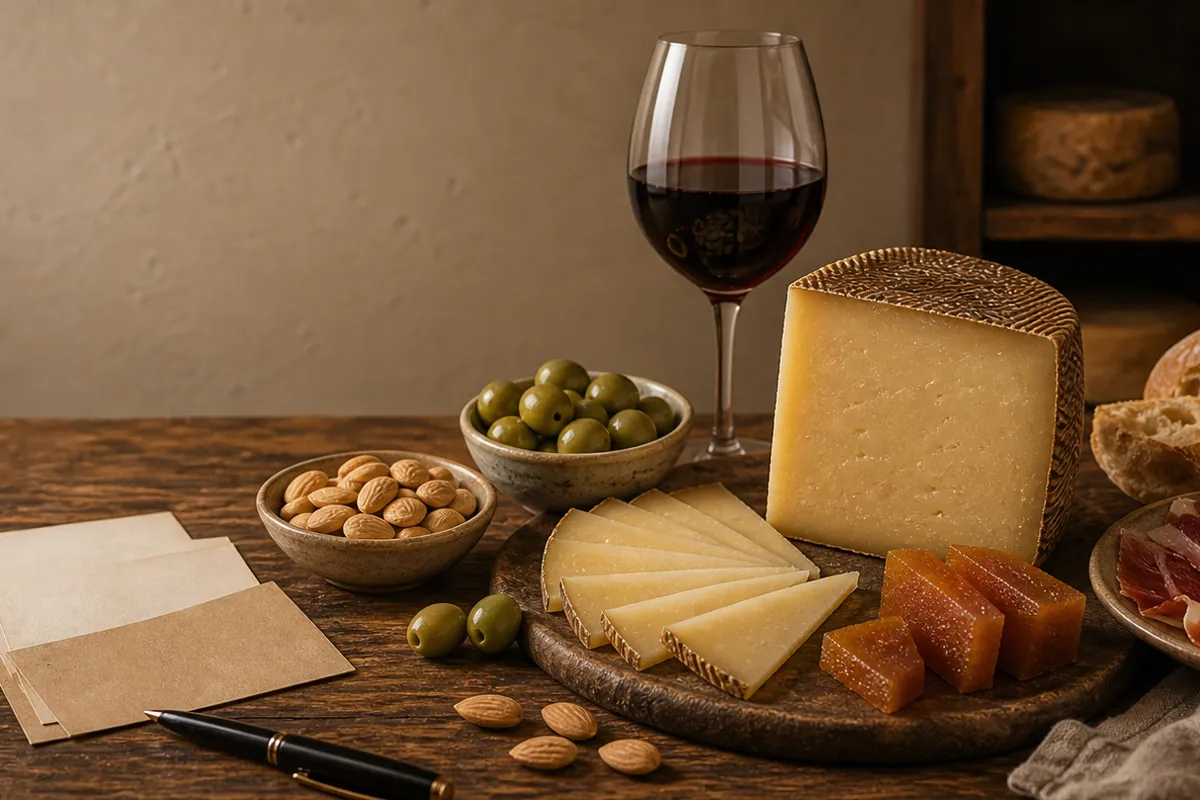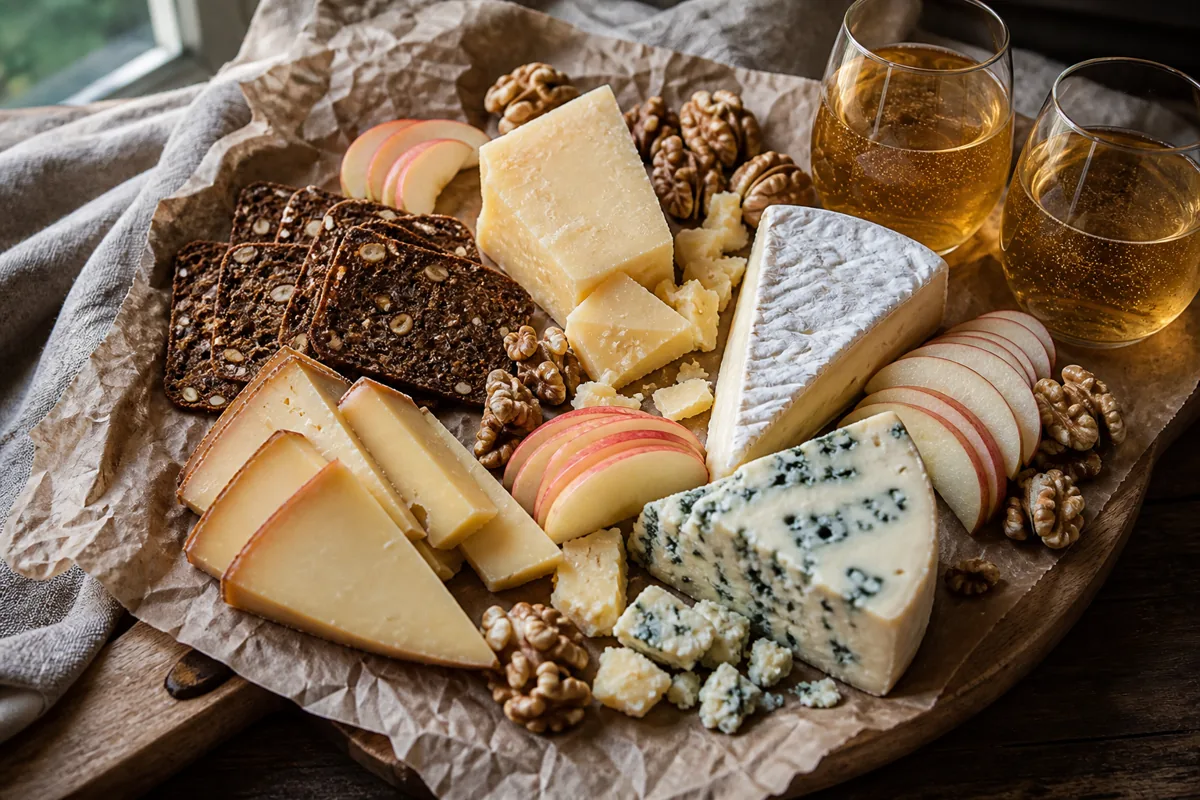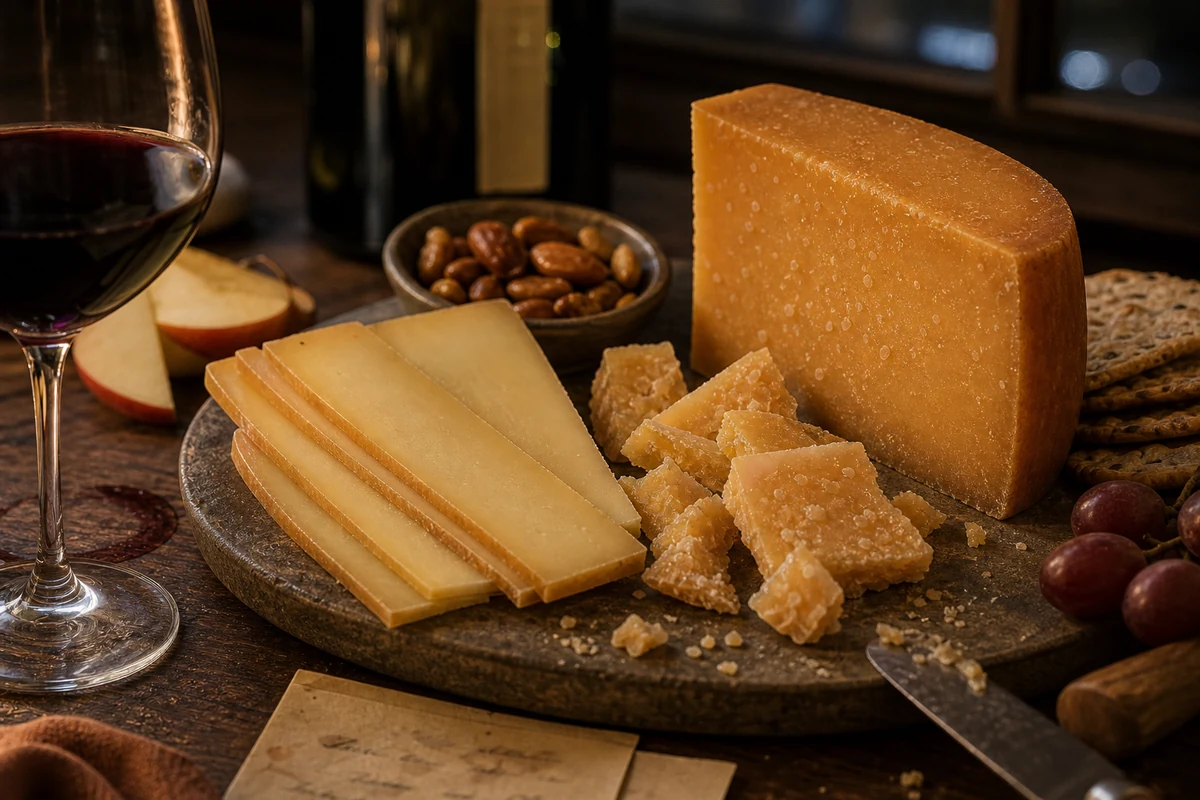
Riesling's bright acidity cuts through Gouda's butterscotch richness while residual sweetness complements the caramel notes that develop during aging. The wine's petrol and stone fruit aromatics add a layer that amplifies Gouda's complexity.
Gouda is unusual among cheeses because its best wine partner changes as it ages. A young, creamy four-week wheel wants crisp white wine.
A 2-year aged Gouda with caramel crystals wants a bold red or a fortified glass.
So the age of the cheese, not the style of the bottle, is where the decision starts.
A wine that flatters young Gouda will taste thin against an aged wheel, and a red that suits an 18-month wheel will bury a four-week one. Every recommendation below names the age it targets, and the Dutch labeling terms are the fastest way to place a wheel before you pour.
Dutch Gouda labels use specific age terms: jong (4 weeks), belegen (4-6 months), oud (10-12 months), and overjarig (18+ months). If the label gives no age, taste for it, because smooth and mild means young while crunchy crystals and deep amber mean aged.
In This Article
Identify Young, Aged, or Smoked Gouda First
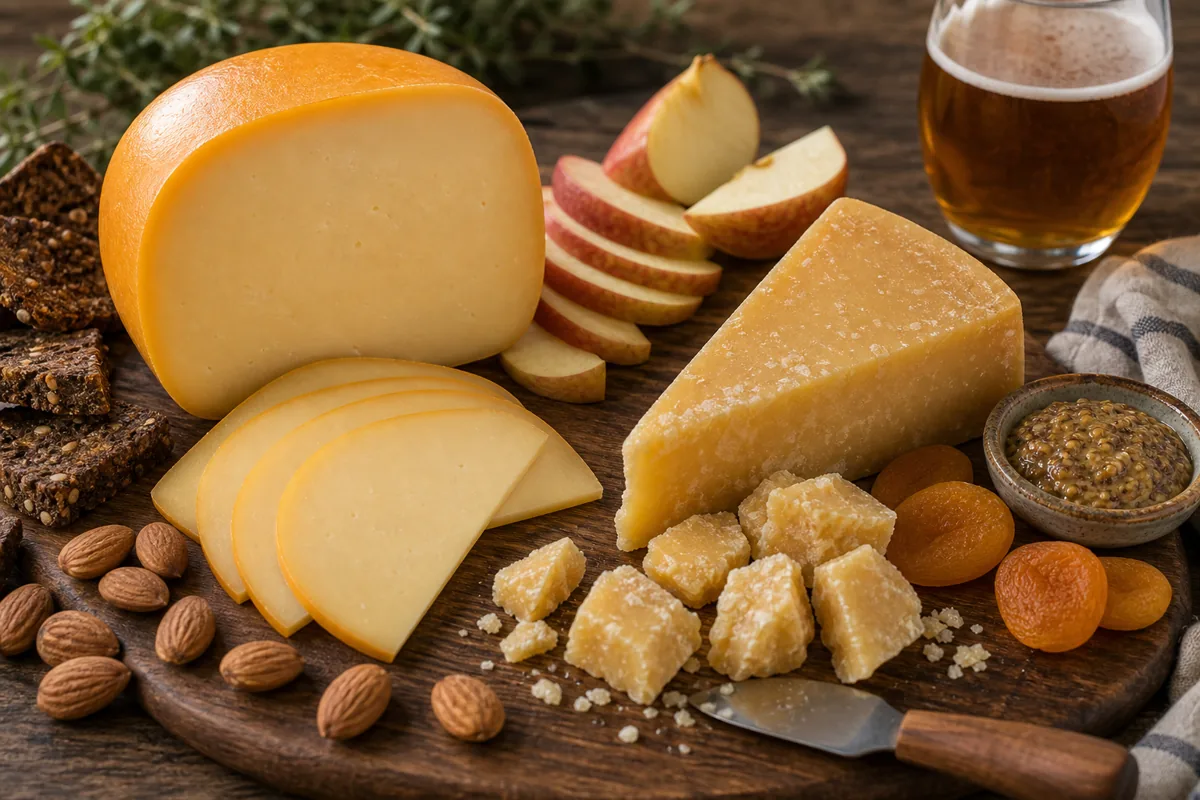
The wine choice starts with the Gouda, not the bottle, and you can place a wheel by hand before you read a label. Young Gouda is pale, smooth, and buttery, and a slice bends rather than snapping when you fold it.
Aged Gouda is darker, denser, sweeter, and often crunchy with crystals.
Smoked Gouda adds a separate smoke problem that can make delicate whites taste thin.
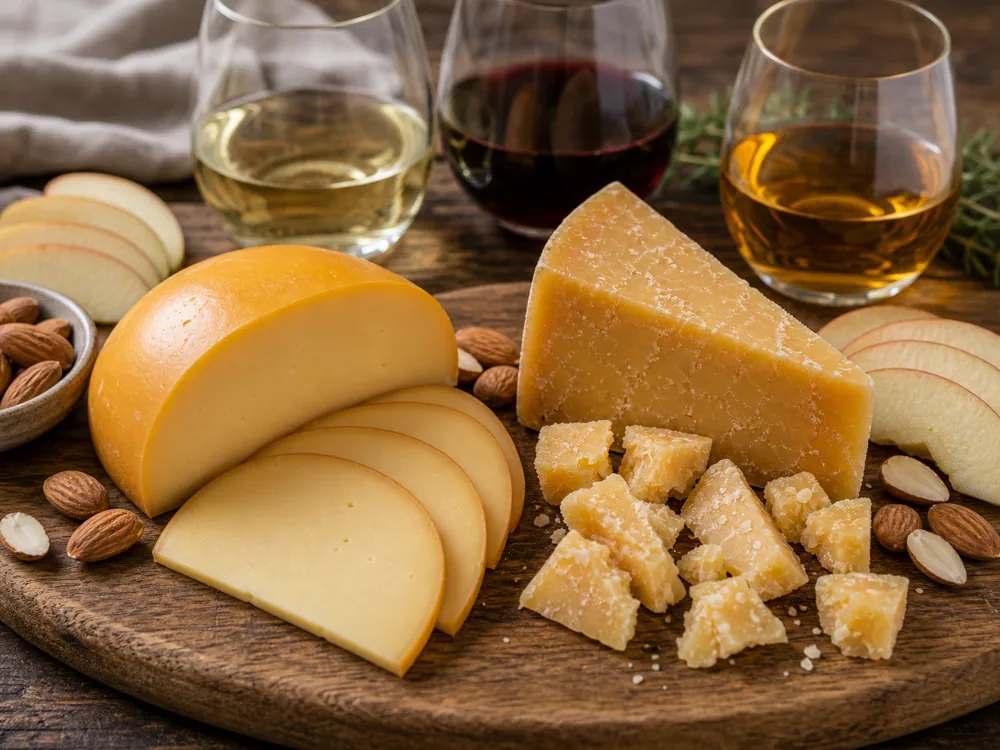
These eight wines cover the full Gouda aging spectrum. The first four target young to medium wheels, and the last four match aged and vintage ones.
| Pairing | Type | Why It Works |
|---|---|---|
| Off-dry Riesling (Spatlese) | White | The universal Gouda match. German Spatlese Riesling has enough sweetness to complement caramel in aged Gouda and enough acidity to cut through young Gouda's butteriness. Works across all ages, making it the safest choice when you are unsure. |
| Gruner Veltliner | White | Austrian Gruner Veltliner brings white pepper and green herb notes that contrast with young Gouda's mild creaminess. The crisp acidity and mineral finish reset the palate cleanly. Best with jong and belegen (young to medium) Gouda. |
| Gewurztraminer (Alsace) | White | The lychee and rose petal aromatics of Gewurztraminer create a striking contrast with Gouda's buttery paste. The wine's natural richness matches the cheese's body. Best with medium-aged Gouda where some caramel has developed. |
| Chenin Blanc (Vouvray) | White | Vouvray demi-sec offers honeyed sweetness and quince flavors that bridge to Gouda's developing caramel notes. High acidity keeps it fresh. Works with belegen through oud Gouda (4-12 months). |
| Aged Merlot (Right Bank Bordeaux) | Red | Plum, chocolate, and soft tannin in a Right Bank Bordeaux complement the deep butterscotch and crystalline crunch of 18-month Gouda. The ripe fruit sweetness bridges to the caramel. Avoid young, tannic Merlot. |
| Pinot Noir (Oregon or Burgundy) | Red | Medium-bodied Pinot Noir with red fruit and earthy notes pairs with oud Gouda (10-12 months). The low tannin avoids clashing with Gouda's mild rind while the cherry and mushroom notes add complexity. |
| Tawny Port (10-year) | Fortified | The caramel, toffee, and dried fruit in a 10-year Tawny Port are a direct flavor match for overjarig Gouda. Both have undergone extended aging that develops similar Maillard compounds. A dessert-course pairing for small portions. |
| Aged Tempranillo (Rioja Reserva) | Red | Oak-aged Rioja Reserva has vanilla, leather, and dried cherry notes that complement the nutty, butterscotch character of aged Gouda. The tannins have softened enough to avoid clashing. Choose Reserva or Gran Reserva, not Joven. |
- Aromatic whites (Riesling, Gewurztraminer): sweetness complements caramel, acidity cuts fat
- Crisp whites (Gruner Veltliner, Chenin Blanc): mineral and herb notes contrast creamy paste
- Medium reds (Pinot Noir, Merlot): soft tannin and fruit match aged intensity
- Fortified (Tawny Port): shared Maillard compounds create direct flavor bridges
Young Gouda pairs with white wines, while aged Gouda pairs with reds and fortified wines. The transition point is around 10 to 12 months of aging, when the paste darkens and crystals begin to form.
When the question extends beyond bottles, board-side Gouda matches cover mustard, fruit, cured meats, and serving context across the same age split.
Riesling is the exception that works across the entire range. Its combination of acidity, sweetness, and aromatic intensity adapts to every Gouda stage.
When in doubt, pour Riesling.
Why Acid, Sweetness, and Tannin Change With Age
Gouda's pairing chemistry changes as it ages because the cheese itself transforms. Young Gouda is 48% moisture with a mild, milky flavor.
Aged Gouda drops to 30% moisture, concentrating fat, salt, and the amino acids that form flavor crystals.
Acidity cuts butterfat.
Young Gouda carries a high fat load in a high-moisture paste, which traps that fat in a smooth, spreadable texture that coats the tongue. Wines with high acidity such as Riesling and Gruner Veltliner stimulate salivation and clear the coating between bites, so each mouthful of cheese tastes like the first rather than an accumulation of the last three.
As Gouda ages, the Maillard reaction produces caramel and butterscotch compounds. These are the same compounds found in aged Tawny Port and oak-aged wines.
The flavor bridge between overjarig Gouda and 10-year Tawny Port is a direct chemical match, not just a subjective impression.
- Young Gouda needs acidity: high moisture and fat require palate-cleansing wines
- Medium Gouda develops caramel: aromatic wines with sweetness complement those notes
- Aged Gouda has crystals and depth: bold reds and fortified wines match the intensity
- Maillard compounds bridge flavors: aged cheese and aged wine share the same chemistry
Tannin remains a variable.
Young Gouda has a thin, edible rind with no bitterness. Tannic wines can overpower it.
Aged Gouda develops a thick, hard rind, which is usually removed before eating, and a concentrated paste that can handle moderate tannin.
That is why aged cheddar and aged Gouda both tolerate bolder reds.
Sparkling wine sits on the same acidity axis, which is why it splits along the age line as sharply as still wine does. Carbonation adds a scrubbing effect on top of acid, so a dry traditional-method sparkling handles young Gouda's fat well.
Against an aged wheel the same bottle loses, because the fine bready notes that make good sparkling interesting are no match for concentrated butterscotch.
Cheap Prosecco fails at both ends, and the bubbles are not the reason. It arrives with residual sugar and too little acid, so nothing is left to cut the fat once the sweetness has met the caramel.
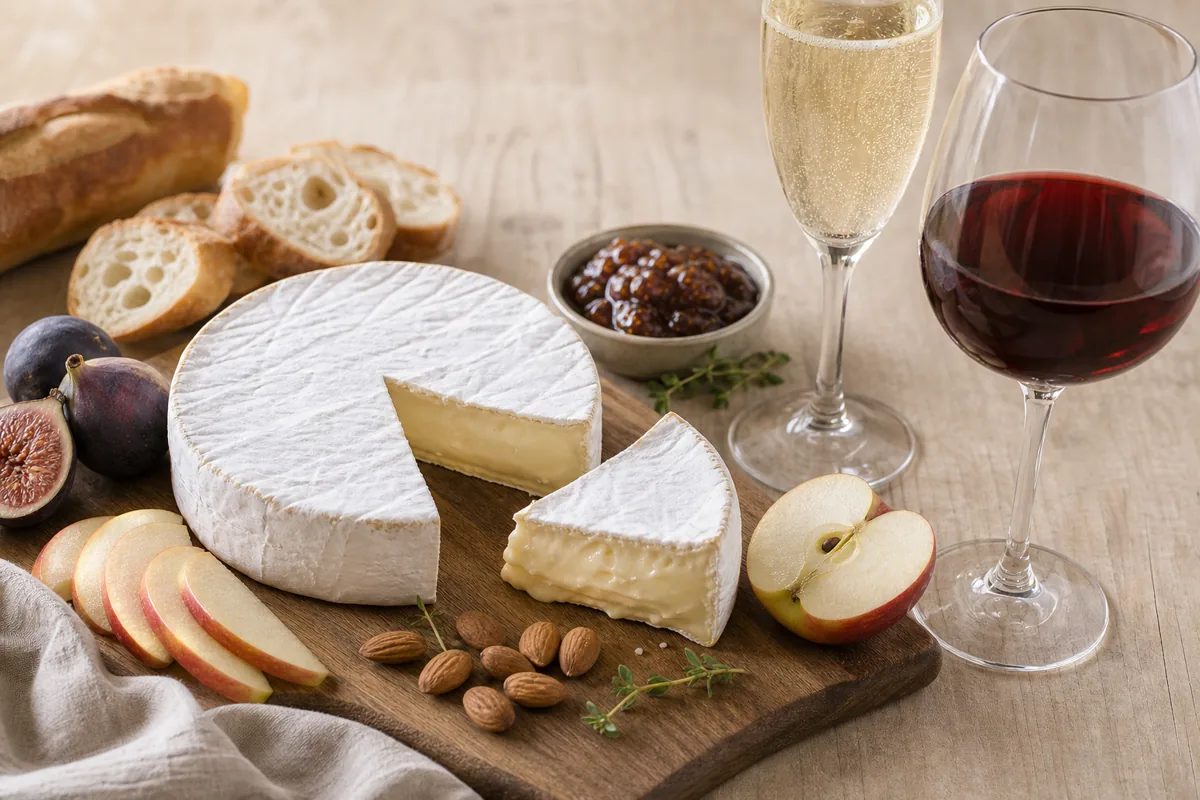
Soft-rind bottle choices show the opposite scenario, a soft high-moisture cheese that needs zero tannin at any age. Gouda and Brie sit at the two ends of the pairing spectrum.
Wines That Make Gouda Taste Flat or Bitter
Some wines clash with Gouda at every age, and others fail only at one stage, which is why a bottle that flattened a four-week wheel can still be the right call against an 18-month one. Sorting the two cases saves you from writing off a wine that simply met the wrong cheese.
Never pair young Gouda with full-bodied Cabernet Sauvignon, because the high tannin overwhelms the mild paste and leaves a bitter, metallic aftertaste. Aged Gouda handles moderate tannin, but Cabernet's grip still dominates rather than complements.
- Cabernet Sauvignon: too tannic for young Gouda, still overpowering for most aged wheels
- Heavily oaked Chardonnay: oak tannins and butter-on-butter richness create a cloying combination with no acidity to cut through
- Bone-dry Muscadet: too lean and austere for Gouda's richness. The cheese overwhelms the wine
- Sweet dessert wines (Sauternes, Tokaji): too much sweetness with Gouda's caramel creates a candy-like overload
- Cheap Prosecco: the coarse bubbles and residual sugar do not pair well with Gouda's waxy texture
The simplest rule: if the wine has high tannin and low acidity, skip it with Gouda.
If the wine is too sweet without acidity to balance, skip it too. You need the acidity axis working in every Gouda pairing.
The Brie and Camembert rind difference shows how two similar cheeses can have different pairing needs based on rind and fat content.
Smoked Gouda needs a different filter because smoke pulls wine toward darker fruit and softer oak. A light smoke layer can make Malbec or Zinfandel more useful than Riesling.
Choose the Bottle by Gouda Age
Find the age of your Gouda first, then read across to the bottle. The same cheese at four weeks and at eighteen months calls for wines from opposite ends of a shop, so the age is the only entry point that works.
Jong Gouda (4 weeks): mild, creamy, milky. Pair with Gruner Veltliner or dry Riesling.
These wines have enough acidity to cut the butterfat without overpowering the gentle flavor.
Think aperitif service with crackers.
Belegen Gouda (4-6 months): firmer paste, developing tang.
Pair with Gewurztraminer or Chenin Blanc (Vouvray). The emerging caramel notes meet the aromatic sweetness in these wines.
The pairing starts to show complexity.
Oud Gouda (10-12 months): amber paste, first crystals, pronounced butterscotch. Pair with Oregon Pinot Noir or off-dry Riesling Spatlese.
The wine can now be red, but keep tannin low.
Medium body matches the concentrated paste.
- Jong (4 weeks): Gruner Veltliner, dry Riesling
- Belegen (4-6 months): Gewurztraminer, Vouvray demi-sec
- Oud (10-12 months): Oregon Pinot Noir, Riesling Spatlese
- Overjarig (18+ months): aged Merlot, Tawny Port, Rioja Reserva
| Gouda age | Best bottle | Why it fits |
|---|---|---|
| Jong | Gruner Veltliner | High acid clears butterfat without crowding the mild paste. |
| Belegen | Gewurztraminer | Aromatic sweetness meets early caramel notes. |
| Oud | Pinot Noir | Low tannin and red fruit fit the denser amber paste. |
| Overjarig | Tawny Port | Shared toffee and dried-fruit compounds create a direct bridge. |
Overjarig Gouda (18+ months): deep amber, dense with crystals, intense butterscotch and toffee.
Pair with aged Merlot, 10-year Tawny Port, or Rioja Reserva. These are bold wines for bold cheese.
Serve in small portions as a closing course.
A Parmigiano-Reggiano at 24 months shares much of that flavor profile. Both cheeses develop tyrosine crystals and deep umami through long aging, so the wines that work with one usually work with the other, and a Tawny Port or a softened Rioja covers both on the same board.
At the counter, ask to taste a small piece whenever the age is unclear. Smooth and mild puts you in white wine territory, while crunchy and caramel means red wine or Port.
Build a Gouda Wine Board by Season and Cut
A board benefits from picking one age as the anchor rather than spreading four across the table, and the season usually decides which age is easiest to buy well. The cut then does the rest of the work, because how you break the cheese changes how much surface the wine meets.
- Spring: jong Gouda with Gruner Veltliner, fresh herbs, and radishes
- Summer: belegen Gouda with Gewurztraminer and stone fruit
- Autumn: oud Gouda with Pinot Noir, fig jam, and walnuts
- Winter: overjarig Gouda with Tawny Port and dark chocolate
The seasonal progression follows the Gouda aging calendar naturally. Cheese made in spring reaches belegen by summer and oud by autumn.
Dutch cheesemakers traditionally released their oldest wheels in winter, which is why overjarig Gouda is a cold-weather cheese.
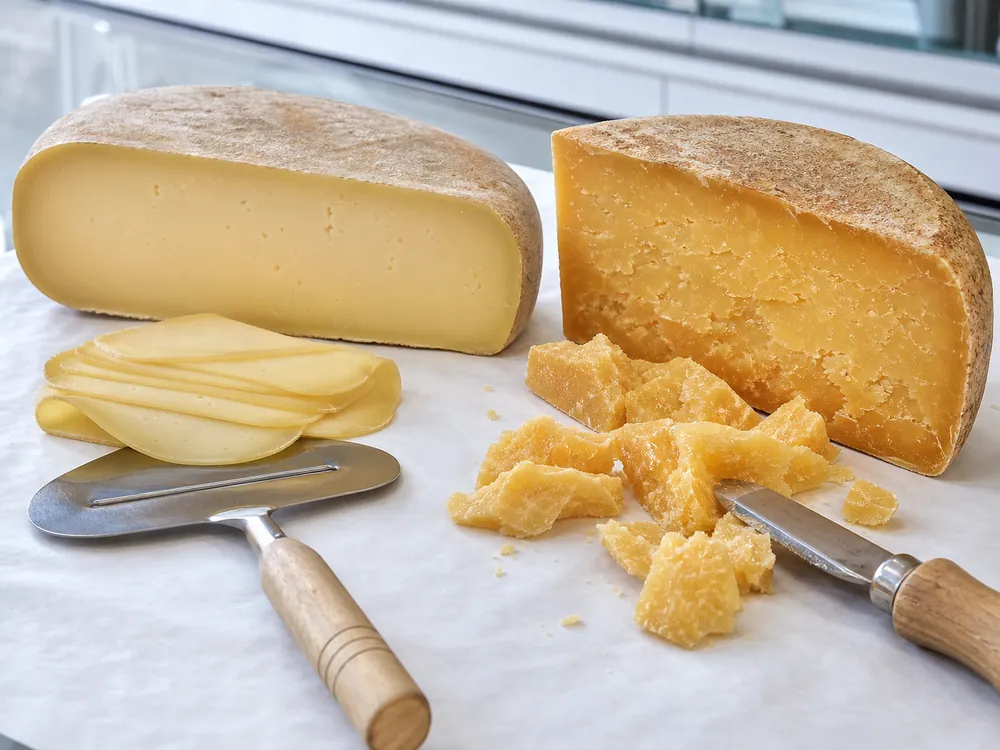
For a mixed board, avoid cutting every Gouda the same way.
Slice young Gouda thin so crisp white wine can reset the fat. Break aged Gouda into rough chunks so Port or Pinot Noir can meet the crystals and caramel.
Keep smoked Gouda in a small lane with darker fruit or a softer red.
For board building, room-temperature management matters because different Gouda ages soften at different speeds. Aged Gouda is more temperature-stable than young Gouda and can sit on a board longer without quality loss.
Serve a multi-age tasting in one direction only, moving from the youngest wheel and the crispest wine toward the oldest and the sweetest. Going the other way leaves Port residue and caramel on the palate, and a jong Gouda tasted after that reads as bland rather than fresh.
If the cheese on hand is the wrong age for the bottle, age-matched Gouda swaps need to solve the same young-melt or aged-crystal job.
Serve Gouda and Wine at the Right Temperature
Temperature and presentation affect how well the pairing registers on the palate.
Gouda serving temperature: 65-68 degrees F (18-20 degrees C). Remove from the fridge 30-40 minutes before serving.
Young Gouda needs less time (20 minutes).
Aged Gouda benefits from a full 40 minutes because the dense paste takes longer to warm through.
White wine temperature: 48-54 degrees F (9-12 degrees C).
Riesling and Gruner Veltliner on the colder end. Gewurztraminer slightly warmer to release aromatics.
- Gouda at 65-68 degrees F: aged Gouda needs 40 minutes out of the fridge
- White wines at 48-54 degrees F: colder for crisp styles, warmer for aromatic
- Red wines at 60-65 degrees F: slightly below room temperature for best tannin balance
- Port at 60-65 degrees F: Tawny Port shows best just below room temperature
Cut aged Gouda with a Gouda knife (a short, wide blade) into irregular chunks rather than neat slices. The crystalline texture means it fractures naturally along crystal lines.
Those rough surfaces expose more flavor than a clean slice.
Young Gouda slices cleanly and can be cut into thin pieces.
The smooth texture and mild flavor benefit from thinner cuts that melt quickly on the tongue. Young Fontina behaves similarly when you need a semi-soft cheese for gentle white wines.
For a mixed Dutch-style board, add one mild cheese before the aged wedge so the wine progression has contrast. Buttery Havarti keeps that opening bite gentle before the Gouda turns caramelized and dense.
If the wine feels right but the pairing still tastes dull, check temperature before you change the bottle. Cold Gouda holds its butter and caramel back, because the fat stays firm and releases little aroma until it warms toward room temperature.
Warm red wine has the opposite problem, since alcohol becomes more volatile and pushes tannin forward.
Fixing either one costs twenty minutes and no money, which makes it the first thing to try rather than the last.
SOURCES & REFERENCES
Gouda Wine Pairing FAQ
These questions address the most frequent decisions when pairing Gouda with wine.
Off-dry Riesling (German Spatlese) is the best universal match for Gouda.
Its combination of bright acidity and residual sweetness works across all Gouda ages. For aged Gouda specifically, 10-year Tawny Port or aged Merlot from Bordeaux's Right Bank are top choices.
Yes, but only with aged Gouda (10 months or older). Pinot Noir works with oud Gouda.
Aged Merlot and Rioja Reserva match overjarig Gouda.
Avoid high-tannin reds like Cabernet Sauvignon, which overpower Gouda at any age. Young Gouda pairs better with white wines.
Yes.
Smoked Gouda has an added layer of smokiness that clashes with delicate whites. Pair smoked Gouda with Malbec, Zinfandel, or oaked Chardonnay that can match the smoky intensity.
The smoke flavor dominates the pairing, so choose wines with enough body to stand alongside it.
If serving multiple Gouda ages on one board, pour Riesling Spatlese. It adapts to every age stage.
If serving only aged Gouda, pour Tawny Port.
If mixing Gouda with other cheeses, a Pinot Noir provides the most versatile pairing across different cheese styles.
Young Gouda pairs reasonably well with Champagne.
The bubbles and acidity cut the butterfat. Aged Gouda does not pair well with Champagne because the intense caramel and crystal flavors overwhelm the wine's delicate character.
Use a fuller wine for aged Gouda.