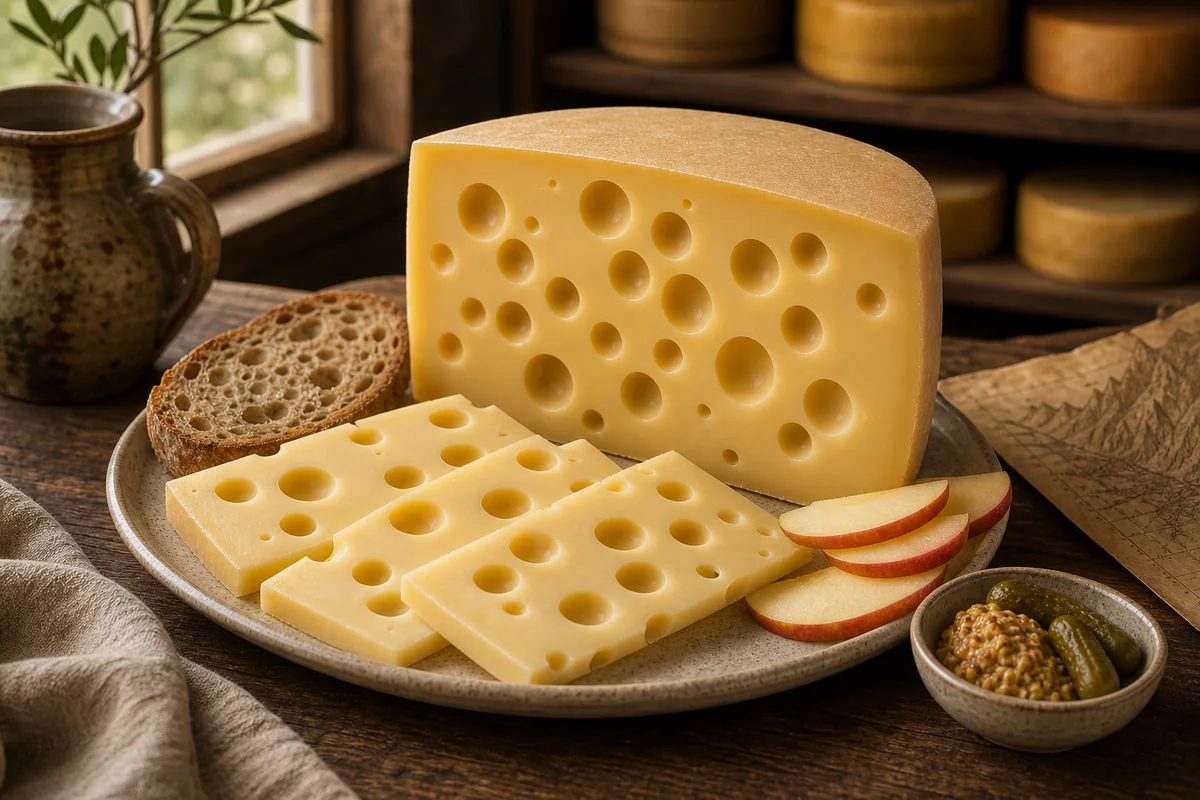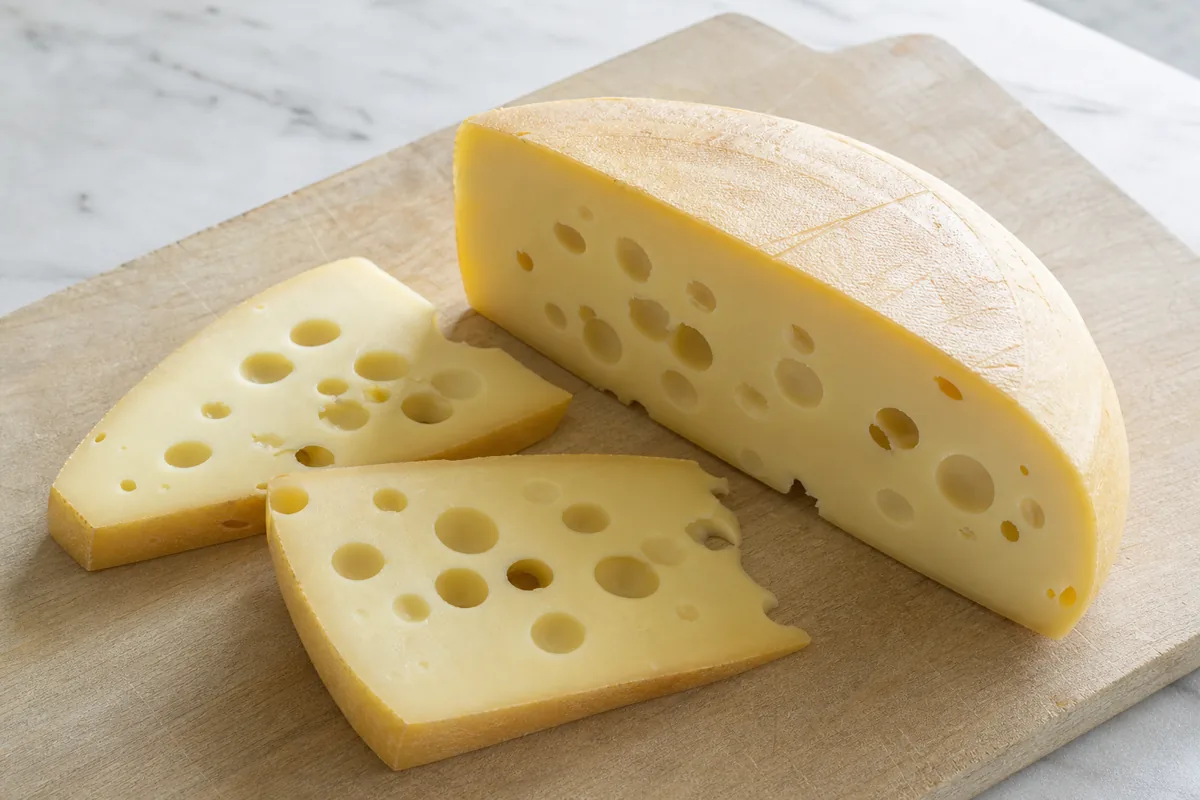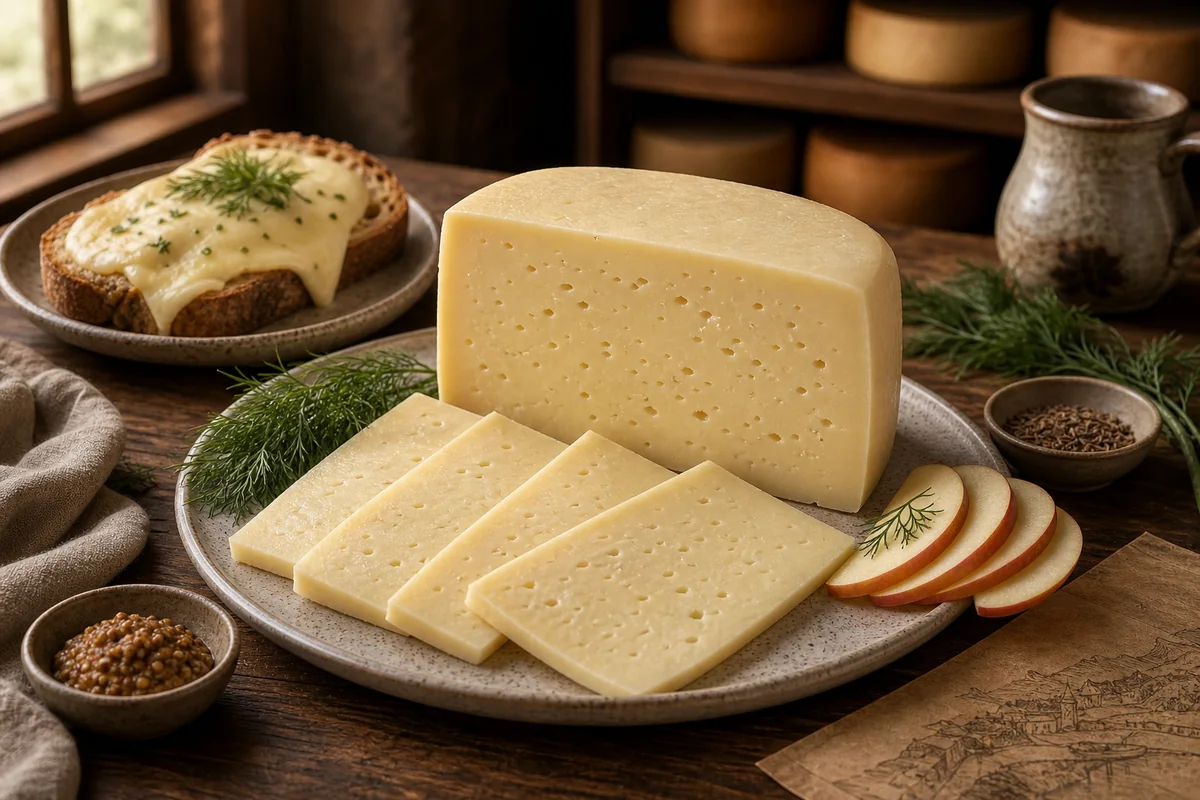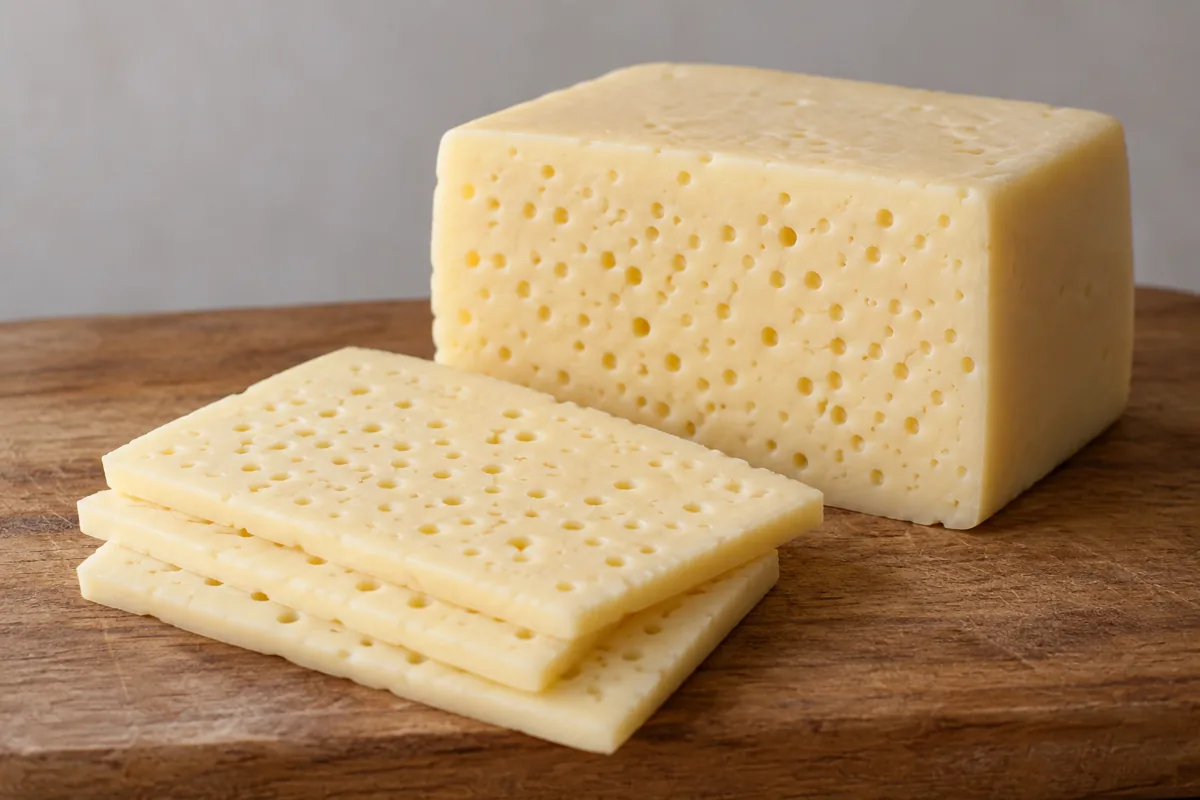
Baby Swiss is an American cow's-milk cheese with small, close-set holes and a milder, creamier taste than traditional Swiss.
Most accounts credit Alfred Guggisberg with developing it near Charm, Ohio, in the mid-1960s.
It is usually described as a whole-milk cheese, but labels range from pasteurized part skim milk to raw cow's milk, so if you are pregnant, read the milk treatment on the pack before buying.
In This Article
How Does Baby Swiss Differ from Traditional Swiss in Production?
Baby Swiss was developed because consumers preferred a milder, more buttery, smooth-bodied cheese, and its make departs from traditional Swiss at three points: a cooler cook, a Cheddar-type starter and whole milk.
| Feature | Baby Swiss | Traditional Swiss |
|---|---|---|
| Curd cooked up to | About 100°F | About 118°F |
| Starter culture | Mesophilic (Lactococcus lactis), like Cheddar | Thermophilic, such as Streptococcus thermophilus or Lactobacillus helveticus |
| Milk fat | Whole milk | Some fat removed, usually to 3.0 to 3.3% fat |
| Composition | A bit higher in fat, otherwise close to Swiss | Moisture about 39 to 41%, fat about 29 to 32%, protein about 21 to 23% |
In the finished cheese, traditional Swiss is firmer, a bit more grainy and harsher in its acetic acid flavor, while Baby Swiss keeps the milder, smoother, more buttery body it was developed for.
Why Are the Holes in Baby Swiss So Small?
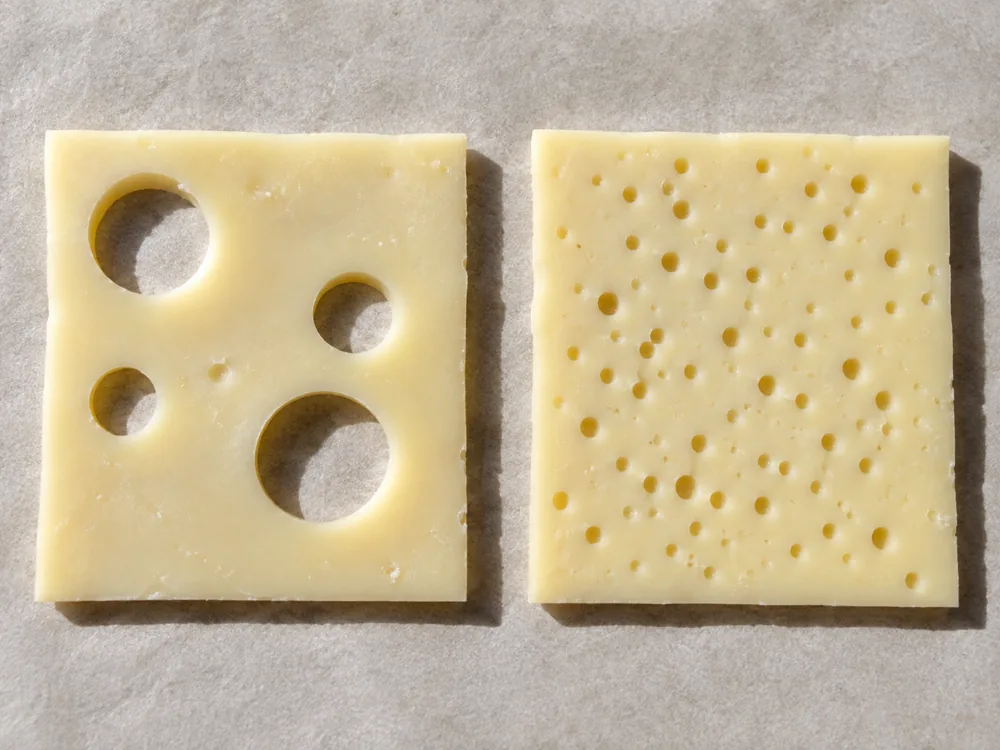
Baby Swiss is not aged for very long, so its holes do not have time to get very large. They end up much smaller than in traditional Swiss and much closer together.
The holes, called eyes, come from propionic bacteria, which ferment lactic acid into CO2 in a warm room held anywhere from 66 to 84°F. A Swiss taken out of the warm room too soon may not develop enough eyes, and the ones that form may be small.
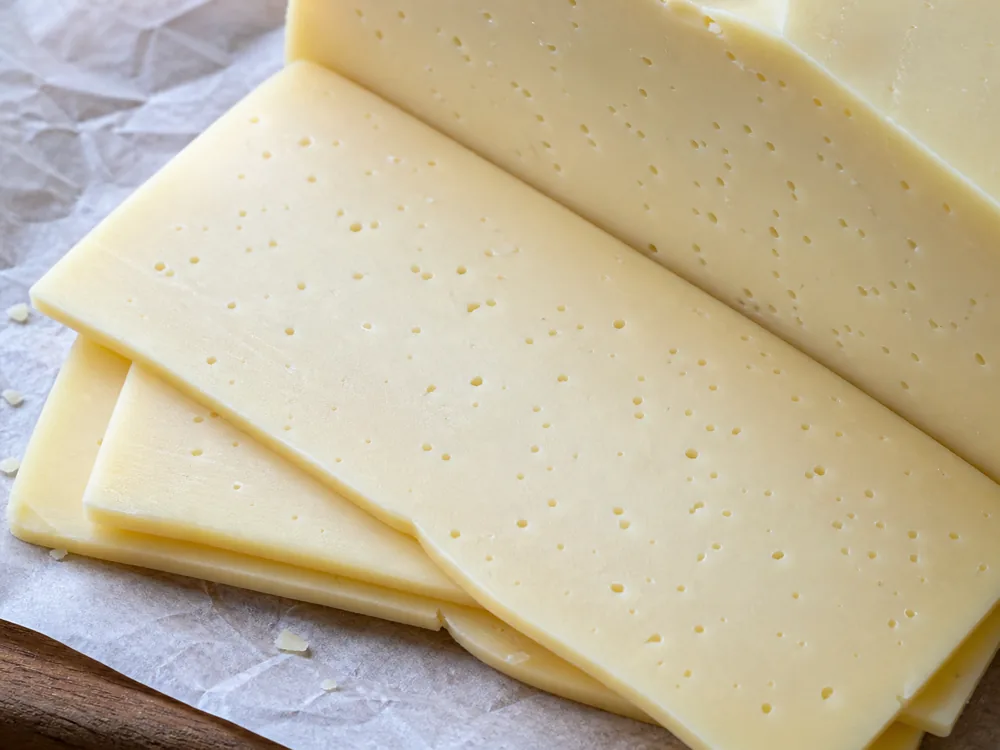
The eyes in Gouda come from different bacteria that use citric acid, and they are smaller and less numerous.
In general, larger eyes mean a more pronounced flavor, because a longer fermentation gives the bacteria more time to act, and Baby Swiss has both the smaller eyes and the milder taste.
Who Invented Baby Swiss and When Was It First Made?
Alfred Guggisberg gets the usual credit: his Guggisberg Cheese Company developed Baby Swiss in the mid-1960s outside Charm, Ohio, and his wife named it.
Guggisberg arrived in the United States in 1947 and took over Doughty Valley Cheese in 1950. He then worked with local milk toward a Swiss with smaller holes and a creamier flavor than traditional Emmental.
The date and the credit are not fully settled. Ohio's Amish Country puts the first Baby Swiss at the Doughty Valley cheesehouse in the late 1960s, and the Center for Dairy Research credits George Reinbold at Iowa State University instead of Guggisberg.
| Question | Answer | Given by |
|---|---|---|
| Who developed it? | Alfred Guggisberg and his Guggisberg Cheese Company; or Dr. George Reinbold at Iowa State University | Guggisberg: Wikipedia, Cheese.com, Shisler's Cheese House. Reinbold: Center for Dairy Research |
| When? | Mid-1960s; late 1960s; from about the 1960s, as U.S. Swiss evolved | Mid-1960s: Wikipedia, Cheese.com. Late 1960s: Ohio's Amish Country. About the 1960s: Center for Dairy Research |
| Where was it first made? | Outside Charm, Ohio; at the Doughty Valley cheesehouse | Wikipedia; Ohio's Amish Country |
| Who named it? | Guggisberg's wife | Cheese.com |
The word Swiss in the name is generic and does not mean the cheese is made in Switzerland.
Is Baby Swiss Made from Whole Milk, Part-Skim, or Raw?
Whole milk is the usual answer, but labels range from pasteurized part skim milk to raw cow's milk, so the ingredient line on your pack is the one to go by.
| Question | Answer | Given by |
|---|---|---|
| Whole or part-skim milk? | Whole milk in most descriptions; pasteurized part skim milk in one Guggisberg listing | Whole milk: Brewster Cheese (made in smaller batches), Wikipedia, Center for Dairy Research. Part skim: Guggisberg, in the Pinconning Cheese Co. listing |
| Pasteurized or raw? | Pasteurized in two ingredient lists; raw at one farm; either, in one reference | Pasteurized: the Guggisberg listing; Sargento sliced Baby Swiss. Raw: Boggy Meadow Farm, per Culture. Pasteurized or unpasteurized: Cheese.com |
| What else is in it? | Cultures, enzymes and salt | The Guggisberg listing (cultures, enzymes, salt); Sargento (cheese culture, salt, enzymes) |
Even Guggisberg's Baby Swiss, the cheese most accounts credit as the first, appears in one retailer's listing with pasteurized part skim milk, so whole milk describes the cheese in general, not every pack.
Baby Swiss is made outside Ohio too. Boggy Meadow Farm in New Hampshire makes its version from raw cow's milk from Holstein and Brown Swiss cows, using a washed-curd method with no salt added to the curds.
What Does Baby Swiss Taste Like?
Descriptions of Baby Swiss agree on mild or mellow, with Cheese.com's the one exception. Brewster Cheese calls it smooth, creamy and milder than Swiss, slightly nutty but also buttery, Sargento says mellow and nutty, and the Guggisberg listing says mild and creamy.
Sharpness is where they split: Cheese.com lists nutty, sharp and sweet, and Culture finds Boggy Meadow's version mild and approachable, with a buttery start and a slightly sharp aftertaste.
In Swiss-style cheese, the nutty, sweet flavor comes from acetate and propionic acid made by the bacteria.
Does Baby Swiss Melt Well?
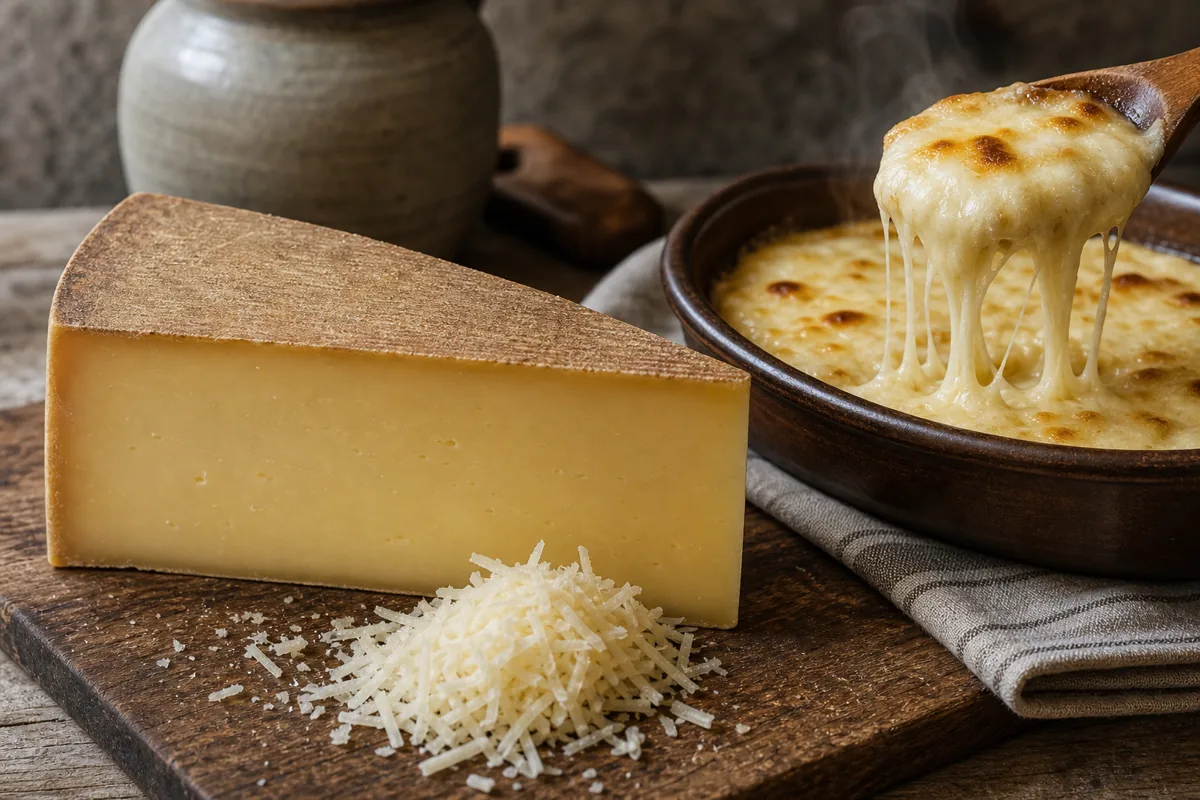
Yes, Baby Swiss melts well when it is shredded.
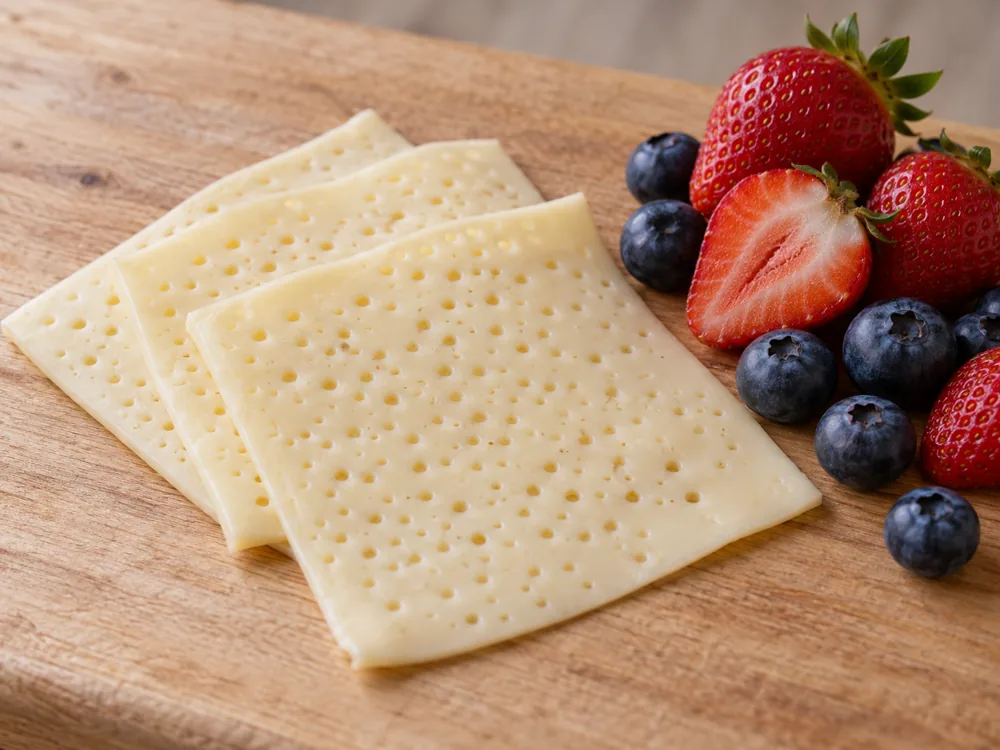
Sargento sells its Baby Swiss slices for sandwiches and snacks and names burgers as another use.
| Pairing | Type | Why It Works |
|---|---|---|
| Sweet fruits and berries | Food | Cheese.com lists them as a match. |
| Croissants and muffins | Food | Also on the Cheese.com list. |
| Peaches, melon, dried fruit and nuts | Food | Suggested in the Pinconning Cheese Co. listing for Guggisberg Baby Swiss. |
| Riesling, Pinot noir, White Zinfandel and sparkling wine | Wine | Pinconning Cheese Co. lists all four for the Guggisberg cheese. |
| Weiss beer and pilsner | Drink | Pinconning lists Weiss beer, and Culture lists pilsner for Boggy Meadow's Baby Swiss. |
| Pinot Blanc | Wine | Culture's pairing for Boggy Meadow's Baby Swiss. |
How Do Baby Swiss Nutrition Labels Differ by Brand?
The three labels use different servings: Sargento's is one 18 g slice, Brewster's is 28 g and Boar's Head's is 1 oz, so the fat and sodium figures do not line up per serving.
| Product | Serving | Calories | Fat | Saturated fat | Sodium | Protein |
|---|---|---|---|---|---|---|
| Brewster Cheese | 28 g | 110 | 9 g | 5 g | 110 mg | 7 g |
| Sargento sliced | 1 slice (18 g) | 70 | 5 g | 3 g | 45 mg | 5 g |
| Boar's Head, per MyFoodDiary | 1 oz | 110 | 9 g | 6 g | 135 mg | 7 g |
Worked out per 100 g, all three come to about 28 to 32 g of fat, but sodium runs from about 250 mg for Sargento to about 390 mg for Brewster and 480 mg for Boar's Head, so the Sargento slice is the lowest in sodium by weight.
Cheese.com puts Baby Swiss at 43% fat, which does not match the fat these labels work out to by weight, so for the pack you are holding, its own label is the figure to use.
Sargento's slice lists 1 g of carbohydrate and 0 g of sugars, and Brewster lists 0 g of carbohydrate.
Once a Sargento pack is open, Sargento advises eating it within five days.
Can You Eat Baby Swiss While Pregnant?
Start with the milk on the label: Sargento and the Guggisberg listing show pasteurized milk, while Boggy Meadow makes its Baby Swiss from raw milk, and the agency rules on eating cheese while pregnant treat the two differently.
The CDC lists hard cheese made with pasteurized milk, including Swiss, Gruyère and Emmental, among its safer choices. It puts soft cheese made from unpasteurized (raw) milk and unheated cheese sliced at a deli among the riskier ones.
If you buy Baby Swiss sliced at a deli counter, the CDC's safer list has deli-sliced cheeses heated to 165°F or until steaming hot. The NHS says any cheese that's been cooked until steaming hot is safe to eat.
The NHS lists pasteurised soft cheeses and pasteurised semi-hard cheeses as safe to eat, along with pasteurised or unpasteurised hard cheeses, and says any foods made from unpasteurised milk must be thoroughly cooked.
Eaten cold from a pack, pasteurized Baby Swiss is described as semi-soft, a type the CDC list does not cover, so if you follow CDC advice, ask a midwife or doctor about the exact pack.
Is Baby Swiss Low in Lactose?
The U.S. National Institute of Diabetes and Digestive and Kidney Diseases suggests hard cheeses such as Cheddar or Swiss as lower in lactose than other milk products.
Baby Swiss is described as semi-soft rather than hard, so if you are limiting lactose, that suggestion fits traditional Swiss more closely than Baby Swiss.
What Can Replace Baby Swiss?
Whether Lacy Swiss is a separate cheese is disputed: Wikipedia describes Lacy Swiss as a cheese with small holes and a mild flavor, made with low-fat milk, while Cheese.com lists Lacy cheese as a synonym for Baby Swiss. If you buy Lacy Swiss in place of Baby Swiss, check whether its label lists low-fat milk.
Traditional Swiss is the other swap if you can accept larger holes and a firmer, grainier cheese with a harsher acetic acid flavor.
SOURCES & REFERENCES
Baby Swiss is an American cow's-milk cheese with small, close-set holes and a mild, creamy flavor. Most accounts credit Alfred Guggisberg with developing it near Charm, Ohio, in the mid-1960s, while the Center for Dairy Research credits George Reinbold at Iowa State University.
Baby Swiss is cooked to about 100°F against about 118°F for traditional Swiss and uses a Cheddar-type starter. It is not aged for very long, so its holes are much smaller and closer together.
Usually: Brewster Cheese, Wikipedia and the Center for Dairy Research describe whole milk, but a retailer listing for Guggisberg's Baby Swiss shows pasteurized part skim milk. Read the ingredient list on the pack you buy.
Yes, Baby Swiss melts well when it is shredded.
It depends on the milk treatment on the label, because some Baby Swiss is pasteurized and one farm makes it from raw milk. The NHS lists pasteurised soft cheeses as safe and says foods made from unpasteurised milk must be thoroughly cooked, while the CDC list does not cover pasteurized semi-soft cheese eaten cold, so confirm the label and ask a midwife or doctor.