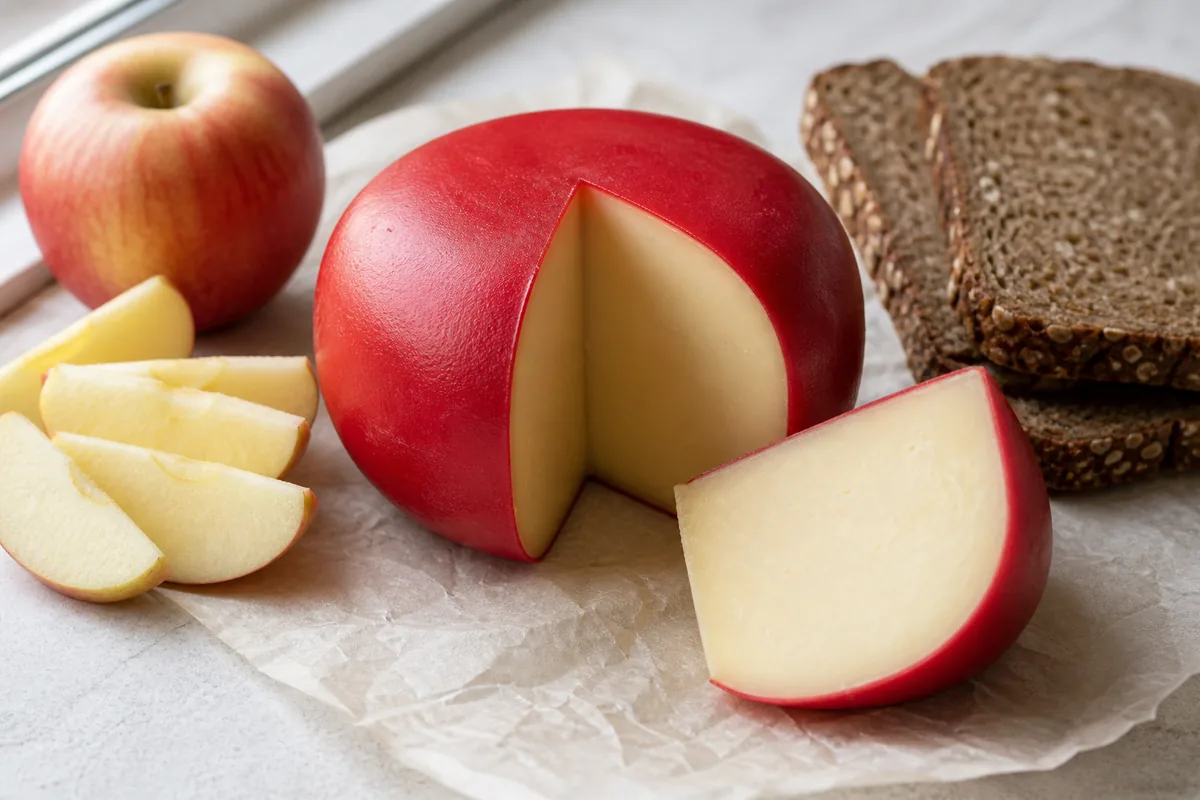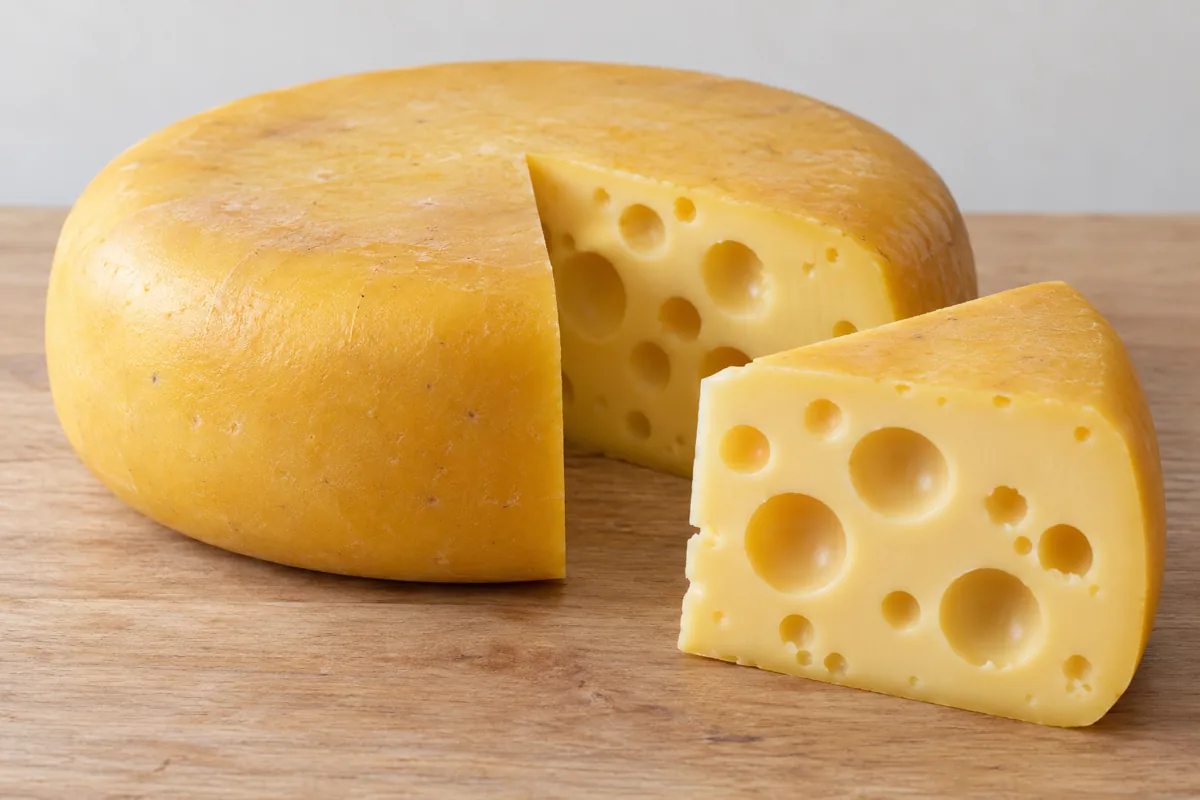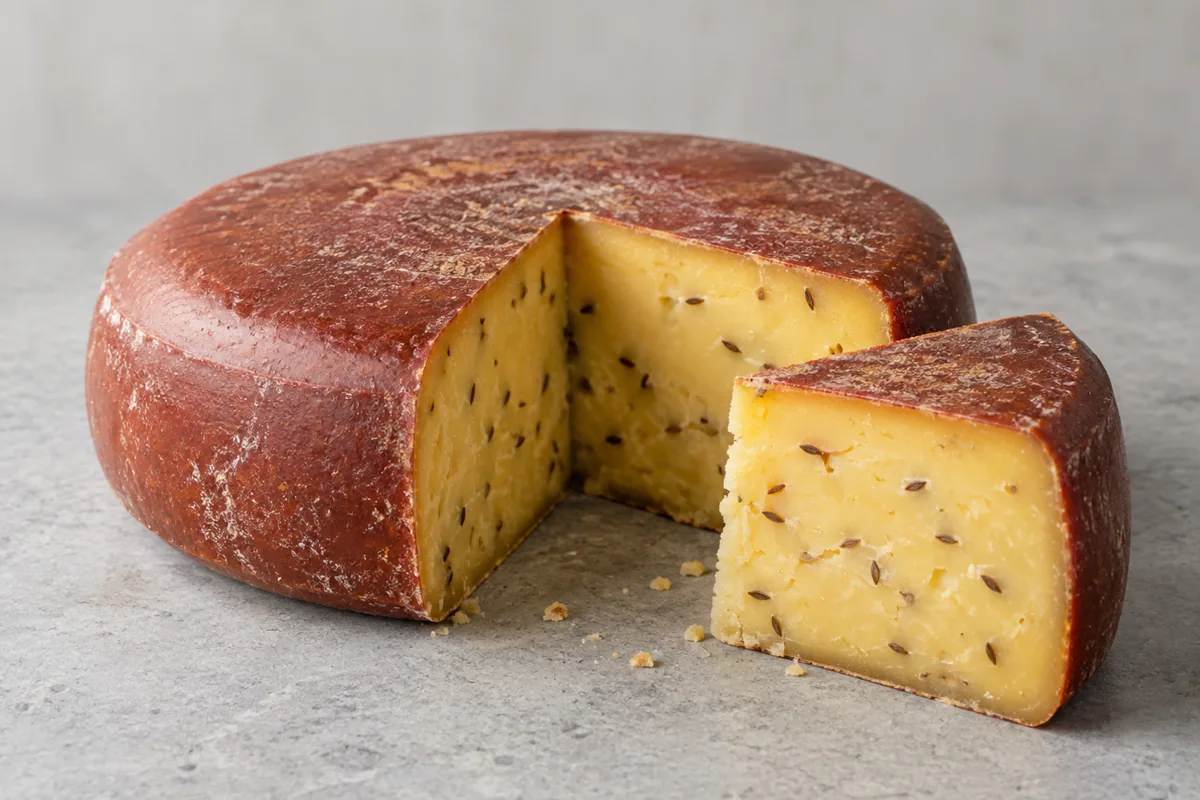
Leyden cheese, or Leidse kaas, is a Dutch cow's milk cheese with cumin seed in a firm paste, and it holds less fat than Gouda. It began on farms near Leiden, where cream went to butter and the skimmed milk that remained went into cheese.
The name covers two kinds of cheese. One is the factory wheel, which one export spec sheet describes as pasteurised, and the other is the farm-made Boeren-Leidse met sleutels, a protected name for cheese stamped with two crossed keys.
In This Article
Is Leyden Made With Cumin or Caraway?
It is made with cumin.
Dutch Wikipedia says cumin seed (komijnzaad) goes into the curd, and its page on caraway states that cumin cheese such as Leidse kaas uses cumin and no caraway seed.
English-language pages blur the two. Wikipedia describes Leyden as flavoured with cumin and caraway seed, and Cheese.com writes “cumin and caraway” as well.
Cheese.com goes further and says cloves and caraway seeds are occasionally added for extra flavour, while the Dutch pages name cumin as the seed.
The seeds are easy to tell apart when you can see them: the same Dutch Wikipedia page says caraway seed is slightly curved, while cumin seeds are straight.
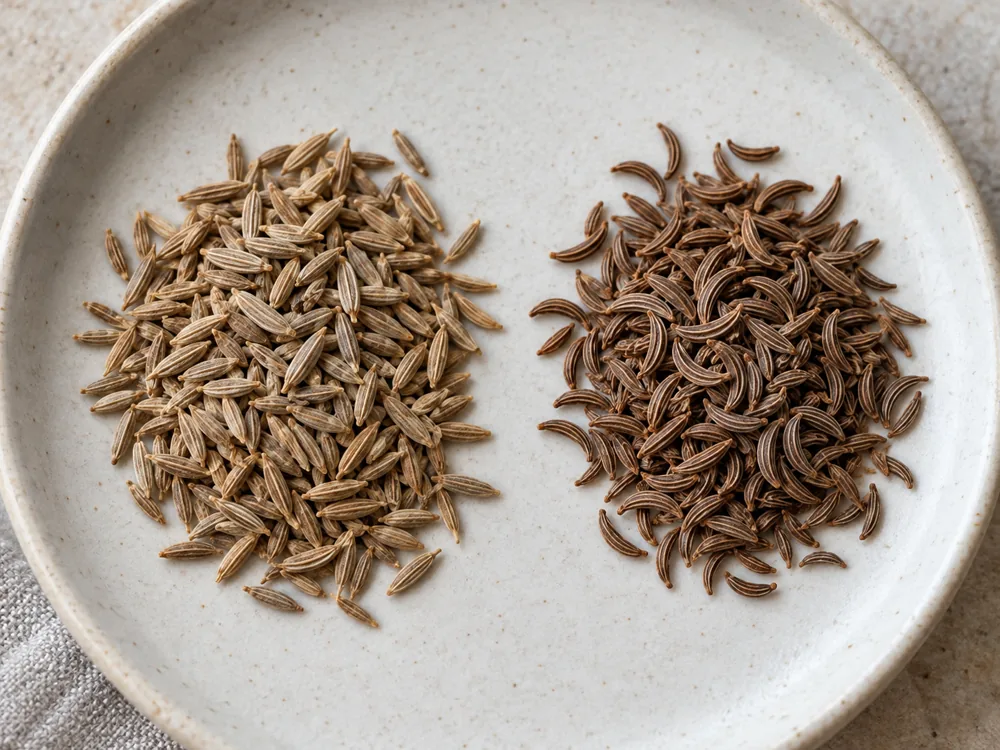
The flavour is close as well, since that page calls both warm, spicy and aniseed-like, but it puts the taste of caraway at roughly twice the strength of cumin.
On the farm the seeds do not go through the whole wheel. Wikipedia describes cumin added to a portion of the curd, which forms the middle of three layers.
English Wikipedia says only that farmers near Leiden added the seeds to their low-fat cheese.
De Sophiahoeve comes closest to a reason: it says the traditional cheese bought as provisions for sailing ships in the 17th century was still easy to slice after two years, partly thanks to the cumin.
How Does Leyden Differ From Gouda?
Cheese.com places Leyden in the Gouda family, and three things set it apart, starting with fat.
Dutch Wikipedia says Leyden carries less fat than Gouda and lists 40+, 30+ and 20+ levels. The Boeren-Leidse makers' association puts its farm cheese at 30 to 40 percent fat in dry matter, made from skimmed milk.
The leanness is a by-product of butter. Wikipedia and the association both say farms made butter for local markets and used the semi-skimmed or skimmed milk left over for cheese.
The association says the roles have since reversed, and butter is now the by-product of making Boeren-Leidse cheese.
The low fat also helped keeping: English Wikipedia says low-fat cheese keeps better than full-cream cheese such as Gouda, especially at higher temperatures, and the association adds that it kept better in the tropics, where it is widely believed to have supplied Dutch East India Company ships.
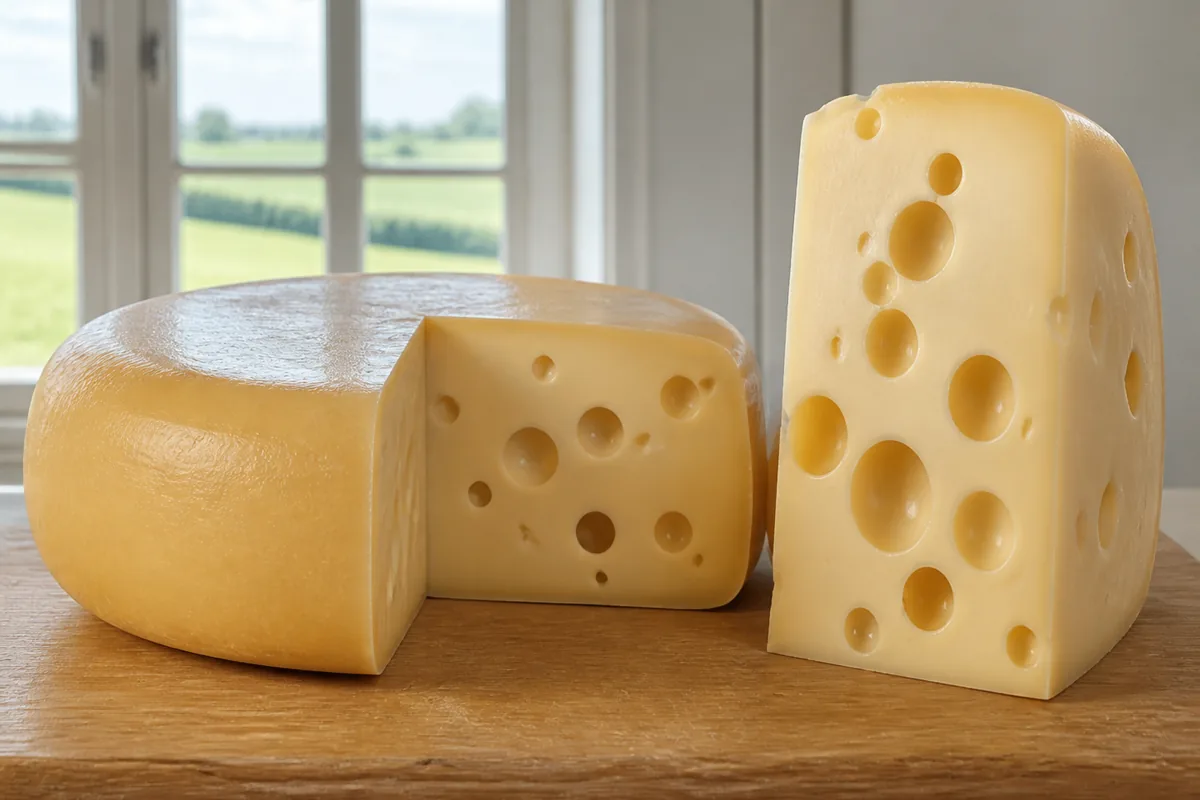
The second difference is the outline. Dutch Wikipedia says Leyden shows one straight and one rounded shoulder where Gouda has two rounded ones, and the association describes the farm cheese as having angular sides.
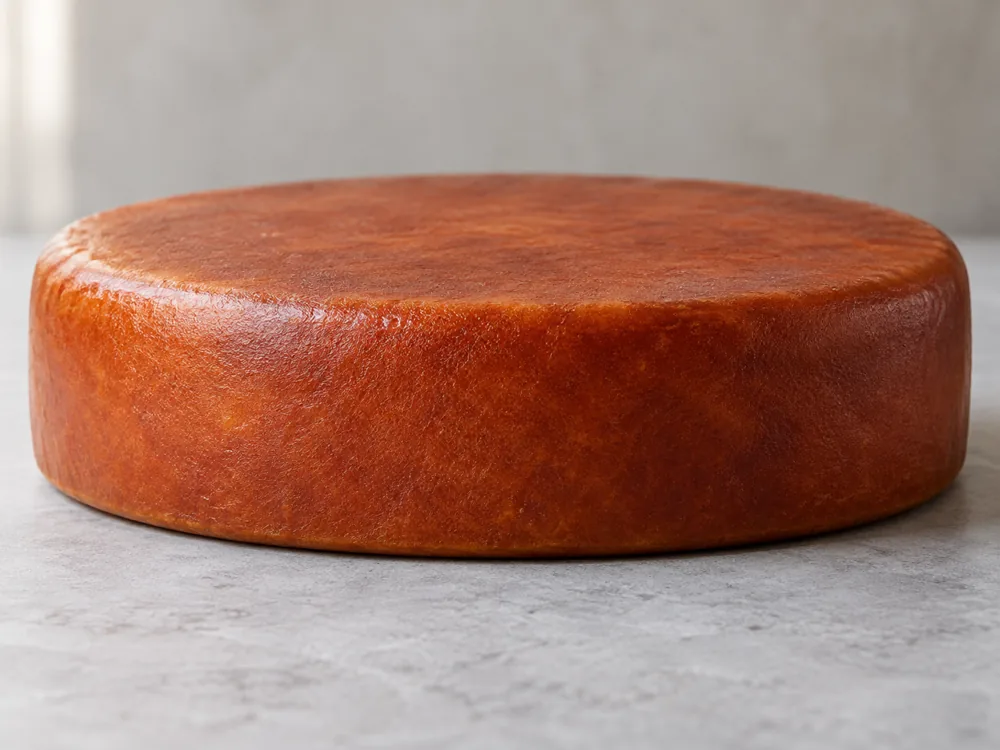
Dutch Wikipedia adds that a cheese with two rounded shoulders is allowed only for Gouda, so on a whole wheel the shoulders show which name the cheese may carry.
The third is bite. With less fat the paste is firmer than Gouda's, according to Dutch Wikipedia.
On a pack the two names can overlap. Dutch Wikipedia says Gouda always has at least 48 percent fat in dry matter, and that in everyday speech “Leidse kaas” is also used for Gouda with cumin.
The overlap runs the other way too, since the same page says Leidse kaas is sometimes called komijnekaas, cumin cheese, although not all komijnekaas is Leidse kaas.
Cheeseland’s spec sheet shows the blur from the exporter’s side: it calls its Leyden “like a Gouda with cumin”, although the 40+ it lists sits below Gouda’s 48+.
How Is Leyden Cheese Made?
Leyden starts with milk that has lost its cream. At De Sophiahoeve the previous morning’s milk is chilled in the vat, the evening milk is added, and early the next day the risen cream is skimmed off and made into raw-milk butter.
The farm says this skimming is what makes its cheese a 30+ cheese.
The skimmed milk is warmed to 29°C and set with rennet and buttermilk as a starter, which fits English Wikipedia’s 28 to 30°C and about 5 percent buttermilk for farm cheese.
After about 30 minutes the milk has thickened, the curd is cut, the whey is drained, and the curd is washed and stirred until it is ready for the vats, according to De Sophiahoeve. English Wikipedia adds that the curd is warmed to about 33°C by pouring in hot whey, then dipped out with a cloth and kneaded.
The vats go under the press and are turned halfway through the day. In the evening the barrel-shaped cheeses come out and go under a second press, which forms the rind, and the farm presses its crossed-keys mark in at that stage.
English Wikipedia gives a similar sequence of about three hours of pressing, redressing and turning, then a second overnight press.
Salt goes in by one of two routes: English Wikipedia says the cheese may be dry-salted or immersed in brine, and De Sophiahoeve uses a brine bath for 4 days, which it says improves keeping and flavour.
De Sophiahoeve ripens the cheeses on wooden shelves and turns them regularly so that they ripen evenly, while English Wikipedia says Leyden is cured in a cool, moist cellar.
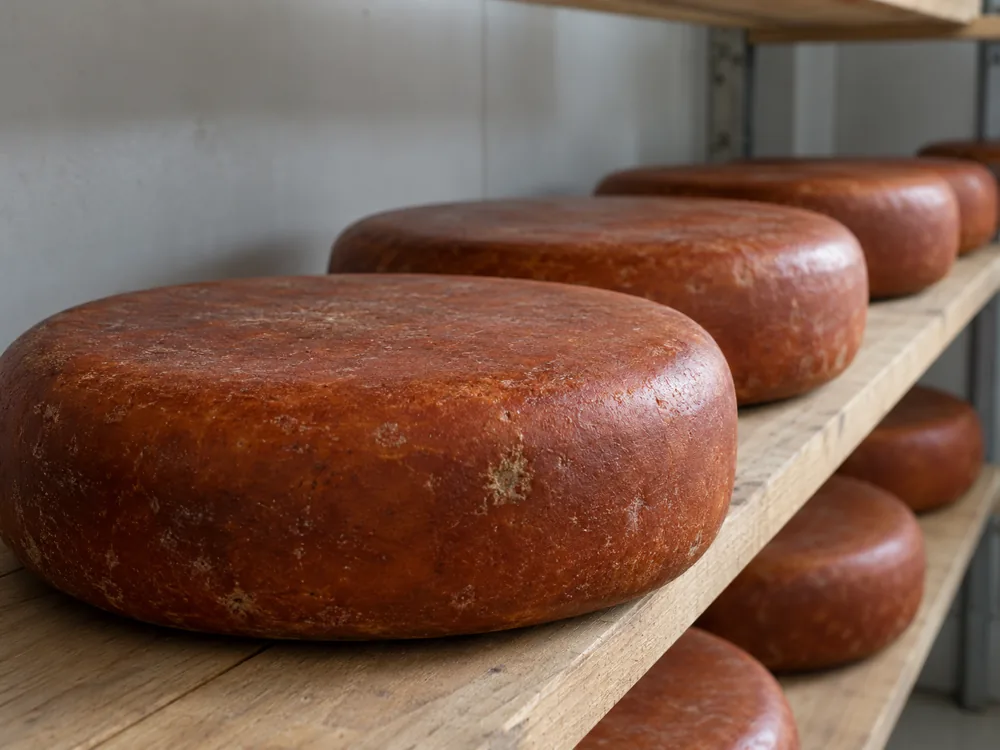
The red-brown coating goes on after brining, and the farm polishes the cheeses from time to time and adds an extra layer. Dutch Wikipedia calls a red rind characteristic of young Leidse kaas, and English Wikipedia says farmers near Leiden coloured their cheeses with annatto.
If the rind turns too hard, English Wikipedia says, it is washed with whey or salty water.
What Does Leyden Cheese Taste Like?
Descriptions depend on who made the wheel. Cheese.com calls Leyden “dry, tangy, and spicy”.
De Sophiahoeve describes its farm cheese as dry with a touch of sourness, and says each wheel differs a little because soil, grass, feed and season change the raw milk.
A creamier picture comes from fuller-fat and younger cheese. One exporter's spec sheet for a 40+ Leyden says “Creamy & Spicy”.
Culture magazine describes Grafton Village's Vermont Leyden, which it lists as raw milk, as having a big, buttery texture and a savory, meaty quality, with cumin that gives “a bold kick without being spicy”.
Those gaps follow the cheeses behind them. A lean farm wheel and a 40+ export wheel start from different fat levels and are sold at very different ages.
How Old Should Leyden Be?
The ages on offer run from weeks to more than a year. The exporter's 40+ spec sheet lists 5 weeks, Culture says the Vermont Leyden is aged at least two months, and the De Sophiahoeve dairy sells its Boeren Leyden Traditioneel from raw milk aged at least one year.
A five-week export wheel and a year-old farm wheel can carry the same name, so the age on a pack says more than the name does.
The Traditioneel label adds conditions to the year: De Sophiahoeve makes it from raw milk in the grazing season, when the cows are outdoors, and inspects candidate wheels several times while they ripen.
The farm says those inspections let it promise a good old cheese in the shop after one or two years.
Is Every Leyden Cheese Boeren-Leidse met Sleutels PDO?
No: the protected name is Boeren-Leidse met sleutels, which received EU protected status in 1997 according to the association and Dutch Wikipedia.
The EU regulation of 1997 attaches a footnote to the name saying that protection of the name “Leidse” is not sought. Leidse alone is not protected, so the word on a pack does not tell you the cheese followed the farm specification.
Other names sit near it. Dutch Wikipedia says Leidse Boerenkaas, like all boerenkaas, has been a Traditional Speciality Guaranteed since 2007 and is made with raw cow’s milk, while Leidse kaas from factories is made with pasteurised cow’s milk.
Boeren Leyden Traditioneel is a Slow Food presidium the association launched in 2017 to record the traditional preparation, and De Sophiahoeve sells its best cheeses under it.
The keys are the visible mark. The Vereniging van Boeren-Leidse Kaasmakers says only its members press the relief mark with crossed keys into their cheese, and that the mark is how the genuine Boeren-Leidse is recognised; the keys come from the coat of arms of Leiden, as Wikipedia notes.
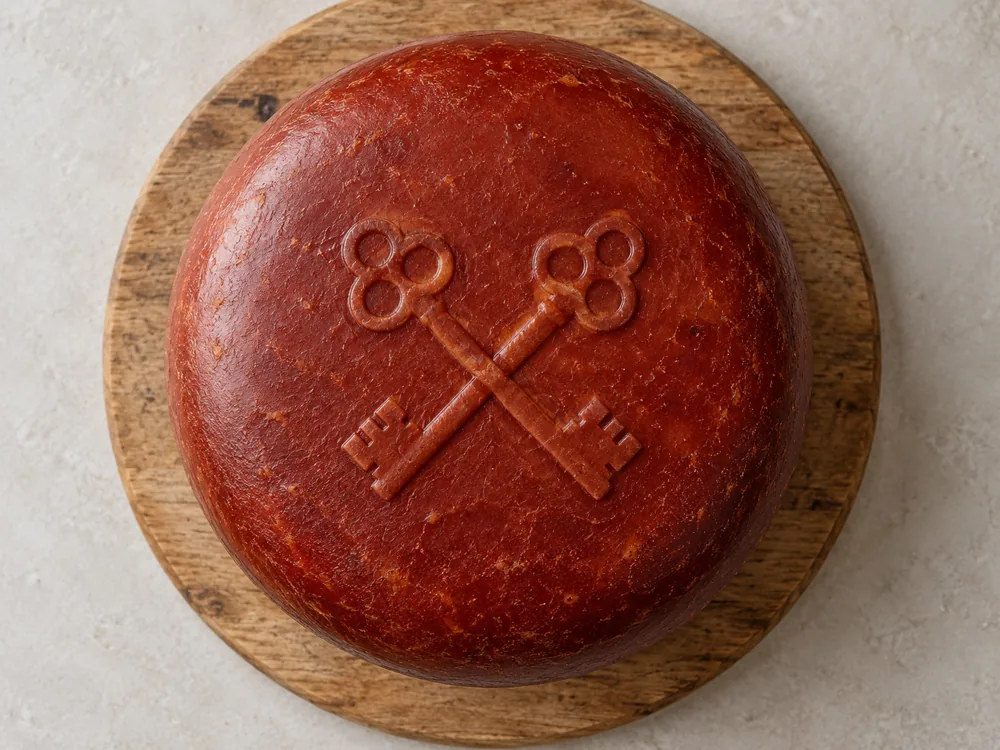
The association lists the other traits of the farm cheese as skimmed-milk base, cumin seed, angular sides and a red-brown coating. The table puts the four names side by side.
| Name | Milk | Standing | Age and marks |
|---|---|---|---|
| Leyden or Leidse kaas from a factory (Cheeseland 40+) | Pasteurised cow’s milk | The word Leidse alone is not protected | 40+, 30+ or 20+ fat levels; 5 weeks on the Cheeseland sheet |
| Leidse Boerenkaas | Raw cow’s milk | Traditional Speciality Guaranteed since 2007 | No age given by the sources |
| Boeren-Leidse met sleutels | Raw milk at De Sophiahoeve | Protected designation of origin since 1997 | 30 to 40% fat in dry matter; keys relief pressed in by association members |
| Boeren Leyden Traditioneel | Raw milk, made in the grazing season | Slow Food presidium launched in 2017 | At least 1 year |
Milk treatment is the column with the most consequence for a buyer, and it comes up again under pregnancy.
A pack that says Leyden without the full protected name or the keys mark carries no farm claim, whatever its rind colour.
De Sophiahoeve goes further and calls the Boeren-Leidse met sleutels the only real Leidse kaas, which is a producer’s view of the category and not a legal rule.
Only Boeren-Leidse met sleutels is protected, and only association members press the crossed keys into the rind. Leyden or Leidse alone on a pack is not a farm claim.
What to Check on a Leyden Label
Start with the milk line, because it varies by maker. The export sheet above lists pasteurised milk and vegetarian rennet, while De Sophiahoeve makes its Traditioneel from raw milk.
Rennet is the next line that varies: Culture lists microbial rennet for Vermont Leyden, and Cheese.com’s general entry marks Leyden as not vegetarian, so the vegetarian rennet on the export sheet cannot be assumed for other wheels.
Next comes the fat level. Dutch Wikipedia lists 40+, 30+ and 20+, and the lean end is the one that gives the firmer paste described above.
Salt is worth a glance. The same exporter sheet gives 1,032 mg of sodium per 100 g, and lists 290 mg in a 28 g serving, with 7 g of fat and 90 calories.
De Sophiahoeve calls its farm cheese low in salt but gives no figure, so the farm and export cheeses cannot be compared in numbers.
The sheet also gives the wheel size, an average 10 kg (21 lb) wheel of 34 by 11 cm, and Culture lists the Vermont Leyden at 10 kg as well, while English Wikipedia gives 3 to 9 kg for Leyden.
The exporter’s expiration date is one year from the production date for its wheel in Cryovac wrap.
Once cut, the wedge belongs in a refrigerator kept at 40°F (about 4°C) or below, which is the CDC's figure for any refrigerator. Neither the exporter sheet nor the dairies give a keeping time for cut Leyden.
What Pairs With Leyden Cheese?
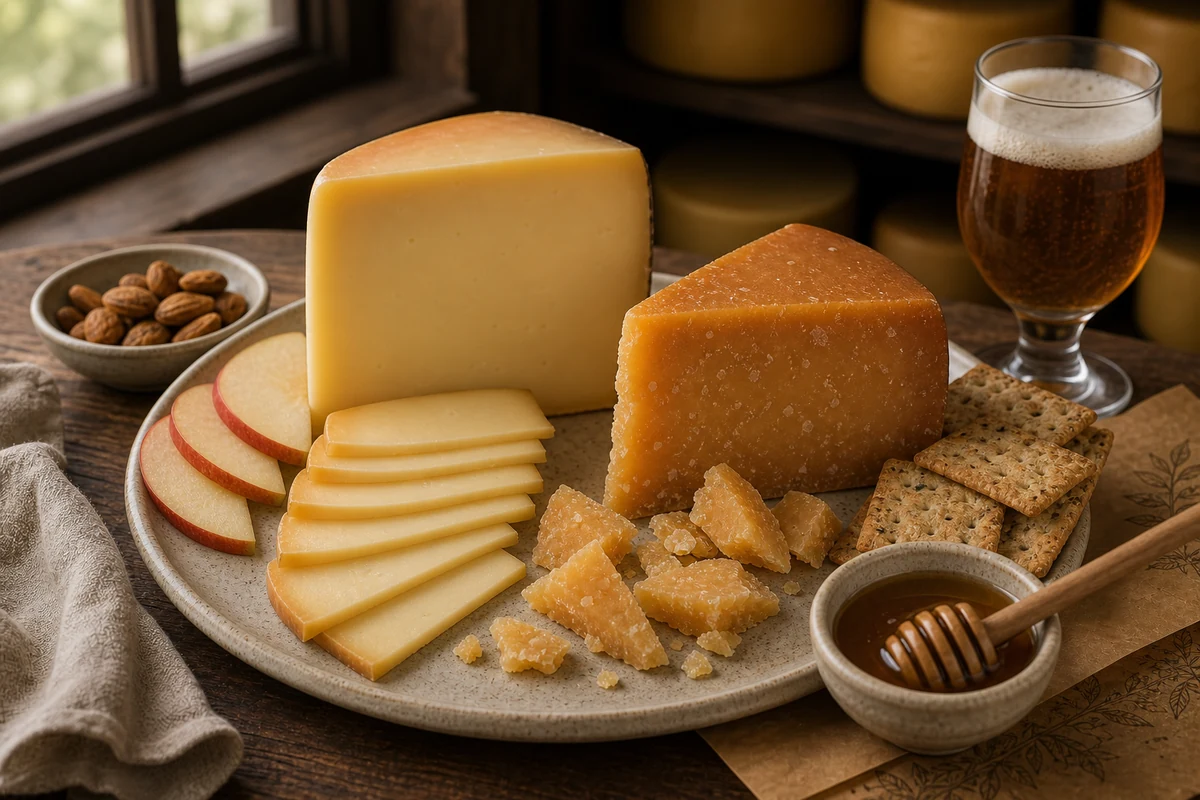
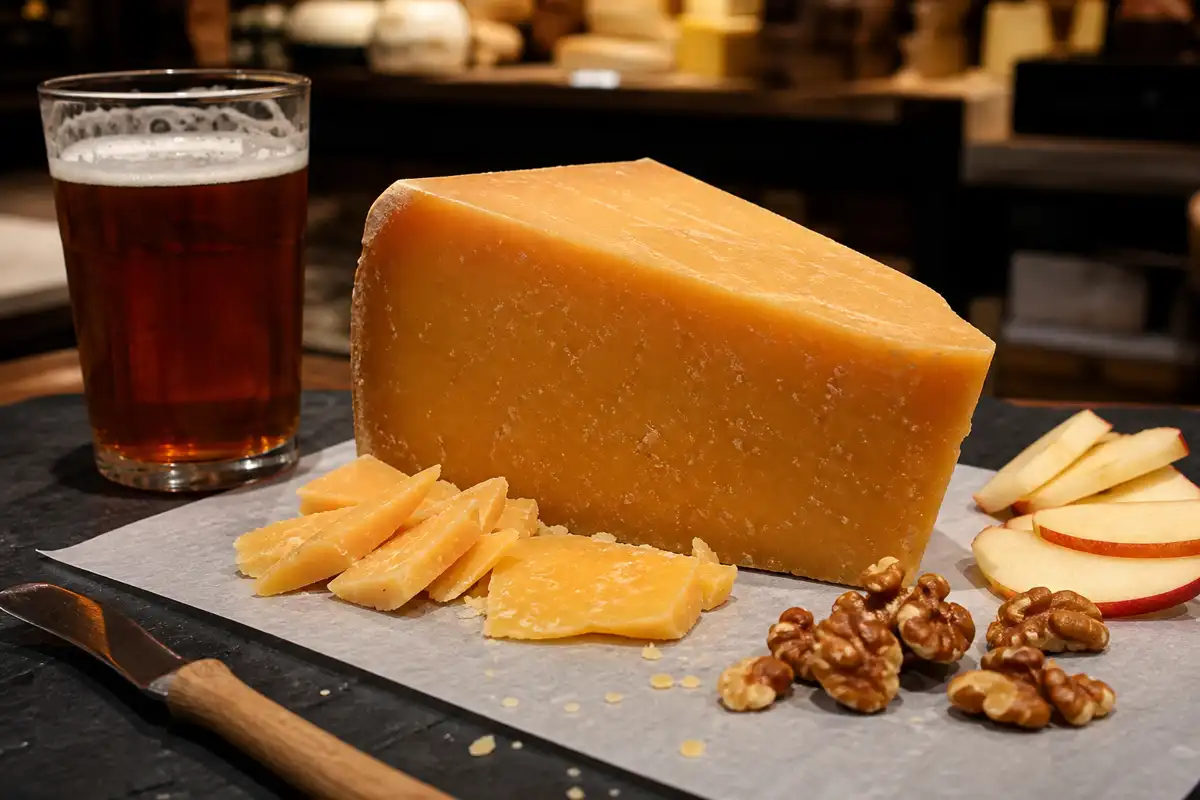
Cheese.com suggests an ice-cold beer or a Shiraz and dark malty bread with Leyden.
Culture suggests a margarita, Shiraz or a dark beer with Vermont Leyden.
Both are suggestions from the sources named, and neither says how age changes the match.
The same sources describe uses too: Cheeseland’s sheet calls Leyden an excellent cheese for winter dishes, ham-and-cheese sandwiches and chili, and Cheese.com says it suits a cheese platter.
Is Leyden Cheese Safe During Pregnancy?
The NHS lists pasteurised semi-hard cheeses such as edam among the cheeses that are safe in pregnancy. Cheese.com and the opening line of English Wikipedia call Leyden semi-hard, while that page's infobox says hard, so the sources disagree on which NHS line applies.
The NHS names unpasteurised cheese as safe only for hard cheeses such as cheddar, gruyère and parmesan, so a raw-milk wedge is not covered by its safe list unless it counts as hard. It separately counts any cheese cooked until steaming hot as safe.
The CDC lists dairy made from raw milk among its riskier choices and hard cheese made with pasteurized milk among its safer ones, but it has no semi-hard line, so it does not say where a pasteurised wedge falls. The milk line on the label matters most: a raw-milk wedge is riskier under the CDC and covered by the NHS only if it counts as hard.