New England Cheesemaking Supply Company rates its 30 Minute Mozzarella as a beginner recipe with no ageing time.
Citric acid takes the place of the starter culture that traditional mozzarella uses, which shortens the work from several hours to one short session.
Two temperatures anchor the recipe: 90°F, where the rennet goes in, and 135°F inside the curd, the point at which it will stretch.
In This Article
Which Milk Works for 30-Minute Mozzarella?
Ultra-pasteurised (UP) milk is the first carton to rule out. The supplier's milk article describes the process as heating milk and cream to at least 280°F for at least 2 seconds, which damages the milk enough to take it out of cheesemaking, and it says such milk must be labelled by law.
Organic name brands need extra care, because the FAQ says most of them are ultra-pasteurised.
The harder problem is milk that is not labelled UP but was heated almost as hard. Some processors take milk to 170 to 180°F, just short of ultra-pasteurisation, and the FAQ says the curd from it can look fine in the pot and then dissolve during heating or stretching.
The milk article explains the mechanism for any milk heated above 172°F. Whey proteins that normally run off with the whey become destabilised and stay in the cheesemaking process, where they interfere with the calcium bonds between the curd proteins and leave a weak curd.
The same article gives 145°F for 30 minutes or 161°F for 16 seconds as the legal pasteurisation standards. The trouble sits in the gap between those and UP, which carries no labelling requirement.
Storage adds a second factor. According to the milk article, the longer milk stays cold-stored, the more its usable calcium declines and the more cold-tolerant bacteria begin to break down its proteins, so the FAQ advises the freshest milk from the most local brand available.
Homogenised and non-homogenised milk both work, the recipe page says. Low-fat milk will set too, but it makes a drier, less flavourful cheese.
Skim, 1% or 2% milk can also leave the finished mozzarella translucent, the FAQ says, because its white colour comes from butterfat.
If you need lactose-free milk, the supplier says it has found none that is not ultra-pasteurised. Cheese made from regular milk contains more lactose than cultured cheeses such as Cheddar or Parmesan, and the FAQ calls the amount comparable to that in soft cheeses.
Choose pasteurised whole milk from the most local brand, confirm the carton does not say ultra-pasteurised, and treat organic name brands with care. When a milk fails to set, the supplier's advice is to try a different milk next time.
What Equipment Does 30-Minute Mozzarella Need?
The kit is short, and each item ties to a step in the method.
- A good thermometer, because the method gives a temperature for the rennet, for the cut-curd reheat and for the stretch, and the stretch figure is the one inside the curd
- A stainless steel pot, or one of Teflon, enamel or anodised aluminium; regular aluminium is not recommended, because acids from the whey etch into the metal
- Cool, non-chlorinated water for the citric acid and the rennet, since chlorine can make rennet ineffective
- A large colander, a large bowl that is microwave-safe if the microwave route is used, a slotted skimmer and a knife to cut the curds
- Rubber gloves, which help because the cheese is almost too hot to touch while it is kneaded
- Butter muslin, for draining curds that do not set into mozzarella
To find out whether your water is chlorinated, ask the town water department, and use distilled water if the answer is unclear. Most filters remove 97% of the chlorine, which the FAQ counts as fine for cheesemaking.
Before you start, clear the work area: put away other food, move sponges, cloths and dirty towels, wipe the sink and stove with soap and water, and finish with an antibacterial cleaner.
How Do You Make 30-Minute Mozzarella?
The card follows the supplier's 30 Minute Mozzarella recipe, written by Ricki Carroll, with milk, acid and rennet handling filled in from the FAQ.
30-Minute Mozzarella
Ingredients
- 1 gallon pasteurised milk, not ultra-pasteurised (whole cow's milk for a first batch)
- 1½ teaspoons citric acid, dissolved in 1 cup cool non-chlorinated water
- ¼ vegetable rennet tablet, crushed and dissolved in ¼ cup cool non-chlorinated water (liquid rennet amounts are in the rennet table below)
- 1 teaspoon cheese salt, adjusted to taste and added near the end of the stretch
- No calcium chloride
Method
- Dissolve the rennet in ¼ cup of cool non-chlorinated water and set it aside. Diluted rennet is good for about 30 minutes.
- Put the dissolved citric acid in the pot, pour in 1 gallon of cold milk and stir well so the acid spreads through the milk quickly.
- Heat slowly to 90°F, stirring gently. The milk may start to curdle slightly as it nears 90°F, and if it passes 90°F, cool it back down to 90°F.
- At 90°F take the pot off the heat and pour in the rennet slowly while stirring top to bottom for about 30 seconds, then stop. Cover and leave undisturbed for 5 minutes.
- Check the set: it should look like custard, with a clear separation between curd and whey. If it is soft or the whey is milky, wait up to 30 minutes more.
- Cut the curd into a 1-inch checkerboard.
- Return the pot to the stove and heat to 105°F (110°F if stretching in hot water), stirring slowly. Take it off the burner and keep stirring slowly for 2 to 5 minutes, since more time gives a firmer cheese.
- Scoop the curds into a colander or microwave-safe bowl and press gently, pouring off as much whey as possible. Keep the whey if you want it.
- Microwave the curd for 1 minute, drain the whey, and work the curd with a spoon or gloved hands until it is cool enough to touch. Microwave 2 more times for 35 seconds each, kneading and draining after each.
- Knead and stretch until the curd is smooth and shiny, microwaving again if it cools before it stretches. The curd must reach 135°F inside to stretch. Add the salt near the finish.
- Shape into a ball and drop it into ice-cold water, or chill it in a brine of 2 to 3 tablespoons salt, 2 to 3 tablespoons clear whey and 1 quart of very cold water. Wrap and refrigerate.
At the check in step 5 the curd should look like thick custard and hold its shape on a spoon while still breaking easily, like a very soft pudding. A finger pushed into it should leave a clean break.
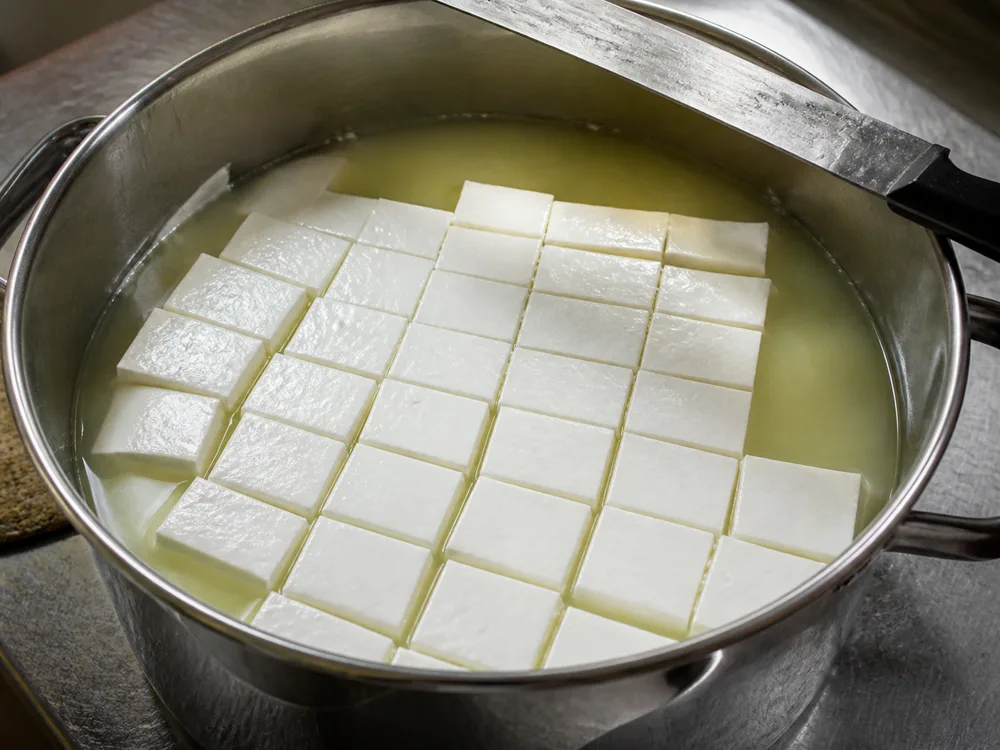
The reheat to 105°F exists for store-bought milk: the step was added because many cheesemakers were having problems with that milk. The FAQ adds that raw or very fresh milk with a perfect, custard-like curd may not need the heat at all.
How Much Citric Acid and Rennet Does Each Milk Need?
Standard milk takes 1½ teaspoons of citric acid per gallon, and the other milks below need more.
| Milk | Citric acid per gallon | Supplier's note |
|---|---|---|
| Pasteurised milk, not UP | 1½ teaspoons in 1 cup of water | The standard amount on the recipe page |
| Raw milk from a cow, goat or sheep in late lactation | 2 teaspoons | Start with this amount instead of 1½ teaspoons |
| Powdered dry milk with cream | 2 teaspoons | Start with this amount instead of 1½ teaspoons |
| Whole milk with cream added to imitate buffalo milk | At least 2 teaspoons | No more than 8 oz of light cream in a gallon |
| Water buffalo's milk | 3½ teaspoons, with ⅛ teaspoon liquid rennet or ⅛ tablet | Passed on from one customer; the supplier says it has not tried it |
Raw milk late in lactation and powdered milk with cream share one adjustment. The buffalo figure is the one to hold loosely, because the supplier passes it on from a customer's experience.
Add the acid slowly while stirring briskly, or put it in the pot first and pour the milk over it. Mixing it into a small amount of milk before adding that to the rest distributes it unevenly.
Lemon juice or ascorbic acid can stand in only as an experiment. The supplier does not recommend substitutes, because there is no reliable way to know their strength, and gives a target pH of 5.4 to 5.6 to anyone who tries.
| Form or situation | Amount for 1 gallon |
|---|---|
| Vegetable rennet tablet | ¼ tablet |
| Liquid animal rennet | ½ tsp, which the FAQ equates to ¼ tablet |
| Liquid vegetable rennet, double strength | ⅛ tsp |
| Soft curd from older milk, or a cheese that comes out too soft | ½ tablet |
In liquid rennet, ¼ tablet is ¼ teaspoon on the recipe page and in the FAQ's rennet test, but ½ teaspoon of liquid animal rennet in the FAQ's tablet-versus-liquid line.
The ¼ tablet amount does not change between those lines, so measuring by tablet avoids the disagreement.
Tablet and liquid rennet make no difference to the taste of the finished cheese, the FAQ says. If you are vegetarian, its vegetable tablets contain microbial chymosin, the same enzyme as calf rennet, and no animal products.
Junket tablets are no substitute. The FAQ says they are nowhere near as strong as rennet for cheesemaking, because rennet is about 80% chymosin and 20% pepsin while junket is roughly 80% pepsin and carries many additives.
Rennet is time-limited. Once diluted it is good for roughly half an hour, and tablets keep for a year at room temperature or five or more years in the freezer.
You can test a rennet of uncertain age: heat 1 cup of milk to 90°F, stir in 2 tablespoons of diluted rennet for 30 seconds, and expect the surface to firm or form a film after two minutes and a curd that holds a knife cut after six to ten.
Why Does 30-Minute Mozzarella Leave Out Calcium Chloride?
The supplier calls mozzarella the exception, because calcium is released during the stretch and adding more works against it. Calcium chloride is normally added to processed or cold-stored milk for a firmer curd, and many sites include it in their mozzarella recipes.
The supplier claims a better stretch and a better final texture without it. Calcium is what holds the curd proteins together, which is why cheesemakers working with cold-stored milk usually add calcium chloride.
How Hot Does the Curd Need to Be to Stretch?
The curd has to reach an internal temperature of 135°F before it will stretch. Hotter than that and it melts and comes apart, and the FAQ warns that in a water bath or microwave above 175°F the curd may dissolve.
When the milk's acid is right and the curd is heated in hot water, the proteins realign and give the stretch that puts mozzarella in the pasta filata, or stretched-curd, family.
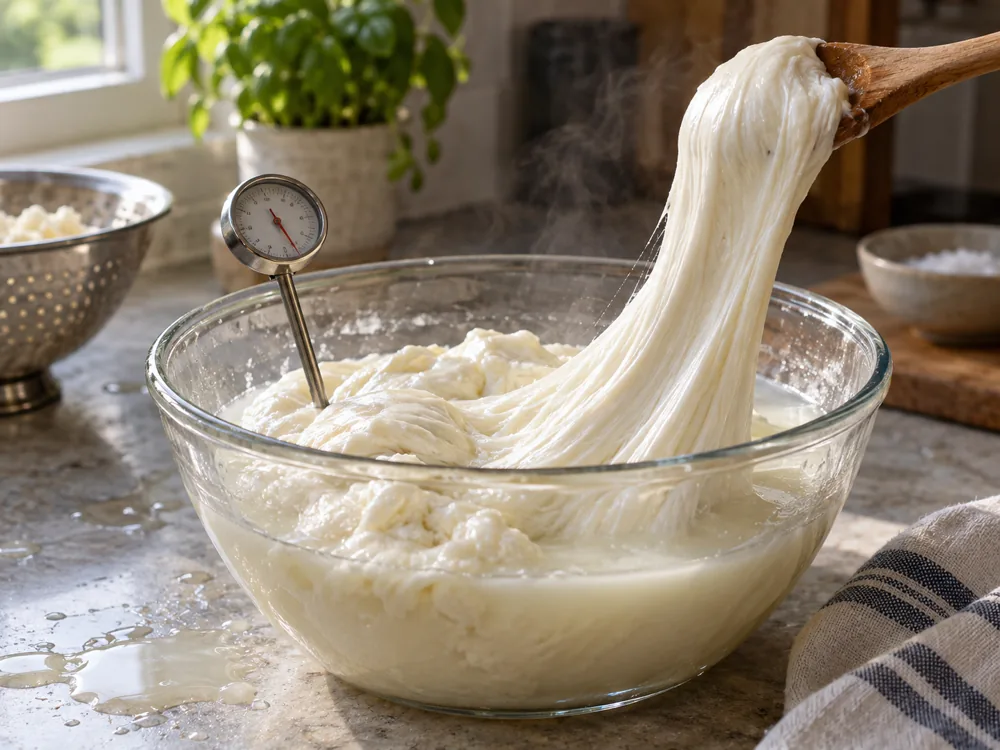
In the microwave, the curd gets one minute, a drain and a knead, then two more rounds of 35 seconds on the recipe page, while the FAQ, which says a microwave that is too strong or a round that runs too long makes the curd crumble, suggests starting with 30 seconds and then another 30.
For the hot-water route, the no-microwave version of the 30 Minute Mozzarella raises the cut-curd reheat to 110°F and sets a pot of water heating to 175°F while the curd drains.
For the stretch, some of that water goes into a bowl and is adjusted to about 175°F, which is too hot for bare hands, so the recipe calls for thick rubber gloves or a spoon.
The curd is cut or broken into 1 to 2 inch pieces, pressed together and folded in the water for even heating, and pulled out to stretch once it begins to meld. If it cools and tears, it goes back into the water to reheat.
That puts the no-microwave recipe's water at about 175°F, the figure above which the FAQ says a water bath may dissolve the curd, and the recipe's own advice for curd that will not stretch is to check the water temperature and put the curd back in.
Push a thermometer into the curd mass: the 135°F reading inside it says more than the setting on the microwave or the temperature of the water.
The stretch itself resembles pulling taffy, per the FAQ: the cheese is left to fall on itself a few times until it looks smooth and shiny, then shaped into a ball and dropped into ice-cold water.
The curd gets kneaded quickly, as with bread dough, on the recipe page, while the FAQ warns that kneading like bread loses too much moisture and leaves the cheese tough and chewy.
Either way, stop when the curd has turned smooth and shiny, the signal both pages give.
Why Will My Curd Not Set, or Fall Apart?
Find what you see in the pot in the table's first column: the FAQ names a separate cause for each of these failures, and most of them come with a rescue.
| What you see | Cause | Fix |
|---|---|---|
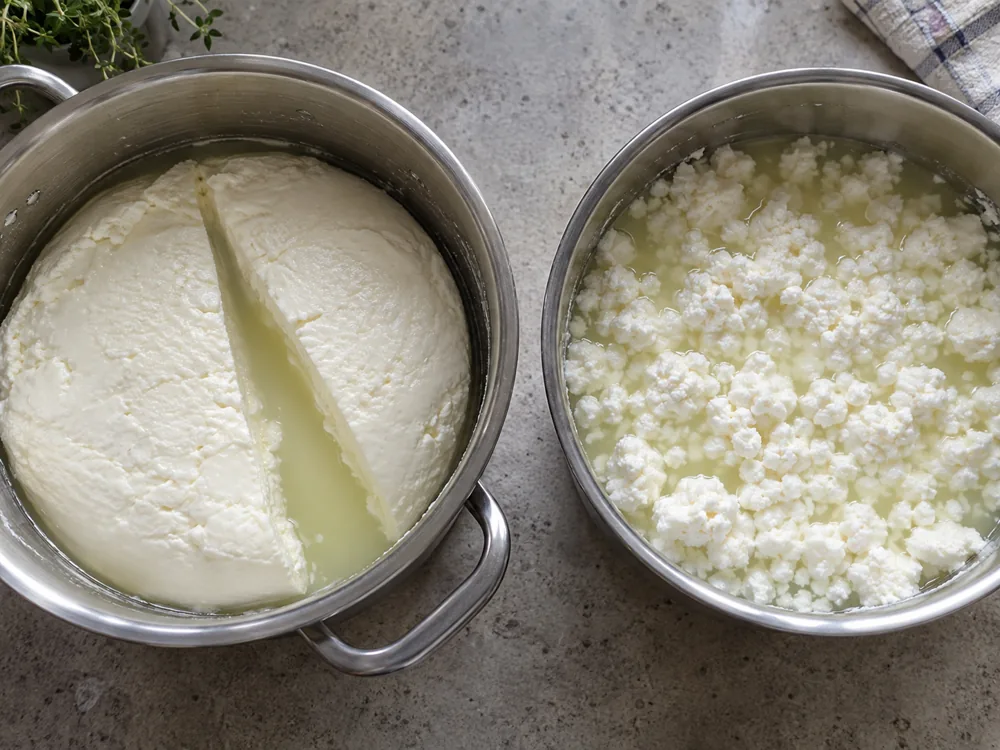
| No curd, even after waiting 10 more minutes | Milk heated almost as hard as UP milk but not labelled UP | Drain the curds in butter muslin and eat them as a seasoned spread; try a different milk next time |
| Curd that looks like cottage cheese floating in the pot | Marginal milk | Heat to 110°F, take it off the burner, cover and leave for 5 minutes; if the curds drain without cheesecloth, mozzarella is likely |
| One glob of curd at the bottom of the pot | Milk that is overly acidic | Go straight to the microwave or water bath step; next time heat to only 86 to 88°F before the rennet |
| Curd with liquid milk underneath | Citric acid that spread too slowly, so part of the milk coagulated at once | Dilute the acid in 1 cup of water, or put the acid in the pot first and pour the milk over it |
| No curd from local milk | Stirring too long after the rennet, which cuts the curd as it forms | Stir for 30 seconds, a few seconds more at the top for raw milk, and let the pot sit off the burner |
| Curd that dissolves in the microwave | Curd not strong enough, if the milk was not overheated or old | Use ½ tablet of rennet next time; the dissolved curds can be used like ricotta |
| Curd that crumbles in the microwave | A microwave that is too strong, or heating too long | Microwave for 30 seconds, then another 30 |
For milk pasteurised a little above the traditional 161°F, up to about 172°F, the milk article gives a rescue sequence. It starts with the milk at 95 to 100°F, and if the curd holds a knife cut it is cut into ½ to ¾ inch squares and left for 3 to 5 minutes.
Then heat the curd slowly to 105°F for 5 to 10 minutes or longer, moving the long pieces gently around the pot until they firm up. If the first curd will not hold a knife cut, the article says to raise the setting temperature by another 5 degrees on the next batch.
When the curd still will not hold together after that heating and stirring, the article's verdict is that the milk will not work and you need another milk.
Why Is My Finished Mozzarella Crumbly, Rubbery, or Too Soft?
After the stretch, texture problems come back to a handful of controls: how much rennet goes in, how warm the curd is held, how small it is cut, how long it is stirred and how much it is stretched.
| What you see | Likely cause | Adjustment |
|---|---|---|
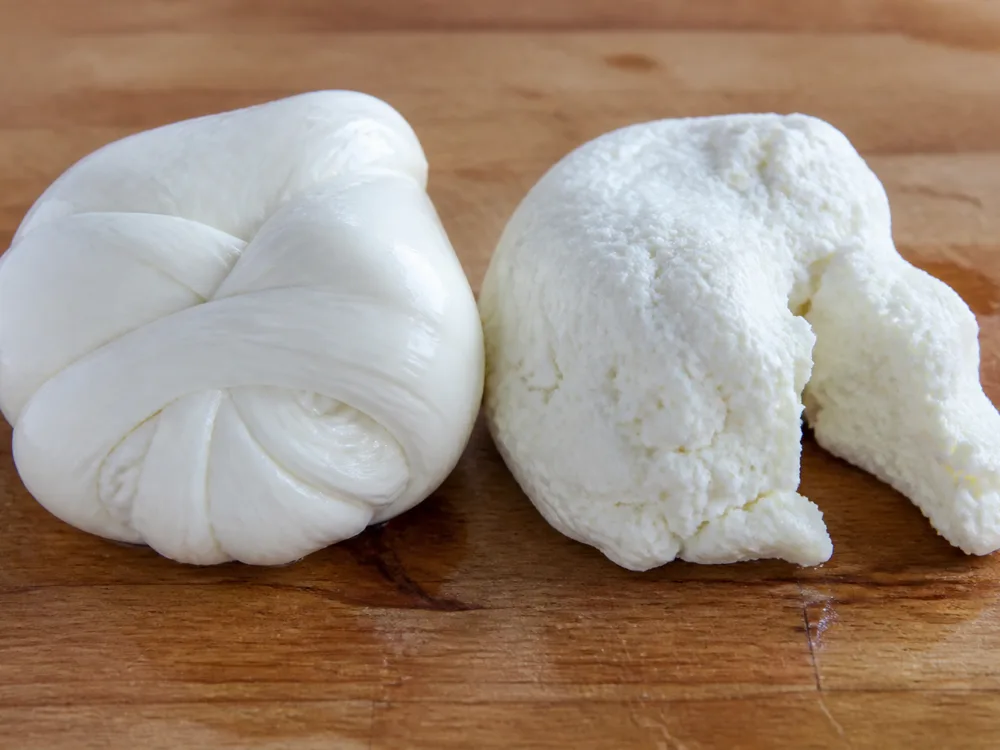
| Too soft | The cheese kept too much moisture | Raise the rennet to ½ tablet, raise the temperatures a few degrees, cut the curds smaller, stir longer after the reheat and stretch more; or partly freeze the cheese and grate it |
| Dry and rubbery | Stretched too much | Let the cheese fall on itself a few times; next time add the rennet 2 to 5 degrees cooler and cut and stir less before stretching |
| Will not melt | Too little moisture left after kneading and stretching | Knead and stretch less, and lower the temperature 2 to 3 degrees before the rennet and at the reheat |
| Translucent after storing | Skim, 1% or 2% milk | The white colour comes from butterfat, so use whole milk |
So if your cheese is too soft, the fixes in the first row all remove moisture, and if it is dry or will not melt, the fixes run the other way on temperature, cutting, stirring and stretching.
How Much Mozzarella Does a Gallon Make, and Can You Scale the Batch?
A gallon of milk gives about 1 pound of mozzarella. Milk with less butterfat gives a lower yield, and so does a curd that was not firm enough, because butterfat is then lost to the whey.
The whey is your check: the FAQ advises letting the curd set until the whey is clear, both before and after cutting, adding 5 or 10 more minutes at either point if it needs them.
Some milkiness is normal, especially with high-butterfat milk. If it comes with a soft set or a lot of handling, the FAQ's answer is to set the milk 3 to 5 degrees warmer next time and stir a few minutes longer while heating to 105°F.
Halving is awkward because ⅛ of a tablet is hard to measure, so the FAQ suggests dissolving ¼ tablet in ½ cup of water and throwing out half of the solution. Doubling means doubling everything, including the water that dissolves the rennet and the acid, and splitting the curd into two portions for heating and stretching.
At high altitude no change is needed, because nothing in the recipe boils.
What Can You Do With the Whey?
Most of the gallon stays in the pot as whey, and you can use it in these ways.
- Soak grains and beans in it
- Filter it and add sweetener to make a whey lemonade
- Use it as soup stock, or in place of the liquid in other recipes
- Water acid-loving plants such as tomatoes with it
- Compost what is left
How Long Does Homemade Mozzarella Keep?
Mozzarella is traditionally a fresh cheese eaten within a day or so, the FAQ says. In a moist cheese the lactose keeps fermenting, and one held too long loses its shape and turns sour or off-tasting.
If you want the cheese to last beyond 1 to 2 days, the FAQ advises cutting the curd smaller and stirring longer before the stretch, which gives a drier cheese with less lactose.
The finished ball goes into a chilling brine of 2 to 3 tablespoons of salt and 2 to 3 tablespoons of clear whey in 1 quart of very cold water on the recipe page, while the FAQ says homemade mozzarella can turn slimy from too much calcium loss in water or brine, which is its answer to why it cannot sit in water like shop mozzarella.
The recipe page then wraps the cheese and stores it in the fridge, adding that the cheese is always best eaten fresh.
The CDC advises keeping a refrigerator at 40°F or below and refrigerating perishable foods, dairy included, within 2 hours, or within 1 hour if they have been above 90°F. Treat the supplier's "best fresh" as a quality guideline and follow those general rules for perishable dairy.
For curd, the FAQ's method is to wrap it well with no air and freeze it, then thaw it in the refrigerator before stretching.
Is Homemade Mozzarella Safe in Pregnancy?
If you are pregnant, check the label for the milk you use: the recipe card calls for pasteurised milk that is not ultra-pasteurised, and the supplier's FAQ also gives citric acid amounts for raw milk.
If the label says pasteurised milk, you can eat the mozzarella you make from it: the NHS lists pasteurised soft cheeses, such as mozzarella and burrata, as safe to eat, and the CDC lists cottage cheese, cream cheese, string cheese, feta and mozzarella, when made with pasteurized milk, as safer.
If you follow NHS advice and the milk has no label, or its label does not say pasteurised, cook the mozzarella until it is steaming hot before you eat it: the NHS says any foods made from unpasteurised milk must be thoroughly cooked and lists any cheese that's been cooked until steaming hot as safe to eat. The NHS also lists unpasteurised milk, cream, yoghurt, butter and ice cream among the foods to avoid.
If you follow US advice, ask a midwife or doctor before you eat mozzarella made from milk without a label that says pasteurised, even cooked: the CDC lists unpasteurized (raw) milk and dairy products made from raw milk, and soft cheese made from unpasteurized (raw) milk, as riskier. It says pregnant women are 10 times more likely to get a Listeria infection.
The supplier's FAQ lists raw milk among the milks that work for this recipe and gives the 2 teaspoon acid adjustment for it. That statement is about whether the curd sets, and the agencies' categories above are what apply to who eats the cheese.
The 135°F that the curd reaches during stretching is a texture threshold from the cheesemaking supplier. The agencies give a different standard for heating soft cheese: the CDC says pasteurized soft cheese heated to an internal 165°F or until steaming hot is safer, and the NHS lists any cheese cooked until steaming hot as safe.
A curd stretched to 135°F is below the 165°F in the CDC's heated line, but that line covers only pasteurized soft cheeses, and the CDC lists soft cheese made from unpasteurized (raw) milk as riskier. Nothing in the recipe cooks the curd the way the NHS asks of foods made from unpasteurised milk, which it says must be thoroughly cooked.
Which Flavourings Work in 30-Minute Mozzarella?
Salt is optional but improves a cheese that is otherwise mild. Use 1 teaspoon of cheese salt, adjusted to taste, and sprinkle it on during the final stretch with everything measured and ready, since the moment is awkward.
Non-iodised sea salt, kosher salt or a salt substitute can replace cheese salt. If you skip salt, the supplier suggests fresh or dried herbs, added the same way.
| Use | How It Works |
|---|---|
| Tomato and herbs | Fresh or dried herbs go in with the salt, and the FAQ says to cut vegetables such as tomatoes into tiny pieces and let them dry slightly before adding them. |
| Lipase | The FAQ adds ¼ teaspoon of mild lipase powder, more or less, after the citric acid is thoroughly stirred in, and raises the rennet to ½ tablet. |
| Liquid smoke | The FAQ gives 1 or 2 teaspoons per gallon, added right after the citric acid. |
| Cold smoke | Real smoking has to be a cold smoke kept below 84°F, because above that the butterfat melts and runs out, the FAQ says. |
| Bocconcini | Break the cheese into small pieces during the stretch and plunge them into ice water, according to the FAQ. |
Can You Make Burrata From the Same Curd?
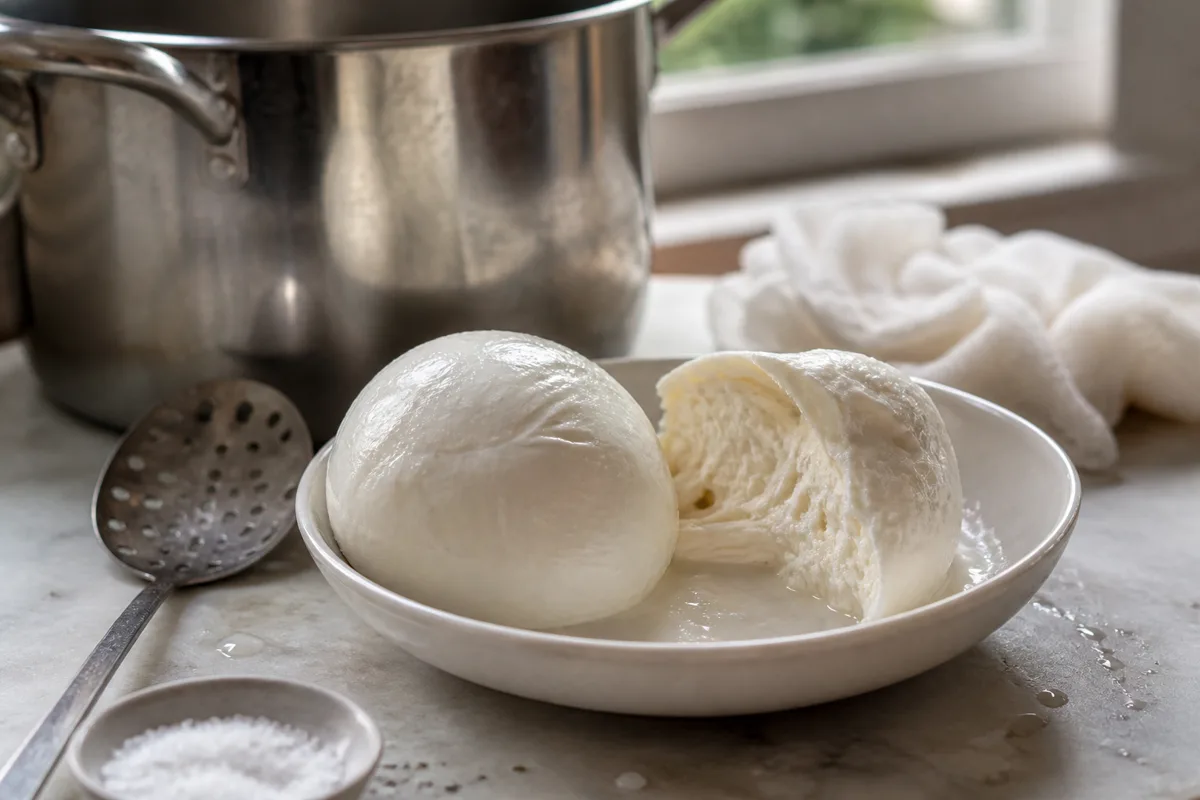
Burrata is built from the same material: an outer pouch of fresh mozzarella that holds stracciatella, soft mozzarella bits mixed with cream. The name comes from the Italian word for buttery.
The original filling used rich whey butter, a by-product of making cheese from extra-creamy milk such as water buffalo's, and heavy cream mixed with curd bits is the modern substitute.
Stracciatella means shredded. It was first made from the bits and pieces left after stretching other mozzarella shapes, torn into fine threads and mixed with the whey butter or cream.
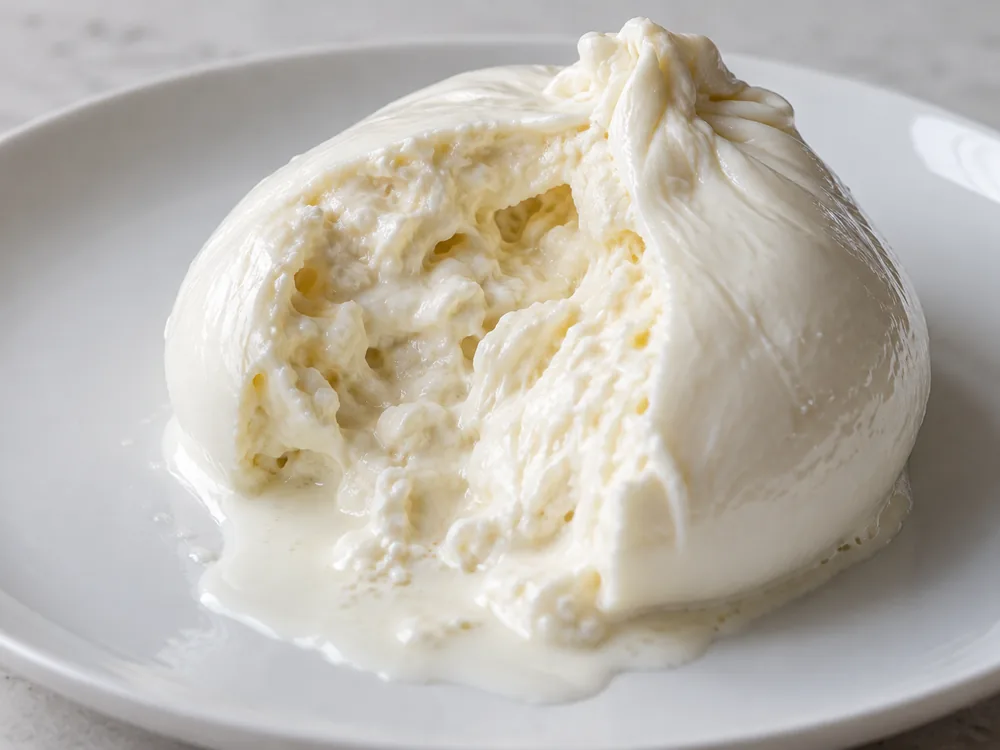
Cheesemaker and author Gianaclis Caldwell, writing in Culture magazine, teaches home cheesemakers burrata with a quick mozzarella recipe. For the filling she suggests an acid-coagulated ricotta mixed with a little heavy cream or butter, salt and pepper, sometimes herbs, and says the whole process takes only a bit over an hour.
How Does Cultured Mozzarella Differ From the 30-Minute Version?
Cultured mozzarella uses a starter culture to convert the lactose in milk into lactic acid. The supplier's cultured recipe says the slower route makes up in flavour and texture for what it lacks in speed.
| Step | 30-minute recipe | Cultured recipe |
|---|---|---|
| Skill level | Beginner | Intermediate |
| Acidification | Citric acid dissolved in water and added to cold milk | Thermophilic starter culture added to milk at 100°F and ripened for 60 minutes |
| Set after the rennet | 5 minutes at 90°F, with up to 30 more if the curd is soft | 45 minutes to 1 hour at 100°F |
| After cutting | Reheated to 105°F, drained, then microwaved or heated in hot water | Rested about 1 hour, drained, then ripened about 2 more hours at 96 to 100°F |
| Signal to stretch | 135°F inside the curd | A test piece in a cup of water at about 180°F stretches 2 to 3 times its length without breaking |
| Moisture control | How far the cut curd is heated and how long the cheese is stretched | Size of the curd pieces, since smaller pieces release more whey and give a drier cheese |
Mozzarella's name comes from mozzare, meaning to cut off, which refers to the way the stretchy curd is formed into balls or blocks.
The same recipe says every variation, from creamy fior di latte to drier pizza cheese, and from water buffalo mozzarella di bufala to smoked scamorza, comes from one technique. Only the moisture level, the milk source and the stretch change.
Hot-water stretching traditionally used whey already heated from making ricotta, though plain hot water works. The cultured recipe's own whey is sweet enough for ricotta, because the acid has not fully developed when the curds are drained.
The recipe's author, Jim Wallace, suggests cutting a big batch of curd into 1-pound portions and freezing them, then thawing one in the refrigerator overnight and heating water for the stretch the next day. He says most shops selling fresh mozzarella buy frozen curd in bulk and stretch it daily.