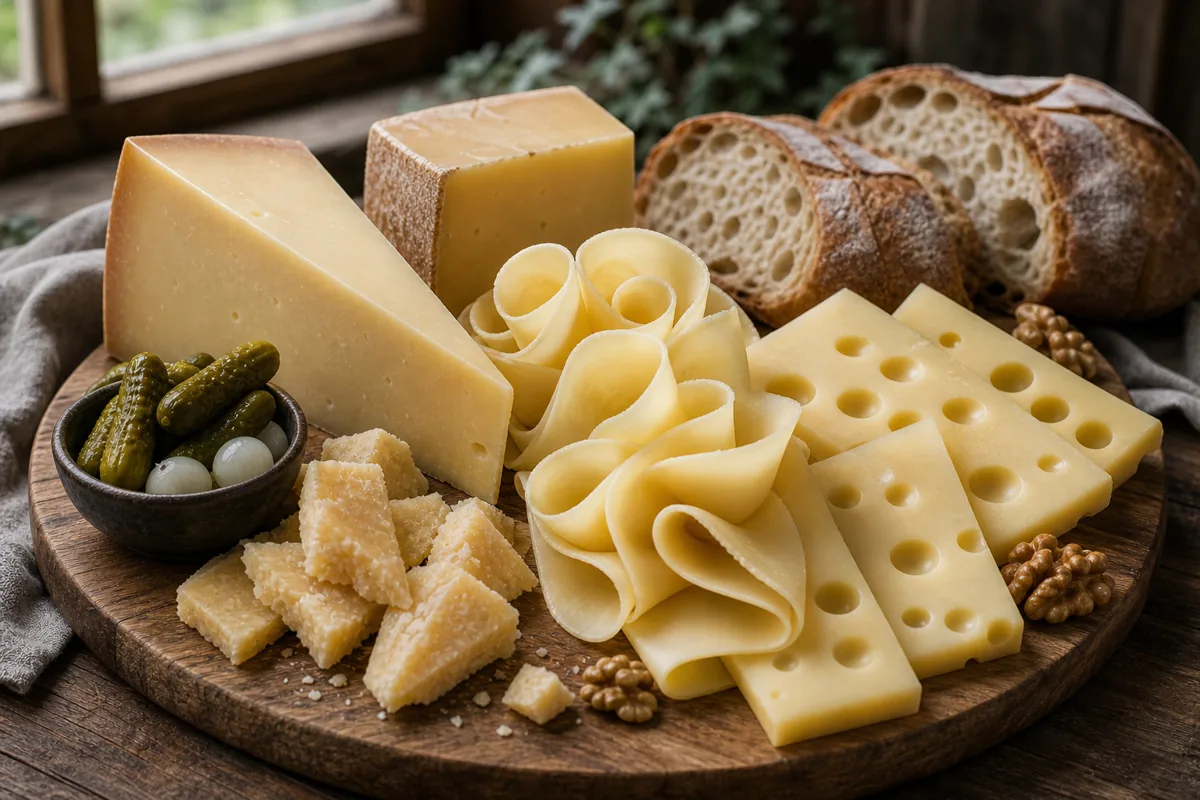
Choose Swiss cheese by the heat it will see. Fondue, raclette, shaved rosettes, hard shards, and sandwich slices each need a different wheel, and the country's protected cheeses are built around those separate jobs rather than around a single house style.
That is why the phrase Swiss cheese does poorly at the counter. In American markets it usually means an Emmental-style slice with holes, while in Switzerland it covers a set of protected wheels with different milk rules, different aging windows, and behavior that changes sharply once heat is involved.
Buying by the word rather than by the named cheese is how a fondue ends up stringy or a raclette pan ends up greasy.
In This Article
What Swiss Cheese Actually Covers
The holes are the detail everyone remembers, and they explain the smallest part of the picture. Eyes are a feature of Emmentaler and a handful of relatives, and they tell you nothing about Gruyere, Sbrinz, Raclette, or Tete de Moine, none of which is supposed to have them at all.
A more useful split starts with what the cheese has to do.
Some Swiss wheels emulsify smoothly into a fondue pot, some hold together under a direct grill so a melting face can be scraped off, some are shaved into thin curls that release aroma without any heat, and some behave like hard grating cheese and go into shards. Those four jobs ask for four different textures, and a wheel that is excellent at one of them is often mediocre at the others.
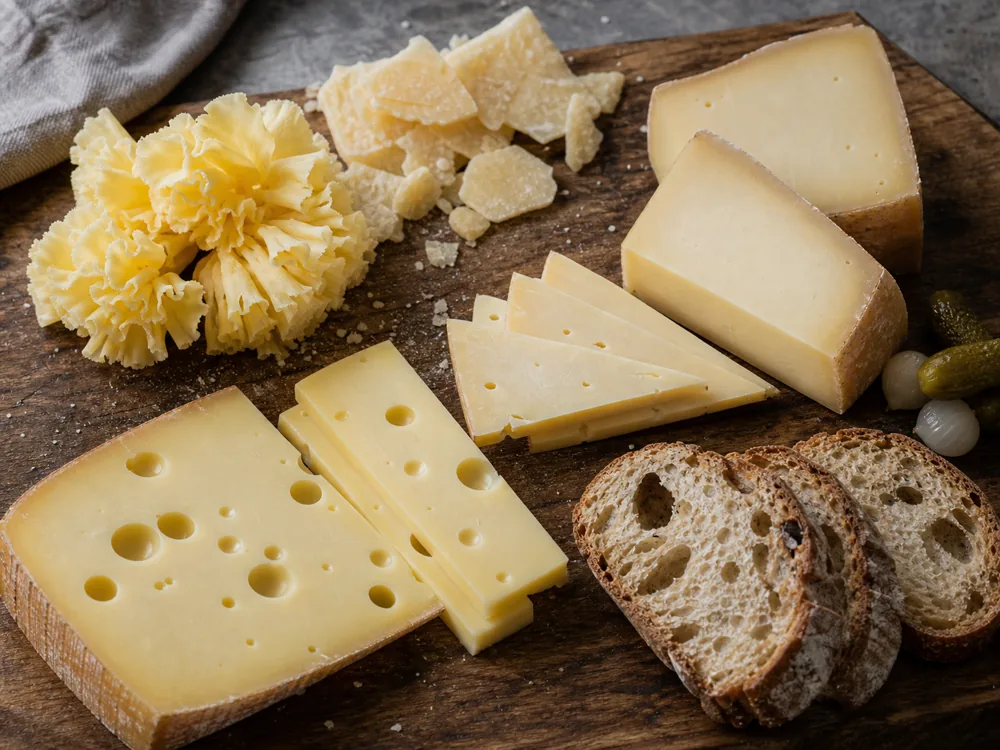
Sorting by use also heads off the most common shopping mistake. A recipe that says Swiss sends most people to Emmental, when the dish often wants the denser body of Gruyere or the looser, creamier texture of a Vacherin.
The recipe named a country, and the kitchen needed a texture.
What AOP Protection Actually Guarantees
Swiss AOP rules fix the production zone, the milk handling, the minimum aging, and the style of the finished wheel. That matters because generic Swiss-style cheese is made everywhere, and it can legally copy the shape and the holes without following any of those rules.
The zones are narrower than most shoppers expect.
Le Gruyere AOP comes from the canton of Fribourg together with Vaud, Neuchatel, Jura, and parts of Bern, and it has held Swiss AOP status since 2013. Emmentaler AOP is tied to its own list of cantons, including Aargau, Bern, Glarus, Lucerne, Schwyz, Solothurn, St Gallen, Thurgau, Zug, and Zurich.
Both are made from raw cow's milk rather than pasteurized, which is part of why they carry more flavor than the industrial versions that borrow their names.
Aging is where the numbers become useful at the counter. Emmentaler AOP has to spend at least four months in the cheese cellar, and the defined varieties run from that four-month mild style to extra-mature at twelve months, with some premium wheels going further still.
Gruyere typically sells between five and twelve months, and the Premier Cru grade is held for fourteen.
Those are not badges of prestige so much as texture predictions, because every extra month in the cellar drives off more moisture and makes the paste firmer, drier, and less willing to melt smoothly.
If the label only says Swiss-style, expect a broad imitation. If it names a protected Swiss cheese and a producer or region, you have a better clue about milk, aging, and use.
So the age on the label answers the question the cheese name cannot.
A young Gruyere at five months still flows well enough for a beginner's fondue. The same cheese at fourteen months tastes considerably better on a board and will fight you in the pot, because there is less water left in it to carry the fat into a smooth sauce.
- Read the named cheese: Gruyere, Emmental, Raclette, Sbrinz, and Tete de Moine are not one category.
- Read the age: older wheels bring more concentration and less easy melt.
- Read the use: table slicing, fondue, raclette, and hard shards ask for different textures.
Where the Holes Come From, and Why Size Varies
Eyes form because bacteria inside the wheel produce carbon dioxide during a warm fermentation stage, and that gas has nowhere to escape. It collects at weak points in the young paste and pushes the curd apart into round cavities.
The traditional Swiss explanation is that those weak points began as microscopic specks of hay dust falling into the milk at milking time, giving the gas somewhere to gather around.
That history also explains why modern Emmental often has smaller and fewer eyes than the wheels people remember.
Closed milking systems and cleaner handling leave less dust in the milk, so the gas has fewer places to collect. A cheese with tidy little eyes has not been made badly, and a cheese with cathedral-sized holes is not automatically better made.
What hole size does tell you is something about the warm-room stage. Bigger eyes generally mean a longer or warmer fermentation, which develops the sweet, nutty notes Emmental is known for.
That is a flavor clue worth reading, though it sits well below age and named cheese in usefulness, and it is worth nothing at all on a Gruyere, where visible holes would be a fault rather than a feature.
How Do Gruyere and Emmental Work Together in a Fondue?
Gruyere, the cave-aged Fribourg classic, gives a fondue its body, its savory depth, and a denser melt that clings to bread. Emmental, the eye-forming Emme Valley wheel, brings sweetness and a lighter nutty profile instead, and it thins the blend enough to keep the pot from turning heavy.
The two are usually sold as a pair for exactly that reason, and they are not interchangeable in a recipe.
Swapping all of the Gruyere for Emmental leaves a sweet pot with no backbone that separates as it cools. Going the other way gives you a dense, insistent fondue that most people stop eating before the bread runs out.
The classic half-and-half blend exists because each cheese covers the other's weakness.
Texture problems in the pot usually come down to this ratio rather than to technique. If the fondue tastes flat, it needs more Gruyere.
If it feels claggy and too strong, it needs more Emmental or a softer Vacherin.
Our Gruyere and Emmental differences breakdown is worth reading before you commit to a blend, because the two cheeses fail in opposite directions.
- Gruyere-led blend: deeper, denser, more savory, better when the fondue needs backbone.
- Emmental support: sweeter and lighter, useful when the blend needs stretch and lift.
- Vacherin support: softer and creamier, useful when the fondue needs a looser texture.
What Makes Raclette, Rosettes, and Hard Shards Different?
Not every Swiss cheese wants to become fondue.
Raclette, the traditional scraping cheese, is built for direct heat, and the whole point is a melting face that can be pushed off onto potatoes while the rest of the piece stays solid. It needs enough moisture to soften quickly and enough structure to avoid collapsing into oil, which is why a random Alpine wedge under a grill usually disappoints.
Tete de Moine, the rosette-served monastery cheese, works in the opposite direction, with no heat at all. Shaving it into thin curls with a girolle multiplies the surface area, so the aroma opens in the air before the cheese reaches the tongue.
Cut the same cheese into cubes and most of that effect is lost, which makes the serving tool part of the recipe rather than a gimmick.
Sbrinz, the extra-hard central Swiss wheel, takes a third route.
Long aging leaves it dry and dense enough to break into shards rather than slice, and it delivers concentrated savory flavor in small pieces. It covers the job Italian grating cheeses usually get called in for, without pulling a Swiss table toward Parmigiano.
| Pairing | Why It Works |
|---|---|
| Raclette | Potatoes, cornichons, and cured meat work because the melted cheese needs acid and starch. |
| Tete de Moine | Thin rosettes with bread or fruit let aroma open without heavy cooking. |
| Sbrinz | Shards with pears, nuts, or bread suit its hard aged concentration. |
| Tilsiter | Sandwiches and simple boards fit its semi-hard table role. |
The serving method decides the experience before anyone tastes anything, which is the part shoppers tend to skip. The same weight of cheese scraped hot over potatoes, curled into rosettes, or broken into dry shards produces three different evenings.
- Scrape: raclette belongs with direct heat, potatoes, pickles, and timing.
- Shave: Tete de Moine earns its rosette shape because thin curls open aroma quickly.
- Break: Sbrinz works in shards when you want hard aged intensity without a sauce.
Which Swiss Cheeses Can You Explore by Name?
The list below links Swiss cheeses that have their own profile here. Type a name, or pick a style, to narrow it.
10 cheese profiles
How Should You Choose Swiss Cheese by the Heat It Will See?
The productive question is not which Swiss cheese is best. It is how much heat this cheese is about to meet, because that single answer eliminates most of the shelf.
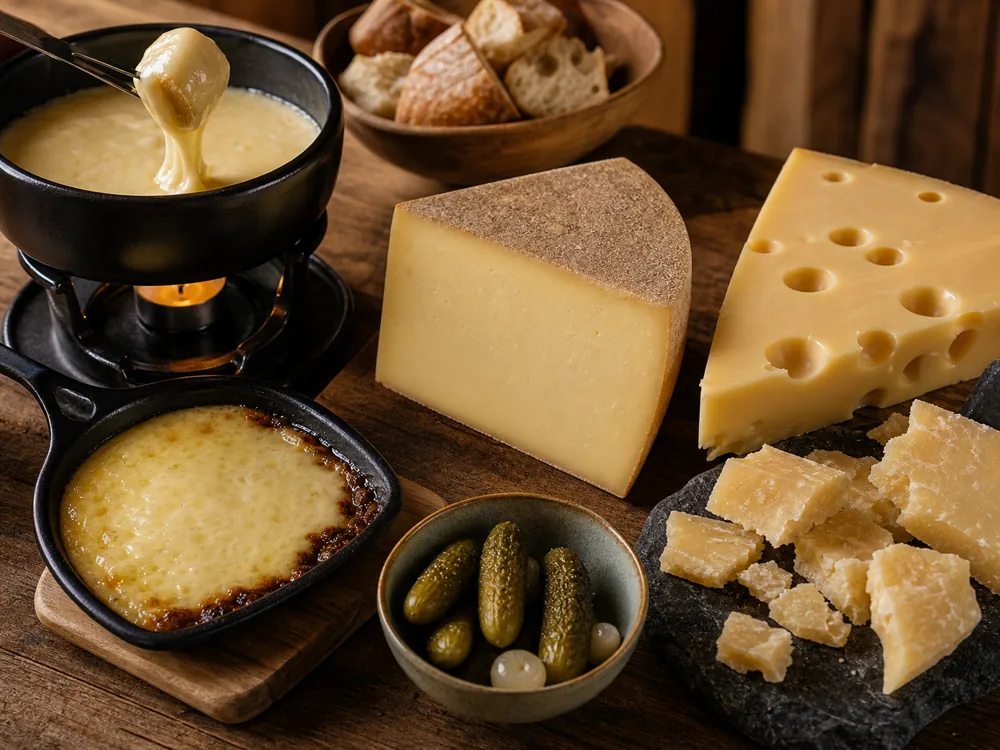
Fondue needs a blend that emulsifies rather than splits, which favors a younger wheel with moisture still in it. Raclette needs a face that softens under a grill while the body holds.
A sandwich needs a cheese that slices without crumbling and melts without flooding the bread.
A board needs no melt behavior at all, which is the one case where the oldest and driest wheels become the obvious pick.
Three wheels are worth knowing once heat becomes the sorting question.
Vacherin Fribourgeois, the Fribourg fondue specialist, loosens a blend that has turned too firm, and the spruce-wrapped Vacherin Mont d'Or is soft enough to warm in its own box and eat with a spoon. Tilsiter, the eastern Swiss semi-hard table cheese, handles the daily sandwich work that a protected Alpine wheel is wasted on.
One habit is worth breaking. When a recipe asks for high-moisture melting cheeses, reaching for a hard Swiss wheel out of familiarity will not work, because the water it lost in the cellar is exactly what the recipe was counting on.
SOURCES & REFERENCES
What Else Do People Ask About Swiss Cheese?
These are the questions readers ask when they are trying to move past generic Swiss-style slices.
No. In many markets, Swiss cheese means an Emmental-style cheese with holes, but Switzerland has many other cheeses, including Gruyere, Raclette, Tete de Moine, Sbrinz, and Vacherin.
Gruyere is the backbone for many fondue blends.
Emmental can add sweetness and lift, while Vacherin can soften the texture. A younger Gruyere around five months melts more easily than a fourteen-month Premier Cru.
Bacteria produce carbon dioxide during a warm fermentation stage, and the trapped gas pushes the young paste apart into round cavities. The traditional explanation is that specks of hay dust in the milk gave the gas somewhere to collect.
Cleaner modern milking leaves less dust, which is why many wheels now have smaller eyes.
Raclette is used for melting and scraping over potatoes, pickles, bread, and cured meats. It is a heat-service cheese, not just a cold board wedge.
Sbrinz is a very hard Swiss cheese often served in shards or shavings. It gives a concentrated aged-cheese bite.
AOP ties the cheese to a defined zone, a milk standard, a minimum aging period, and a style. Generic Swiss-style cheese can copy the shape and the holes without following any of those rules, so the protected name is the only part of the label that predicts how the cheese will behave.