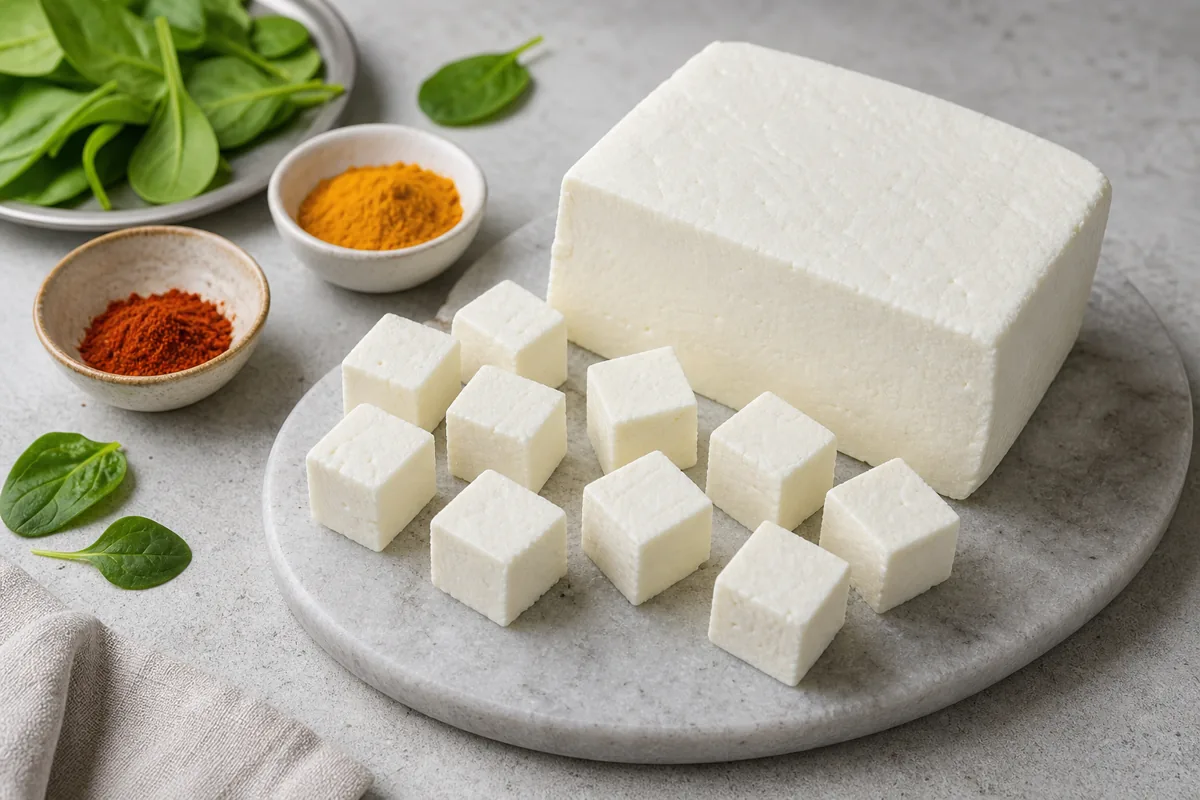
Paneer is a fresh cheese made by curdling hot milk with an acid, then draining and pressing the curds into a block. English Wikipedia classes it as a non-aged, non-melting cheese, and Cheese.com says it holds its shape well during cooking.
That shape is why paneer can sit in palak paneer or on a paneer tikka skewer and still come out as cubes.
Cheese.com lists India and Bangladesh as its home and chhena or chhana as other names. English Wikipedia lists Indian cottage cheese as another name.
In This Article
How Is Paneer Made?
Every method starts with hot milk and an acid. English Wikipedia names lemon juice, vinegar, citric acid or dahi (yogurt) as the acids that separate the curds from the whey, and the curds are then drained in muslin or cheesecloth.
FoodCrumbles says a strong acid such as vinegar gives a firmer paneer and a weaker one such as yogurt a softer one. NIFTEM says citric acid is the usual plant choice, while lemon or lime juice and vinegar leave a flavour of their own.
The amount matters as much as the kind. NIFTEM gives the usual plant dose as 1.8 to 2.0 kg of citric acid per 1,000 L of milk and says too much acid gives an acid flavour and a harder block, with more solids lost to the whey.
Heat does two jobs. FoodCrumbles says the same amount of acid that does nothing in cold milk will likely curdle hot milk at once.
NIFTEM says heating to 90°C lets the whey proteins β-lactoglobulin and α-lactalbumin bind to casein and stay in the curd, which raises the yield. The same heating gives the cooked flavour NIFTEM counts as desirable, through sulphydryl compounds the heat releases from the milk.
Stirring decides curd size. FoodCrumbles says larger curds give a softer, moister paneer and very small ones a drier block, because small curds hold water less well, which is why it warns against stirring too vigorously.
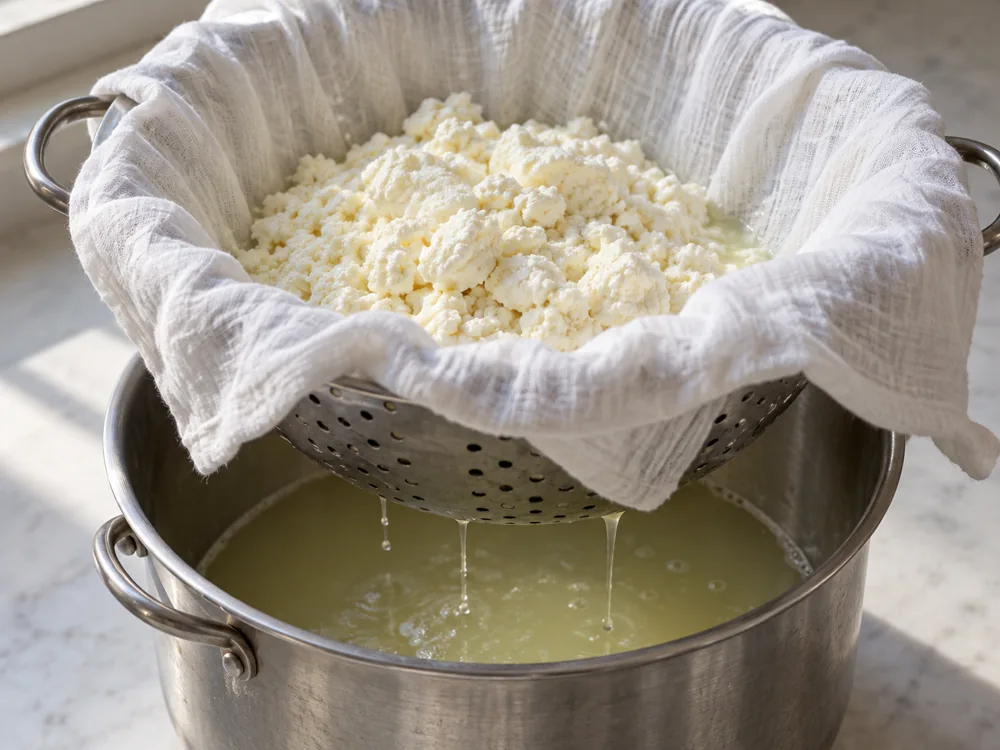
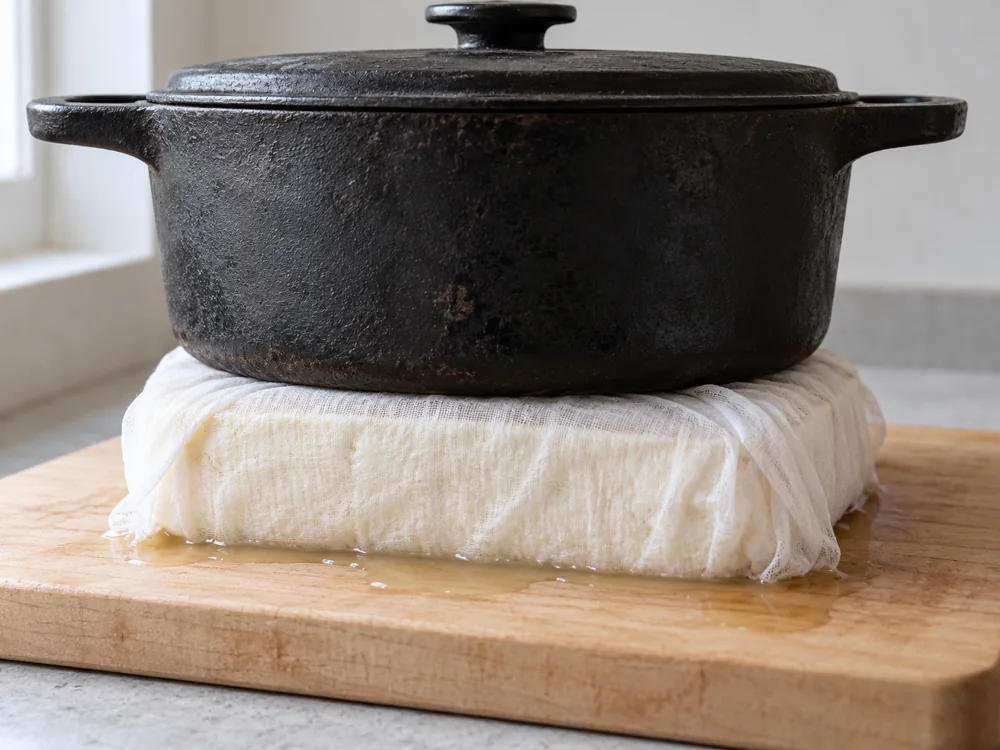
Pressing time decides the texture. In the North Indian method Wikipedia describes, the wrapped curds sit under a heavy weight for two to three hours before being cut into cubes, while about 20 minutes of pressing gives a softer, fluffier cheese.
FoodCrumbles says 15 to 20 minutes under a thick book often does the job at home, while Piping Pot Curry presses for 1 to 2 hours so the paneer hardens and holds its shape. FoodCrumbles adds that pressing drives water out, so a block pressed too hard or too long can turn dry.
Dairy plants work to tighter numbers, set out in a paneer processing manual from NIFTEM, an institute under India's Ministry of Food Processing Industries.
| Milk | Buffalo milk standardised to 5.8% fat and 9.5% solids-not-fat |
| Heating | 90°C without holding, or 82°C held for 5 minutes |
| Curdling | Cooled to 70°C, then a 1% hot citric acid solution stirred in until clear whey separates at pH 5.30 to 5.35 |
| Pressing | Curd filled into cloth-lined hoops under 0.5 to 1 kg/cm² |
| Chilling | Pressed blocks immersed in chilled water for 2 to 3 hours |
| Packing | Wrapped in parchment paper or polyethylene bags and held in a cold room |
The 70°C curdling temperature is a deliberate choice. NIFTEM reports that raising it from 60°C to 86°C cuts the moisture in the paneer from 59% to 49%, and that 70°C gives the best frying quality in shape retention, softness and integrity.
The acidity window is narrow too. NIFTEM says that above pH 5.35 the block turns very soft, fragile and crumbly, while a lower pH cuts moisture and yield.
Why Doesn't Paneer Melt?
The acid sets the proteins before the cheese ever reaches a pan. The food-science site FoodCrumbles explains that the low pH neutralises the charges on casein proteins so they stop repelling each other, and that curds formed this way are not affected by heat because the proteins keep bonding.
FoodCrumbles also says paneer holds its shape very well when fried.
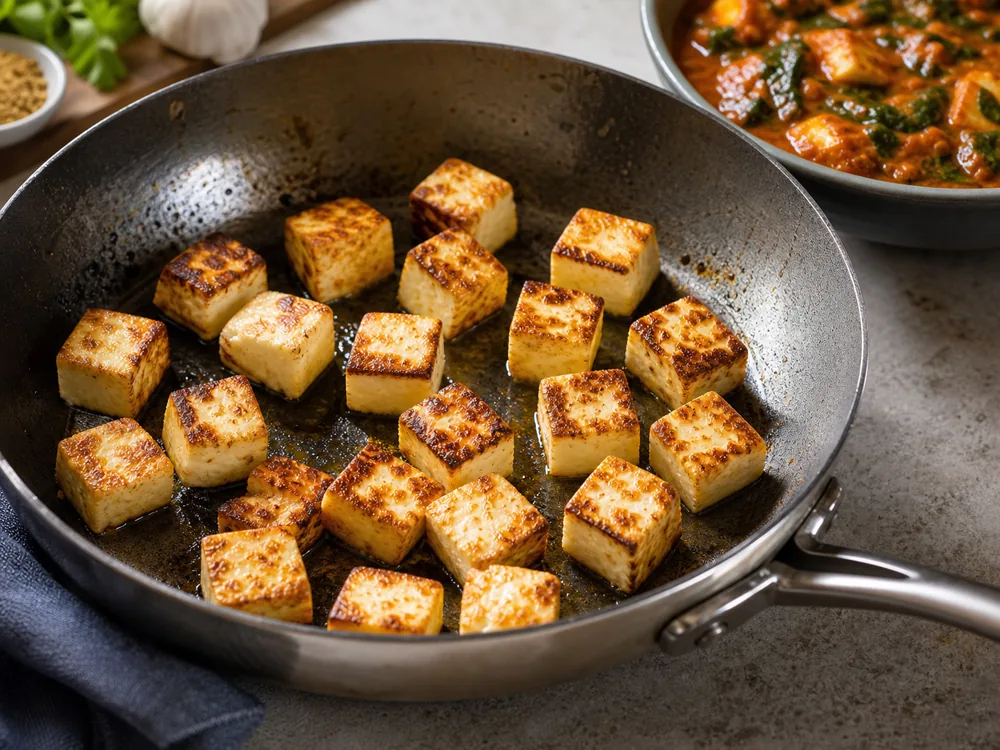
FoodCrumbles puts paneer with other fresh cheeses that do not melt, naming queso fresco and feta, and calls it almost the opposite of processed cheese, which is made to melt easily.
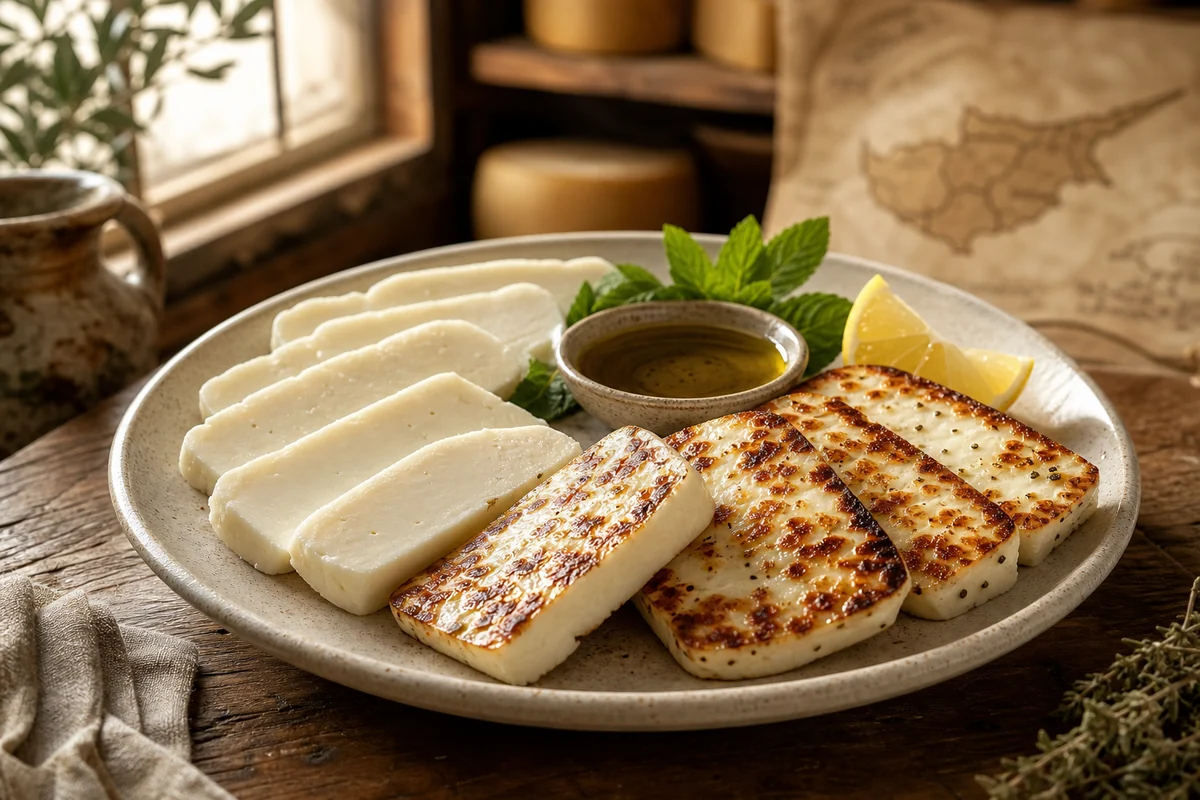
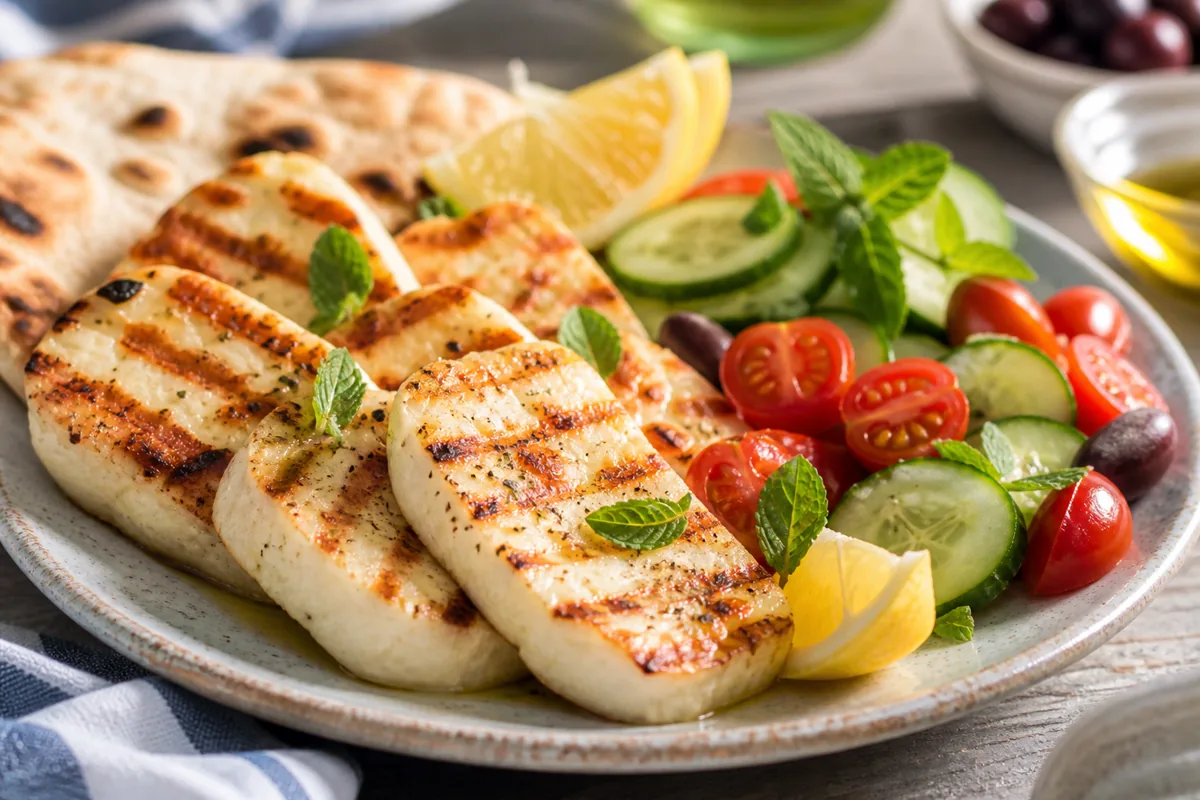
Halloumi reaches a similar result by another route. English Wikipedia says it is curdled with rennet and boiled in hot whey for at least 30 minutes, which it calls the most crucial step for the texture, and its higher-than-typical melting point lets it fry brown without melting.
Is Paneer the Same as Chhena or Cottage Cheese?
Cheese.com calls chhena or chhana an East Indian variant of paneer, eaten in West Bengal, Orissa and Bangladesh, and the Indian standard quoted by NIFTEM covers both under one definition: milk precipitated with permitted acids and heat.
Wikipedia says Bengali, Odia and other East Indian cooks beat or knead the chhena by hand into a dough-like mass, salt it heavily and harden it into ponir, which is eaten in slices at teatime or deep-fried in a light batter. That heavy salting sets ponir apart from paneer, which Piping Pot Curry describes as usually unsalted.
Wikipedia also lists surti paneer, made around Surat in Gujarat by draining buffalo-milk curds and ripening them in whey, so the non-aged label above does not fit every paneer.
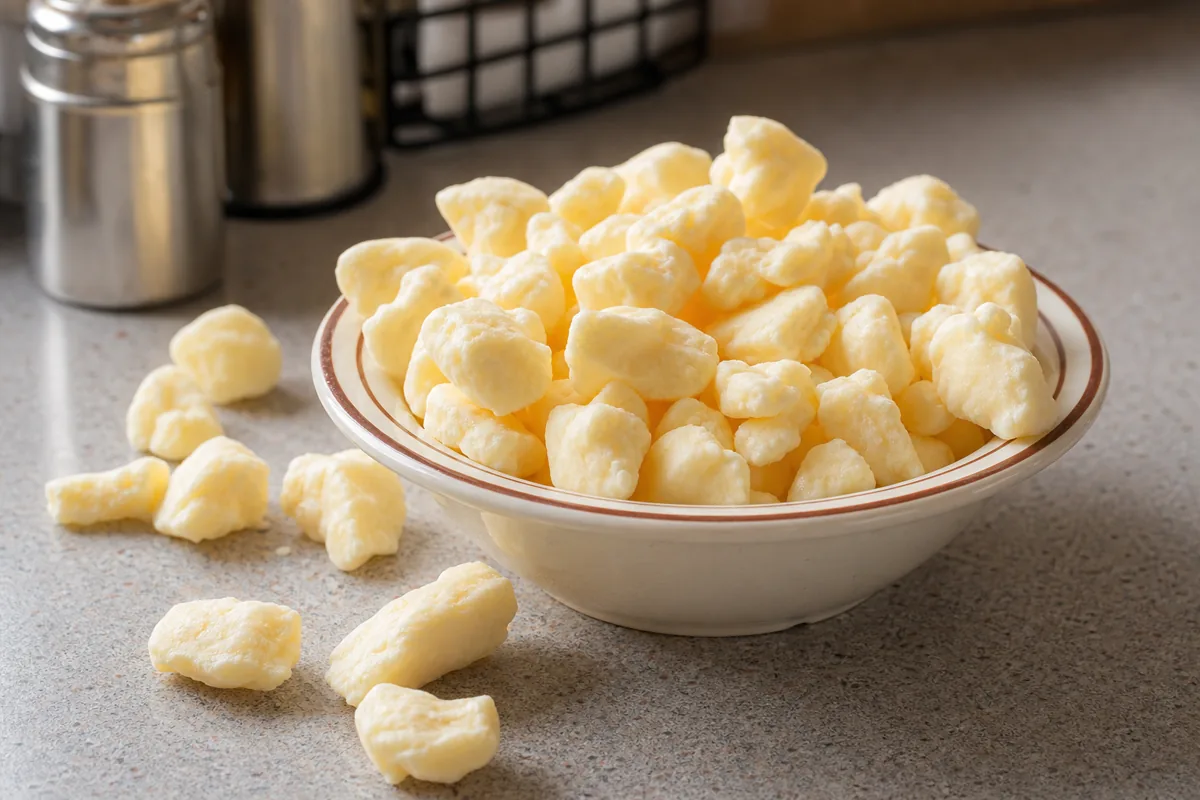
Indian cottage cheese, the other English name Wikipedia gives, says little about texture. Piping Pot Curry reports that cottage cheese is moist and watery, while paneer is dry and holds its shape.
Cheese.com calls paneer similar to queso blanco, a fresh, crumbly cheese of Latin American cooking in Piping Pot Curry's description.
Cow Milk or Buffalo Milk?
Cheese.com and Wikipedia both list cow or water buffalo milk, and the choice changes the block. NIFTEM calls paneer made only from cow milk too soft, weak and fragile for frying, while buffalo milk, with more casein, calcium and phosphorus, tends toward a hard, rubbery body.
FoodCrumbles is milder: it says buffalo milk has a few percentage points more fat and larger casein micelles, so it suits paneer slightly better, but cow milk works and the choice may come down to taste.
NIFTEM's answer is a blend: replacing one third of the buffalo milk with cow milk makes good paneer, and it adds that a 50:50 mix beats cow milk alone.
Paneer from cow milk alone needs changes to the method. NIFTEM adds calcium chloride at 0.08 to 0.1% of the milk and curdles it hotter, at 85 to 90°C and pH 5.20 to 5.25, to get a compact, sliceable block.
The milk also shows in the colour: NIFTEM describes buffalo milk paneer as white with a greenish tinge and cow milk paneer as light yellow.
How Much Fat and Protein Is in Paneer?
Indian law sets a floor for paneer's fat. India's Food Safety and Standards Regulations of 2011, as quoted in the NIFTEM manual, require milk fat to make up at least 50% of the dry matter.
| Measure | Figure | Source |
|---|---|---|
| Moisture, most allowed | 70% | FSSR 2011, quoted by NIFTEM |
| Moisture, most allowed | 60% | BIS standard IS:10484, quoted by NIFTEM |
| Milk fat in dry matter, least allowed | 50% | FSSR 2011 and BIS, quoted by NIFTEM |
| Milk fat in dry matter, low-fat paneer | 15% at most | FSSR 2011, quoted by NIFTEM |
| Fat per 100 g | 15.5 g | English Wikipedia |
| Fat per 100 g | 20.8 g | Cheese.com |
| Protein per 100 g | 15.9 g | English Wikipedia |
| Sodium per 100 g | 185 mg | English Wikipedia |
| Calcium per 100 g | 208 mg | Cheese.com |
| Calcium per 100 g | 597 mg | English Wikipedia |
The two calcium figures differ by almost three times, and neither page names the paneer it measured.
The fat rule counts dry matter, so it also explains part of the spread in fat per 100 g. At the 70% moisture ceiling, 100 g of paneer holds 30 g of dry matter, so 50% fat means at least 15 g of fat, and at the BIS 60% ceiling it means at least 20 g (our arithmetic from the NIFTEM figures).
Wikipedia's 15.5 g and Cheese.com's 20.8 g sit just above those two floors, so the gap between them may reflect how much water each block holds rather than richer milk.
What Does a Paneer Label Tell You?
The Indian standard that NIFTEM quotes sets the names a pack may carry: Chhana, Paneer, Medium Fat Paneer or Low Fat Paneer, chosen by composition. Low-fat and medium-fat paneer must be sold in sealed packs, and a medium-fat pack must print its percentage of milk fat.
Low-fat milk alone gives a hard, bland block, and NIFTEM says plants repair it with additives such as whey protein concentrate with lecithin, soy protein isolate or a little salt. It also reports that more than 0.2% soy protein isolate gives a beany flavour.
A packaged block can hold more than milk and acid. Nanak's ingredient list reads pasteurized milk, cream, milk protein concentrate, calcium lactate, citric acid, potassium sorbate and glucono delta lactone.
India's standard, as NIFTEM quotes it, allows added milk solids and lists sorbates, nisin, propionates and glucono delta-lactone as permitted additives for chhana and paneer.
NIFTEM's summary of India's labelling rules adds that ingredients appear in descending order by weight and that prepackaged food shows its manufacture or packing date with a best-before date.
What Does Good Paneer Look and Taste Like?
Cheese.com describes paneer as white and milky, with a mild, slightly tangy flavour and a fresh, milky aroma.
NIFTEM's description of high-grade paneer asks for a pleasing mild acid, slightly sweet and nutty flavour. The body should be firm enough to hold its shape when cut or sliced, yet tender enough to crush easily when chewed, with a compact, smooth and velvety texture.
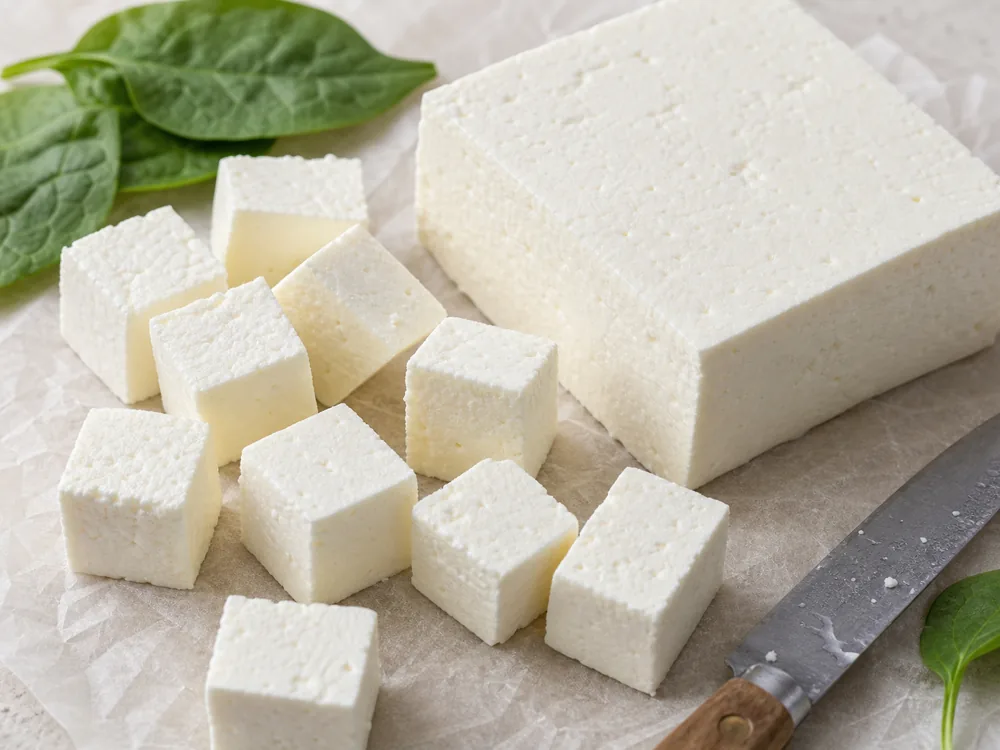
The tang stays mild. FoodCrumbles says paneer holds too little acid to taste sour, so a sharp sour note points to the excess acid that NIFTEM blames in its fault list below.
Sources also disagree on the body. Cheese.com and Piping Pot Curry describe paneer as firm yet crumbly, while NIFTEM wants a smooth, velvety block and counts crumbling as a defect.
The gap follows use: Piping Pot Curry lists dishes such as bhurji and kofta that call for crumbled paneer, while NIFTEM grades blocks that must slice and fry.
The same manual lists the faults a buyer can smell or see on a freshly cut piece.
- Sour: too much acid, or milk that was already acidic.
- Stale or yeasty: held too long in cold storage.
- Putrid or cheesy: held too long at a warm temperature.
- Surface skin: the surface dried out from long exposure to air.
- Mouldy surface: NIFTEM calls this paneer inedible.
NIFTEM also grades the body, and each texture fault points back to a step in the making.
| Texture fault | What it feels like | What NIFTEM links it to |
|---|---|---|
| Hard | Resists crushing when chewed | Low-fat milk, or low moisture from faulty making |
| Rubbery or chewy | Resists squeezing and springs back | Skim or low-fat milk; the higher casein and minerals of buffalo milk |
| Soft | Wet, weak body | High moisture from delayed straining or a low coagulation temperature |
| Pasty | Holds too much water | Low coagulation temperature and pH make fine curds that clog the drain cloth; colostrum in the milk |
| Crumbly | Falls apart when sliced or pressed | Often frozen storage |
| Mealy or coarse | Gritty, like corn meal, in the mouth | Low-fat, high-acid milk; coagulation too hot or at too low a pH; frozen storage |
| Open | Irregular holes | Curd not matted together because it was pressed too little |
FoodCrumbles explains the fat link: fat makes paneer softer and more tender, so paneer from skimmed milk comes out drier and in smaller amount.
A good block is white, mildly acid, slightly sweet and nutty, and firm enough to slice yet tender to chew. A sour note, a dried skin, a mouldy surface or a body that falls apart when sliced marks a fault.
How Do You Cook Paneer Without Making It Rubbery?
In the pan, time is the risk. FoodCrumbles says heat evaporates moisture and makes paneer firmer and drier, and that paneer cooked for too long turns rubbery and dry.
That risk shapes the classic dishes. FoodCrumbles says paneer is often cooked in or added to moist sauces so it does not dry out, and that a firmer block fries more easily, with the extra drying buying crisp, browned edges.
FoodCrumbles' method for a plain block is to cut it into cubes, marinate them if wanted and fry or bake them, and its finished example is saag paneer, a spinach sauce with browned pieces of paneer inside.
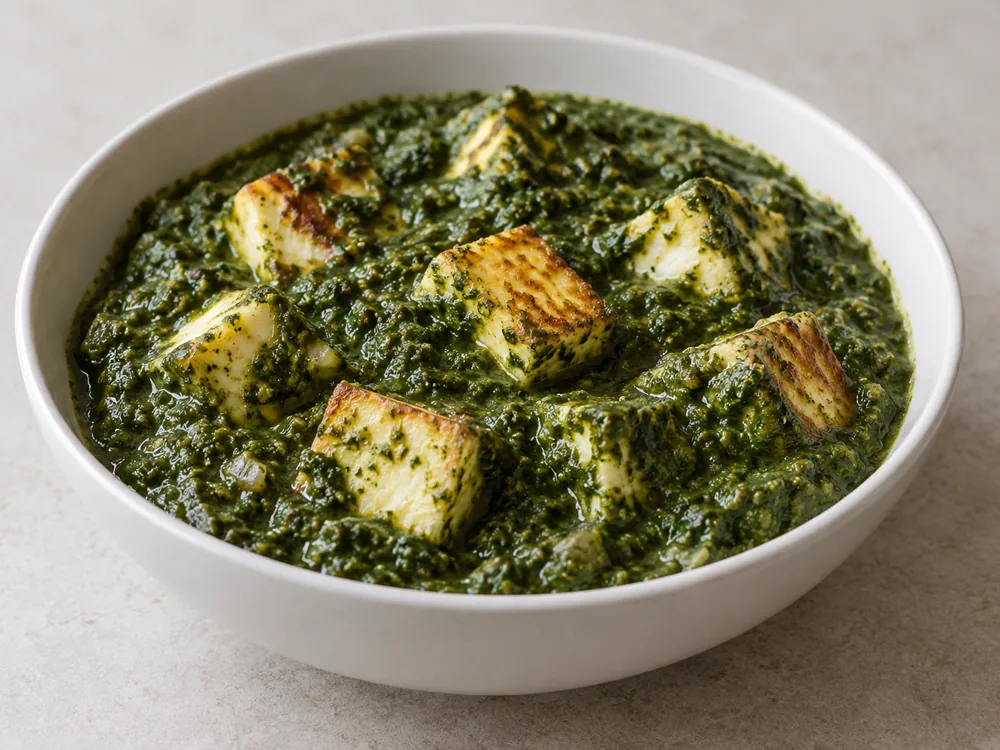
Some packaged paneer is made to take up sauce. Nanak, a paneer maker, says its paneer has a porous, open texture that lets sauces and spices penetrate the pieces.
NIFTEM's defect list also has an open texture, irregular holes from too little pressing, so the word alone does not say whether a block is flawed or made to absorb sauce.
| Use | How It Works |
|---|---|
| Palak paneer | Named by Cheese.com; Wikipedia lists paneer with spinach, and FoodCrumbles shows browned pieces in a spinach sauce. |
| Paneer tikka | Named by Cheese.com; Wikipedia calls it a vegetarian version of chicken tikka, with paneer placed on skewers and roasted. |
| Paneer butter masala | Named by Cheese.com; Wikipedia lists paneer makhani with butter, tomatoes and cashews. |
| Matar paneer | Paneer with peas, per Wikipedia. |
| Kadai paneer | Paneer with bell peppers, per Wikipedia. |
| Chilli paneer | An Indian Chinese dish, per Wikipedia. |
| Paneer pakora | Paneer fritters, per Wikipedia. |
How Long Does Paneer Keep?
The CDC says to refrigerate perishable food such as dairy within 2 hours, or within 1 hour above 90°F, and to keep the refrigerator at 40°F (4°C) or below.
NIFTEM also lists refrigerated keeping times by packaging. They come from its manual and are not a food-safety limit.
| Packaging and storage | Keeping time |
|---|---|
| Vegetable parchment, refrigerated | 10 days |
| Vacuum-packed in barrier film, refrigerated | 3 months |
Homemade paneer has none of that packaging. FoodCrumbles says it keeps a few days at most in the fridge before yeasts and moulds start growing on it.
NIFTEM says vacuum packing is used for paneer because microorganisms grow on its surface. It adds that mould follows long storage in a humid place in a block with higher moisture.
Freezing keeps the flavour but not the texture. NIFTEM reports that paneer frozen at −13°C and −32°C for 120 days kept its flavour and appearance but turned crumbly and fluffy on thawing, which it blames on large ice crystals.
Blast freezing makes smaller crystals, and NIFTEM says blast-frozen paneer stored below −19°C keeps for more than a year. Nanak claims excellent freeze-thaw stability for its own paneer.
What Can Replace Paneer?
The right replacement depends on what the paneer does in the dish. Meeta Arora's substitute guide on Piping Pot Curry picks extra-firm tofu or queso panela for curries, and tofu, halloumi or queso panela for grilling.
| Substitute | Uses it suits | Catch |
|---|---|---|
| Extra-firm tofu | Curries, grilling, crumbled fillings | Milder taste than paneer; pressing it first helps it hold its shape |
| Halloumi | Grilling | Saltier than paneer; soaking it in water for about 30 minutes reduces the salt |
| Queso panela | Curries, grilling, stir fries, crumbled fillings | Slightly saltier than paneer; may contain animal rennet |
| Feta | Curries | Saltier and crumbly-creamy; best as a block, and may only suit curries |
| Queso fresco or queso blanco | Crumbled fillings such as bhurji and kofta | Listed for crumbled uses only |
| Strained cottage cheese | Crumbled fillings | Moist and wet next to firm, pressed paneer |
| Ricotta | Sweets such as kalakand | Listed for desserts only |
Piping Pot Curry names queso panela the closest cheese, since it is firm, crumbly and milky and keeps its shape without melting completely, and tofu the best vegan option, higher in protein and lower in fat than paneer. Tofu has a lower melting point, so it softens and turns creamier in the pan where paneer stays firm.
Two of those cheeses need extra handling. Piping Pot Curry suggests pressing cottage cheese in a clean cloth for 1 to 2 hours to firm it, and says ricotta does not look like paneer because its texture is wet and crumbly.
Is Paneer Safe During Pregnancy?
The NHS says yes when it is pasteurised. It names pasteurised paneer among the soft cheeses that are safe to eat in pregnancy, alongside cottage cheese, mozzarella, feta and halloumi.
For paneer made from unpasteurised milk, the NHS says any food made from unpasteurised milk must be thoroughly cooked. It also counts any cheese cooked until steaming hot as safe.
US advice on cheese during pregnancy is stricter for queso fresco-type fresh cheeses. The CDC does not name paneer, but it lists any queso fresco-type cheese, such as queso fresco, queso blanco or similar fresh, soft cheeses, as riskier whether made with pasteurized or raw milk.
The CDC's safer list also includes pasteurized soft cheeses heated to an internal temperature of 165°F or until steaming hot.
Packaged paneer usually names its milk; Nanak's ingredient list, for example, starts with pasteurized milk.
SOURCES & REFERENCES
What Else Should You Know About Paneer?
No. English Wikipedia classes paneer as non-melting, and FoodCrumbles explains that acid-set curds keep bonding when heated, so the cubes hold their shape when fried.
Cheese.com calls it milky, mild and slightly tangy. NIFTEM describes good paneer as mild acid, slightly sweet and nutty.
Cheese.com calls chhena an East Indian variant of paneer, and the Indian standard NIFTEM quotes covers chhana and paneer together. Cottage cheese is moist and watery, while Piping Pot Curry says paneer is dry and holds its shape.
Yes, but NIFTEM found ordinary frozen paneer turned crumbly and fluffy on thawing, even though its flavour held after 120 days.
It depends on the dish. Piping Pot Curry suggests extra-firm tofu or queso panela for curries, halloumi for grilling, and ricotta for sweets.
Wikipedia and NIFTEM describe paneer as curdled with acids such as lemon juice, vinegar, citric acid, dahi or sour whey; neither lists rennet as a paneer coagulant. Cheese.com lists paneer as vegetarian.