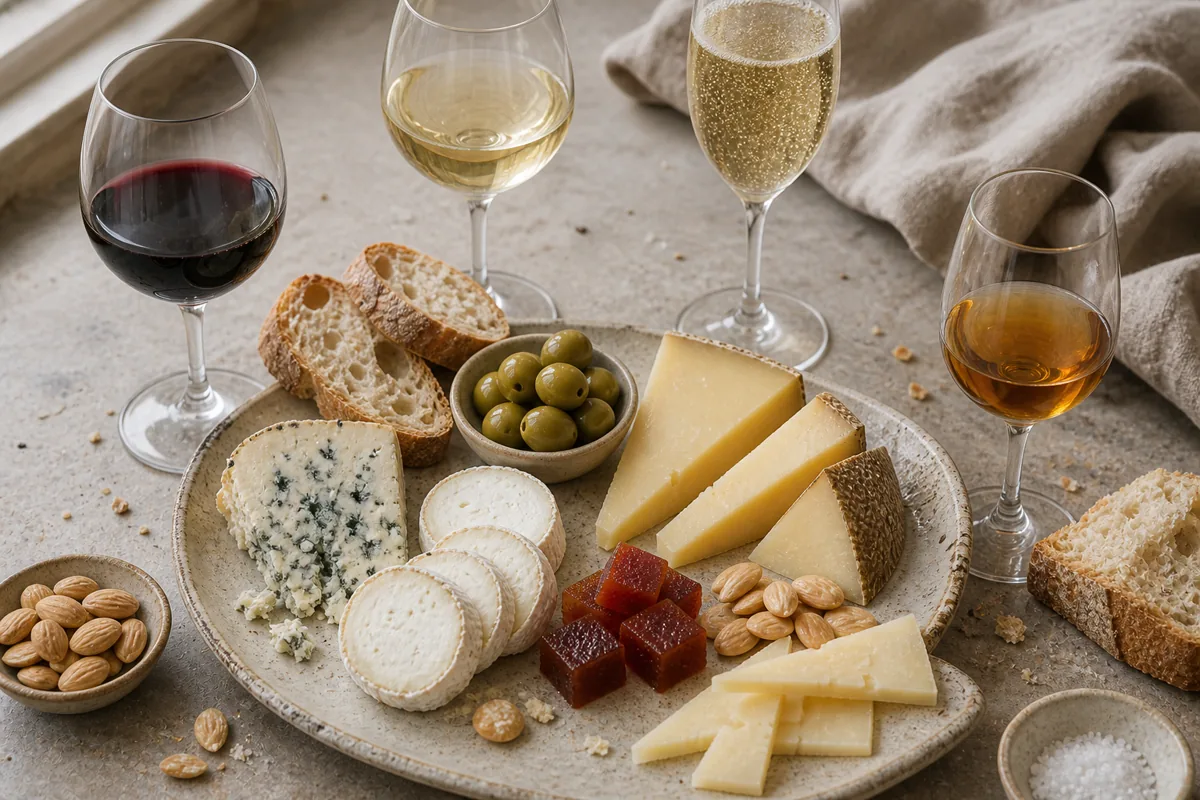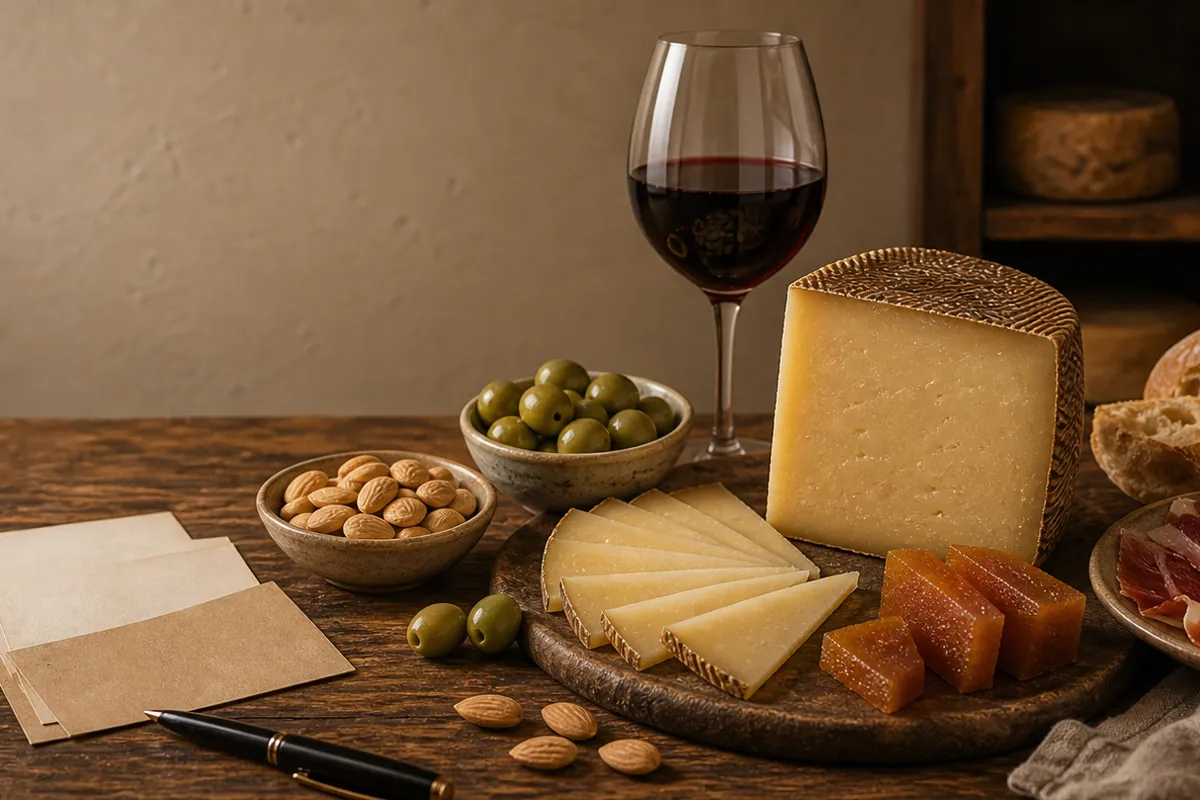
Manchego is a sheep's milk cheese from La Mancha in central Spain, and its Consejo Regulador describes the taste as slightly acidic, strong and savoury, turning peppery in very aged cheese.
Most drink picks for Manchego are tied to a young or an aged wheel, so the age name on your wedge is the first thing to find.
In This Article
What Do the Age Names on Manchego Mean?
Manchego's four age names run from fresco at two weeks to viejo at one to two years, with semicurado ending at three or at three to four months depending on the reference.
| Age name | Age | Flavour note (Cheese.com) |
|---|---|---|
| Fresco | 2 weeks | Mild; rarely sold outside Spain |
| Semicurado | 3 weeks to 3–4 months (Wikipedia); 3 weeks to 3 months (Cheese.com) | Fruity with tangy notes |
| Curado | 3–6 months | Subtle, with hints of caramel and nuts |
| Viejo | 1–2 years | Sharp, with peppery notes |
The Consejo Regulador sets a minimum ripening time rather than age names: 60 days for most wheels, and 30 days only for pasteurised-milk cheeses of 1.5 kg or less, with a maximum of two years.
The Cheese Professor gives the same split for raw milk, with wheels up to 3 pounds needing 60 days and pasteurised ones half that. In English Wikipedia's version, the 30 days apply to cheeses up to 1.5 kg.
By the council's wording, a raw-milk wheel of any size is therefore at least 60 days old, and a two-week fresco falls below the minimum for the protected name. That lack of ageing is why fresco is not a true queso manchego.
The council's tasting notes show what the months change: the aroma turns peppery in the most aged cheeses, and the buttery, slightly floury texture can turn grainy in very mature ones.
The Cheese Professor describes the two ends of that shift: semicurado is still soft and supple, while viejo is compact and firm.
A fresco is rarely found outside Spain, and Culture's Tara Q. Thomas writes that US shoppers can rarely find Manchego as young and tender as in Spain, so her young-cheese pairings start at four- or six-month-old wedges.
Kerin Auth, who connects Spanish wineries with American importers, told Culture that the category varies with the ageing, the producer, where it is bought and the time of year it is made.
Which Sherry Suits Young or Aged Manchego?
Most Sherry picks put Fino or Manzanilla with a young wheel and Amontillado or Oloroso with an aged one: Helen Highley, Adam Centamore and Culture's Tara Q. Thomas each move to a richer Sherry as the cheese gets older.
Highley, writing for the Sherry Wines site, pairs Fino with young Manchego and Oloroso with very mature Manchego. Her Fino list also includes mild to medium Cheddar and Cheshire, and her Oloroso list includes mature Cheddar.
Her rule of thumb behind those picks is that the stronger and sharper the cheese, the browner the Sherry. Fino wants a decent salty tang in the cheese but nothing too complex, she says, because anything more complex overpowers the wine.
At the browner end, Highley says Oloroso does more than stand up to strong flavours: it brings out their best, as it does with a deeply flavoured casserole.
Kerin Auth, quoted in Culture's Sherry piece as manager of the New York wine shop Tinto Fino, called Manchego one of the few cheeses with the right balance for Fino's cutting acidity and bone-dry, salty flavour.
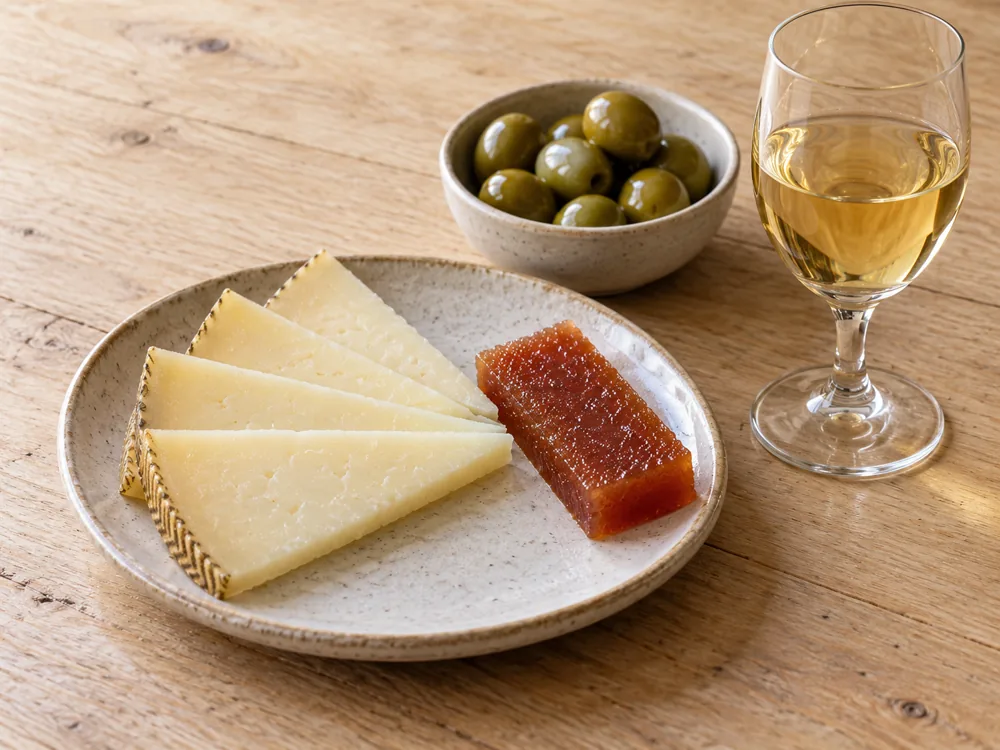
Centamore, of The Cheese Professor, names Manzanilla for younger wheels, for its more delicate body, and Amontillado or Oloroso for more aged ones. For any Sherry pairing, he adds a handful of Manzanilla olives and a thick slice of membrillo.
| Sherry style | Young wheel | Aged wheel |
|---|---|---|
| Fino | Helen Highley | Grapes & Grains, as Fino or Manzanilla |
| Manzanilla | Adam Centamore; Tara Q. Thomas and Kerin Auth in Culture's Manchego and Spanish wine piece | Grapes & Grains, as Fino or Manzanilla |
| Amontillado | Not stated | Adam Centamore; Tara Q. Thomas, for older and smoked wedges |
| Oloroso | Not stated | Adam Centamore; Helen Highley, for very mature wheels; Tara Q. Thomas, for older and smoked wedges |
For young wheels, Auth picks a Manzanilla whose fruity prickle suits the cheese's delicate texture and flavours. In Culture's Sherry piece she was quoted calling Manzanillas harder to pair than regular Finos because they are saltier.
Grapes & Grains lists Fino or Manzanilla for aged Manchego as well, which runs against Highley's rule of a browner Sherry for a stronger cheese.
If your wedge is smoked, go to the richer end: Thomas recommends Amontillado and Oloroso for older wedges, especially smoked ones, and Auth told Culture that the richer Sherries make smoked Manchego taste nutty and meaty, like jamón Ibérico.
Highley gives Amontillado to earthy, barn-floor cheeses such as Brie, Caerphilly and Torta del Casar, and adds that a smoked cheese works too, which is where her list meets Thomas's.
In the Sherry piece, Auth said dry Oloroso and Amontillado have a little more fruit than Fino, which makes them easier to work with, and that they are not as rich as the sweet Sherries.
Palo Cortado is the one style Highley gives to a different sheep's milk cheese: she pairs it with Idiazabal from the Basque Country. Auth, calling some Finos and Manzanillas hard to pair because they are so dry and salty, suggested strong, dry cheeses such as Idiazabal and Roncal for them.
How Do You Read a Sherry Label for Manchego?
The style word on the label places the bottle between the Fino Highley pairs with young Manchego and the Oloroso she pairs with very mature wheels. Fino is the driest and palest traditional Sherry, aged under a cap of flor yeast, and Manzanilla is an especially light Fino made around Sanlúcar de Barrameda.
Amontillado is first aged under flor and then exposed to oxygen, which leaves it darker than Fino but lighter than Oloroso, and Oloroso is aged oxidatively for longer than either.
Culture's Tara Thomas, in the Sherry piece, describes Fino as light-coloured, bracingly sharp and sea-scented, Manzanilla as saltier still, and Oloroso as golden brown and so concentrated that even a dry one often gives an impression of sweetness.
A sweetened Oloroso is labelled Cream Sherry, because terms such as Oloroso Dulce were prohibited from April 2012, and Cream carries 115 to 140 grams of sugar per litre against 0 to 5 for Oloroso. Vinocritic says sweet wines clash with the cheese's flavour.
Highley's Pedro Ximénez list is blue cheeses and very strong, salty hard cheeses. Her Cream picks are hard, sharp cheeses such as Parmesan, with a bit of membrillo added because of the wine's sweetness.
Which Wines Suit Young or Aged Manchego?
For a younger wheel, most wine picks are Cava, Verdejo or a young red, and for an aged one they move to Reserva or Gran Reserva Rioja, red or white.
The DO La Mancha wine council scales the red to the cure, from younger reds for young cheese up to Gran Reservas for the most aged. It calls Manchego a case of regional pairing, where the wine and the cheese share a home region and complement each other.
The council names Cabernet Sauvignon as one of the best-suited grapes, with Merlot, Syrah and Tempranillo, called Cencibel in La Mancha, working equally well. For white-wine drinkers it suggests a white aged in oak.
| Wheel | Wines named | Who names them |
|---|---|---|
| Young or semi-curado | Cava, Verdejo, Rioja Blanco, young Rioja or Tempranillo, Garnacha, younger reds | Grapes & Grains (Cava, Verdejo, Rioja Blanco, young Rioja or Tempranillo, for semi-curado); Kerin Auth (Cava); Vinocritic (Garnacha); DO La Mancha council (younger reds) |
| Four- or six-month wedges | Cava | Tara Q. Thomas |
| Older or aged | Rioja Crianza or Reserva; Reserva or Gran Reserva Rioja, red or white; aged Rioja Blanco; Tawny Port; Riesling; Gran Reserva reds | Adam Centamore (Crianza or Reserva, with Reserva for aged wheels); Tara Q. Thomas and Grapes & Grains (Reserva or Gran Reserva); Kerin Auth (aged Rioja, red or white); Grapes & Grains (aged Rioja Blanco, Tawny Port, Riesling); DO La Mancha council (Gran Reservas) |
| Smoked, or on a warm day | A lightly chilled bright red, such as un-oaked Mencía or a fresh young Rioja | Kerin Auth |
| Not stated | White Priorat, Albariño, Cava de Guarda Superior Gran Reserva, Chardonnay, Malbec | Tara Q. Thomas (white Priorat, Albariño); Emma Young, D.O. Cava (Cava de Guarda Superior Gran Reserva); Vinocritic (Chardonnay, Malbec) |
For the younger wedges, Thomas says a four- or six-month wedge has a gentle sweetness that suits Cava, and Auth likes bubbles with younger Manchego.
Grapes & Grains places Cava and Verdejo with semi-curado wheels and credits the white wines with citrus and tropical fruit and ample acidity. Vinocritic lists both too, and describes Verdejo as light, crisp and dry, with lime, grapefruit, green apple and fennel.
Vinocritic also says Garnacha brings out the freshness in a young Manchego, and describes the wine as bold candied fruit with notes of cinnamon and citrus.
For red wine, Centamore picks Rioja Crianza or Reserva, with Reserva for aged wheels, and says its round texture and deep red fruit match the cheese's bite and weight. He completes that plate with a few slices of jamón Serrano and some dried cherries.
Auth goes older for older cheese: she wants a classic, rustic aged Rioja, red or white, and says the aged whites turn nutty and mushroomy. Her reason is texture, since a rustic aged Rioja enhances the bit of gritty texture that age gives the cheese, and for red she wants barnyard and dried-fruit character.
Thomas says to look for Riojas labelled Reserva or Gran Reserva, and adds that both the red and the white have the bright acidity to handle the fat and acid of sheep's milk cheese.
Grapes & Grains puts Reserva and Gran Reserva with aged Manchego as well, and adds aged Rioja Blanco, Tawny Port and Riesling.
For a chunk of smoked Manchego or a warm day, Auth chooses a lightly chilled bright red, such as an un-oaked Mencía whose dried cranberry flavours tart up the smoke, or a fresh young Rioja with enough acidity to play off the cheese.
Thomas also names white Priorat, whose golden fruit and marzipan richness cushion Manchego's salty edges, and Albariño, whose waxy texture and almond-like flavours stand up to the cheese's assertive flavours while its acidity refreshes the palate.
Emma Young, writing for the D.O. Cava council, names Cava de Guarda Superior Gran Reserva for Manchego and describes coconut, almond, coffee and apricot flavours in the pair.
Vinocritic calls Chardonnay dry and acidic, with citrus, apple and a buttery finish, and says it complements the cheese's tangy, salty flavour.
It describes Malbec, from Argentina, as full-bodied with strong tannins and blackberry, plum and a chocolate finish, and recommends it to readers who like bold flavours.
What Wine Style Suits Manchego When the Named Bottle Is Missing?
Look for the five traits Vinocritic reduces its advice to: a dry wine with medium to high acidity, medium tannins, medium to full body, and fruity, nutty or herbaceous notes.
Bold acidity, it says, complements the cheese's rich, nutty flavour, while structured tannins bring body and complexity. It also asks white wines to have some body, since light-bodied whites are easily overpowered, yet it describes Verdejo, one of its own picks, as light.
Among reds, Vinocritic says the dark fruit of Tempranillo lifts the cheese's nutty notes and that herbal notes in both the wine and the cheese play well together. It describes Rioja as savoury and smooth, with cherry, plum, vanilla and dill.
How Do Wine Age Labels Line Up with Cheese Age?
The Reserva and Gran Reserva named for aged Manchego are minimum times in oak and bottle, and at Crianza and Gran Reserva the same label word carries different minimums in La Mancha and in Rioja.
| Label | DO La Mancha (council) | Red Rioja (minimum) | Serving temperature (La Mancha council) |
|---|---|---|---|
| Joven | Labelled in the harvest it was made, drunk within 9 months | Not stated | 6–8 °C (43–46 °F) for whites and rosés; 10–12 °C (50–54 °F) for reds |
| Crianza | 2 years, at least 6 months in oak | 2 calendar years from 1 October of the harvest year, with at least 1 year in barrel | 15–18 °C (59–64 °F) for reds; 10–12 °C (50–54 °F) for whites |
| Reserva | 3 years, at least 12 months in oak and the rest in bottle | 36 months, with at least 12 months in oak barrels | 15–18 °C (59–64 °F) |
| Gran Reserva | 5 years, at least 18 months in oak and the rest in bottle | 24 months in barrel, then at least 36 months in bottle | 15–18 °C (59–64 °F) |
The time in wood differs at Crianza and Gran Reserva: a red Rioja Crianza needs at least 1 year in barrel against the La Mancha council's 6 months in oak, and a red Rioja Gran Reserva 24 months in barrel against 18.
For white and rosé Rioja, Crianza keeps the same total time but needs only 6 months in oak, while Reserva needs 24 months in total and Gran Reserva 48 months in total, again with 6 months in oak. So an aged white Rioja, the kind Auth and Grapes & Grains name, reaches Reserva at 24 months, where a red one needs 36.
On the Cava side, Young sets out the ladder in months: Cava de Guarda is aged at least 9 months, Reserva more than 18 months and Gran Reserva more than 30 months.
She describes Guarda as tasting of citrus, white fruit and herbs, Reserva of riper fruit, dried nuts, coffee and pastry, and Gran Reserva of toast, butter and spice, with cooked fruit and a brandy-like note.
Young says Cava suits sheep's milk cheeses especially, and credits its good acidity, its balance and its lack of tannins. Her rule is to pair younger, less complex cheeses with younger Cava and bolder, more complex ones with older Cava.
She describes Manchego as sweet from the milk, with grassy and nutty tones and a tang at the finish, and says it gains toasty, nutty and caramel flavours with age, as Cava does.
The middle step has two figures: Reserva Cava ages in bottle for at least 15 months by Thomas's account in 2018, and more than 18 by Young's in 2021.
Which Foods Go with Manchego?
Membrillo is Spain's famous fruit paste made from quince, and Centamore explains why sweet partners suit Manchego: they counter the cheese's naturally savoury and salty side.
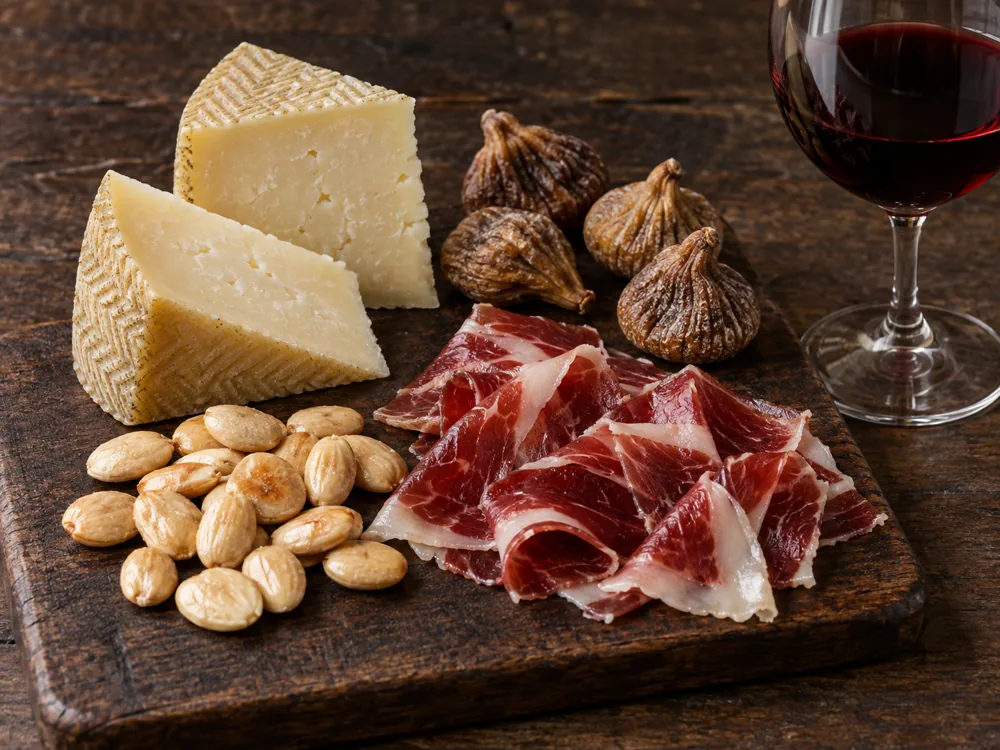
His classic sweet list is dates, fresh figs and membrillo. For the savoury side of a meat and cheese board, he looks for foods that echo the cheese's fruitiness and slightly oily mouthfeel.
| Pairing | Why It Works |
|---|---|
| Marcona almonds | The Cheese Professor names Spanish-grown Marcona almonds, fried in sunflower oil and salted. |
| Jamón Ibérico | The Cheese Professor calls marbled slices a superb partner for Manchego's assertiveness. |
| Sun-dried tomatoes and olives | The Cheese Professor lists both for aged cheeses. |
| Fresh fruit | Cheese.com lists fresh fruit with cured meats and olives for a Manchego platter. |
Grapes & Grains also names almonds, sun-dried tomatoes and olives, and adds hazelnuts, walnuts, crackers, crusty bread, fig spread and a light drizzle of extra virgin olive oil.
Vinocritic adds berry jams, honey, whole wheat or rye crackers, and dry-cured meats such as prosciutto and Genoa salami, which it says add salt and bring balance.
Which Manchego and Which Wine Suit Salads, Tapas and Hot Dishes?
For a grilled sandwich, reach for a younger wedge: Cheese.com says the younger, milder versions are often used in dishes such as grilled sandwiches, while the older versions develop a more intense flavour and are enjoyed with fruit and wine.
The Cheese Professor calls Manchego a nearly ubiquitous choice for tapas and says viejo can be grated or shaved but is most often sliced as part of tapas.
Cheese.com lists cheese platters first among Manchego's uses, then melting and grating, salads and sandwiches, and desserts.
It cubes the cheese into a crisp salad, and says shaved or grated Manchego adds depth and creaminess to salads and sandwiches.
Cheese.com adds that Manchego melts well in quesadillas, tacos, burritos and baked dishes, so a wedge can go into a hot dish as well as onto a plate. It also puts the cheese in desserts, saying the taste complements the sweetness of fruit and honey.
For the wine, Vinocritic ties each of its picks to a dish or a setting:
- Rioja: a Manchego grilled cheese.
- Malbec: a Manchego-topped burger.
- Garnacha: marinara-based pasta topped with Manchego.
- Verdejo: a green salad topped with shredded Manchego.
- Chardonnay: prosciutto and crusty bread.
- Cava: a snack of Cava, Manchego and almonds.
- Tempranillo: a charcuterie board that includes Manchego.
- Sherry: a glass with a hunk of Manchego as an appetizer, with Fino the place to start.
How Should You Serve Manchego with Wine?
The Manchego producer Las Terceras recommends serving the cheese between 16 °C and 18 °C and cutting thin slices of three to five millimetres.
It advises taking the cheese out of the fridge about 30 minutes before serving. Its cutting advice is a clean, slightly warmed knife and even cuts from the centre of the piece, preparing only the amount that will be eaten.
On a mixed cheese board, the producer starts with the milder cheeses and ends with the more intense ones, placing the milder around the outside and the intense in the centre, with bread or crackers served separately.
How Can You Tell Real Manchego from Look-Alikes?
In Mexico and Spanish-speaking parts of the United States, manchego or queso tipo manchego is an industrialised cow's milk cheese similar in taste to Monterey Jack.
It melts well and is used as a table cheese and for cooking, and apart from the name it has nothing in common with the Spanish cheese.
A cheese made in the same region from a blend of cow's, goat's and ewe's milk is sold as queso ibérico, and English Wikipedia calls it similar to Manchego.
The manchego-type cheeses made in Costa Rica can carry a Don Quixote drawing and the pleita pattern on the side. Both also appear on the genuine label and rind, so neither settles the question.
Genuine Queso Manchego carries a numbered counter-label with the DOP logo, and the words Denominación de Origen Queso Manchego on the commercial label.
On a whole wheel, the commercial label must also state that the cheese is made entirely from Manchega sheep's milk, and the EU's PDO logo sits on it.
Each whole wheel carries a casein disc set into the rind, marked D.O.P. QUESO MANCHEGO with five digits and three letters.
A band across the upper right corner of the counter-label shows the format: blue on wheels under 1.5 kg, and green on a wedge in plastic film, which also shows its piece of the casein disc on the back.
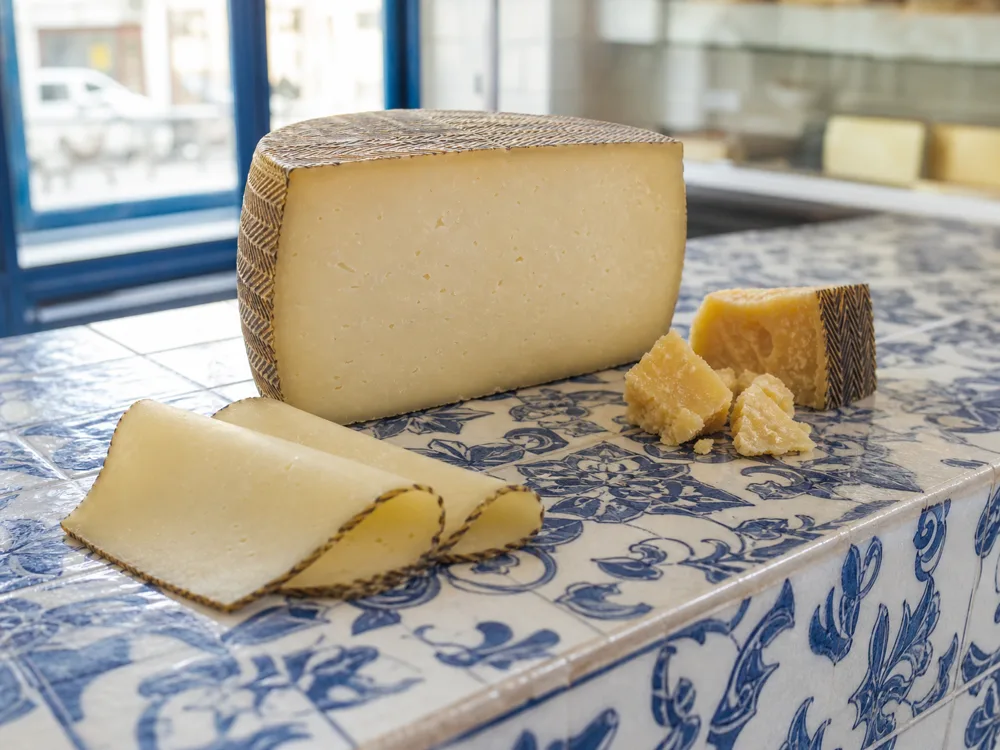
The council describes a hard rind, pale yellow or greenish-black where the moulds that grow during ageing are not cleaned off, with the pleita on the side and the flor mark on the flat faces. Inside, the paste runs from white to ivory-yellow, with small, unevenly spread eyes or none at all.
The rules allow the rind to be washed, coated in paraffin, dipped in olive oil or treated with approved transparent substances, but not removed from a PDO cheese, so a paraffin coat does not mark a look-alike.
Under the PDO, wheels weigh 0.4 to 4 kg and measure at most 22 cm across and 12 cm high.
A genuine wedge in film carries the PDO counter-label with a green band and its piece of the numbered casein disc. A cow's milk cheese sold as manchego is a different cheese.
Can You Eat Manchego While Pregnant?
It depends on the milk and on how hard the wedge is, and descriptions of Manchego's texture differ: Cheese.com calls it hard in its fact box and semi-hard in its text, while The Cheese Professor calls semicurado soft and supple and viejo compact and firm.
When the cheese is made with raw milk, the Consejo Regulador says the label also carries the word artesano. The NHS says most dairy products, like milk, cheese and butter you buy in supermarkets, are pasteurised, and you can check the packaging to make sure.
The NHS lists pasteurised or unpasteurised hard cheeses, pasteurised semi-hard cheeses such as edam and pasteurised soft cheeses as safe to eat, along with any cheese that's been cooked until steaming hot.
It also says any foods made from unpasteurised milk must be thoroughly cooked. For a raw-milk artesano wheel, the NHS hard-cheese line applies only on Cheese.com's hard reading, and on the semi-hard, soft and supple, or compact and firm readings the wheel must be thoroughly cooked.
The CDC lists hard cheese, when made with pasteurized milk, and pasteurized soft cheeses heated to an internal temperature of 165°F or until steaming hot as safer choices. It lists unpasteurized (raw) milk and dairy products made from raw milk, and soft cheese made from unpasteurized (raw) milk, as riskier choices.
Served cold, a pasteurized Manchego described as semi-hard, as soft and supple, or as compact and firm is a type the CDC list does not cover, so ask a midwife or doctor whether your wedge counts as a hard cheese.
SOURCES & REFERENCES
The Cheese Professor names dates, fresh figs and membrillo, a quince paste, as classic sweet partners, and adds dried cherries to a Rioja plate. Cheese.com lists fresh fruit for a Manchego platter and says the cheese suits the sweetness of fruit and honey.
Both. The DO La Mancha wine council scales reds from young wines to Gran Reservas as the cheese ages and also suggests an oak-aged white.
For whites, Grapes & Grains lists Verdejo and Rioja Blanco for semi-curado wheels, and Kerin Auth, in Culture, names aged white Rioja as well as red for older cheese.
Yes. Cheese.com says it melts well in quesadillas, tacos, burritos and baked dishes, and The Cheese Professor says viejo can be grated or shaved.
Vinocritic says sweet wines clash with the cheese's flavour, and on a Sherry shelf a sweetened Oloroso is labelled Cream Sherry.
No. In Mexico and Spanish-speaking parts of the United States, manchego or queso tipo manchego is an industrialised cow's milk cheese that shares only the name with the Spanish sheep's milk cheese.