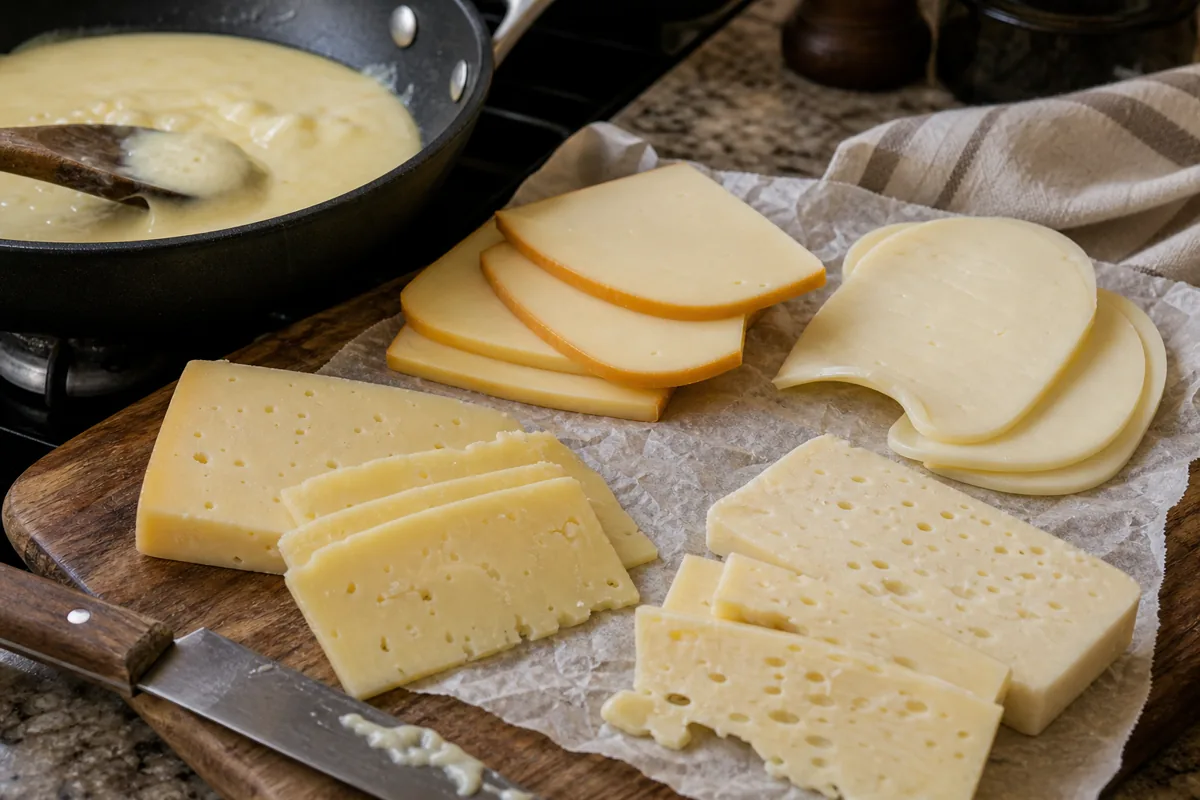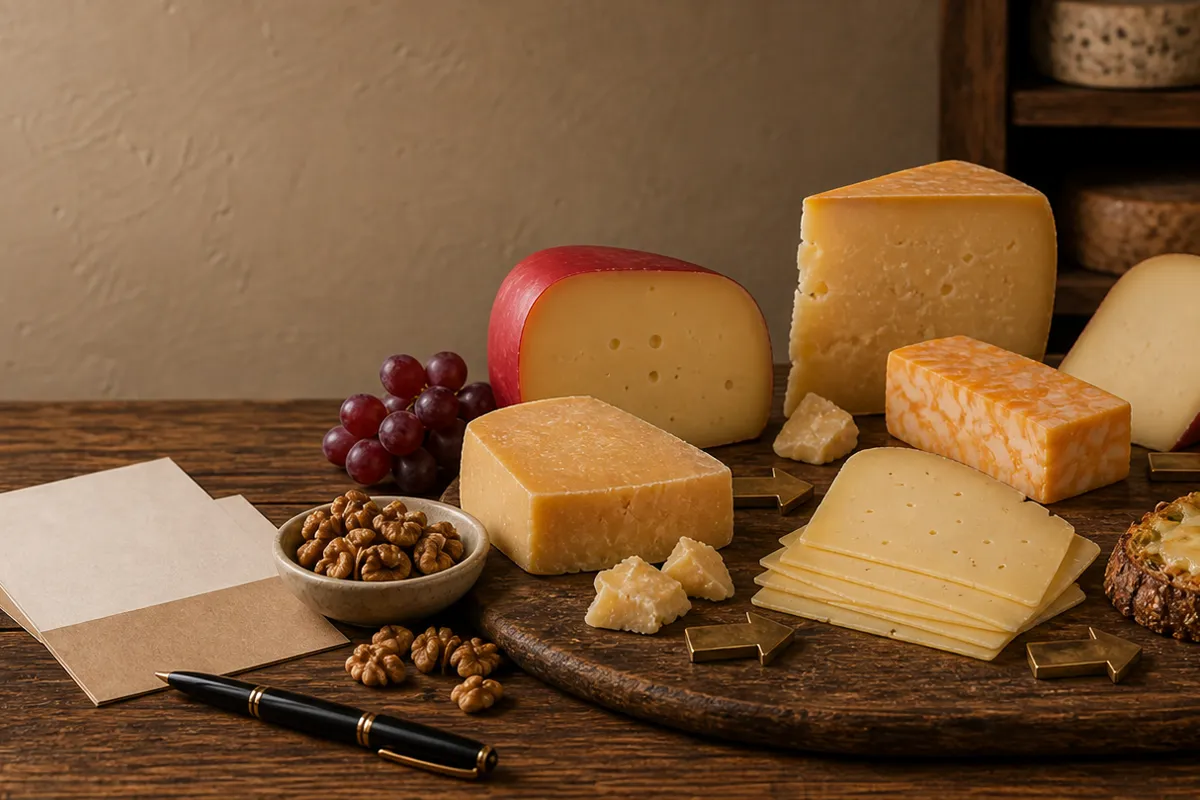
Gouda is one of the most confusing swaps to shop for, because the Dutch wheel can mean a young deli-style slice, a caramel-sweet aged wedge, or a smoky burger cheese. Those are different buying jobs, not one flavor target.
The safest answer is Havarti for young Gouda. It is mild, creamy, easy to find, and melts without making the dish taste sharp.
Once the Gouda is aged or smoked, Havarti stops being the right answer.
Age and smoke are the two things that change the answer. Read the label for both before you pick a stand-in.
In This Article
8 Gouda Substitutes: Best Alternatives for Melting and Boards
Gouda means three different cheeses depending on age, so the list is grouped the same way: young melters first, aged board wedges next, smoked last.
Buying across those lines is the single most common mistake, and no adjustment in the pan repairs it.
- Slices or snack cubes on the shelf mean young Gouda behaviour.
- A waxed wedge with a firm cut face means a table cheese.
- A hard amber wedge with small crystals means an aged wedge.
- Colour tells you little; orange and pale Gouda of the same age behave the same.
1. Havarti
The default for young Gouda, and the answer for most sandwiches, burgers, omelettes and grilled cheese.
It is a Danish semi-soft cheese, mild and buttery, and it softens quickly without turning oily.
Swap it one to one and slice it thinly for a sandwich, since it melts faster than Gouda and does not need the extra time.
It fails where the Gouda was aged or smoked, and the symptom is a dish that tastes empty. A plain Havarti slice has nothing to put in place of caramel sweetness or smoke.
Slice Havarti thinner than you would slice Gouda. It melts faster, so the same thickness leaves you with a greasy layer before the bread is ready.
2. Edam
The closest Dutch relative, and the better choice when the cheese has to hold its shape.
It is lower in fat and firmer than Gouda, from the same tradition, so it reads as the same family on a table plate.
Use it where firmness helps, such as an omelette or a snack board, and grate rather than slice it into a bake so it distributes before it stiffens.
It fails on flow, and the symptom is a melt that stays in distinct pieces rather than pooling. Choose Havarti instead when the dish wants softness.
3. Monterey Jack
The everyday backup when the dish can take a slightly stretchier melt.
It is a young mild American cheese made for melting, so it flows readily and carries almost no flavour of its own.
Use it in burgers and quesadillas where other ingredients season the plate, and expect a stretch Gouda does not have.
It fails on Dutch sweetness, and the symptom is a melt that is smooth and anonymous. Nothing in it replaces the gentle caramel note young Gouda brings.
4. Young Cheddar
For melting jobs where a little more tang is welcome rather than a problem.
It is firmer and noticeably sharper than young Gouda, with more acidity in the finish.
Blend it with Havarti or Jack in a mac or casserole so you get the colour and tang without losing the smooth flow.
It fails on mildness, and the symptom is a dish that tastes of cheddar. Anything relying on Gouda's quietness will be overwritten.
5. Aged Cheddar
The first choice for a board where the recipe meant an aged Gouda wedge.
A well-aged cheddar shares the firm bite and the crystalline crunch, though its depth runs savoury and sharp rather than sweet.
Serve it in the same thin shards you would cut from aged Gouda, and pair it with something sweet to stand in for the caramel note.
It fails on sweetness, and the symptom is a board that tastes sharper and drier than intended. Add fruit, honey or a sweet wine to close the gap.
Put something sweet on the board next to aged cheddar. Pear, quince or honey stands in for the butterscotch note that aged Gouda brings by itself.
6. Comte
For aged Gouda's sweetness rather than its crunch, especially where the cheese is also cooked.
It is a firm French Alpine wheel with a nutty, faintly sweet depth that comes closer to aged Gouda than cheddar does.
Use a longer-aged wheel for a board and a younger one if it also has to melt, since older Comte carries crystals that will not dissolve.
It fails on the caramel note specifically, and the symptom is a wedge that tastes nutty where you expected butterscotch.
7. Gruyere
For aged Gouda in cooking, where the cheese has to season a gratin or a sauce as well as melt.
It is drier and more savoury than Gouda at any age, and it melts far better than an aged Dutch wedge does.
Grate it fine and heat it gently, and cut the salt elsewhere in the dish because it is more assertive than Gouda.
It fails on a plain board, and the symptom is a wedge that reads as Alpine rather than Dutch. Its savour arrives where Gouda's sweetness should have been.
8. Smoked Cheddar or Smoked Mozzarella
The only honest answers when smoke is the reason the recipe said Gouda.
Both are genuinely smoked cheeses, so they carry aroma into a hot burger, mac and cheese or potato dish the way smoked Gouda does.
Check whether the package says naturally smoked or smoke flavoured, since the two behave differently once heated. Use smoked cheddar when you want the smoke to lead and smoked mozzarella when you want it under a melt.
It fails as a substitute for plain Gouda, and the symptom is a dish that tastes of a campfire nobody asked for. Keep it strictly for the smoked lane.
Check whether the label says naturally smoked or smoke flavoured. The two behave differently under heat, and flavouring can turn harsh in a hot dish where real smoke does not.
Why Should You Start with the Age of the Gouda?
Young Gouda is creamy, elastic, and mild. It belongs in sandwiches, snack plates, omelets, burgers, and grilled cheese when you want a soft melt without a strong bite.
Havarti, Monterey Jack, and Edam are the closest practical choices in that lane.
Aged Gouda is a different cheese experience. It becomes firmer, sweeter, nuttier, and sometimes crunchy with crystals.
A young melter cannot replace that board role. For aged Gouda, look at aged cheddar, Comte, Gruyere, or an older Dutch-style cheese instead.

The age question protects you from the most common mistake: using a mild melter where the dish needed aged Gouda's caramel and crunch. If the recipe says Gouda but also mentions crystals, butterscotch, or an aged board, do not buy a soft sandwich cheese.
Package format gives another clue.
Slices and snack cubes usually point to young Gouda behavior.
A waxed wedge with a firm cut face points toward table cheese. A hard amber wedge with small crystals points toward an aged substitute, where sweetness and concentration matter more than melt.
Color is a weaker clue than texture. Orange Gouda and pale Gouda can behave the same way if they are the same age.
A darker aged wedge may taste sweeter and firmer, but the substitute decision still comes from moisture, age, and whether the cheese is going into heat.
A substitute for young Gouda should melt gently, while a substitute for aged Gouda should taste concentrated. Those are separate goals.
Which Gouda Substitutes Work Best for Melting?
For burgers, grilled cheese, omelets, breakfast sandwiches, and quesadillas, the substitute should melt before it gets oily. Havarti is the cleanest choice because it softens quickly and keeps a buttery mildness close to young Gouda.
A mild California Jack is a good everyday backup when the dish can handle a slightly stretchier melt. Young cheddar works only when you want more tang.
American cheese melts better than all of them, but it tastes processed rather than like Gouda.
| Use | Best substitute | What changes |
|---|---|---|
| Grilled cheese | Havarti | Similar creamy melt, less Dutch sweetness. |
| Burger slice | Havarti or Monterey Jack | Smoother melt, milder finish. |
| Omelet | Edam or Havarti | Edam holds firmer; Havarti melts softer. |
| Mac or casserole | Young cheddar blend | More tang and color than Gouda. |
If the dish is mainly about melt, compare the decision with grilled cheese picks or burger cheese choices. Gouda may be one good option, but the job might be better owned by a different cheese.
Young Gouda is forgiving because its flavor is mild. That means the substitute can lean slightly buttery, slightly tangy, or slightly elastic without ruining the dish.
The real danger is using a dry aged cheese in a place where the original was supposed to soften into the bread or meat.
When replacing Gouda in a melted dish, use the same thickness of slice. A thick Havarti slice and a thin Gouda slice will not melt at the same speed.
Which Gouda Substitute Works Best for Snack Plates?
Young Gouda on a snack plate is mild, slightly sweet, and easy to cut. Edam is the most natural substitute when you want that Dutch table-cheese feel with a leaner texture.
It is less buttery than Gouda, but it slices cleanly and does not dominate crackers or fruit.
Havarti can work on a snack plate, but it is softer and creamier. It can feel too rich if the board already has salami, olives, nuts, or buttery crackers.
Colby is milder still and works for a casual kid-friendly plate, not a Dutch-style flavor match.
- Simple snack plate: Edam gives mild flavor and clean slices.
- Soft lunch slices: Havarti gives a creamier bite.
- Budget cubes: Colby works when mildness matters more than Gouda character.
- Board upgrade: Comte or Gruyere adds nutty depth instead of mild sweetness.
A leaner Dutch table cheese is especially useful when you want lower moisture and a familiar flavor beside apples, grapes, ham, crackers, and mustard. It is not as lush as Gouda, but it stays neat on a board.
For snack plates, sweetness should stay quiet. If the board already has jam, dried fruit, or honey, a very sweet aged substitute can make the plate taste flat.
Edam, Havarti, or a mild young cheddar keeps the snack plate more balanced.
Why Do Smoked and Aged Gouda Need Separate Substitute Paths?
Smoked Gouda is not just young Gouda with a different label. Smoke becomes the main signal in burgers, mac and cheese, potatoes, and snack boards.
If smoke is the reason the recipe named Gouda, a plain Havarti slice will taste empty.
Use smoked cheddar, smoked mozzarella, or another real smoked cheese when the dish needs that campfire edge. Use aged cheddar, Comte, or Gruyere when the recipe needs older Gouda's firm sweetness and savory depth instead.

Smoked Gouda matters when the bottle or package does not make the smoke style clear. Some products are naturally smoked.
Others use smoke flavoring.
That difference matters more in simple dishes where the cheese is exposed.
Smoked substitutes should usually be used in smaller amounts than plain young Gouda. Smoke spreads through a dish faster than mild dairy flavor, especially in mac and cheese, potato gratin, and burgers with bacon or barbecue sauce.
Blend a smoked cheese with Havarti or young cheddar when you want aroma without bitterness.
Do not replace smoked Gouda with plain young Gouda or Havarti in a recipe where smoke is the whole point. The texture may work, but the dish loses its main flavor cue.
How Should You Adjust the Substitute Before Blaming the Cheese?
Most Gouda substitute problems come from cut size, heat, and seasoning. Mild substitutes need more salt or mustard.
Aged substitutes need smaller pieces. Smoked substitutes need restraint because smoke can take over a whole casserole or burger.
For sauces and casseroles, grate the substitute instead of dropping in cubes. For boards, cut aged substitutes into shards rather than thick blocks.
For sandwiches, slice evenly so the bread browns before the cheese leaks.
- Too bland: add mustard, pickles, or a sharper support cheese.
- Too oily: lower the heat and grate the cheese finer.
- Too smoky: blend smoked cheese with a mild melter.
- Too firm: switch from aged cheddar to Havarti or Edam.
- For Alpine depth, compare against a nutty French mountain cheese.
- For fondue-style melt, compare against a classic Swiss melter.
- For smoke, keep the smoke source visible instead of hiding it in a mild blend.
Store leftovers by moisture level. Soft slices need tighter wrapping and faster use, while aged cheddar, Comte, and Gruyere tolerate longer storage if wrapped correctly.
An opened wedge needs clean wrapping before it goes back in the refrigerator.
The best Gouda substitute starts with the Gouda style you were trying to replace. Young, aged, and smoked Gouda each need a different answer.
Cut shape is the final adjustment. Slices solve sandwiches and burgers.
Small cubes solve snack plates. Shards solve aged boards.
Grated cheese solves casseroles.
If the substitute is right but the cut is wrong, the dish can still feel like a poor swap.
When the recipe is flexible, blend two substitutes instead of forcing one. Havarti plus young cheddar can cover melt and tang.
Smoked cheddar plus Havarti can cover smoke and creaminess. Aged cheddar plus Comte can make a board feel deeper without pretending either cheese is aged Gouda.
When the recipe is not flexible, follow the original Gouda style closely. A mild lunch sandwich can accept Havarti.
A smoked Gouda mac and cheese needs smoke.
An aged Gouda board needs hard, concentrated pieces.
Those boundaries keep the swap from drifting into a different dish.
For buying, avoid shredded blends unless the recipe is a casserole and the flavor is secondary. Shreds are convenient, but they rarely tell you age, smoke style, or exact cheese balance.
A small wedge gives you more control over cut, melt, and board texture.
For a party board, serve the substitute at room temperature and cut it for the job. Young substitutes can be cubes or slices, while aged substitutes should be smaller shards.
That portion difference helps guests understand whether the cheese is meant to be mild and snackable or concentrated and slow.
If the board already has a strong blue or washed rind, choose the milder Gouda substitute. If it is mostly mild cheeses, choose the aged substitute for contrast.
SOURCES & REFERENCES
What Else Do People Ask About Gouda Substitutes?
These answers cover the common ways Gouda appears in recipes and snack plates.
Havarti is the best substitute for young Gouda because it is mild, creamy, easy to find, and melts smoothly. Edam is better when you want a firmer Dutch-style table cheese.
Yes, but choose the cheddar by job. Young cheddar is tangier than young Gouda, while aged cheddar works better as a substitute for older Gouda on boards and in sharp cooked dishes.
Smoked cheddar is the easiest replacement for smoked Gouda when the recipe needs smoke. Smoked mozzarella can work for milder melt, but it will not bring the same firm Dutch-style body.
Edam is a good substitute for young Gouda on snack plates, sandwiches, and simple slices.
It is leaner and less buttery, so Havarti is better for a creamy melt.
Use Havarti for mild creaminess, young cheddar for more tang, or a small amount of smoked cheddar when the recipe wanted smoked Gouda. Grate the cheese finely and use gentle heat.